
Agate is a patterned chalcedony material in the microcrystalline quartz family, composed mainly of silicon dioxide (SiO₂). It is especially known for bands, layers, clouds, plumes, moss-like inclusions, and miniature landscapes that make each bead, cabochon, or carving feel like a small world of its own. With a Mohs hardness of about 6.5–7 and a typical specific gravity of about 2.60–2.65, agate is well suited to jewelry and meaningful objects when it is cut and cared for thoughtfully.
Across Eastern material culture, agate manao (玛瑙) has long been shaped into beads, ornaments, seals, vessels, and carvings. Its flowing layers are often associated with steadiness, protection, courage, harmony, and good fortune. People choose it for the beauty of its natural pattern and as a medium through which they hope to welcome calm strength, enduring connection, and a life that unfolds with balance.
How agate forms
Agate develops when silica-rich fluids move through cavities, fractures, or porous spaces in rock and deposit extremely fine quartz-family material over repeated stages. Many famous agates formed in volcanic cavities, but that is not the only setting: agate can also grow in fractures, sedimentary environments, and cavities within different host rocks.

Changes in fluid chemistry, mineral inclusions, porosity, crystal size, and growth direction create successive layers. Some nodules preserve curved concentric bands; others show level horizontal lines, feathery plumes, branching inclusions, or an open center lined with larger quartz crystals. The pattern is therefore a record of mineral growth through time, not a design added in a single moment.
Agate, chalcedony, onyx, and jasper
The names around agate overlap because mineral science, historical craft language, and modern trade do not always divide materials in exactly the same way. “Visible bands equal agate, no visible bands equal chalcedony” is useful as a first impression, but it is not an absolute rule.
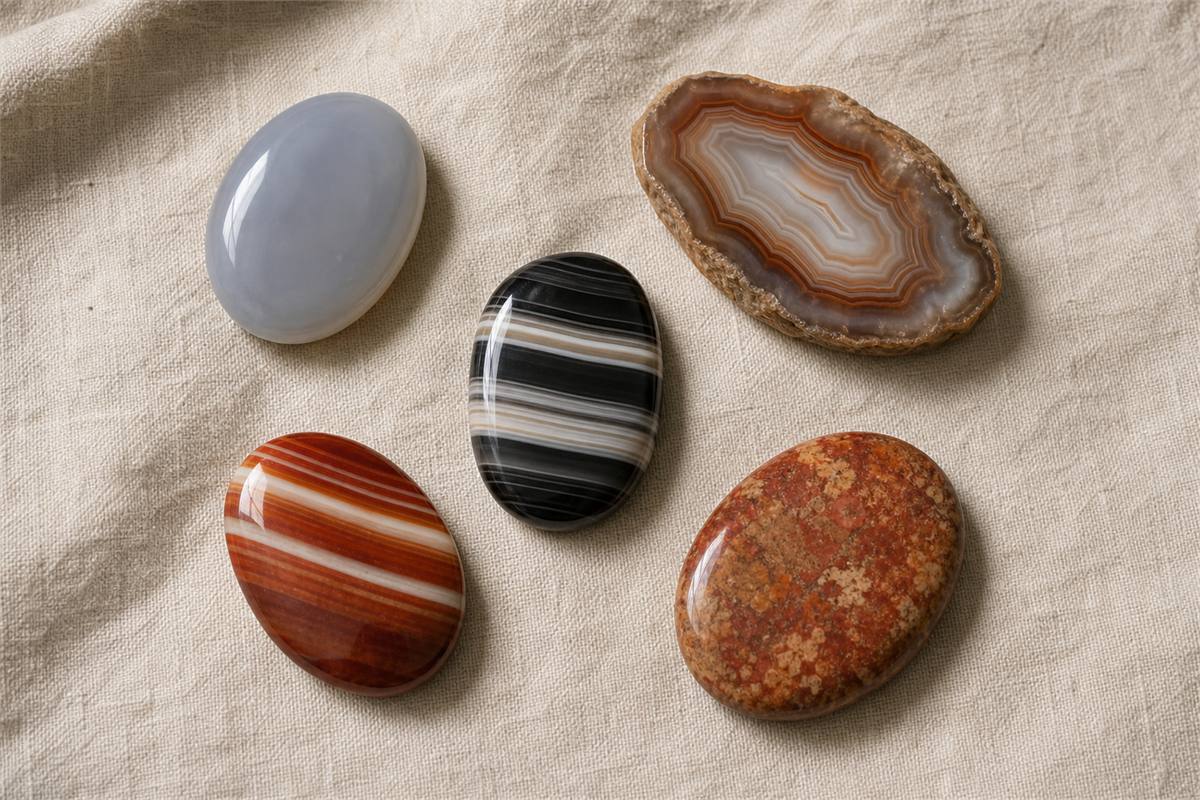
| Name | How the term is generally used | Important distinction |
|---|---|---|
| Chalcedony | The broad term for microcrystalline quartz-family material | Agate belongs within this wider material family |
| Agate | Chalcedony that usually emphasizes banded or patterned growth | Some established trade names, including moss agate, may show little typical banding |
| Onyx | Chalcedony or agate with straight, parallel bands | Much uniformly black material sold as onyx has been dyed |
| Sardonyx | Parallel-banded chalcedony combining sard-brown, red, white, or dark layers | It is a banded material name, not simply any reddish agate |
| Jasper | Generally opaque microcrystalline quartz colored by abundant inclusions | It is not the same material as Chinese nephrite called biyu (碧玉) |
| Geode | A hollow mineral-lined cavity or nodule | A geode may contain agate bands, quartz crystals, or both |
The broader chalcedony guide explores this family relationship in more detail. In practice, a clear description of color, pattern, transparency, and treatment is often more useful than forcing every piece into a rigid label.
Major agate types and trade names
Banded, fortification, and waterline agate
Banded agate displays repeated layers of chalcedony. Fortification agate forms angular nested outlines that resemble the plan of a fortress, while waterline agate shows level bands deposited across the bottom of a cavity. Cutting direction matters: one slice may reveal a complete pattern while another from the same nodule looks quieter.

Moss, dendritic, plume, and water-grass agate
Moss agate usually contains diffuse green, brown, or dark inclusions that resemble moss, although it often lacks typical bands. Dendritic agate has branching mineral forms like winter trees, while plume agate carries feather-like clouds. The Chinese market name water-grass agate shuicao manao (水草玛瑙) is used for scenic inclusions that evoke drifting aquatic plants or a miniature garden. These patterns are mineral inclusions rather than preserved vegetation.

Fire agate and other optical effects
Fire agate can show shifting red, gold, green, and violet color produced by light interacting with very thin layers associated with iron oxides. Its effect depends strongly on the curve and depth of the cut. Iris agate can reveal spectral color through extremely fine banding when light passes through it. These varieties are best appreciated in motion and under more than one lighting condition.
Regional and Chinese market names
Names such as Nanhong (南红), Warring States Red zhanguo hong (战国红), Yanyuan (盐源), Alashan (阿拉善), and cherry blossom agate describe recognized regional materials, visual styles, or market traditions. Nanhong is prized for rich red tones and a warm, dense appearance; Warring States Red is known for dramatic red, yellow, and related banding; Yanyuan material is admired for varied colors that invite thoughtful color-led carving; and Alashan names often encompass colorful agate and chalcedony materials from a broad desert-region market context. Cherry blossom agate is known for soft flower-like inclusions, commonly associated in trade with material from Madagascar.
Water-filled agate shuidan manao (水胆玛瑙) contains a sealed cavity with movable liquid and needs especially careful handling. Yuhua stone yuhua shi (雨花石), by contrast, is a regional ornamental-stone name covering more than one rock or mineral material; it is not a single agate variety. Locality and trade names are most meaningful when the seller explains what the name describes instead of using it as a claim of automatic rarity.
Why agate has so many colors
Agate may be white, gray, brown, red, orange, yellow, blue, black, purple, green, or multicolored. Color can arise from iron oxides, manganese oxides, other mineral inclusions, light scattering, and the structure of the material itself. The relationship is complex: a single element does not always produce one fixed color, and appearance can change with its chemical state, particle size, distribution, and surrounding structure.

Artificial treatment is also common because the fine, porous layers of some agate accept color readily. Brilliant blue, green, purple, pink, red, or uniform black may be natural, treated, or a combination of both; color alone cannot settle the question.
Heat, dye, and impregnation are different treatments
- Heat treatment changes existing color-producing components and may strengthen red, orange, or related tones.
- Dyeing introduces color into receptive pores, bands, fractures, or drilled areas.
- Impregnation or polymer treatment fills pores or fractures to improve stability, surface appearance, or workability.
These processes have different purposes and can affect color stability, care, and value. A beautifully treated piece can still carry personal meaning; the important point is to understand what created the appearance so that natural pattern, craft, and price can be judged in the right context.
What determines agate quality and value?
There is no universal price ladder for agate. Broad market descriptions range from accessible everyday pieces to finely carved or exceptional works commanding hundreds, thousands, or more in US dollars, but those phrases do not form a reliable price table. This page therefore focuses on the factors that create value instead of inventing precise ranges.

| Factor | What makes it meaningful |
|---|---|
| Type and pattern | Distinctive bands, landscapes, plumes, optical effects, or a composition that feels complete |
| Color | Harmony, contrast, depth, and an honest understanding of natural or treated appearance |
| Cut and orientation | A slice, cabochon, bead, or carving positioned to reveal the stone’s strongest story |
| Condition | Limited chips, unstable cracks, repairs, or damaged drill holes |
| Size | Enough surface to express the pattern without sacrificing balance or wearability |
| Craftsmanship | Clean polish, thoughtful matching, secure setting, and carving that responds to natural color |
| Treatment | How heating, dye, impregnation, or assembly shaped the final appearance |
| Market form | Rough, slabs, beads, jewelry, carvings, and one-of-one art objects are valued in different ways |
Transparency is only one part of the picture. A translucent agate may glow beautifully, while an opaque or softly clouded material may carry the stronger pattern or carving. “More transparent” does not automatically mean “more valuable,” and terms such as glassy, icy, or jelly-like are descriptive trade language rather than a single universal gemological grading system.
How to choose agate thoughtfully
Start with the reason the piece speaks to you. A fortification band can suggest protection and an inner boundary; moss-like inclusions can evoke renewal and patient growth; warm red agate is often chosen to welcome courage, vitality, and auspicious joy; quiet gray or white layers can accompany a wish for clarity and peace. In Eastern jewelry symbolism, agate is worn to invite steadiness and harmony, and it can make a caring gift for a new beginning, a demanding transition, or a relationship one hopes to protect.

- View the piece in ordinary daylight and softer indoor light, and look at more than one angle.
- Ask whether the color or structure has been heated, dyed, impregnated, coated, glued, or assembled.
- Check the edges, drilled holes, setting, and high points for chips, unstable cracks, or color concentration.
- Judge matched beads as a group: intentional variation can be beautiful, while careless mismatch can interrupt the design.
- Choose craftsmanship that follows the natural pattern. Skillful color use, relief carving, openwork, and three-dimensional carving can turn the stone’s layers into clouds, mountains, flowers, guardians, or flowing landscapes.
Touch, coolness, weight, sound, ultraviolet light, and a flashlight view are not reliable single-step answers for natural origin, dye, impregnation, locality, or value. They may reveal something worth asking about, but the best buying decision comes from the full object: pattern, workmanship, condition, treatment information, and whether its story feels right for the person who will carry it.
For beads, 6–8 mm feels light and delicate, 8–10 mm has a balanced everyday presence, and 12–14 mm creates a bolder visual rhythm. Choose by visual weight and personal comfort. For a bangle, measure the widest part of the hand and follow the actual seller’s sizing method; wrist circumference alone cannot be converted into a dependable inner diameter by adding a fixed amount.
Wearing and gifting agate
Agate works beautifully as beads, pendants, earrings, protected rings, bangles, seals, and carved objects because each format reveals pattern differently. Broad bands need enough surface to unfold, while lace-like patterns remain lively in smaller beads. A carving can follow a natural red patch into a flower, a pale layer into mist, or a dark band into a protective outline, allowing material and story to grow together.

As a personal piece, agate can mark a season of rebuilding, focused work, travel, or a quieter return to oneself. As a gift, it carries a wish for peace, protection, courage, harmony, and good fortune—an expression of ping’an ruyi (平安如意), the hope that life may be safe, peaceful, and aligned with one’s heartfelt wishes. The black agate bracelet guide explores one darker, grounding expression, while the Blessing collection offers more symbols chosen to welcome meaningful wishes into everyday life.
How to care for agate
Clean most finished agate gently with lukewarm water, mild soap, and a soft cloth or brush, then rinse and dry it thoroughly, including drilled holes and settings. Avoid sharp impacts, sudden temperature changes, strong acids or alkalis, abrasive powders, and prolonged contact with household chemicals. Store pieces separately from harder gems and sharp metal edges.

Care for the most sensitive part of the object. Dyed material may need protection from strong sunlight and solvents; glued, coated, impregnated, heavily fractured, or set pieces should not be soaked; openwork and thin carving edges need extra protection from impact. Water-filled agate should be kept away from heat and freezing conditions that may stress its sealed cavity. Surface damage and repolishing are best entrusted to an experienced professional.
Conclusion
Agate is patterned chalcedony shaped by repeated mineral growth and transformed by the eye of the cutter. Its value is never just transparency, color, or a famous name. It lies in the conversation among natural layers, careful craft, honest treatment information, personal aesthetics, and the wish carried by the finished piece. Choose the pattern that feels like your own landscape, and let it accompany a hope for steadiness, harmony, courage, and all things unfolding as you wish.
Frequently Asked Questions
Related Posts


3 Comments