
Chinese bracelet symbols and meanings are best understood as a visual language. A bat can stand for good fortune because bat and blessing sound alike in Chinese; a gourd suggests fortune and rank through another wordplay; a dragon or phoenix carries stories formed across centuries of art, ritual, and court culture. Modern jewelry then reshapes these older motifs into beads, plaques, links, clasps, and charms.
To choose well, first identify what the pattern actually depicts, then separate its historical source from folk wishes and modern product storytelling. The clearest design usually works better than the bracelet with the longest list of promised meanings.
Chinese bracelet symbols at a glance
| Symbol | How to recognize it | Common cultural meaning |
|---|---|---|
| Pixiu (貔貅) | Horned, winged or lion-like mythical animal | Auspicious wealth wishes in modern jewelry |
| Money toad (金蟾) | Squatting three-legged toad, often with a coin | Prosperity folklore and commercial symbolism |
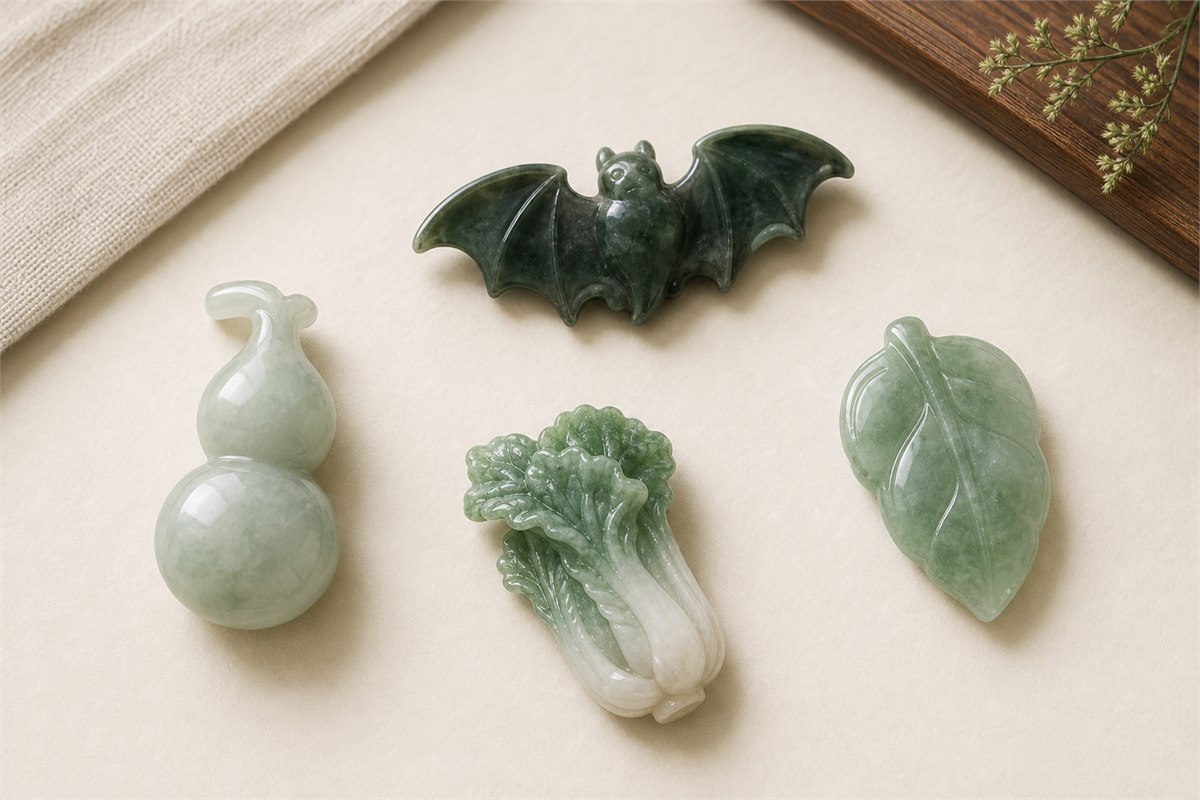
| Gourd, hulu (葫芦) | Small neck and two rounded lobes | Fortune, rank, continuity, and health wishes |
| Coin pattern | Round disc with square center hole | Money, circulation, and ordered balance |
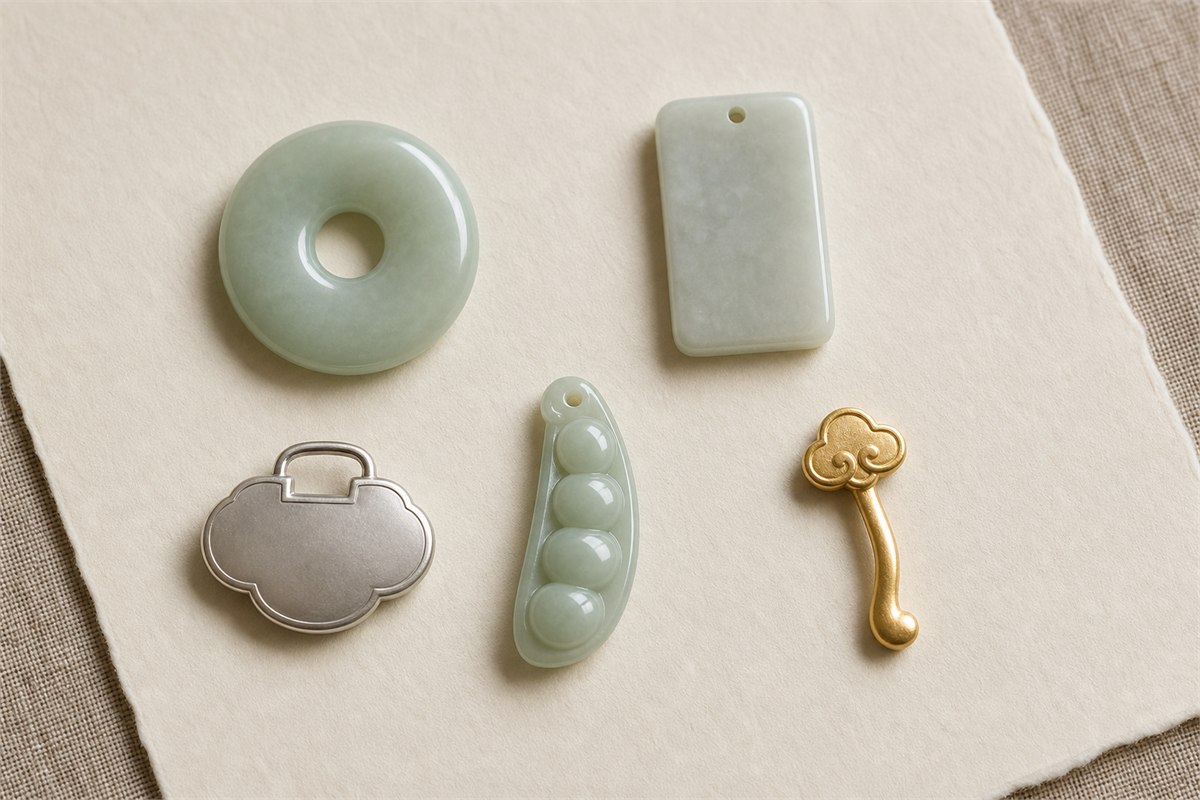
| Peace buckle (平安扣) | Smooth circular disc with a round opening | Peace, wholeness, and an easy daily life |
| Plain plaque, wushipai (无事牌) | Uncarved or minimally carved rectangular plaque | Calm, simplicity, and “nothing troublesome” |
| Fu (福) | The written character 福 | Blessing and good fortune |
| Bat (蝙蝠) | Spread wings with a compact animal body | Blessing through the homophone fu |
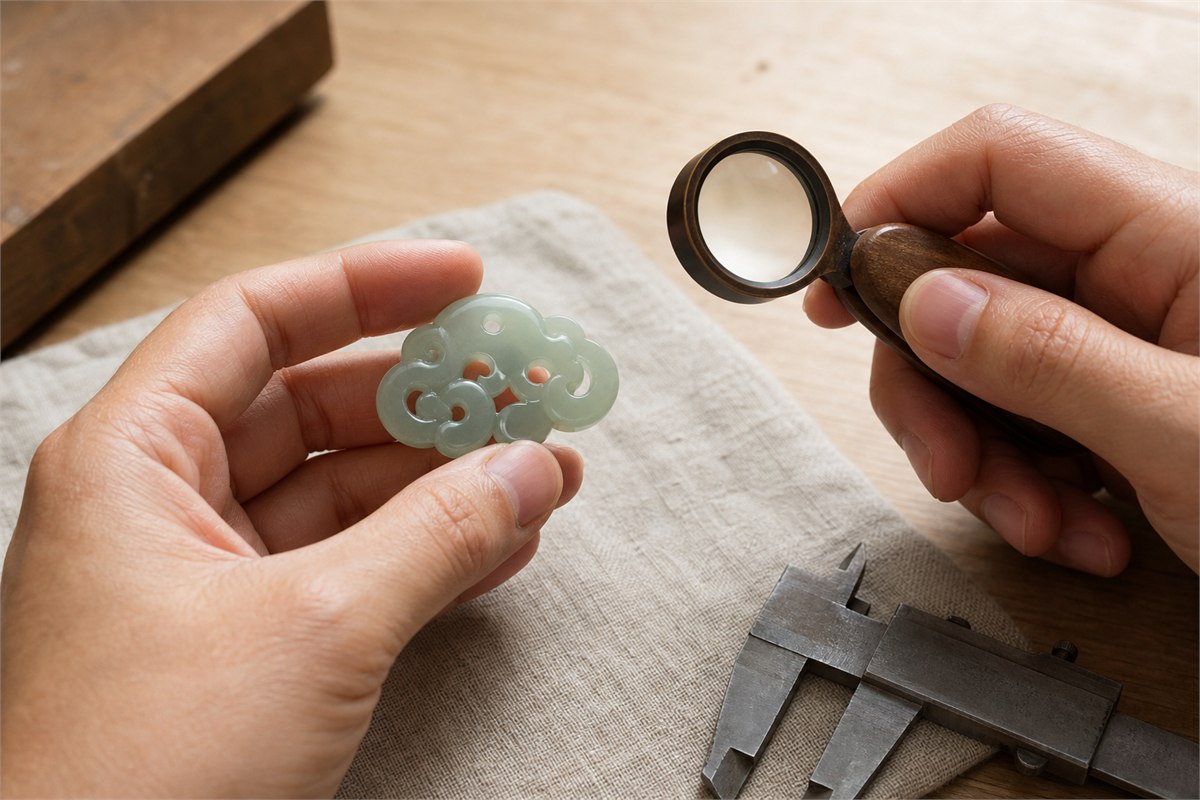
| Auspicious cloud / ruyi cloud | Rounded, curling cloud lobes | Heavenly atmosphere and wishes fulfilled |
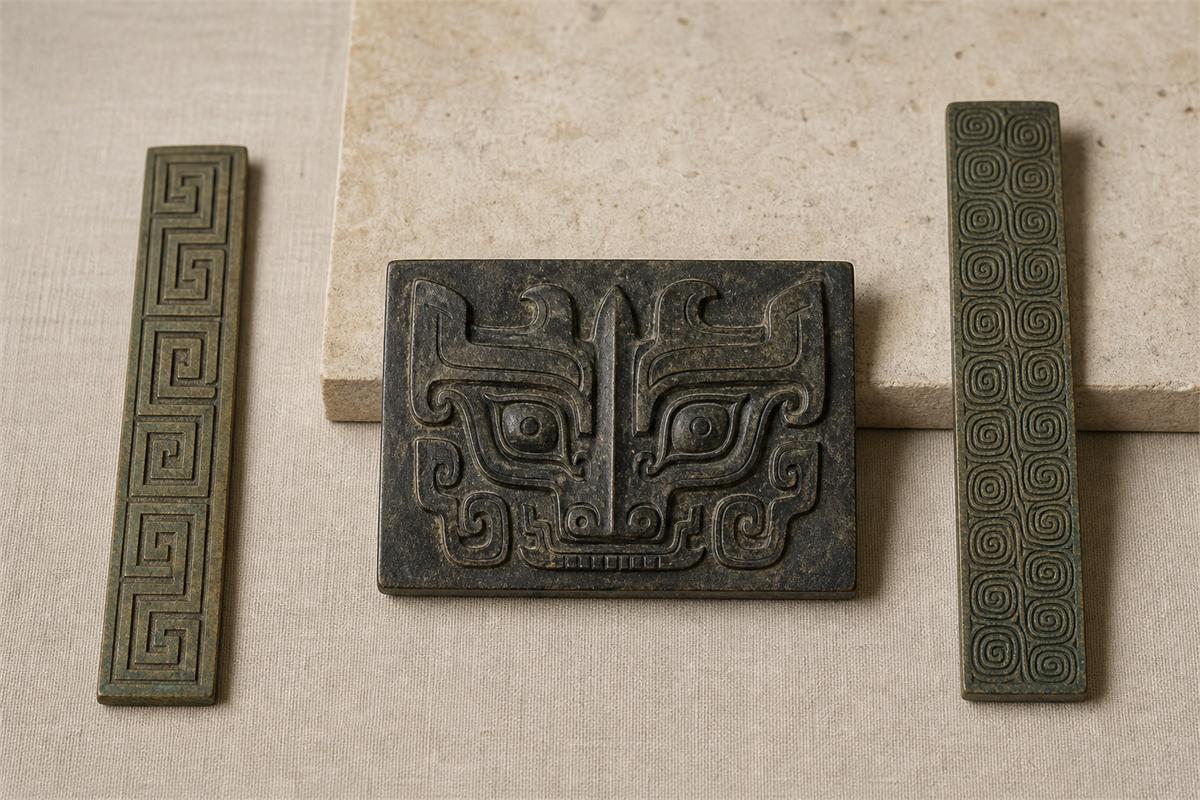
| Meander, huiwen (回纹) | Continuous squared spiral border | Continuity and ordered repetition |
| Koi or carp (锦鲤/鲤鱼) | Fish with scales, fins, and curved tail | Abundance, advancement, and perseverance |
| Bamboo joint (竹节) | Segmented tube with raised nodes | Growth, integrity, and progress by stages |
| Dragon (龙) | Long scaled body, claws, horns, and flowing mane | Authority, vitality, and auspicious power |
| Phoenix (凤凰) | Elegant bird with crest and long layered tail | Virtue, harmony, beauty, and high rank |
| Taotie (饕餮纹) | Frontal, symmetrical mask with prominent eyes | Ancient bronze decoration with debated interpretation |
| Cabbage (白菜) | Layered vegetable leaves around a pale stalk | Purity and modern wealth wordplay |
| Cicada (蝉) | Long insect body and folded wings | Renewal, elevated character, and historical burial imagery |
| Leaf (树叶) | Veined botanical form | Growth, vitality, and family wordplay in modern jewelry |
| Four-season bean (四季豆) | Curved pod with visible rounded seeds | Seasonal peace, harvest, and family blessings |
| Lock (锁) | Padlock or traditional longevity-lock shape | Care, longevity, and wishes for a child’s safe growth |
| Ruyi (如意) | Curved scepter or cloud-shaped head | “As you wish” and fulfilled intentions |

Mythical animals: Pixiu, dragon, phoenix, and money toad
Pixiu: a mythical auspicious creature
Pixiu (貔貅) is a Chinese mythical auspicious animal, commonly represented with a powerful feline or leonine body, a horned head, open mouth, curled tail, and sometimes wings. Ancient textual names, later artistic forms, regional lore, and today’s jewelry are not perfectly uniform, so two credible designs may look different.
The familiar story that Pixiu eats treasure and allows it to enter but not leave is a later popular narrative, especially influential in contemporary feng shui jewelry. It makes Pixiu an intuitive symbol of prosperity wishes and careful stewardship, but it is not one fixed definition shared by every ancient source. Rules about male and female forms, one horn versus two, an undrilled tail, the head facing the little finger, strangers touching the eyes or mouth, or a bracelet “recognizing its owner” largely belong to modern commercial practice. Treat them as optional rituals, not historical requirements.
Look for a readable head, balanced body, smooth horn and claw tips, and a drill path that does not weaken the carving. For a deeper page focused on this creature, see the Pixiu bracelet meaning guide.
Dragon and phoenix
The Eastern dragon (龙) combines features that vary by period and medium: a long serpentine body, scales, horns, claws, whiskers, and a flowing mane are common. Dragons became symbols of authority, vitality, transformation, and auspicious power. Their connection with clouds, rain, and waterways is culturally important, yet the simplified claim “water equals money, therefore the dragon guarantees wealth” collapses a much richer tradition.
The Eastern phoenix, fenghuang (凤凰), is usually shown as an elegant composite bird with a crest and long tail feathers. It has associations with virtue, harmony, ordered rule, beauty, and high rank. Rebirth from fire is not the universal core of classical Chinese fenghuang tradition; the phoenix-as-rebirth story became prominent through later and cross-cultural retellings.
Dragon and Phoenix Bring Auspiciousness (龙凤呈祥) became a familiar wedding and celebration design expressing a harmonious pairing. On a bracelet, it is a visual blessing for partnership rather than a mechanism for producing romance. Zodiac restrictions such as “people born in Dog, Rabbit, or Ox years cannot wear dragons” are not uniform traditional rules. Choose the motif by cultural affinity, design quality, and comfort.

Money toad or Jin Chan
The money toad, Jin Chan (金蟾), is usually a squat toad shown with three legs, a coin in or near its mouth, and sometimes a coin-covered base. It belongs to a web of later legends and prosperity folklore; it is not a historical coin or a zoological creature. Contemporary jewelry often labels any coin-holding toad “money frog,” so check whether the three-legged feature is actually visible.
Instructions to point the toad inward at a certain hour are commercial ritual conventions rather than universal historical rules. On a bracelet, orientation should preserve visual readability and keep raised toes, coins, and crowns from snagging sleeves.
Wordplay symbols: Fu, bats, gourds, cabbage, and leaves
Chinese decorative art often turns sound into image. These rebuses work because words with different characters can sound alike or nearly alike. The meaning may be old, newly popular, or substantially repackaged by the modern jewelry trade.
- Fu (福): the written character means blessing or good fortune. A correct, legible character matters more than ornate distortion. Rotated Fu customs belong to specific festive settings and should not be assumed for every bracelet.
- Bat (蝙蝠): the word for bat, fu, echoes 福, making the bat a blessing image rather than a sinister animal in traditional Chinese art. Five bats may evoke the Five Blessings. Wings, ears, and body should remain readable.
- Gourd, hulu (葫芦): its name is associated in popular wordplay with fu-lu, fortune and emolument or rank. The vessel also appears in Daoist, medical, and literary imagery. Modern jewelry often compresses these layers into “fortune and health.”
- Cabbage, baicai (白菜): the vegetable is real; its jewelry meaning often relies on a modern-sounding association with baicai (百财, “hundred kinds of wealth”). White stalk and green leaves can also suggest purity and vitality. The wealth pun is especially prominent in recent carving and sales language.
- Leaf, yezi (叶子): leaves naturally suggest growth and renewal. Modern jewelry also connects ye with phrases about lineage and flourishing family branches. That marketing story is not one ancient, universal origin.
- Gourd plus coin: this pairing tells a design story of fortune, rank, and prosperity. It does not multiply effects like stacked game bonuses.
Coins and money patterns: what is historical and what is modern
A traditional cash coin is round with a square central hole. The object was currency; the bracelet pattern may be a cast replica, engraved outline, openwork link, or actual old coin. The round-and-square geometry later attracted cosmological readings such as heaven and earth, while jewelry sellers also use it as a straightforward sign of money and circulation.
Five Emperors Coins (五帝钱) usually refers to cash coins of five Qing emperors: Shunzhi, Kangxi, Yongzheng, Qianlong, and Jiaqing. Their use in contemporary feng shui arrangements should be described as folk practice, not as a device that changes luck when the order is switched. The chronological order is useful for historical presentation, but it is not an energy switch.

Panchan (盘缠) historically meant travel expenses or money carried for a journey. Spiral gold-wire or ring forms sold under that name are modern jewelry interpretations that play on “coiling” and “binding.” Likewise, the double-coin pattern can mean two interlocking coin shapes; the label qingfu or “money returning” draws on old literary folklore but is often simplified in sales copy.
Distinguish a genuine historical coin from a newly made charm. Replicas are often the more responsible choice for wearable design. Old copper pieces may have sharp edges, unstable corrosion, surface contamination, or unknown alloy content. Copper and nickel-containing metal can irritate sensitive skin. Avoid drilling, cutting, polishing, or soldering historically significant coins, and consider lawful provenance when an object may be culturally important.
Peace forms: Ping An buckle, plain plaque, lock, bean, and Ruyi
Peace buckle and plain plaque
The peace buckle, Ping An Kou (平安扣), is a smooth disc with a circular opening. Its balanced rings suggest wholeness, continuity, and peace. Sellers sometimes connect it directly to ancient bi discs, but today’s wearable buckle is a modern jewelry form with its own proportions and market history. A good example has even thickness, a smooth inner rim, and a suspension point that lets the disc sit flat.
A wushipai (无事牌) is a plain or minimally decorated plaque. The popular explanation links “without ornament,” wushi (无饰), to “without trouble,” wushi (无事). This is a useful modern jewelry reading, not the only certain origin of the name. Its appeal also comes from restrained form, open stone surface, and room for material color to lead.
Locks, beans, and Ruyi
- Longevity or peace lock: traditional locks given to children inspired jewelry expressing care, long life, and safe growth. A lock charm is a blessing symbol, not a literal seal against harm.
- Four-season bean (四季豆): a pod with two to four rounded seeds, frequently carved in jade. Its name supports wishes for peace through the seasons; seeds also suggest harvest, fertility, and family continuity in modern gift language.
- Ruyi (如意): the historic ruyi scepter has a curved shaft and a head often compared with a cloud or lingzhi fungus. Its name means “as wished,” so jewelry uses the head silhouette to express fulfilled intentions and ease.
Nature motifs: koi, bamboo, cicada, and cloud
Carp and koi are recognized by scales, fins, whiskers in some depictions, and a strong curved tail. Fish symbolism draws on abundance wordplay—yu for fish echoes yu for surplus—and the carp leaping the Dragon Gate became a story of effort and advancement. Modern “lucky koi” jewelry blends these older themes with contemporary popular culture.
Bamboo joints (竹节) appear as raised nodes along a slender segment. Bamboo’s upright growth, hollow center, resilience, and evergreen appearance support meanings of integrity, modesty, and steady progress. The phrase “rising joint by joint” makes the shape popular for graduation or career gifts, as an encouraging message rather than a promised promotion.
The cicada (蝉) has long associations with summer, renewal, elevated conduct, and transformation. Jade cicadas also occurred in historical mortuary contexts, so “rebirth” can refer to more than one cultural layer. A modern bracelet may use a lively insect charm without invoking burial practice. Look for folded wings, a segmented body, and smooth legs that will not catch fabric.
Auspicious clouds (祥云) use rounded, curling lobes to evoke the sky and favorable omens. Ruyi clouds resemble the lobed head of a ruyi scepter, and designers often blend the two. Cloud scrolls can frame dragons, phoenixes, cranes, or Fu characters without claiming that the motif controls weather or outcomes.

Geometric and ancient patterns: huiwen, leiwen, and taotie
Huiwen (回纹), often called a meander or key-fret pattern, is a continuous squared spiral used as a border or repeating band. Leiwen (雷纹), or thunder pattern, is a tighter spiral ground common in ancient bronze decoration. The two can resemble one another at small scale, but they are not interchangeable labels. Ask for a close photograph and follow the actual line path.
The taotie pattern (饕餮纹) is a frontal, bilaterally symmetrical animal-mask design prominent on Shang and Zhou bronze vessels. Large eyes, brows, horns, jaws, and a central ridge may emerge from dense relief. Scholars continue to debate how ancient viewers understood these masks; “a monster that wards off evil” is too simple. A bracelet using taotie is better described as drawing on the visual power and mystery of early bronze art.
Do not confuse huiwen or leiwen with the Buddhist swastika or wan symbol (卍/万字纹). In Asian Buddhist and other religious contexts, that sign has a history and meaning distinct from the Nazi emblem, but modern Western audiences may misread it immediately. A seller should name its context accurately, and a wearer should consider the setting rather than treating it as a generic “luck pattern.”
Religious text and sacred figures require context
The Six-Syllable Mantra, Buddha-head imagery, Guanyin, and references such as the Fourteen Fearlessnesses belong to religious traditions, not a universal catalog of decorative feng shui motifs. Text should be linguistically correct and placed where it will not be routinely stepped on, abraded, or treated carelessly. If the lettering cannot be verified, choose a non-text design. Sacred figures also deserve thoughtful placement and use rather than sales claims about automatic protection or disaster removal.
How motif combinations tell a story
| Combination | Design narrative | What to inspect |
|---|---|---|
| Fu + bat | Two visual forms of blessing, one written and one phonetic | Correct Fu character and recognizable bat wings |
| Dragon + phoenix | Celebration, complementary dignity, and marital harmony | Balanced scale and neither creature visually crushed |
| Phoenix + peony | Elegant bird with the “king of flowers,” suggesting splendor | Feather detail, flower depth, and uncluttered outline |
| Gourd + coin | Fortune-and-rank wordplay paired with prosperity imagery | Clear waist of gourd and safe coin edges |
| Ruyi + cloud | Fulfilled wishes within an auspicious sky pattern | Distinct silhouette and readable negative space |
Combinations create narrative, not “buff stacking.” Begin with one dominant motif, let a second support it, and use borders or beads as rhythm. At bracelet scale, excessive micro-carving turns dragons, bats, clouds, and text into an unreadable texture.
How to choose a clear, wearable pattern
- Readability: identify the motif at normal viewing distance, not only in a magnified listing image.
- Proportion: check head-to-body scale, border width, and whether suspension holes cut through important details.
- Relief: deep carving gives contrast but may create weak edges; shallow carving can disappear on translucent or highly patterned material.
- Safety: feel horns, claws, coin corners, openwork bridges, and bead holes for sharpness or snagging.
- Strength: inspect thin cloud curls, bat wings, fish fins, gourd waists, and open coin centers for cracks.
- Text: confirm character accuracy, orientation, stroke completeness, and legibility.
- Symmetry: intentional asymmetry is fine, but paired animals, masks, and repeating borders should not look accidentally displaced.
- Direction: choose an orientation that reads correctly when worn. There is no universal rule that every creature head must point toward the little finger.
Wrist choice should follow dominant-hand use, comfort, clasp access, and collision risk. “Left receives, right releases,” left-hand blessing rules, secondhand “energy,” a break absorbing disaster, and restrictions involving bathrooms, funerals, or intimacy circulate in some modern folk and commercial explanations. They are not one uniform tradition and do not create objective effects. The practical left-or-right wrist guide offers a safer decision framework.
Materials change the look, price, and care
The same symbol behaves differently in gold, silver, alloy, stone, wood, or enamel. Gold price responds to purity, weight, construction, and workmanship. Silver and base-metal alloys cost less but may tarnish or contain nickel. Plating can wear at raised Pixiu noses, coin rims, and bracelet contact points.
Jadeite and nephrite are the two materials properly called jade in gemological usage; they differ in mineral structure, appearance, and market factors. Xiuyan jade is commonly serpentine-group material, not jadeite or nephrite. Agate and chalcedony are quartz varieties. Rock crystal, amethyst, rose quartz, and citrine are also quartz varieties, while glass can imitate them. Wood brings grain and light weight but reacts to moisture. Enamel adds color but can chip. The material supplied for this article contains no clear dollar figure, so an exact USD price table would be misleading; material identity, metal weight, treatment, carving quality, matching, brand service, and construction explain price better than the symbol alone.

Traditional cinnabar contains mercury sulfide. Keep it intact: do not grind it, heat it, or put it in the mouth, and use special caution for children’s jewelry. “Cinnabar-style” resin or composite pieces should be described by what they are. Jade and crystals are culturally valued materials, but phrases such as “jade nourishes the body,” “a broken stone blocked disaster,” or “crystal absorbs harmful energy” belong to belief or sales narratives rather than material properties. Explore the distinctions in Eastern Story’s material guide. The separate Five Elements bracelet, bracelet color, and bracelet bead-count guides address elemental systems, palette decisions, and strand structure without expanding this page beyond pattern recognition.
Care by material and construction
| Component | Practical care |
|---|---|
| Gold, silver, or alloy | Wipe with a soft cloth; use a cleaner suitable for the exact metal; keep harsh chemicals away from plating and glued settings. |
| Jadeite or nephrite | Use a soft damp cloth or brief mild-soap cleaning; dry well; avoid hard knocks and extreme temperature change. |
| Agate, chalcedony, or quartz | Clean gently with mild soap when construction allows; protect from impact, heat, and sudden temperature change. |
| Wood | Keep relatively dry; wipe after wear; avoid soaking, aggressive cleaners, and abrupt humidity changes. |
| Enamel, plating, glue, or openwork | Start with a soft dry or barely damp cloth; avoid abrasion, bending, long soaking, and ultrasonic cleaning. |
| Carved recesses | Use a very soft brush without forcing bristles under fragile relief or openwork. |
| Old coin | Avoid aggressive polishing and soaking; handle corrosion cautiously and seek conservation advice for historically important pieces. |

Store bracelets separately so hard stones and raised metal do not scratch softer, plated, lacquered, or enameled surfaces. Inspect cord, elastic, jump rings, and sharp relief whenever the fit changes. Pure water, sunlight, salt, smoke, and “energy cleansing” are not universal care methods and may harm sensitive components. The jewelry care guide gives material-specific next steps.
Frequently Asked Questions
Related Posts


One Comment