
Xiuyan jade (岫岩玉, Xiùyán yù) is not one single mineral. It is a regional and commercial-cultural name connected with Xiuyan County in Liaoning, China. Most jewelry sold simply as Xiuyan jade is serpentine-rich material, but the Xiuyan area also produces tremolite-rich nephrite known through names such as lao yu (老玉) and hemo yu (河磨玉), as well as rocks in which mineral families occur together. The exact material matters because appearance, durability, care, and price expectations are not the same across these groups.
This guide explains Xiuyan jade meaning, types, colors, physical properties, history, uses, value factors, practical risk checks, and conservative care. It also separates geological identity from market vocabulary, so a green carving, a river-worn nephrite pebble, and a translucent serpentine bangle are not treated as interchangeable.

What Is Xiuyan Jade?
“Xiuyan jade” works at two levels. Geographically, it points to a long-established jade-working region in Liaoning. Commercially and culturally, it covers several locally recognized carving materials. In a narrow jewelry listing, however, “Xiuyu” or “Xiu Yu” often means a serpentine-rich jade material rather than jadeite or tremolite-actinolite nephrite.
This distinction resolves a common contradiction. In modern gemology, the unqualified word jade is usually reserved for jadeite jade and nephrite jade. Chinese historical and trade usage of yu (玉) is broader and can include other fine, tough, polishable stones. Xiuyan jade belongs to that wider cultural vocabulary, while a precise material description should still state whether a piece is serpentine-rich, tremolite-rich, or mixed.
Where Xiuyan Jade Comes From
Xiuyan Manchu Autonomous County lies in Liaoning Province in northeastern China. Its deposits and workshops support both smaller jewelry pieces and larger carvings. Material may come from primary rock deposits or from secondary river settings, but “river-worn” describes geological transport and surface form; it does not make every pebble the same mineral or quality.

Names tied to a mine, locality, working tradition, color, or sales channel can overlap. For that reason, origin language should be read alongside mineral-family language. A locality name answers “where or from which tradition?” A mineral name answers “what is it made of?” Neither question replaces the other.
The Mineral Families Behind the Name
Serpentine-rich Xiuyu
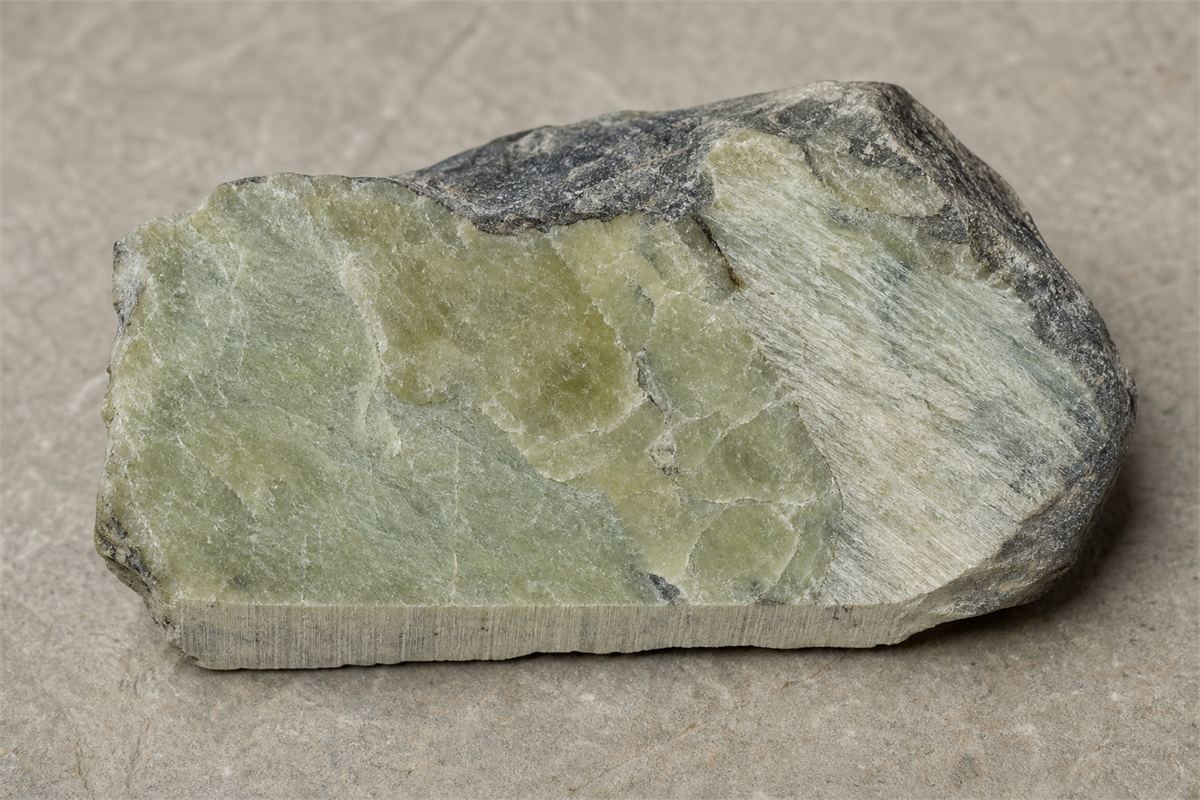
The most familiar translucent yellow-green, olive, pale green, white, grey, or dark Xiuyu is commonly dominated by serpentine-group minerals, often antigorite in compact carving material. Serpentine-rich jade is relatively soft, takes a smooth polish, and can show waxy to greasy luster. Its lower scratch resistance makes protective wear and separate storage important.

Tremolite-rich lao yu and hemo yu
Some Xiuyan-area material is tremolite-rich nephrite. Local and market vocabulary may call primary material lao yu (“old jade”) and river-worn material hemo yu (“river-polished jade”). Here “old” is a traditional grade or source term, not proof that a finished object is antique. Nephrite’s interlocking fibrous texture gives it greater toughness and higher hardness than serpentine-rich Xiuyu.

Mixed and associated rocks
Xiuyan deposits can also yield compositionally mixed material. Serpentine, tremolite and other associated minerals may occur in the same broader geological setting or rock. A trade name based on pattern or color cannot establish the proportions. This is why one universal hardness, density, or refractive-index number for all Xiuyan jade would be misleading.
| Material discussed | Main mineral family | Typical Mohs hardness | Typical specific gravity | Typical refractive-index range |
|---|---|---|---|---|
| Serpentine-rich Xiuyu | Serpentine group, commonly antigorite-rich | about 2.5–5.5, often around 3.5–5 in compact material | about 2.44–2.62 | about 1.56–1.57 |
| Xiuyan-area nephrite | Tremolite-actinolite series | about 6–6.5 | about 2.90–3.03 | about 1.61–1.63 |
| Jadeite jade | Jadeite-rich pyroxene | about 6.5–7 | about 3.30–3.38 | about 1.65–1.67 |

Xiuyan Jade Types and Trade Names
Commercial names help sellers and carvers describe recognizable looks, but they are not a universal scientific classification. The same label may be used differently between mines, workshops, livestream sellers, and overseas shops.

| Name | How to understand it | Important boundary |
|---|---|---|
| 180 material | A local trade name usually associated with fine-textured, deep or bright green serpentine-rich Xiuyu | Do not infer a fixed mine elevation, composition, or quality from the number alone |
| 501 material | A mine- or trade-linked label often used for darker green, blue-green, grey-green, or black-patterned Xiuyu | Color and composition still need piece-specific description |
| Jiacui (甲翠) | A patterned commercial variety, commonly showing green and pale areas | It is not jadeite merely because the name contains “cui” |
| Huayu (花玉) | Patterned “flower jade” with contrasting colors or mottling | A visual category can include varied mineral mixtures |
| Bingliao (冰料) | “Icy material,” a transparency and texture description | It does not mean jadeite “ice type” or guarantee durability |
| Shuimoyu (水墨玉) | An ink-wash-like pattern name | Pattern alone does not establish origin or mineral family |
| Hemo yu / Xiuyan lao yu | Xiuyan-region tremolite-rich nephrite, with hemo yu referring to river-worn material | “Lao” does not date the finished piece |
| Ximu hemo yu (析木河磨玉) | A locality-specific river-worn nephrite name associated with the Ximu area | It should not be reduced to generic green serpentine Xiuyu |
| Tianqingdong (天青冻) | A blue-grey translucent trade look used for more than one material in the wider market | Material sold from Xinjiang should not automatically be relabeled as Liaoning Xiuyan jade |


Xiuyan Jade Colors and Appearance
Xiuyan jade colors include pale green, yellow-green, apple green, olive, grey-green, cream, white, yellow, brown, reddish areas, and very dark green to near-black. Patterned pieces may combine several tones. Translucency ranges from opaque to translucent, and a waxy or softly greasy polish is common. These visual traits are useful for choosing a piece, but none proves mineral identity by itself.

Color quality is better judged by coherence than by a slogan such as “the greener, the better.” Look at whether the color suits the carving, whether transitions appear visually plausible, and whether photos taken under ordinary neutral light agree with the sales images. Very even or saturated color can be a reason to look more closely, but it is only a risk signal.
History Without the Marketing Shortcuts
Northeastern China has an important prehistoric jade tradition, and scientific work has connected some excavated tremolite-nephrite objects with Liaoning and possible Xiuyan sources. That evidence must be applied object by object. It does not justify saying that every jade from Xinglongwa, Chahai, or Hongshan sites came from Xiuyan.

The same caution applies to famous forms. C-shaped dragons and pig-dragons belong to discussions of Hongshan jade culture, but their materials and sources are research questions, not automatic labels. Han jade burial suits also contain many plaques whose material cannot be collapsed into “Xiuyan jade” as a class. Broad titles such as “one of China’s four famous jades” are traditional or promotional rankings rather than mineralogical conclusions.
What can be said confidently is that Xiuyan developed a durable carving and jade-trade identity, and that both serpentine-rich material and local nephrite are part of that story. The region’s significance does not depend on assigning every celebrated ancient object to it.
Xiuyan Jade vs Jadeite and Nephrite
| Feature | Serpentine-rich Xiuyu | Nephrite | Jadeite jade |
|---|---|---|---|
| Mineral group | Serpentine group | Tremolite-actinolite amphibole | Jadeite-rich pyroxene |
| Hardness | Lower and variable | About 6–6.5 | About 6.5–7 |
| Density | Usually lowest of the three | Intermediate | Usually highest |
| Luster | Often waxy to greasy | Greasy to vitreous | Often vitreous to greasy |
| Common look | Soft greens, yellow-greens, translucent or mottled carving material | White, cream and green tones with a compact, tough texture | Wide colors; fine material can show vivid color and strong translucency |
| Wear expectation | More vulnerable to scratches and impacts | Very tough, though not damage-proof | Harder, but fractures can still occur |

Hetian jade is a geographic and cultural trade category centered on nephrite, not a synonym for every nephrite worldwide. For a deeper comparison, read what Hetian jade is. For jade’s wider cultural vocabulary, see jade meaning in Chinese culture.
What Determines Xiuyan Jade Value?
Xiuyan jade value depends first on what material the name covers. Mineral family, locality claim, color, translucency, texture, cracks, inclusions, size, carving quality, polish, treatment disclosure, and the credibility of the seller’s description all affect asking prices. A large carving may cost more because of labor and usable rough; a small piece may command attention because of fine work or unusual material.

Trade labels such as 180, 501, “icy,” or “river-polished” do not create a guaranteed price tier. Nor does a higher asking price promise rarity or future resale. Compare pieces with similar material, dimensions, condition, workmanship, and sales context. The attachment supplied no clear public USD figures with a sufficiently defined product context, so this article does not invent or convert a price chart.
How to Identify Xiuyan Jade: Useful Clues and Limits
Home observation can reveal reasons for caution, but it cannot reliably determine every natural material or treatment. Start with non-destructive checks:

- Read the exact material and locality wording; “Xiuyan style,” “Xiuyu color,” and “Xiuyan nephrite” are different claims.
- Inspect neutral-light photos or video for color consistency, cracks, filled-looking surface areas, pits, polish, drill holes, and carving edges.
- Compare stated dimensions and weight only with genuinely similar pieces. Density cannot be judged accurately by hand.
- Look for concentrated color along fractures or holes as a possible treatment clue, not a verdict.
- Check construction: smooth bangle edges, sound bead holes, secure stringing, and a setting that protects vulnerable corners.
Knocking sounds, coolness, heaviness, bubbles, a flashlight, ultraviolet glow, wiping with alcohol, and supposed “color roots” do not by themselves establish natural origin, dyeing, filling, or mineral family. Glass, resin, dyed stone, waxed stone, serpentine, nephrite, and jadeite can overlap in one or more casual observations. Avoid scratch tests, hot needles, chemicals, or any other destructive experiment.

Treatments also need material-specific language. Dye, surface wax, fracture filling, coating, and composite construction are distinct possibilities. A jadeite-style “acid wash and polymer impregnation” script should not be copied mechanically onto every Xiuyu listing without evidence.
Best Uses, Wearing, and Styling
Serpentine-rich Xiuyu is well suited to pendants, beads, modestly protected bangles, small sculptures, seals, vessels, and larger decorative carving. Nephrite-rich material is tougher and may suit pieces that depend on thin yet resilient carving, although any stone can break when struck.

Soft green and cream pieces pair naturally with linen, cotton, wood, silver, warm gold tones, and restrained everyday clothing. Patterned huayu can serve as the visual focus. Avoid stacking a softer Xiuyu bangle directly against watches, metal bangles, or harder gemstone bracelets, where repeated contact can scratch edges or cause impact damage.

In jewelry, Xiuyan jade may carry traditional associations with refinement, continuity, harmony, and a thoughtful gift. These are cultural symbols and personal meanings, not promises of health, wealth, luck, or supernatural effects. The jade bracelet guide explains the form’s symbolism without confusing it with mineral identity.
Scientific Care for Xiuyan Jade
Because Xiuyan jade can refer to materials with different hardness and structures, conservative care is safest. Remove jewelry before sports, heavy housework, bathing, swimming, cooking near high heat, or any activity with impact and chemical exposure.
- Avoid knocks, drops, abrasion, extreme temperature changes, sustained heat, strong acids or alkalis, and chemical cleaners.
- Clean briefly with lukewarm water and a soft cloth or soft brush. Use only a small amount of mild soap when needed.
- Rinse away residue, dry completely, and inspect cords or settings before wearing again.
- Store separately in a soft-lined compartment, away from harder stones and metal edges.
Some serpentine-rich material can appear temporarily clearer or darker when wet, waxed, or coated. Longer-term changes may relate to surface wax, moisture, microstructure, residues, heat, or environment. Water immersion is not a guaranteed repair, and repeated soaking can affect cords, adhesives, waxed surfaces, or settings. Body oil and perspiration are not maintenance oil; routine oiling, sealed wet storage, and fixed “rehydration” schedules are unnecessary and can mask the actual surface condition. See the general Eastern Story jewelry care guide for setting and cord care.

Frequently Asked Questions
Related Posts


One Comment