
“Titanium quartz” is not one stable mineralogical or gemological name. Depending on the seller, it can mean natural rutilated quartz, the Chinese-market trade category titanium crystal Ti Jing (钛晶), iridescent surface-coated quartz, or an industrial titania-silicate glass. The direct answer is therefore simple: do not use the name alone to identify the material.
Ask the seller to state in writing whether the item is natural or synthetic quartz, what the visible inclusions have been identified as, and whether the surface or fractures have been coated, dyed, filled, or assembled. This guide explains titanium quartz vs rutilated quartz without turning regional trade language into a universal gem standard.
What Does “Titanium Quartz” Mean?
In jewelry listings, titanium quartz is an umbrella label rather than a complete identity. One listing may show clear quartz with golden needles inside it; another may show a rainbow-colored crystal with color concentrated on the outer surface. Both can be marketed under similar English names even though their structure, treatment status, durability, and pricing logic are different.

A careful invoice or product page should replace the vague label with a material statement such as “natural quartz with rutile inclusions,” “natural quartz with an iridescent surface coating,” or “coated synthetic quartz.” If a seller uses Ti Jing (钛晶), ask what the laboratory calls the host and inclusions rather than assuming the trade term answers both questions.
Four Materials Sold Under Similar Names
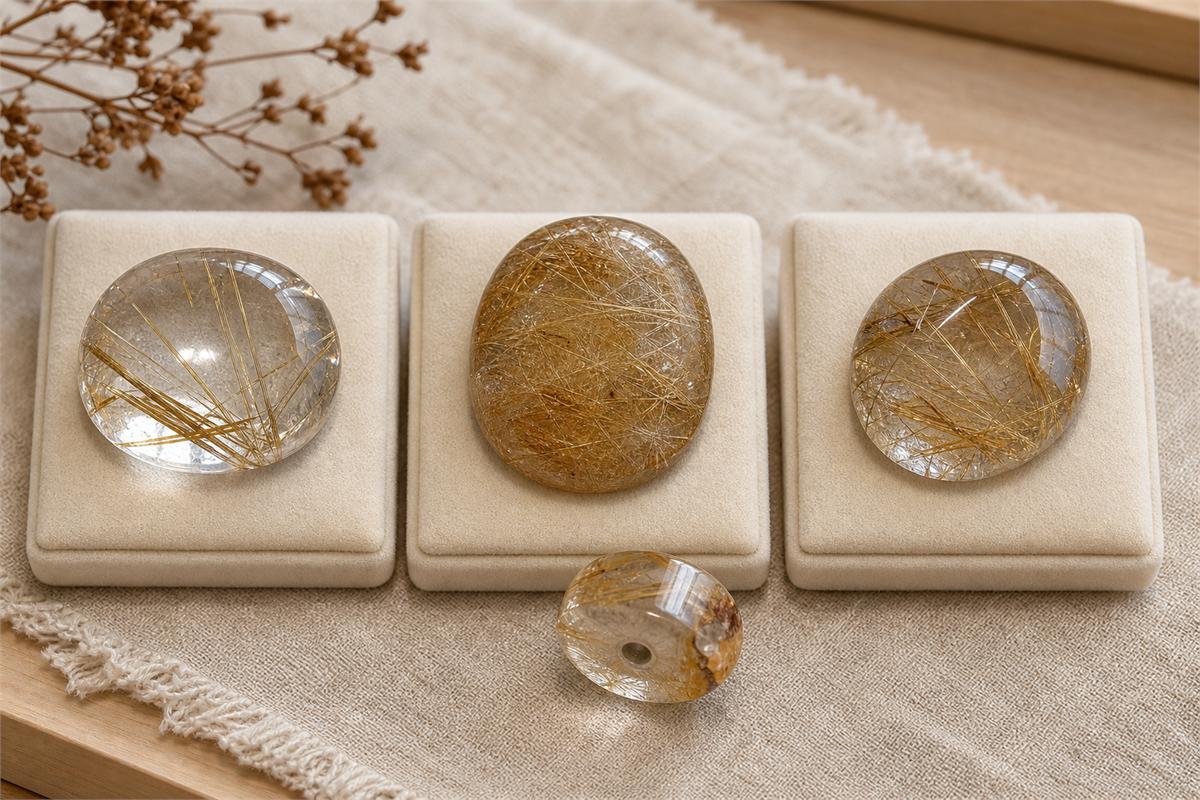
- Natural rutilated quartz: quartz containing visible rutile, a titanium dioxide mineral. Needles, rods, tufts, clusters, and some thicker-looking aggregates may occur.
- Titanium crystal Ti Jing (钛晶): a regional Chinese-market and collector term often applied to quartz with coarse, bundled, plate-like, or strongly reflective golden inclusions. It is not a globally standardized gem variety or quality grade.
- Titanium aura quartz or rainbow quartz: quartz whose iridescence comes primarily from a very thin deposited surface film. The coating may contain titanium, gold, platinum, or other materials, depending on the process and product.
- Titania-silicate low-expansion glass: an engineered industrial material used for precision optical or thermal applications. It is separate from both rutilated quartz jewelry and aura-coated crystal.

These categories can overlap at the level of marketing language. For example, a coated item may use a natural quartz crystal as its substrate, while another may use synthetic quartz. “Real quartz” and “untreated natural quartz with rutile” are therefore different questions.
What Rutilated Quartz Actually Is
Rutilated quartz means quartz containing visible rutile inclusions. Rutile is a crystalline form of titanium dioxide, TiO₂, and commonly appears as acicular or hair-like crystals. In transparent quartz, it can create golden, orange, red-brown, gray, or near-black linear features, but color alone is not a mineral identification.

Quartz is a host for many minerals. Hematite can form reflective plates or rose-like aggregates; goethite may form yellowish to brown broom-like inclusions; tourmaline and amphibole can occur as needles or rods. That is why a yellow, red, black, or metallic-looking “hair” seen in a photograph should not automatically be called rutile. Laboratories can use microscopy with Raman or other analytical methods to identify an inclusion rather than relying only on visual resemblance.
The geology is also more varied than a single story about magma cooling and rutile being wrapped by silica. Quartz occurs in igneous, hydrothermal, and metamorphic settings. Rutile may predate the host quartz, grow in a related mineral-forming event, or occur as exsolved needles in some metamorphic quartz. A particular jewel needs locality and laboratory evidence before a detailed origin story is assigned to it.
Is Titanium Crystal Ti Jing (钛晶) a Gemological Variety?
Ti Jing is useful as a trade-language description, especially for Chinese-speaking buyers, but it is not a universal GIA, Gem-A, CIBJO, SSEF, or Gübelin quality category. The same applies to market expressions such as gold hair crystal Jin Fa Jing (金发晶), plate titanium Ban Tai (板钛), aligned hair Shun Fa (顺发), and titanium flower Ti Jing Hua (钛晶花). Their use and boundaries vary by seller and region.

A trade term can still communicate appearance. Ti Jing often suggests thicker, more reflective, bundled, or plate-like golden inclusions, while Jin Fa Jing often suggests finer golden needles. What it should not do is silently promise that every thick-looking feature is rutile, that one category is automatically rarer, or that a piece belongs to a fixed global grade.
Fine Needles, Bundles, Plates, and Star-Like Inclusions
Needles and bundles
Rutile commonly forms needles, rods, sprays, and dense tufts. When many needles overlap, the group may look like a ribbon, feather, brush, or reflective plate at normal viewing distance. A photograph may not resolve whether that “plate” is one crystal, an aggregate of needles, an oriented intergrowth, or another mineral.

Stars, flowers, and mineral roses
A radiating rutile cluster enclosed in quartz may be sold as a titanium flower. That object is different from an independent rutile specimen showing cyclic twinning, and different again from a hematite rose enclosed in quartz. Star-like form is a description of geometry, not proof that every example has the same mineral identity or growth history.

Chatoyancy and the cat’s-eye effect
True chatoyancy is a narrow moving light band produced when suitable parallel inclusions or tubes are oriented beneath a domed cabochon. Cutting direction matters: the reflective features must be aligned correctly relative to the cabochon base. Parallel “hair” or a broad flash in a bead is not automatically a cat’s-eye.

Golden Rutilated Quartz vs Trade-Name Titanium Crystal
Golden rutilated quartz is the clearer English description when the host is quartz and the inclusions are identified as golden rutile. In Chinese-market language, Jin Fa Jing often emphasizes fine hair-like needles, while Ti Jing often emphasizes thicker, denser, bundled, or highly reflective features. These are appearance-led trade distinctions, not a biological family tree in which Ti Jing is the inevitable “top grade.”

Neither style is universally more valuable. A collector may prefer sparse, architectural needles in exceptionally clear quartz; another may favor dense metallic sprays; a jewelry buyer may prioritize matching beads and a comfortable weight. Very dense inclusions can reduce transparency, while fractures that create dramatic internal reflections can also reduce durability.
Titanium Aura Quartz: A Surface Treatment
Titanium aura quartz usually refers to quartz with a thin iridescent surface film produced by a deposition process. Thin metallic or metal-oxide layers create interference colors, so purple, blue, gold, green, and rainbow hues appear to sit on the surface and change with angle. Published gemological studies of coated quartz have found different coating compositions; “titanium molecules attached by heat” is too broad to describe every product.

Coating is a treatment, not a statement that the underlying object is glass or “fake quartz.” The substrate may be natural quartz or synthetic quartz. A coated crystal can be attractive and intentionally designed, but its value and care depend on accurate disclosure and the film’s durability. Ask the seller to identify both the substrate and the treatment.
Industrial Titanium-Doped Fused Silica: A Brief Disambiguation
In engineering, a similar phrase may refer to titania-silicate ultra-low-expansion glass. Manufacturers tailor this material for dimensional stability in precision optics, telescope mirrors, metrology, and extreme-ultraviolet lithography. It is an engineered glass family, not titanium aura quartz and not natural quartz containing rutile needles. Industrial TiO₂ pigment and natural rutile ore are also separate materials.

Side-by-Side Identification Table
| Material sold under a similar name | Where the visual feature occurs | What the name can support | What still needs disclosure or testing |
|---|---|---|---|
| Natural rutilated quartz | Mineral inclusions inside a quartz host | Quartz containing rutile when the inclusion is identified | Natural or synthetic host, inclusion identity, filling or other treatment |
| Titanium crystal Ti Jing (钛晶) | Usually coarse, bundled, plate-like, or strongly reflective internal features | A regional trade description of appearance | Host identity, inclusion identity, treatment, and seller-defined grade |
| Titanium aura or rainbow quartz | Iridescent film on the surface, edges, cavities, or surface-reaching fractures | Coated quartz when treatment is clearly stated | Coating composition when known; natural or synthetic substrate |
| Glass or synthetic simulant | Features may be internal, applied, assembled, or molded | Only the material proven by testing | Identity, manufacturing method, coating, filling, and assembly |
| Titania-silicate low-expansion glass | Titania is part of an engineered glass composition | An industrial optical material | Manufacturer specification; unrelated to jewelry trade grading |

Treatments, Imitations, and Composites
Different interventions should be named separately. A coating changes the surface. Dye adds color, often along fractures or porous areas. Fracture filling introduces a substance into surface-reaching breaks. A composite or assembled stone joins two or more parts. Glass, synthetic quartz, and other manufactured materials are material identities rather than synonyms for every treatment.

Microscopy may reveal concentrated surface color, abrasion at facet junctions, filled fractures, glue planes, or joined sections. These are clues, not a complete diagnosis. Some natural quartz is very clean; some glass contains bubbles; some glass has no obvious bubbles; and natural inclusions are not a certificate of authenticity. For a broader comparison of hosts and imitations, read the natural crystal vs artificial crystal guide.

What Visual Inspection Can—and Cannot—Prove
Use a 10× loupe and neutral lighting to map where color and reflective features occur. Rotate the object, compare the front and back, inspect drill holes and facet edges, and look for a surface film, wear, glue boundaries, open fractures, or inclusions that shift in depth. This is a sensible first screen.

Temperature by touch, heaviness, price, a scratch with a fingernail, alcohol wipes, soaking, flame, sunlight, magnets, a single bubble, “perfectly straight hair,” or the amount of cloud and fracture cannot establish identity. Destructive home tests can damage the object and weaken return rights. Our guide to telling whether a crystal is real explains how to separate observation from confirmation.
When Laboratory Testing Is Needed
Laboratory testing is worth considering when treatment or origin materially affects price, when a seller’s language is contradictory, when the object is high value, or when a large batch is being purchased. A gemologist may combine refractive-index testing, polariscope reactions, microscopic inclusion study, Raman analysis, optical spectroscopy, and elemental analysis. No single method answers every question.

For wholesale or repeated purchases, agree on random sampling, a sealed reference sample, batch-consistency terms, an independent recheck, and a return remedy if the goods do not match the written specification. One report for one selected bead should not silently cover an entire shipment.
How to Read a Gem Report
- Verify the issuing laboratory and the report number through the laboratory’s own channel.
- Match the tested object by photograph, weight, measurements, shape, and identifying features.
- Read the identity line for the host material and whether it is natural or synthetic.
- Read the comments for coating, dye, filling, assembly, or other treatment disclosure.
- Check how the inclusions are described; “needle-like inclusions” is less specific than an analytical identification of rutile.
- Treat commercial labels and seller grades separately from the laboratory conclusion.

In China, CMA is a regulatory qualification mark used within an inspection and testing institution’s approved scope; it is not the same kind of entity as a laboratory brand such as GIA. A logo alone is not enough. Verify the institution, its authorized scope, the report number, and the match between the report and the object.
Quality, Durability, and Value Without Investment Hype
Evaluate identity and disclosure first. Then consider transparency, body color, the design and visibility of the inclusions, cut, polish, fractures, edge wear, drill-hole condition, size, bead matching, and how the piece looks in ordinary light. More needles are not always better, and “no cloud, no fracture” is not a universal ideal.
Quartz has a Mohs hardness of about 7, which describes resistance to scratching—not resistance to impact. Surface-reaching fractures, filling, coating, drilled holes, glue, prongs, elastic cord, and thin edges can all change real-world durability. A piece can be hard enough for jewelry and still chip or crack if struck.
Rutilated quartz has no uniform exchange price or universally accepted investment grade. Seller reputation, treatment disclosure, size, cutting, visual composition, matching, and current demand all affect retail and resale results. Country-of-origin claims should be supported by traceability or laboratory evidence; a Brazilian, Madagascan, Pakistani, Australian, or Chinese label alone does not determine quality.
Choosing Beads, Cabochons, Pendants, and Specimens
Beads and bracelets
Compare the full strand, not only the best bead. Check diameter consistency, drill-hole chipping, elastic or cord condition, total weight, inclusion matching, and whether fractures reach the surface. Ask whether the report covers one bead or the complete bracelet.

Cabochons and pendants
A cabochon can display sprays, stars, and possible chatoyancy more clearly than a faceted stone when the orientation is right. Inspect the dome, base, setting pressure, bail, glue, and any reflective backing. A broad flash is attractive, but reserve “cat’s-eye” for a distinct moving band produced by oriented features.

Mineral specimens
For a specimen, examine crystal termination, contact points, repaired areas, added bases, coating, and locality documentation. An enclosed rutile star, an independent twinned rutile specimen, and a hematite rose in quartz are different collecting objects even when sellers use similar floral language.

Bracelet Fit and Practical Wearing
Fit means physical comfort: wrist circumference, bead diameter, bracelet inner circumference, total weight, clasp or elastic behavior, edge shape, activity level, and any metal sensitivity. It is not a gemological match between a person’s body and a stone.

Use the non-dominant wrist if it reduces knocks, or choose the other wrist if that feels better. Remove the bracelet for lifting, contact sports, heavy housework, swimming, and sauna use when impact, chemicals, heat, hardware stress, or loss is a concern. For measurements and movement allowance, use the crystal bracelet size guide.
How to Clean Natural Rutilated Quartz
For stable, untreated rutilated quartz with no filling, delicate coating, or vulnerable assembly, use lukewarm water with a small amount of mild detergent. Wipe with a soft lint-free cloth or use a very soft brush around a secure setting. Keep the cleaning brief, rinse carefully, and dry immediately.

Avoid high heat, sudden temperature changes, hard impact, and long soaking. Cosmetics and perspiration are more likely to leave residue or affect coatings, glue, elastic, and metal parts than to destabilize rutile sealed inside quartz. Follow the maker’s instructions for the complete piece, and consult the Eastern Story jewelry care guide for storage and routine handling.
Store pieces separately or in divided compartments. Diamond and corundum can scratch quartz, while quartz can scratch softer gems. A padded box also limits impacts between beads, clasps, and other jewelry.
Caring for Coated, Filled, or Assembled Pieces
If the item is coated, dyed, filled, glued, or assembled—or if its treatment is unknown—use a soft, lightly damp cloth and dry it at once unless the seller provides a more specific safe method. Avoid abrasives, solvents, alcohol testing, steam, and home ultrasonic cleaning. These methods may alter a film, filler, adhesive, cord, or setting and still fail to identify the treatment.

Ultrasonic risk should be explained accurately. Rutile needles enclosed within solid quartz do not simply detach because of vibration. The practical concerns are existing fractures, surface-reaching breaks, fillers, coatings, glue joints, drill holes, loose settings, and thermal or mechanical stress.
Modern Crystal Lore vs Gemological Evidence
In modern crystal lore, golden rutilated quartz and Ti Jing are sometimes associated with confidence, prosperity, decisiveness, or personal momentum. These are contemporary symbolic interpretations rather than mineral properties. Choose a piece for its design, personal meaning, or commemorative value; health and mental-health concerns belong with qualified professionals.

Left-hand and right-hand rules, Five Elements matching, chakra prescriptions, and fixed cleansing schedules are personal belief practices, not identification or care standards. If a private ritual involves water, smoke, ash, sunlight, or another material, first protect any coating, cord, glue, metal, and setting.
The Most Reliable Buying Question
Instead of asking only “Is this titanium quartz?”, ask: What is the host, what are the inclusions, what treatments or assemblies are present, and what evidence supports the description? That one sentence separates a useful trade name from a complete material disclosure.

For a wider view of gold rutile jewelry, meaning, selection, and care, continue with the rutilated quartz bracelet guide. The best choice is the piece whose identity, treatment, construction, fit, and visual character are all clear before purchase.
Frequently Asked Questions
Related Posts


One Comment