
Tianlu (天鹿 or 天禄) is a name associated with auspicious composite beasts in Chinese texts and art. It is often translated as “heavenly deer,” yet surviving images do not form a single zoological type: a Tianlu may look deer-like, feline, leonine, equine, or broadly fantastic, and it may carry wings, one horn, two horns, or no clearly visible horn. The most reliable way to understand this Tianlu Chinese mythical creature is therefore to read its name, date, object type, and cultural setting together.
This guide explains Tianlu meaning from early textual evidence through later art, then separates Tianlu from Bixie, Pixiu, Qilin, and ordinary deer imagery. It also offers practical guidance for choosing a Tianlu jade carving, Tianlu jewelry, or home object without turning a complex historical subject into a promise of wealth or protection.
Tianlu Meaning at a Glance
- What it is: an auspicious, sometimes winged composite beast named in Chinese textual and visual traditions.
- What the name suggests: tianlu may be written 天鹿 (“heavenly deer”) or 天禄 (“heavenly emolument/blessing”), but those spellings and the objects attached to them have not always been used consistently.
- Typical appearance: variable combinations of deer, lion, tiger, horse, bull, wings, horns, claws, hooves, and a long tail.
- Historical roles: a sign of good rule in omen literature, a guardian on some tomb approaches, and an auspicious motif in later decorative art.
- Common associations: blessing, honorable rank, good fortune, longevity, protection, and—in later visual culture—the sound-link between 鹿, deer, and 禄, official emolument or prosperity.
- Important caution: Tianlu is not simply an old name for every Bixie or Pixiu, and the popular “one horn equals Tianlu, two horns equal Bixie” rule is useful only as a clue.
What Is Tianlu? Names and Identity
The term appears in more than one written form. 天鹿 literally combines “heaven” and “deer.” 天禄 combines “heaven” with lu (禄), a word historically connected with official emolument, rank, and bestowed fortune. Modern labels may favor one form while a museum, catalogue, local tradition, or seller uses another. The variation matters because it warns us not to assume that one spelling identifies one fixed animal.

Early commentarial language also connects Tianlu with names transcribed as taoba or fuba (桃拔, 符拔, and later variant writings). These names have generated several interpretations, including connections to animals arriving from western regions and to imagined hybrids inspired by imported species. The evidence does not support the modern folk explanation that “taoba” means “to pick away disaster” or “part the clouds.” It is safer to treat the words as old names whose exact zoological reference remains debated.

“Tianlu,” then, is best understood as a historically changing label within a family of auspicious beasts. Art historians may classify an object by inscription, horns, posture, archaeological context, or comparison with related works. Those methods can lead to different labels for visually similar creatures—and to similar labels for creatures that do not look identical.
Historical Sources: From Taoba and Fuba to Tianlu
The Han Shu record and its commentary
The Han Shu (Book of Han), in its account of the Western Regions, lists taoba among unusual animals associated with the distant polity of Wuyi. The base text does not give us a complete picture of Tianlu. A received commentary attributed to Meng Kang supplies the better-known description: taoba was also called fuba, resembled a deer, and had a long tail; a one-horned example could be called Tianlu, while a two-horned example could be called Bixie.

The small word translated as “could” or “in some cases” is crucial. The commentary says huo wei (或为)—not that every one-horned beast must be Tianlu and every two-horned beast must be Bixie. Modern summaries often turn this flexible observation into an absolute identification key. Museum catalogues and surviving objects show why that is risky: names, horn counts, and forms do not always align.
Tianlu as an auspicious omen in the Song Shu
The “Treatise on Auspicious Omens” in the Song Shu (Book of Song) describes Tianlu as a numinous beast whose five-colored radiance becomes brilliantly visible and says it appears when a ruler’s Way is complete. The received Chinese text reads “王者道备则至”—“it arrives when the ruler’s Way is fully realized”—rather than the frequently repeated substitution “when the ruler’s virtue is complete.”

This is a political and cosmological context. The beast signals an ideally ordered reign in omen literature; it is not being presented as a household device that automatically produces money. That distinction helps explain why Tianlu symbolism can include auspicious rule, harmony, and legitimacy as well as later wishes for personal fortune.
What Does a Tianlu Look Like?
There is no single standard Tianlu anatomy. Early and medieval Chinese artists built fantastic beasts from familiar and foreign animal forms. Depending on period, region, scale, and medium, a Tianlu or closely related Chinese winged beast may show:

- a deer-like head, legs, or long tail;
- a muscular lion- or tiger-like body;
- hooves, paws, or clawed feet;
- one horn, two horns, branching antlers, or a horn obscured by damage and viewpoint;
- wings rendered as large feathered appendages, small shoulder scrolls, flame-like ridges, or abstract curls;
- a beard, mane, open mouth, protruding chest, or striding pose;
- features borrowed from horses, bulls, dragons, or other composite beasts.
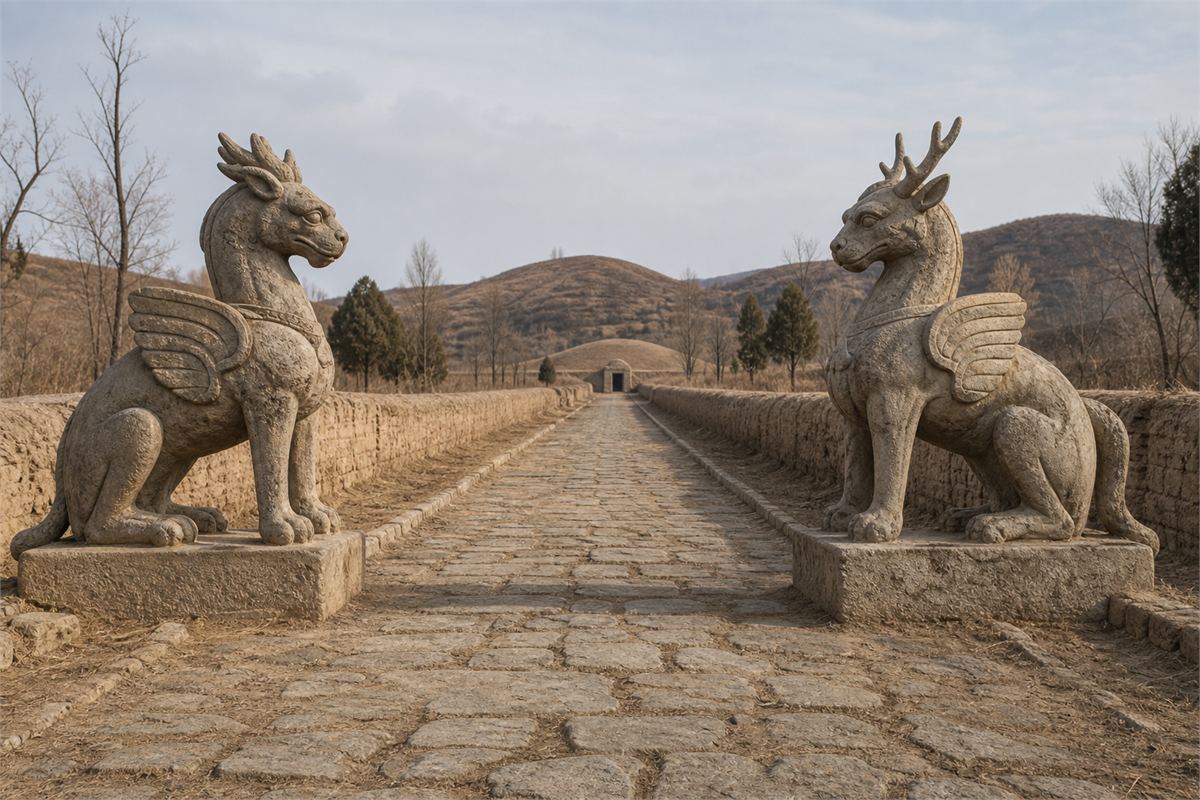
Scale changes the image too. A monumental stone guardian on a tomb avenue can emphasize mass, motion, and authority. A palm-sized jade may compress wings into shallow relief and make the horn easier—or harder—to read. A porcelain motif may stylize the creature further. Wear, broken horns, restoration, and modern antiquing can also alter what a viewer thinks they see.

For that reason, descriptions such as “dragon head, lion body, wings, and one horn” should be treated as one modern reconstruction, not the timeless template for all Tianlu.
Tianlu vs. Bixie vs. Pixiu vs. Deer
| Term | Best historical reading | Common visual clues | What not to assume |
|---|---|---|---|
| Tianlu (天鹿/天禄) | An auspicious composite beast; in some texts an omen of good rule, and in some art a guardian or decorative motif. | May be deer-like or feline, winged, long-tailed, and horned; form varies widely. | It is not always one-horned, and not every Tianlu is a wealth charm. |
| Bixie (辟邪) | A name literally associated with warding off harmful influences; often applied to fierce winged beasts in tomb and decorative art. | Frequently feline, powerful, winged, and sometimes two-horned. | Two horns alone do not prove an identification; some catalogues use Bixie for objects others classify differently. |
| Pixiu (貔貅) | An old beast name with its own complex textual history; today it is widely used for auspicious jewelry and décor connected with wealth. | Modern forms often have a dragon-like head, rounded body, wings, horns, and an open mouth. | The “eats treasure but has no anus” story is mainly a modern commercial narrative, not a secure ancient Tianlu attribute. |
| Deer (鹿) | A real animal and a long-lived artistic subject; in later auspicious imagery its name sounds like 禄, emolument or prosperity. | Naturalistic deer, antlers, herd scenes, cranes, peaches, or officials. | White deer, fallow deer, the Nine-Colored Deer, and Tianlu are not one species or interchangeable “incarnations.” |
Tianlu vs. Bixie: is horn count enough?
The formula “one horn for Tianlu, two horns for Bixie” comes from a genuine commentarial tradition, so it should not be dismissed. It can be a useful first clue when examining paired stone beasts or a labelled reproduction. But it is not a universal law. The National Museum of China, for example, discusses different naming systems for Eastern Han winged beasts, while the Palace Museum describes a Qing porcelain motif as a two-horned Tianlu. In practice, scholars also consider inscription, provenance, pairing, date, and catalogue history.

Tianlu vs. Pixiu: related, but not identical
Tianlu vs. Pixiu is partly a question of period and usage. Historical sources preserve several beast names without giving us a neat modern family tree. In today’s market, sellers sometimes use Tianlu, Pixiu, and Bixie interchangeably because all can suggest an auspicious horned beast. That retail habit does not erase the distinctions found in texts, museums, and archaeology.
If you are looking at modern wealth jewelry, our guide to Pixiu meaning, history, and use explains the better-known Pixiu tradition. If an object is sold as Tianlu, ask why: is the name based on an inscription, a museum model, a single horn, a deer-like form, or simply the seller’s preferred label?
Tianlu is not simply a Qilin or an auspicious deer
Qilin, Tianlu, Bixie, and deer can share hooves, horns, wings, or auspicious meanings, but overlap does not make them the same creature. Qilin has its own textual genealogy and iconographic history. The Nine-Colored Deer belongs to a Buddhist jātaka narrative, while fallow deer is a real cervid. Later Chinese auspicious deer imagery often uses the sound of lu (鹿) to evoke lu (禄), yet that pun cannot by itself explain every early use of the word Tianlu.

Tianlu Symbolism in Historical Context
Auspicious rule and political order
In omen catalogues, rare creatures could reveal the moral and cosmic condition of a reign. The Tianlu described in the Song Shu belongs to this language of ideal government. Its brilliance and arrival express a world responding to proper rule. “Auspicious” here is public and political before it is personal.

Guardians on tomb approaches and sacred routes
Large winged beasts placed along some tomb approaches helped mark a transition from ordinary space to a prestigious funerary landscape. Their scale, stance, and fantastic anatomy projected authority and vigilance. Context matters: a beast on a spirit road is not automatically a domestic “feng shui cure,” and a small decorative carving is not automatically a tomb guardian. Tomb avenue, chamber, gate, palace, desk, pendant, and textile are different settings with different functions.
Lu, rank, prosperity, and later wishes
Chinese decorative art often builds meaning through homophones. Because deer (鹿, lù) sounds like emolument or official prosperity (禄, also lù), deer became a flexible sign of rank, salary, abundance, and blessing, especially in later art. The spelling 天禄 strengthens those associations for Tianlu. A modern gift can therefore express congratulations on a new role, steady progress, or honorable success without claiming that the object controls a career.
Protection, longevity, and good wishes
Fierce posture and guardian settings support protective readings, while deer-related visual culture can contribute wishes for longevity and peaceful abundance. These meanings belong to cultural interpretation, historical imagery, and personal intention. A Tianlu object can carry a thoughtful message; it is not a guarantee of wealth, promotion, safety, or health.
Tianlu in Archaeology and Art
Surviving works show how the image changed across time and medium. They also show why labels should remain attached to evidence rather than to a rigid silhouette.

- Eastern Han stone beasts: monumental winged animals stood on some tomb approaches. Research by the National Museum of China on the Sunqitun pair dates them to the middle-to-late Eastern Han and discusses why Tianlu/Bixie names vary among textual, archaeological, and art-historical systems.
- Han jade Bixie: a white-jade winged beast in the National Museum of China has two horns, wings, a long tail, and a dynamic posture. The museum identifies it as Bixie and places it in a funerary context. It is a useful comparison, not an object that should be relabelled Tianlu.
- Shunling stone carving: Shunling in Shaanxi is the Tang-period tomb of Lady Yang, mother of Wu Zetian. Its stone Tianlu and lions belong to a Tang imperial funerary landscape—not to Han sculpture.
- Qing imperial porcelain: the Palace Museum catalogues a white-glazed square washer with a Qianlong poem and a Tianlu-and-cloud design. Its description calls the Tianlu short-legged, winged, and two-horned, a clear reminder that later museum naming does not always follow the one-horn rule.

These examples span stone, jade, and porcelain and serve different purposes. They should not be collapsed into a single evolutionary ladder. Nor should uncertain figures in murals, flags, rank badges, or textiles be called Tianlu solely because they have wings or horns; a secure identification depends on the catalogue, inscription, documented context, and specialist comparison.

Materials and Craft Traditions
Tianlu is a subject, not a material. Historic and modern makers can render the beast in many substances, each shaping the result differently:

- Stone: monumental limestone or other local stone suits architectural and funerary sculpture; weathering, repairs, and later recutting matter greatly.
- Jade and hardstone: nephrite, jadeite, and other carving stones allow compact forms and polished surfaces. “Jade” should be identified more precisely whenever possible.
- Seal stone: softer stones can support detailed miniature carving, but names such as Tianhuang or chicken-blood stone refer to particular materials and qualities, not to required Tianlu media.
- Wood: grain, joinery, coating, insect damage, and age affect both appearance and value.
- Ceramic and porcelain: the motif may be modelled in the round, moulded, incised, painted, or combined with inscriptions and clouds.
- Bronze and copper alloy: casting can produce sculptures, fittings, vessels, seals, or ornaments; alloy, patina, corrosion, and casting method need separate assessment.
- Gold, silver, and jewelry alloys: small charms may be cast, chased, engraved, or stone-set. “18K gold with diamonds” describes one possible modern object, not a traditional Tianlu standard.
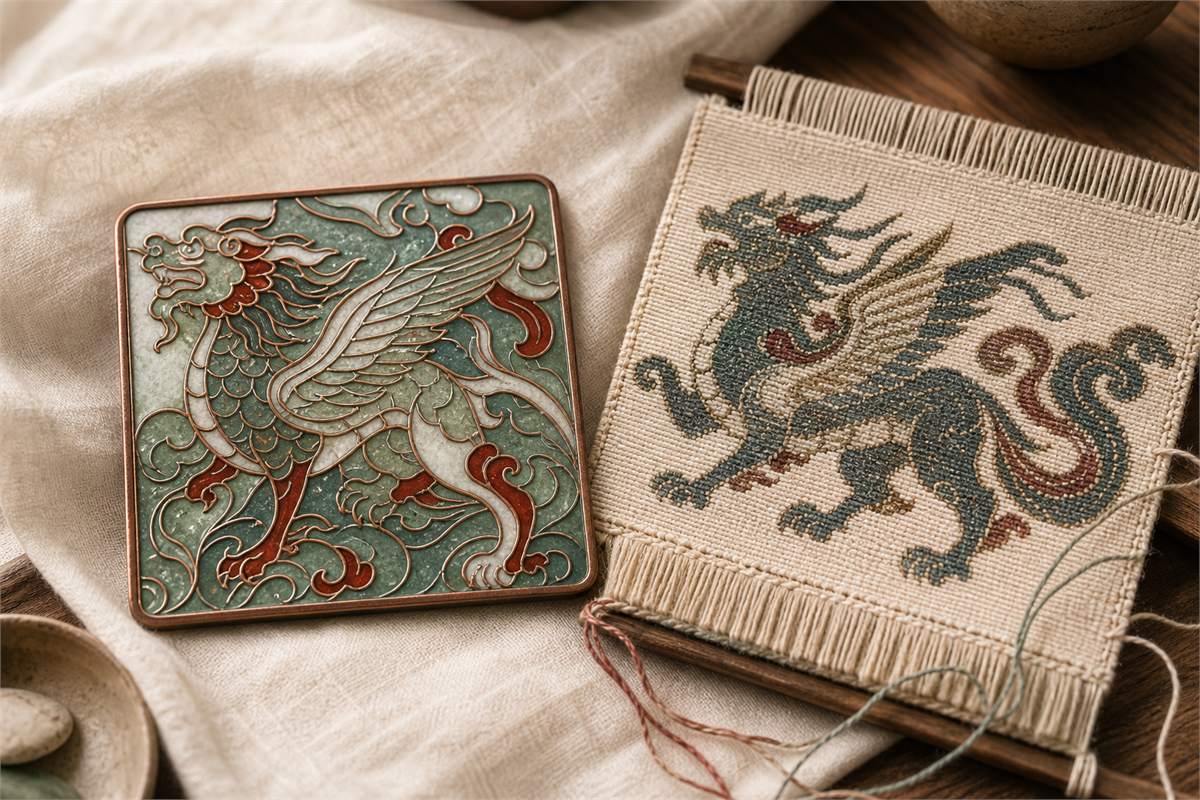
- Enamel and textiles: cloisonné, painted enamel, embroidery, brocade, and tapestry can adapt the beast to colorful surface design, but the motif still needs reliable identification.
Tianlu Jade Carving and Jewelry
A Tianlu jade carving may be a small animal in the round, a pendant, bead, seal finial, belt ornament, plaque, or desk sculpture. Look first at the design: can you read the head, limbs, tail, wing treatment, and horn arrangement from more than one angle? Good carving gives the animal structure rather than relying on a label alone. Our overview of jade carving patterns and meanings can help you compare motif, technique, and symbolic context.

For Tianlu jewelry, practical quality matters as much as imagery. Check the bail or drill hole, sharp edges, setting security, metal fineness marks, cord wear, clasp, stone treatment, and total weight. If the piece uses an antique-style finish, the seller should say whether the darkening, abrasion, or patina was intentionally created. A modern pendant can be meaningful without being described as ancient.

Because Tianlu forms vary, a product description should explain why the maker uses that name. A clear account might point to a one-horned, long-tailed design inspired by Han imagery, or to a documented museum object. “It looks like Pixiu” is not enough for a historical claim, though it may accurately describe a modern hybrid style.
Tianlu in Home Decor: Is There a Fixed Placement?
Historical Tianlu and related beasts appeared in specific architectural, funerary, ceremonial, and decorative settings. Those contexts do not create one universal rule for placing a modern figurine. Advice that every Tianlu must face a door, window, wealth corner, compass direction, or pair with another beast belongs to particular modern practices, not to a single rule documented across Chinese history.
For a contemporary home, choose a stable, respectful place where the carving can be seen without being knocked over. Consider scale, sightline, direct sun, moisture, children, pets, and the material’s care needs. A desk may suit a small piece given for professional progress; an entry console may suit a guardian theme; a display cabinet may be better for fragile jade or ceramic. The meaning comes from the object, its story, and the intention of the household—not from a guaranteed directional effect.

How to Buy a Tianlu Carving or Jewelry Piece
1. Confirm what the material actually is
Ask for a precise material name rather than accepting “jade,” “stone,” or “metal.” For a higher-value gem or jade object, an independent laboratory report can identify species and, where the laboratory offers it, treatments. For metal, look for fineness disclosure and ask whether components are solid, plated, filled, or alloyed.

2. Judge carving and construction
Examine symmetry where intended, undercutting, transitions between limbs and body, polished recesses, tool marks, cracks, chips, and weak points. On jewelry, check settings and fittings. Photographs should show the front, back, sides, base, drill holes, and any damage at useful scale.
3. Separate age from antique style
Age cannot be proved by a dark surface, “burial color,” wear, or a seller’s story. Ask for ownership history, invoices, old collection records, excavation context where lawful, comparable publications, and a condition report. Artificial staining, acid treatment, abrasion, recutting, and added patina can imitate age. For a serious antiquity, consult a qualified specialist and check applicable cultural-property and export laws.
4. Request disclosure of repair and restoration
Look for filled chips, joined breaks, replaced horns, reattached wings, overpainting, solder, adhesive, and concealed mounts. Restoration is not automatically disqualifying, but it affects condition, interpretation, durability, and value. The seller should describe it clearly.

5. Evaluate the name and provenance together
Ask what supports “Tianlu” rather than Bixie, Pixiu, Qilin, or simply “winged beast.” An inscription or well-documented model is stronger evidence than horn count alone. For a modern craft piece, the artist’s stated inspiration may be the most honest provenance. Prices cannot be compared sensibly across an excavated stone sculpture, an antique jade, and a newly made charm; material, age, authorship, condition, documentation, and legal title all change the market.
Choosing Tianlu as a Gift
Tianlu can make a thoughtful gift when the message is specific and culturally grounded. Suitable occasions include:

- a promotion, graduation, or new role: a wish for honorable progress and responsibility;
- a business opening or career milestone: encouragement toward steady prosperity and good judgment;
- a new home: a guardian-themed object chosen for welcome and stability;
- a birthday or family occasion: a wish for blessing, dignity, and long life;
- a collector or art lover: a piece selected for its historical reference, material, and craftsmanship.
Include a short note explaining the intended meaning and, if known, the design source. Choose wearable size and secure construction for jewelry; choose a stable base and appropriate scale for décor. A gift from our Chinese blessing collection is most meaningful when its material, motif, and message fit the recipient rather than when it is presented as a guaranteed result.
How to Read a Tianlu Object Responsibly
- Start with the label: record the Chinese name, translation, institution or seller, and catalogue number.
- Check date and context: tomb avenue, vessel, pendant, textile, or modern sculpture changes the interpretation.
- Describe before naming: note body type, feet, wings, horn count, tail, posture, and damage without forcing a conclusion.
- Compare authoritative examples: museum records and archaeological reports are stronger than repeated retail descriptions.
- Keep certainty proportional to evidence: “identified as Tianlu by the museum” is better than “all beasts of this form are Tianlu.”
This method preserves what makes Tianlu fascinating: it is not a logo with one approved outline, but a changing idea carried through texts, tomb landscapes, court art, craft, and modern design.

Conclusion
The clearest answer to “What is Tianlu?” is also the most nuanced. Tianlu is an auspicious composite beast whose names, forms, and meanings changed across Chinese history. Early commentary links a deer-like, long-tailed animal with Tianlu and Bixie and offers horn count as a possible distinction. Omen literature connects Tianlu with ideal rule. Stone guardians, jade animals, and later decorative motifs expand the image rather than fixing it.
Today, Tianlu can express blessing, honorable prosperity, guardianship, or admiration for Chinese craft. The best carving, jewel, or gift is one that identifies its material honestly, explains its design source, respects historical uncertainty, and lets symbolism remain a meaningful cultural wish.
Frequently Asked Questions
Related Posts


