
Garden Quartz usually means a natural quartz crystal filled with mineral inclusions that resemble moss, forests, mountains, clouds, or flowers. In the crystal trade it may also be called garden crystal (花园水晶), garden ghost quartz (花园幽灵), scenic quartz, or Lodolite. In landscaping and renovation, however, “garden quartz” can mean garden quartz tile: a manufactured outdoor paving material used for courtyards, patios, walls, and public spaces. These are not the same product. One is a natural included crystal chosen for beauty, symbolism, jewelry, or collecting; the other is a high-temperature-sintered construction material chosen for grip, weather resistance, thickness, drainage, and maintenance.
Garden Quartz at a Glance: Crystal or Outdoor Tile?
The surrounding words usually reveal which meaning a seller, designer, or search result intends. Mentions of inclusions, Lodolite, chlorite, pendants, specimens, or spiritual meaning point to the crystal. Mentions of millimeters, water absorption, R ratings, paving, patios, or square-meter prices point to outdoor tile.

| Context | What Garden Quartz means | What to examine |
|---|---|---|
| Crystal and mineral collecting | Natural quartz containing scenic mineral inclusions | Inclusion identity, scene, depth, transparency, natural texture, origin, treatment |
| Jewelry and symbolic gifts | Garden Quartz beads, bracelets, pendants, carvings, or display crystals | Comfort, setting, durability, visual appeal, personal symbolism, care |
| Garden and landscape construction | Manufactured garden quartz tile, outdoor quartz tile, or PC brick | Thickness, absorption, slip rating, strength report, full-body construction, substrate, joints |
| Quartz sand or gravel landscaping | Loose quartz aggregate used for paths, borders, or dry-landscape compositions | Particle size, drainage, color, migration control, cleaning, local suitability |
How Garden Quartz Crystal Forms
Garden Quartz belongs to the quartz family, whose main component is silicon dioxide. The clear quartz guide explains the host mineral in more detail. Scenic varieties develop when quartz grows from silica-rich hydrothermal fluids and encloses other minerals or fine particles during successive stages of crystal growth. A change in temperature, pressure, fluid chemistry, or the surrounding rock can alter what reaches the growing crystal face. Quartz then continues to grow around that material, preserving layers, veils, needles, flakes, or clouds inside.
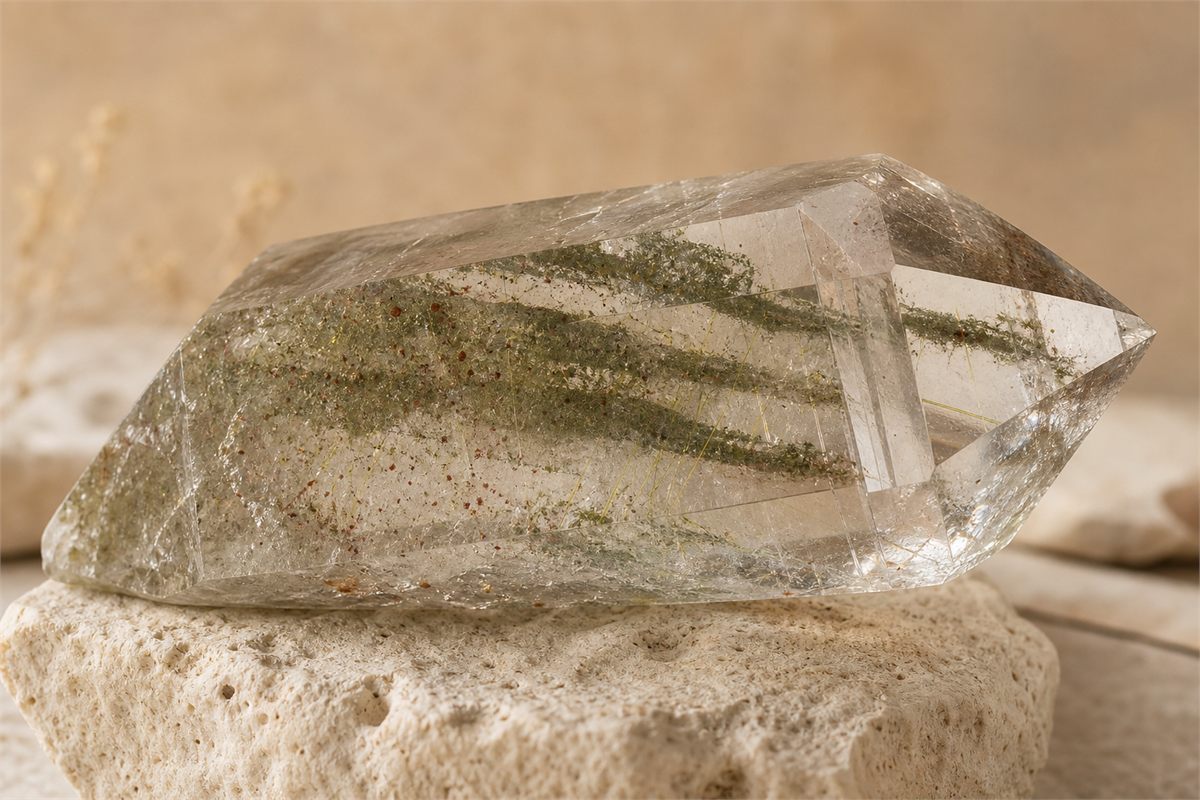
The result may resemble a miniature landscape, but the “garden” is a visual interpretation rather than a separate mineral species. Lodolite is widely used as a trade name for included scenic quartz. Garden Quartz, garden crystal, and garden ghost quartz can overlap with phantom quartz, yet the terms are not perfectly standardized. Phantom quartz usually emphasizes a visible earlier crystal-growth outline; Garden Quartz emphasizes the overall landscape-like scene.
Common Inclusions and the Scenes They Create
| Inclusion or material | Typical visual effect | How it may read in the crystal |
|---|---|---|
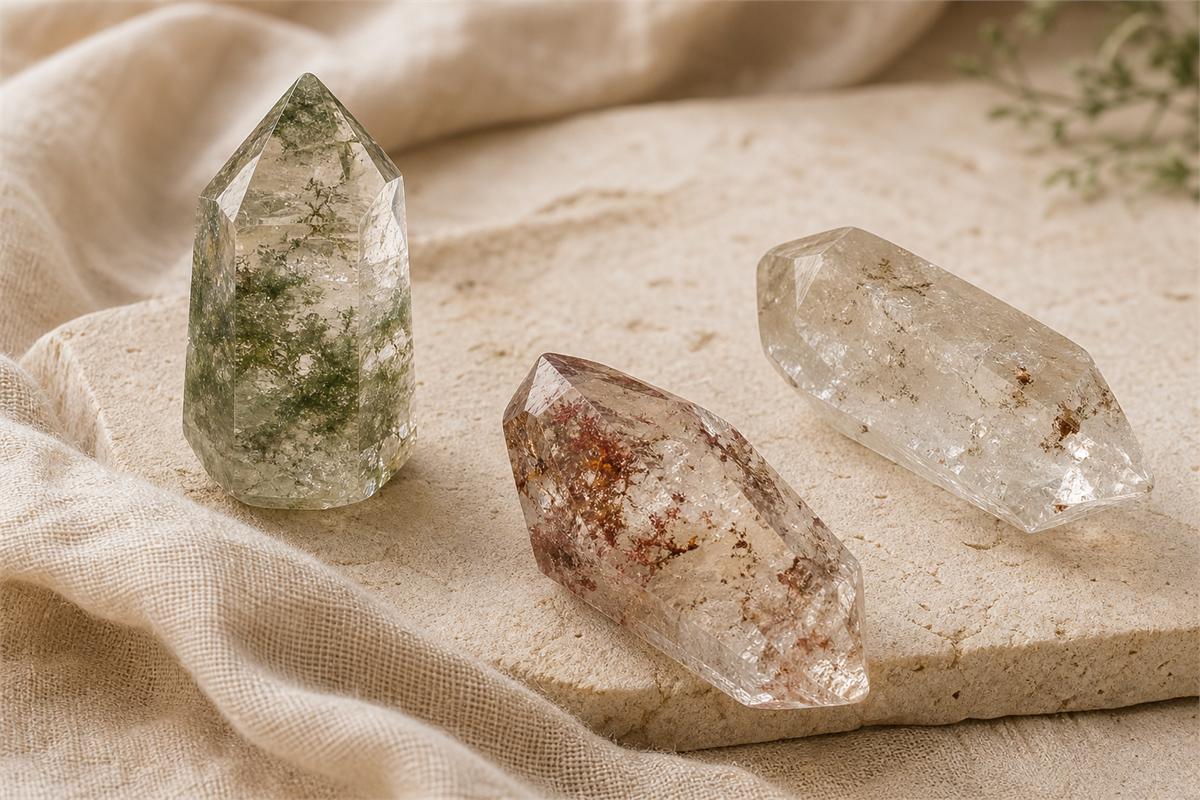
| Chlorite | Green, olive, or gray-green clouds and flakes | Moss, forest floor, ferns, valleys, or layered green slopes |
| Epidote | Green to yellow-green needles, grains, or clustered forms | Branches, grass, mineral gardens, or angular mountain detail |
| Hematite | Red, rust, brown, black, or sometimes golden-looking plates and dust | Autumn foliage, red earth, metallic sunlight, or warm ridgelines |
| Mica | Reflective flakes and fine plates | Glittering water, frost, drifting petals, or points of light |
| Dolomite or carbonate material | Pale, white, cream, or cloudy forms | Snow, cliffs, mist, clouds, or flower-like clusters |
| Actinolite | Green needle-like or fibrous inclusions | Grass, reeds, sprays, or fine forest structure |
| Fine earthy or volcanic material | Dusty veils, dark specks, or diffuse layers | Distant hills, storm clouds, islands, or atmospheric depth |
Internal fractures can also split light into rainbow flashes, while thin reflective planes may produce aurora-like color. These optical effects are different from the mineral inclusions themselves. Together, inclusions, growth zones, fractures, and the host crystal’s transparency create the sense of depth that makes Garden Quartz attractive.
How to Read and Collect Garden Quartz
A strong specimen is not simply the clearest stone or the one with the most material inside. Collectors often begin with composition: does the scene have a foreground, middle distance, and background? Do layers lead the eye through the crystal? A piece may evoke a mossy ravine, a clouded mountain, falling petals, snow, or an island without forming a literal picture. The most compelling examples balance suggestion and natural abstraction.

- Scene and layering: look for depth, separation, and a visual path rather than a flat patch of color.
- Transparency: enough clear quartz should remain to reveal the internal landscape, although misty areas can add atmosphere.
- Color and distribution: green chlorite often feels forest-like; red or golden hematite can feel warmer and more dramatic.
- Natural texture: growth marks, dissolution patterns, and partly natural surfaces can add mineral character when they suit the object.
- Condition: distinguish stable natural features from fresh chips, weak points, surface-reaching fractures, glue, coatings, or careless polishing.
- Personal response: choose a scene that rewards repeated viewing rather than relying only on a seller’s poetic label.
Natural inclusion combinations vary from crystal to crystal because growth conditions are local and change over time. That variation makes individual specimens meaningfully different without needing the sales claim that every piece is a once-in-history “one of one.” Compare several examples under neutral light, rotate each stone, and inspect both the most attractive view and the less flattering angles.
Origins and Responsible Claims about Rarity
Garden Quartz is associated in the trade with Brazil, Madagascar, India, Pakistan’s Balochistan region, and localities in China, including Meigu in Liangshan, Sichuan. Material from Meigu is especially discussed for epidote-bearing quartz and flat or flower-like crystal groups. Locality can shape a specimen’s color, habit, and inclusion style, but seller attribution is strongest when supported by reliable mine, dealer, or collection records.

Stories that a vein is completely exhausted, that a mine lies inside a protected area, or that production has reached an absolute limit should be treated as market narratives unless documentation supports the specific claim. A locality may be difficult to access, intermittently worked, restricted, or currently unproductive without being geologically “gone.” Buy for the specimen’s quality and documented history, not scarcity pressure alone.
Garden Quartz Meaning and Symbolism
Garden Quartz meaning begins with its appearance: a clear mineral holding earth-like layers without losing its own structure. This makes it a natural symbol of grounding, patient growth, memory, and beauty formed through accumulation. People entering a new life stage may use it as a quiet reminder that change does not erase the past; experience can become part of a deeper internal landscape.

In crystal culture and modern spiritual practice, Garden Quartz is sometimes called an attraction stone or karma stone. The common idea is that what a person cultivates through attention, action, and habit eventually shapes what returns. Green included varieties are also associated with steady prosperity, career growth, and building a secure foundation. These meanings function as personal symbolism and ritual language: they help a wearer frame intentions, reflection, or meditation.
The stone is also chosen for calm, compassion, creativity, and a renewed relationship with nature. Some practitioners connect green material with heart-centered reflection or place the crystal on a desk as an inspiration object. A thoughtful approach keeps these meanings within spiritual practice and personal interpretation while letting mineral facts remain mineral facts. Readers interested in related prosperity symbolism can compare the green phantom quartz guide and the broader guide to good-luck bracelet meanings.

| Symbolic theme | Why Garden Quartz evokes it | A modern way to use the meaning |
|---|---|---|
| Grounding | Earth-toned inclusions appear held inside clear quartz | A desk object or pendant during a move, career shift, or demanding season |
| Patient growth | The landscape records multiple stages of crystal formation | A reminder to value gradual work and accumulated skill |
| Renewal | Mist, green growth, and layered scenes suggest seasons and regrowth | A gift for a new beginning or a return to creative practice |
| Cause and reflection | The attraction or karma-stone reading emphasizes what one cultivates | A meditation object tied to habits, choices, and accountability |
| Prosperity and foundation | Green phantom-like layers are linked with steady career and wealth symbolism | A business-opening gift or personal symbol of sustainable progress |
| Inner landscape | A complex scene remains visible within a coherent crystal | A prompt for slow looking, journaling, or quiet contemplation |
Using, Choosing, and Caring for Garden Quartz Crystal
As a raw specimen, Garden Quartz works best where light can enter from the side or behind without exposing it to strong sun all day. A polished point, sphere, or freeform makes the internal scene easier to view from several angles. Bracelets bring the inclusions into everyday movement; pendants can showcase one carefully oriented scene; smaller stones can become rings or earrings when the setting protects vulnerable edges.

Choose jewelry by checking the drill holes, bead surfaces, metal security, and whether the most scenic face remains visible when worn. For carvings and display pieces, inspect the base, stability, polished windows, natural surfaces, and any filled fractures. A seller should describe treatments, repairs, composite areas, or coatings clearly. The Eastern Story material guide can help frame these questions before purchase.
For routine care, use a soft cloth. If needed, wash briefly with lukewarm water and mild soap, then rinse and dry thoroughly. Avoid strong acids, alkalis, bleach, household chemicals, sudden temperature changes, prolonged intense sunlight, and hard blows. Quartz is durable, but points, carvings, surface-reaching inclusions, and thin jewelry sections can chip. Store pieces separately in a soft pouch or lined compartment.

Moonlight, sound, incense, or resting the stone beside a clear quartz cluster are personal cleansing practices in crystal communities rather than required mineral-care procedures. Choose a ritual if it adds meaning, while using gentle physical cleaning for dust and skin oils. More practical routines are available in the Eastern Story care guide.
What Is Garden Quartz Tile?
In garden design, garden quartz tile is a manufactured paving or cladding product, not a natural Garden Quartz crystal. It may be sold as outdoor quartz tile, PC brick, or full-body quartz tile (通体石英砖). Mineral powders, ceramic raw materials, pigments, and binders are formed and fired or sintered at high temperatures to create a dense, stone-like unit. Formulations and standards vary by manufacturer, so the product data sheet matters more than the category name alone.

These tiles are used in courtyards, terraces, garden paths, villa façades, landscape walls, municipal plazas, and other exterior settings. Their appeal comes from consistent dimensions, stone-like textures, low water absorption, wear resistance, stain resistance, compressive performance, weather resistance, and reduced efflorescence risk when the product and installation system are properly matched.
Outdoor Quartz Tile Performance: What the Numbers Mean
Water absorption is central because absorbed water can contribute to staining, freeze-thaw stress, biological growth, and efflorescence-related problems. Many outdoor tile specifications use a maximum of 0.5%. Some product lines advertise below 0.1%, below 0.05%, or even below 0.01%. These figures should be read as product-specific claims under a stated test method, not as one universal number for every garden quartz tile.

| Property | Figures or claims in the market | How to use the information |
|---|---|---|
| Water absorption | ≤0.5%; some products claim <0.1%, <0.05%, or <0.01% | Match the report to the exact model, batch, test method, and climate requirement |
| Surface hardness | Some product literature cites Mohs 7 | Treat it as comparative product data; confirm the test and remember joints and edges have different vulnerabilities |
| Outdoor thickness | 18 mm or more | A practical starting point for pedestrian courtyards on a correctly built base |
| Vehicle areas | 20–25 mm | Use with a structural base and installation system designed for wheel loads |
| Indoor-oriented thickness | Around 12 mm | Better suited to lighter indoor conditions than exposed, load-bearing outdoor paving |
| Slip resistance | R10–R11 or higher | Choose for the wetness, slope, footwear, use, and local code of the specific area |

Freeze-thaw resistance, abrasion, stain resistance, compressive performance, weathering, and low efflorescence are useful comparison points, but they depend on both the tile and the assembly. A dense tile over a weak, poorly drained, or moving base can still fail. Compare the tile, adhesive or mortar, grout or joint system, waterproofing, drainage, edge restraint, and substrate as one exterior system.
Outdoor Surface Textures and Their Trade-Offs
Texture changes grip, touch, shadow, drainage behavior, and cleaning effort. A sample should be viewed dry and wet, in morning and evening light, and beside the building materials it will meet.
| Surface | Look and feel | Best use and maintenance trade-off |
|---|---|---|
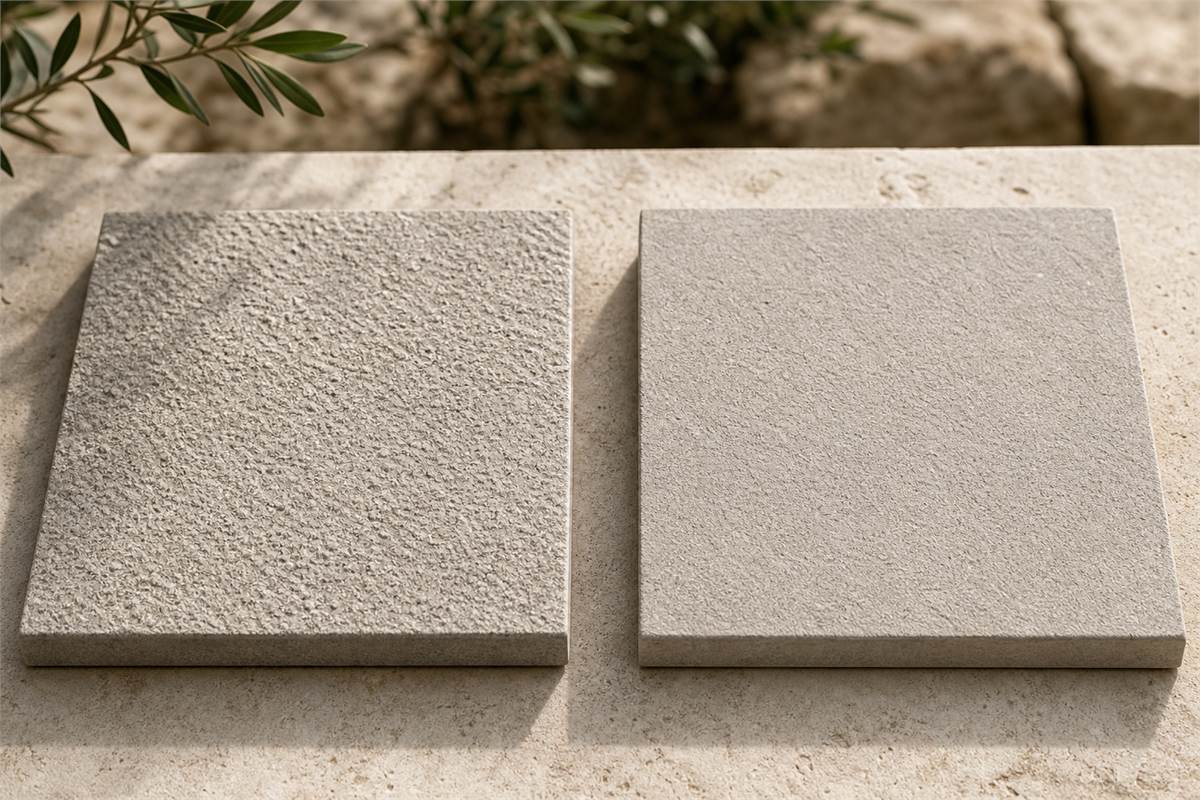
| Litchi texture (荔枝面) | Deep, granular, strongly textured surface | High-grip paths and exposed areas; comfortable traction but a rough feel and more dust retention |
| Flamed matte (火烧面) | Dry, stone-like matte texture created to evoke flamed stone | A durable, practical courtyard finish with good wear and temperature-change performance |
| Dry-grain texture (干粒面) | Fine particles and a detailed decorative surface | Refined visual effect; small gaps can hold dirt and may need more attentive cleaning |
| Axe-chiseled texture (斧凿面) | Linear cuts and stronger directional shadow | Feature walls, borders, or mixed paving where light should reveal relief |
| Horseshoe texture (马蹄面) | Rounded, irregular relief with changing highlights | Mixed wall or paving compositions that need a less uniform stone rhythm |

How to Buy and Install Outdoor Quartz Tile
Begin with the load and exposure. Use at least 18 mm for ordinary outdoor paving, then move to 20–25 mm for parking or vehicle traffic. Around 12 mm is better reserved for indoor work. For a small courtyard or terrace, 600 × 600 mm and 600 × 1200 mm modules are flexible. Larger yards and vehicle areas may use 600 × 1200 mm or 750 × 1500 mm units when the base, handling plan, and load design support them.

- Ask for the exact report. Confirm water absorption, flexural strength, slip value or classification, and the standard used for the model you will receive.
- Inspect a cut edge. A full-body tile should show consistent body color and composition through the section rather than relying only on a thin decorative face.
- Order samples first. Compare color, texture, thickness, edge quality, and wet grip. Pour water over the surface and test it cautiously with the footwear used in the space.
- Calculate complete cost. Garden quartz tile itself is $30–$95 per square meter, excluding installation. Thickness, body formulation, format, texture, freight, waste, base work, drainage, and labor shape the installed budget.
- Build a level structural base. Do not lay rigid tile directly on soil. Prepare and level the concrete or engineered base, provide the specified falls, and coordinate waterproofing and drainage.
- Leave movement space. Use 3–5 mm joints between tiles and follow the system designer’s requirements for perimeter and movement joints. Outdoor temperature changes make zero-joint installation a poor choice.
- Choose the joint system for exposure. Outdoor-rated joint materials or deliberately detailed open joints must suit drainage, freeze-thaw conditions, cleaning, and the base below.

Large-format tiles reduce the number of visible joints and can make a garden feel broader, but they demand a flatter base, careful lifting, reliable back coverage, and disciplined drainage. Smaller modules adapt more easily to curves, steps, planting pockets, and complex falls. The best size is the one that fits the courtyard’s geometry and structural conditions, not simply the largest available slab.

Garden Landscaping Quartz and Scenic Depth
“Garden quartz scenic depth” is not a single standardized landscape term. It is a useful way to describe how paving, aggregate, light, plants, drainage, and empty space work together to make a garden feel layered rather than flat. Material alone cannot create that depth; the eye needs foreground texture, a middle-distance route or planting mass, and a background edge, wall, tree, or pool of shadow.
Four Design Directions
- Modern minimal: lay light gray or warm off-white 600 × 1200 mm tiles in a calm direction, finish edges with dark gray gravel, and integrate a discreet linear drain.
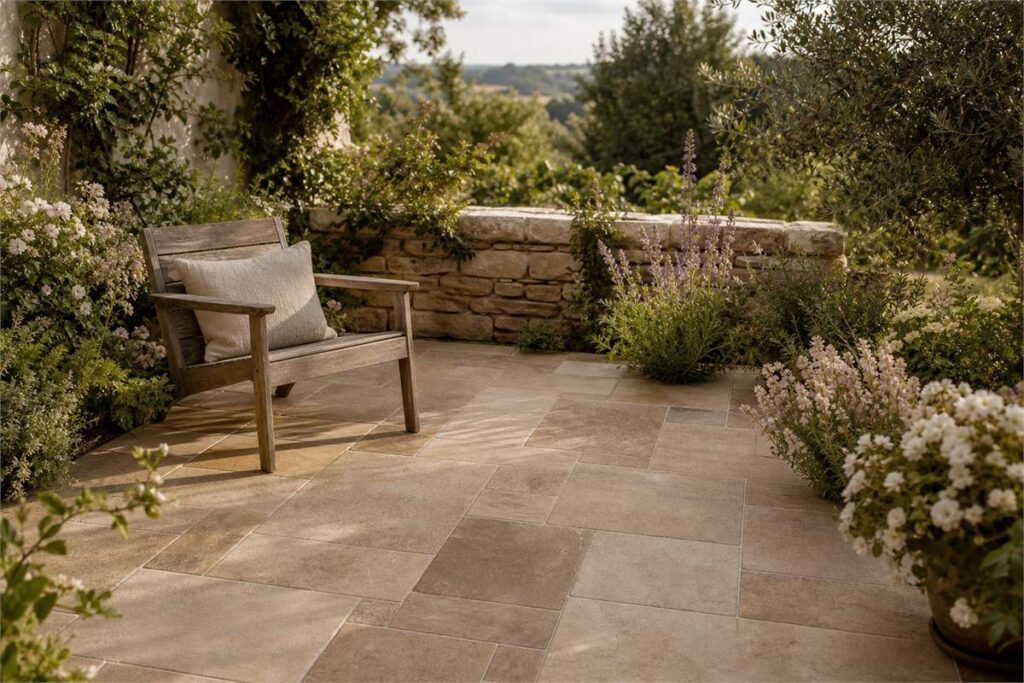
- Rustic garden: combine travertine-like quartz tiles in a Roman-pattern mix, allowing several formats to create an aged, relaxed field rather than a single repeated grid.
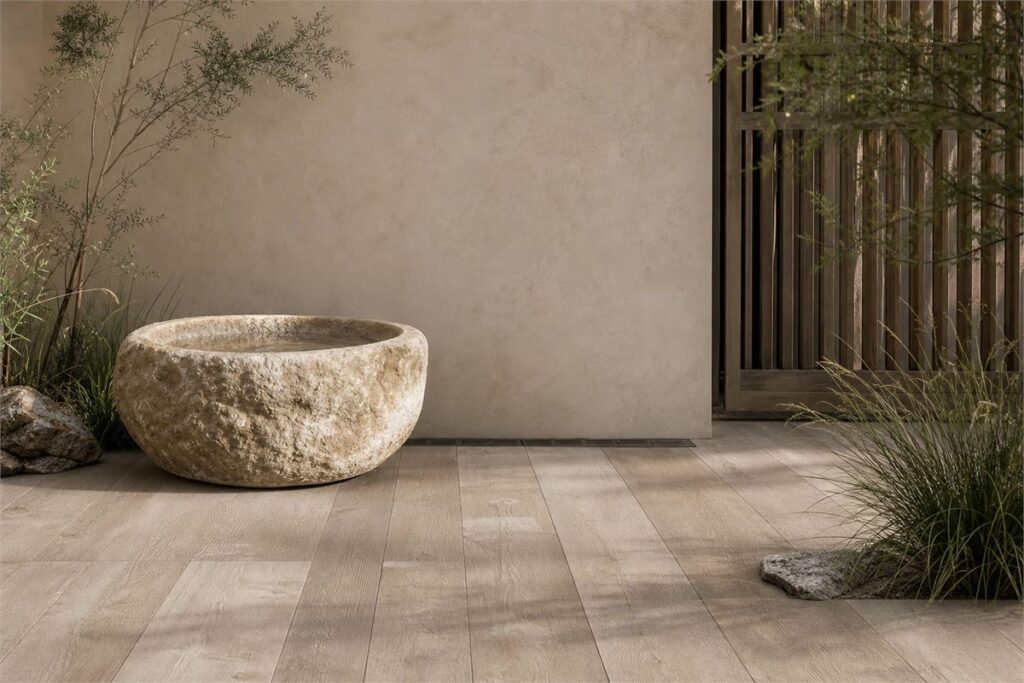
- Wood and wabi-sabi: pair wood-look quartz paving with a pale slate-textured wall for a restrained wabi-sabi aesthetic (侘寂), balancing weathered character with practical outdoor durability.
- Karesansui: use 3–5 mm pale quartz sand in a small karesansui dry-landscape garden (枯山水), rake quiet wave patterns, and place stones, moss, or low planting to hold the composition.
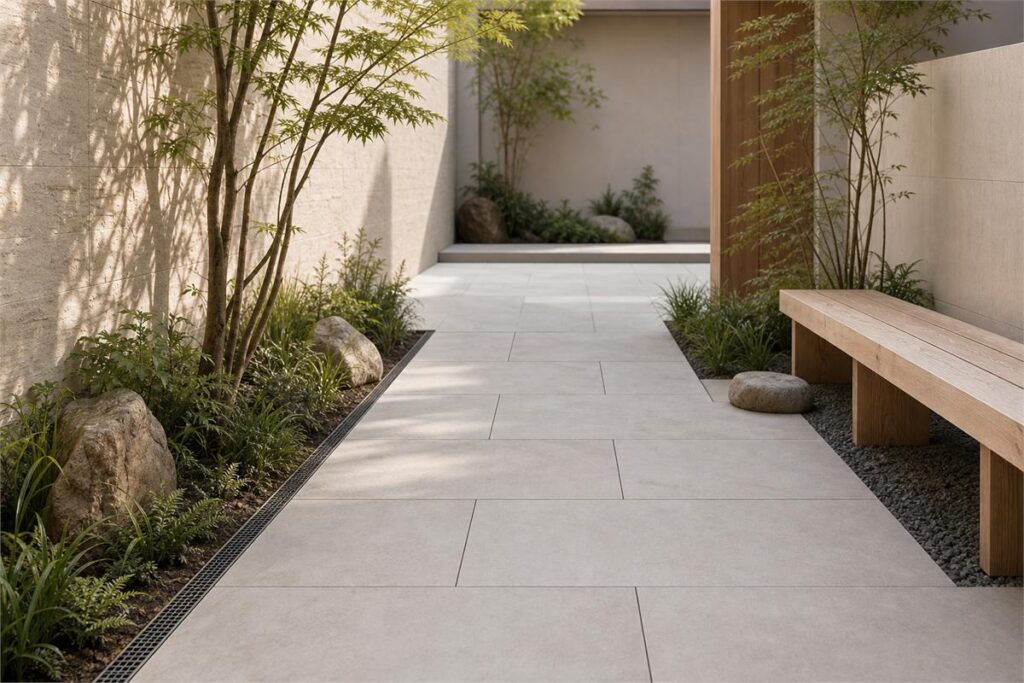
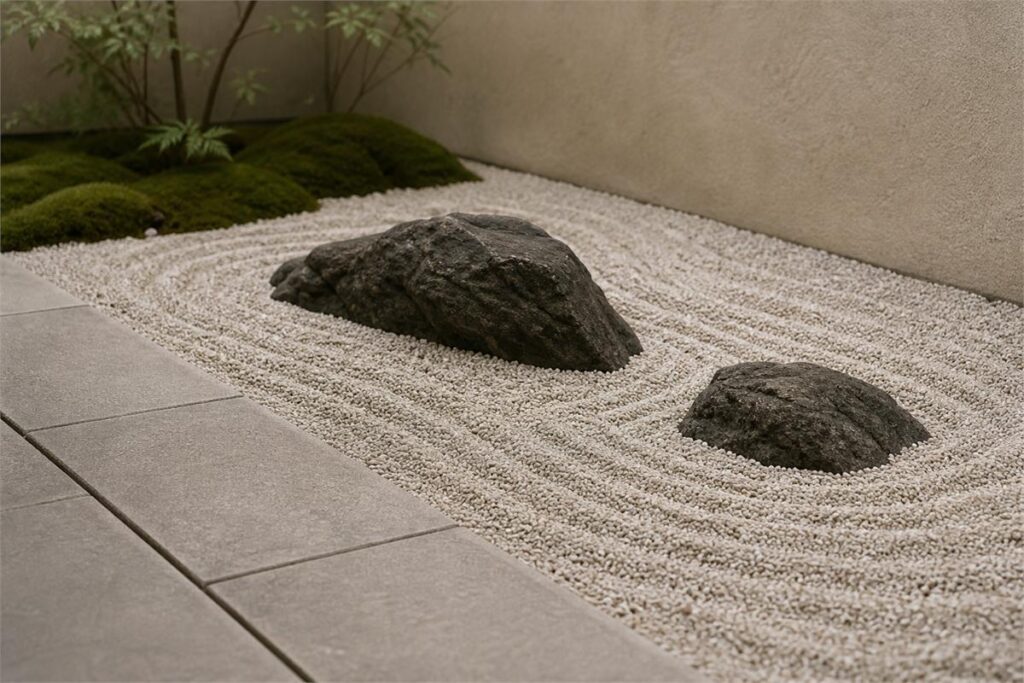
Dark gray quartz gravel is often easier to keep visually calm than bright white aggregate. It can edge paths, define planting beds, or surround water features while connecting paving to soil and plants. Use landscape fabric, a stable sub-base, and edge restraints appropriate to the site so loose material does not migrate into drains or walking surfaces.
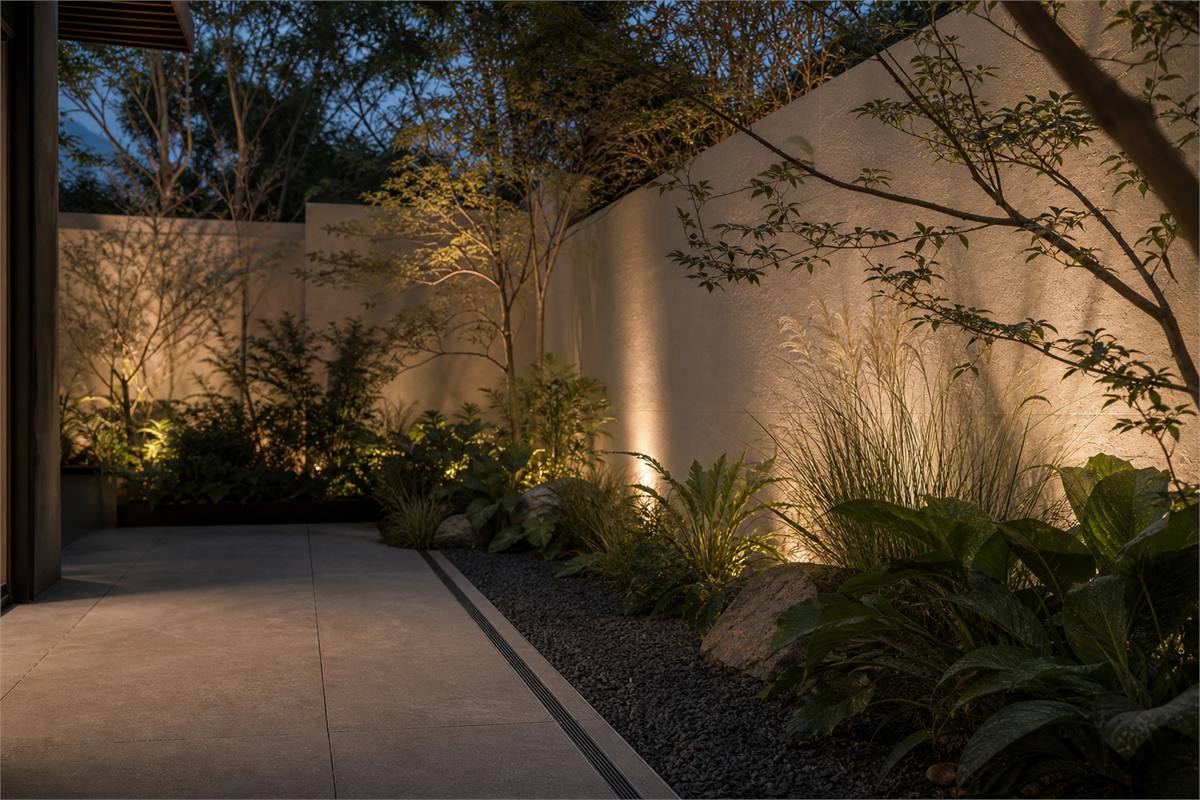
Warm linear lighting placed at the base or top of axe-chiseled and horseshoe-textured walls brings out relief after sunset. Creeping thyme in selected joints, hydrangea, ornamental grasses, ferns, and ivy soften hard surfaces. Concealed linear drainage preserves the visual field while removing water. Repeating the building’s window frames, wall color, timber, rattan furniture, or clay pots gives the garden continuity. Scenic depth comes from these relationships—and from leaving enough unfilled space for light and shadow to register.
Garden Quartz as a Gift or Housewarming Choice
A Garden Quartz crystal can be given as a raw specimen, display object, bracelet, pendant, or flower-inspired carving. Its durable mineral body and preserved internal scene make it a poetic symbol of enduring love and companionship. The garden image can express a wish for a life that continues to grow, while green and golden inclusions can carry modern good-fortune or prosperity symbolism.

It is especially suitable for someone who loves natural mineral aesthetics, meditation, slow living, or a new phase that calls for renewed grounding. That phase might be a move, a career change, recovery, the start of a creative practice, or a zodiac birth year Benmingnian (本命年). Choose the actual scene and form for the recipient rather than assuming Garden Quartz is a universally recognized gift category. For more gift-language examples, see the symbolic bracelet gift guide.
Outdoor quartz tile is an entirely different kind of gift. When a friend or family member is already renovating a courtyard, contributing specified tiles, sample costs, or part of the paving budget can be a practical housewarming gesture. It expresses care for durability, easier upkeep, safety, and long-term quality of life. Confirm color, quantity, specification, installer, delivery, and return terms with the recipient first; construction material is personal to the project.

Readers looking for wearable or keepable symbolic objects can explore the Eastern Story blessing collection. More mineral, cultural, and design guides are available in the Eastern Story library.
Frequently Asked Questions
Choose the Right Garden Quartz for Your Context
Start with the noun that follows the phrase. If the conversation is about inclusions, Lodolite, jewelry, symbolism, specimens, or gifts, choose Garden Quartz crystal. Compare the internal landscape, transparency, inclusion distribution, condition, documentation, and the way the piece makes you feel. If the conversation is about a courtyard, terrace, façade, thickness, absorption, slip rating, or price per square meter, choose outdoor quartz tile and evaluate the complete construction system.
For the crystal, let natural variation and personal meaning guide the final choice, then use gentle care. For the tile, let climate, load, drainage, verified product data, and installation quality lead. Both can bring a garden-like sense of depth into daily life, but one holds a landscape inside quartz while the other helps build the landscape around you. Continue with the clear quartz guide, green phantom quartz meaning, or the practical material guide.
Related Posts


One Comment