
In Eastern symbolism, the crane symbolizes longevity, purity and elegance, high rank and career ascent, loyal love, and immortal or Taoist transcendence. The red-crowned crane is often called the immortal crane Xianhe (仙鹤), the first-rank bird Yipin Niao (一品鸟), and the honored head of birds Bai Yu Zhi Zong (百羽之宗). A crane motif can bless an elder with long life, praise a person of upright character, wish for promotion, honor a faithful couple, or evoke the free world of immortals and cloud-borne sages.
Because the crane carries so many layers, the meaning depends on its setting. A crane with pine reads as a birthday blessing. A crane on an official robe reads as rank and civil virtue. Paired cranes read as devotion. A crane among clouds, mountains, or Taoist clothing reads as spiritual freedom. In jade carving and traditional Eastern jewelry, the crane becomes a compact symbol that can be worn, gifted, displayed, and explained in one elegant sentence.
What Does the Crane Mean in Eastern Culture?
The crane as he (鹤) has a rare position in Eastern culture because it joins natural beauty with moral, social, and spiritual meaning. Its tall body, long neck, long legs, white feathers, and bright red crown give it a refined appearance. Traditional writers and artists read that form as purity, distance from vulgarity, and an almost immortal bearing.

In folk blessing language, the crane is one of the clearest longevity birds. Old expressions such as crane age He Ling (鹤龄), crane count He Suan (鹤算), and crane lifespan of a thousand years He Shou Qian Sui (鹤寿千岁) make the bird a gentle wish for elders and respected teachers. In art, this wish often becomes Pine and Crane Extend the Years Song He Yan Nian (松鹤延年) or Turtle and Crane Share Longevity Gui He Qi Ling (龟鹤齐龄).
The crane also carries a public and career-facing meaning. During the Ming and Qing dynasties, the crane appeared on the mandarin square Buzi (补子) of first-rank civil officials, which is why the bird is called the first-rank bird Yipin Niao (一品鸟). In palatial design, bronze cranes before the Hall of Supreme Harmony Taihe Dian (太和殿) suggested enduring imperial order and ceremonial dignity.
The crane reaches beyond social rank into Taoist imagination. Traditional language calls it the chief of feathered creatures and the fine steed of immortals Yu Zu Zhi Zong Zhang, Xian Ren Zhi Qiji (羽族之宗长,仙人之骐骥). It appears with clouds, mountain retreats, feathered scholars Yushi (羽士), the crane robe Hechang (鹤氅), and the phrase riding a crane west Jia He Xi Qu (驾鹤西去), a refined image of departing toward the immortal realm.
Quick Symbol Map: Longevity, Purity, Rank, Love, and Immortality
| Symbolic layer | Chinese term | What the crane says | Common use |
|---|---|---|---|
| Longevity and blessing | Xianhe (仙鹤), He Ling (鹤龄), He Suan (鹤算) | Long life, health, elder respect, auspicious years | Birthday gifts, elder jewelry, home art, blessing objects |
| Purity and elegance | Xian Feng Dao Gu (仙风道骨), He Ming Yu Jiu Gao (鹤鸣于九皋) | Clean character, scholar taste, moral distance from noise | Scholar-style jewelry, paintings, refined New Eastern styling |
| High rank and career ascent | Yipin Niao (一品鸟), Yipin Dangchao (一品当朝) | First rank, official dignity, advancement, visible achievement | Business gifts, promotion gifts, office display, graduation gifts |
| Loyal love | Shuang He (双鹤), paired cranes | Faithful companionship, long partnership, elegant marital blessing | Wedding jewelry, anniversary gifts, couple pendants, embroidered gifts |
| Immortal transcendence | Xianhe (仙鹤), Yushi (羽士), Hechang (鹤氅), Jia He Xi Qu (驾鹤西去) | Taoist freedom, cloud travel, mountain retreat, immortal bearing | Spiritual art, cloud-crane pattern, robes, pendants, altar or study objects |
Longevity and Auspicious Blessings: Pine, Turtle, and Crane Motifs
The crane is one of the most beloved longevity symbols because its body already looks light, clean, and unburdened by age. Traditional imagination gave the crane an extraordinary lifespan and placed it beside other long-life emblems. The old saying thousand-year turtle and ten-thousand-year crane Qian Nian Gui Wan Nian He (千年龟万年鹤) expresses this shared longevity language in a memorable form.

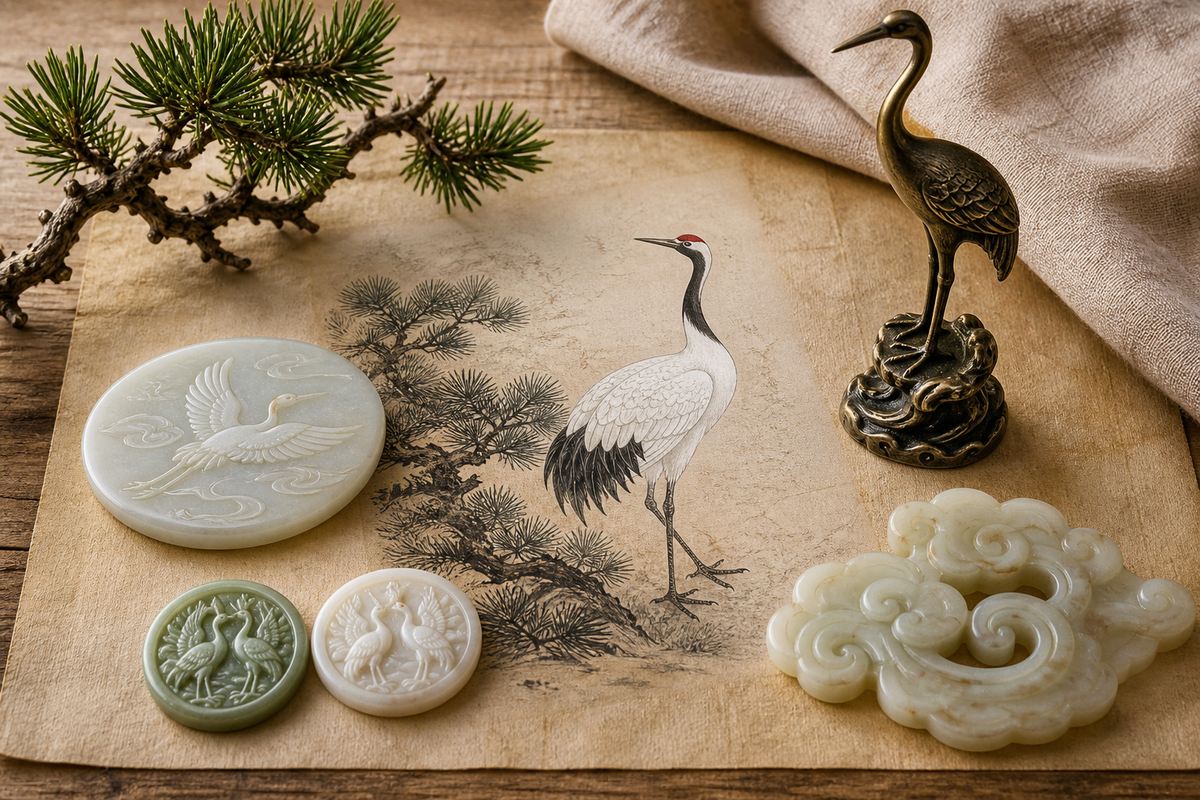
Pine and Crane Extend the Years Song He Yan Nian (松鹤延年) is the most familiar birthday image. The pine is evergreen, rooted, and resilient. The crane is white, tall, and skyward. Together they form a blessing for health, long life, and an elegant old age. In paintings, porcelain, textiles, jade plaques, and birthday gifts, this pairing speaks immediately to elder respect.
Turtle and Crane Share Longevity Gui He Qi Ling (龟鹤齐龄) joins two legendary long-life creatures. The turtle brings grounded endurance, while the crane brings upward grace. A design using both can feel more formal than a single crane pendant, making it well suited to elder gifts, home display, or ceremonial birthday objects.
Crane and Deer Share Spring He Lu Tong Chun (鹤鹿同春) adds vitality and prosperity to longevity. The deer Lu (鹿) echoes rank or emolument Lu (禄), while spring suggests renewal. This combination can bless a family with long life, prosperity, and flourishing energy. In modern jewelry, the design is often simplified into a crane, deer, pine, or cloud scene so the meaning stays readable.
Purity, Elegance, and the Gentleman Ideal
The crane is also a symbol of purity because it seems to stand apart. Its white feathers, upright posture, and long, controlled movements give it a sense of clean distance. Traditional taste describes this bearing as immortal wind and Taoist bones Xian Feng Dao Gu (仙风道骨): elegant, unhurried, and beyond coarse display.

The line from the Book of Songs, crane cries in the deep marsh, its voice is heard in heaven He Ming Yu Jiu Gao, Sheng Wen Yu Tian (鹤鸣于九皋,声闻于天), gives the crane a moral dimension. The bird can represent a worthy person whose virtue and reputation travel far even when he lives away from the center of power. This is why crane imagery feels natural in scholar paintings, ink designs, studio objects, and refined jewelry.
The idiom crane among chickens He Li Ji Qun (鹤立鸡群) uses the bird’s height and elegance to describe someone who stands out through talent, bearing, or moral quality. The Song recluse Lin Bu is remembered through the phrase plum wife and crane child Mei Qi He Zi (梅妻鹤子), a poetic image of a person choosing quiet refinement, landscape, and self-cultivation over noisy ambition.
Rank, Career Ascent, and the First-Rank Bird
The crane’s official meaning comes from court dress. In Ming and Qing official costume, a first-rank civil official used the crane on his mandarin square Buzi (补子). This system turned the bird into the first-rank bird Yipin Niao (一品鸟), a visual sign of high civil office, visible achievement, and cultivated authority.

In auspicious design, a crane standing on a tide-washed rock can form First Rank at Court Yipin Dangchao (一品当朝), because tide Chao (潮) echoes court Chao (朝). A crane rising among clouds can suggest first-rank promotion Yipin Gaosheng (一品高升). These images are useful in career gifts because they express ambition in a cultured and indirect way.
The bronze cranes before Taihe Dian (太和殿) in the Forbidden City also shaped public imagination. In that setting, the crane is ceremonial, stately, and enduring. For modern business gifts, office display, or a graduation piece, crane symbolism can carry dignity and upward movement without becoming loud.
Loyal Love and Paired Crane Motifs
In Eastern folk symbolism, cranes are understood as loyal pair birds. This makes paired cranes Shuang He (双鹤) a graceful love motif. A single crane often emphasizes longevity, elegance, or spiritual freedom; two cranes introduce companionship, mutual regard, and a wish for a long life together.

Paired cranes work especially well for wedding gifts, anniversaries, couple pendants, embroidery, and home objects. Their tone is quieter than a dragon and phoenix pairing: dragon and phoenix meaning often feels ceremonial and grand, while paired cranes feel calm, faithful, and refined.
Taoist Immortality and the Crane as a Sacred Mount
The immortal crane Xianhe (仙鹤) is central to Taoist visual culture. In stories and paintings, immortals ride cranes through clouds, arrive from mountains, or travel between the human and immortal realms. The crane therefore becomes a sacred mount, a messenger, and a sign of spiritual freedom.

Several terms preserve this world. Taoist practitioners and reclusive figures may be called feathered scholars Yushi (羽士). A loose robe associated with such imagery can be called a crane robe Hechang (鹤氅). The phrase riding a crane west Jia He Xi Qu (驾鹤西去) turns departure into an image of cloud-borne transcendence. The expression free clouds and wild cranes Xian Yun Ye He (闲云野鹤) describes a life unbound by worldly pressure.
The story of Wangzi Qiao riding a crane Wangzi Qiao Jia He (王子乔驾鹤) gives this imagery a classic narrative shape. In the legend, the prince cultivates the way and appears riding a white crane before ascending. Whether used in painting, robe pattern, jade carving, or jewelry, this crane is less about rank and more about elevation of spirit.
Classic Crane Motif Combinations
| Motif | Chinese phrase | Core meaning | Best context |
|---|---|---|---|
| Crane with pine | Song He Yan Nian (松鹤延年) | Long life, elder respect, enduring vitality | Birthday gifts, elder pendants, home art |
| Crane with turtle | Gui He Qi Ling (龟鹤齐龄) | Great longevity, grounded endurance plus skyward grace | Formal elder gifts, ceremonial blessing objects |
| Crane with deer | He Lu Tong Chun (鹤鹿同春) | Prosperity, renewal, long life, family flourishing | Home decor, jade plaques, seasonal gifts |
| Crane with clouds | Yun He Wen (云鹤纹) | Immortal atmosphere, auspicious travel, refined spiritual freedom | Robes, silk, pendants, scholar accessories |
| Crane at tide or court | Yipin Dangchao (一品当朝) | First-rank status, career ascent, court dignity | Promotion gifts, business gifts, office display |
| Crane among other birds | He Li Ji Qun (鹤立鸡群) | Outstanding talent, visible excellence, clean distinction | Student gifts, professional milestones, personal talismans |

The crane rarely needs many extra symbols. A clean composition often works better than a crowded one. Pine and crane can own longevity by themselves. Clouds and crane can own the immortal mood. A crane facing the sun or standing above waves can own career ascent. In jewelry, one main companion motif is usually enough.
Crane in Visual Design: Shape, Color, Composition, and Modern Eastern Aesthetics
The crane is visually powerful because of its three long features: beak, neck, and legs. In design, these three lengths create a flowing silhouette that can be refined into ink lines, embroidery, metalwork, jade carving, enamel, or modern logo-like geometry. The wings add movement, while the red crown creates a natural focal point.

Color controls mood. The red crown can be read through cinnabar red Dan Ding Zhu Sha (丹顶朱砂), a small note of life and auspicious energy. White feathers with sky blue Tian Qing (天青) or open negative space create a Song-style quietness. Ink black and white can emphasize brush rhythm and literati taste. Blue-green landscape colors Qing Lu Shan Shui (青绿山水) can make the crane feel dreamlike, mountain-bound, and immortal.
Composition also carries meaning. Symmetry and round frames suit formal patterns, mandarin squares, fans, and medallions. Large empty space suits scholar painting because the blank area becomes air, sky, and distance. Geometric minimalism works in modern jewelry when it keeps the crane’s neck, wings, and upward line legible. The design principle is simple: use line to show form, use form to show spirit, and use spirit to carry the blessing.
Crane in Jade Carving and Jewelry
A jade crane Yu Diao Xian He (玉雕仙鹤) brings together two refined materials of meaning: the immortal crane and warm jade. The result can express longevity and peace, career ascent and reputation, or an elegant self-cultivation mood. In traditional Eastern jewelry, this makes crane pendants, plaques, brooches, and small charms useful for both cultural storytelling and daily wear.

Qiao se carving Qiao Se Qiao Diao (俏色巧雕) is especially effective for cranes. A carver can use natural skin color, red skin, yellow skin, or a warm patch of jade to suggest the red crown, wing edge, rock, or sunrise while keeping the white body clean. Good crane carving depends on line: the neck must be alive, the wings must breathe, and the legs must feel stable rather than brittle.
| Material | Design feeling | Crane use |
|---|---|---|
| Hetian jade seed material He Tian Yu Zi Liao (和田玉籽料) | Warm, restrained, classical, often with useful skin color | Fine pendants, plaques, elder gifts, scholar-style pieces |
| Jadeite Feicui (翡翠) | Clearer, brighter, more jewel-like | Modern pendants, brooches, small luxury gifts |
| Xiuyan jade Xiu Yu (岫玉) | Softer color range, accessible, gentle | Decorative carvings, larger ornaments, casual gifts |
| Gold, silver, enamel, or pearl | More fashion-facing and wearable | Brooches, earrings, crane feather lines, New Eastern styling |
When choosing a crane carving, look at three points: jade quality, carving quality, and poetic scene. Jade should feel fine, moist, and visually clean for its grade. Carving should show lively eyes, feather rhythm, balanced proportions, and a graceful neck. The scene should have intention: pine, cloud, water, deer, turtle, or sunrise should strengthen the main message rather than fill empty space.
Care is practical. Protect thin legs, beaks, openwork bridges, wing tips, and cloud edges from impact. Keep jade away from kitchen oil, perfume, detergent, harsh chemicals, and heavy sweat buildup. After summer wear, rinse gently with clean water and dry with a soft cloth. For long storage, keep jade from becoming overly dry; a sealed pouch or a trace of baby oil on suitable pieces can help preserve a moist feel. Store jade away from diamonds and other harder stones.
Modern Crane-Inspired Jewelry Directions
Modern crane jewelry can stay traditional or become very minimal. A classic direction uses crane with pine, lingzhi, cloud, or pearl for elder gifts and blessing jewelry. A New Eastern direction uses a single crane line, a long neck curve, a red enamel crown, or a wing-shaped brooch with clean negative space. A scholar-style direction uses ink-like black and white, matte metal, pale jade, or restrained silk cord.

Some contemporary brands and designers have explored crane, feather, or folded-bird themes through Chinoiserie, relief work, filigree, silver, K gold, and jade carving. The most useful lesson for Eastern Story is the design direction, rather than any single brand claim: the crane works best when craft supports the bird’s lightness. Heavy surfaces, crowded gemstones, or awkward proportions weaken the symbol.
Crane Gifts and Wearing Guide
| Recipient or occasion | Best crane form | Gift language |
|---|---|---|
| Elder birthday | Pine and crane jade pendant, crane-and-turtle plaque, crane home ornament | Long life, peaceful years, health, and elder respect |
| Career promotion or graduation | First-rank bird pendant, crane rising through clouds, crane at tide | High rank, visible achievement, steady ascent |
| Wedding or anniversary | Paired cranes, two cranes with cloud or lingzhi, double-crane pendant | Loyal love, long companionship, graceful partnership |
| New Eastern styling | Minimal crane brooch, crane feather earrings, jade crane charm, crane silk scarf | Clean taste, cultural elegance, quiet distinction |
| Scholar, artist, or self-cultivation gift | Ink-style crane, crane with plum, cloud-crane pattern, study display | Purity, retreat, moral bearing, and free spirit |

For wearing, keep scale and movement in mind. A long crane pendant should hang where the neck and legs can be seen. A brooch can use the wing span more dramatically. Earrings should simplify the crane into feather, wing, or neck lines so they remain comfortable. For business gifts, a crane motif can be more subtle than an obvious money symbol while still carrying career ascent through Yipin Niao (一品鸟) and Yipin Gaosheng (一品高升).
How to Read a Crane Motif in a Real Piece
- Identify the bird first: long neck, long legs, long beak, white body, red crown, and a poised or flying posture point toward crane symbolism.
- Read the companion motif: pine, turtle, deer, cloud, sunrise, water, court rock, lingzhi, or peach changes the sentence the design is speaking.
- Check the direction: a rising crane emphasizes ascent; a standing crane emphasizes dignity; paired cranes emphasize loyalty; a crane in clouds emphasizes immortality.
- Match the material: jade and ink feel restrained, gold and enamel feel celebratory, pearl and silver feel lighter and more contemporary.
- Choose one message: longevity, rank, love, elegance, or immortal freedom should lead the design.

Frequently Asked Questions
Conclusion
Crane symbolism is powerful because one bird can speak to several deeply human wishes: a long life, a clean character, a visible rise in the world, loyal companionship, and freedom beyond ordinary noise. The immortal crane Xianhe (仙鹤) is gentle, but it is never weak. It stands tall, flies high, and carries a refined blessing wherever it appears.
For more auspicious objects and gift meanings, continue through the Eastern Story Blessing collection, jade carving pattern meanings, jade meaning in Eastern culture, auspicious cloud meaning, lingzhi meaning, and dragon and phoenix meaning.
Related Posts


