Short answer: Hetian jade (和田玉) suits most people who want a calm, durable, culturally meaningful piece of jewelry or carving. It is especially fitting for readers who like understated style, Chinese jade (玉) culture, smooth tactile materials, symbolic gifts, and pieces that can be worn for many years with careful use.
This guide answers the wearing question first, then uses the new source material to explain color meanings, age and career choices, zodiac and Five Element folk readings, gender-neutral styling, common carving symbols, craftsmanship, value, simple identification, safety boundaries, and care. It does not turn the page into a full general pillar on what Hetian jade is; the definition, history, craft, safety, and identification notes are included only to help readers choose and wear Hetian jade wisely.
Editorial boundary: cultural meanings such as protection, abundance, peach blossom luck (桃花运), study progress, grounding, and health wishes are presented as Chinese folk symbolism, family blessing language, or personal intention. They are not medical treatment, wealth guarantees, destiny changes, investment advice, or proof that a product will cause a result.
Who Is Hetian Jade Best For?
Hetian jade is best for people who value quiet presence over sparkle. In Chinese jade culture, jade is associated with refinement, restraint, endurance, virtue, and a kind of warmth that is felt through touch rather than flash. That makes it useful as everyday jewelry, a gift object, a cultural keepsake, or a personal reminder.

| Reader or wearer | Good fit | How to choose without overclaiming |
|---|---|---|
| Students and young wearers | Light pendants, small safety buckles, qingbai jade, qing-shui tones, and simple beads can feel fresh without being distracting. | Choose light weight, smooth edges, secure cord, and supervised use for younger children. |
| New professionals | Biyu (碧玉), sugar-white jade, pale green, or small pendants can work with commuting and office clothing. | Treat career meanings as symbolic encouragement, not career prediction. |
| Mature wearers | Qinghua (青花), dark green, black jade, taqing, plain plaques, and substantial beads can feel calm and dignified. | Prioritize comfort, polish, proportion, and a tone that matches the wearer. |
| Older wearers | Mutton-fat white jade (羊脂玉), white jade, black jade, round bangles, peace buckles, and plain pendants can feel settled and elegant. | Avoid overly heavy pieces if they are uncomfortable or hard to remove. |
| Business or gift occasions | Yellow jade, warm sugar jade, ruyi (如意), pixiu (貔貅), lu lu tong, dragon (龙), and other auspicious forms are common blessing choices. | Use abundance language as cultural blessing, not a promise of profit. |
| People under stress | Smooth jade can be used as a tactile object and a reminder to slow down. | Do not describe jade as anxiety treatment or a substitute for mental health care. |
| Traditional culture lovers | Hetian jade carries deep associations with Chinese jade culture, Kunlun, court craft, and the idea of wearing virtue. | Explain the story carefully and distinguish culture from guaranteed effect. |
| Low-key luxury wearers | Fine texture, restrained color, and soft luster make Hetian jade less showy than many bright gemstones. | Choose better polish and material honesty over exaggerated labels. |
For a reader who asks, 'Who should wear Hetian jade?', the practical answer is: wear it if the piece is comfortable, secure, honestly described, within budget, and meaningful to you. Use color, zodiac, Five Elements (五行), and symbols as a language of preference and blessing, not as a rule that must control the purchase.
What Hetian Jade Is, in Simple Terms
Hetian jade is a Chinese trade and cultural name closely associated with nephrite jade. Modern gemological descriptions of jade distinguish nephrite from jadeite; nephrite is related to the tremolite-actinolite mineral series and is valued for a soft to oily luster, fine interlocking structure, toughness, and a muted color range that may include white, green, yellow, brown, gray, and black.

| Question | Careful answer for this wearing guide |
|---|---|
| Is Hetian jade only from Xinjiang Hotan? | Historically and culturally, Hotan/Hetian in Xinjiang is the emblematic source. In modern Chinese naming and trade, comparable nephrite material from several origins may be sold or certified under Hetian jade-related naming, so origin claims still need careful documentation. |
| Is 98 percent tremolite a safe sentence? | For this page, the safer wording is 'tremolite-actinolite dominated nephrite' or 'mainly tremolite-actinolite.' The exact threshold should be left to the applicable lab standard and certificate rather than stated as a universal consumer rule. |
| How hard is it? | Nephrite is commonly listed around Mohs 6 to 6.5. It has excellent toughness, but it can still be scratched, cracked by impact, or damaged by harsh treatment. |
| Is it transparent? | Hetian jade is usually valued for fine texture, oiliness, and soft luster, not high transparency. Too glassy a look can be a warning sign depending on the material. |
| Is the 2024 grading standard real? | Yes. The official Chinese national standards platform lists GB/T 44914-2024, Hetianyu grading, published on 2024-11-28 and implemented on 2025-06-01. This guide mentions it as a current grading reference, not as a simplified price promise. |
The historical claims also need careful layering. Sources support deep Chinese jade culture, Hetian/Hotan's long importance, and Xinjiang's role since the Neolithic period, but this article avoids presenting a single exact '7,000 or 8,000 year' number as if it were a universally settled laboratory fact. A better reader-facing phrase is: Hetian jade is part of a very long Chinese jade tradition, with Xinjiang Hetian jade important from early history and especially prominent in court culture.
Color Meanings, Five Elements, and Who They Suit
Color is one of the easiest ways to choose Hetian jade. Some choices are material-based, such as texture and even color. Others are cultural, especially when colors are connected with the Five Elements, seasonal feeling, personality, or gift intention.

| Color or trade color | Cultural association | Often suits |
|---|---|---|
| Mutton-fat white jade | Purity, refinement, virtue, dignity, and the classic idea of gentlemanly jade. | Collectors, elders, formal gifts, and people who like quiet elegance. |
| White jade | Clean energy, restraint, and a polished but gentle presence; in Five Element color language, white often points to Metal. | Readers wanting a timeless, low-risk first piece. |
| Qingbai jade | Between white and green, modest and easy to wear. | Students, daily pendants, and understated office style. |
| Qing-shui green | Clear, watery, soft green; often read as fresh, calm, and modern. | Young wearers, soft-color styling, and daily pieces. |
| Biyu | Green vitality, growth, and career blessing language; green often points to Wood. | Workplace wearers, business gifts, and people who like deeper green. |
| Spinach green | Deep, rich green with a substantial, mature feeling. | Statement beads, rings, and dignified gifts. |
| Apple green | Lively, bright, fresh green. | Modern styling and people who want a more visible color. |
| Duck-egg qing | Soft gray-green, restrained and literary. | Minimalists and people who prefer quiet tone over brightness. |
| Cat's-eye biyu | Movement, attention, and a lively optical effect. | Wearers who want a distinctive but still jade-centered piece. |
| Yellow jade or huangkou | Stability, earthiness, warmth, and abundance blessing; yellow often points to Earth. | Business gifts and readers who like warm, rare-looking color. |
| Chicken-oil yellow | Bright warm yellow, confidence, and festive warmth in popular description. | Bold warm-toned jewelry, with quality checked carefully. |
| Sugar jade | Brown-red warmth, sweetness, family feeling; sometimes read as Earth, sometimes Fire because of red-brown warmth. | Personal gifts, gentle daily pieces, and people who like warmer jade. |
| Lotus-pink or oufen | Softness, friendliness, peach-blossom style blessing, and modern tenderness. | Young wearers, romantic gifts, and gentle styling. |
| Black jade or moyu | Depth, stillness, protection symbolism, and Water in color-based Five Element language. | Mature wearers, pressure-heavy work, and darker outfits. |
| Qinghua | Ink-wash contrast, focus, study, and artistic feeling. | Students, writers, and people who like black-white composition. |
| Taqing | Very dark green-black, low-key and serious. | Men's plaques, substantial beads, and restrained style. |
| Smoky purple or violet-gray | Cool, small-niche, reflective, and modern. | Readers who like unusual color without loud brightness. |
| Cuiqing (翠青) | White ground with green accents; lively and rare-looking when natural. | Collectors of distinctive color and gift pieces with careful authentication. |
| Shazao qing and fenqing/fenlv | Low-saturation green and powdery green tones, often praised for softness. | Quiet daily wear and refined color collectors. |
A good color choice should still pass material checks. A beautiful color does not excuse poor structure, cracks in risky places, suspicious dyeing, exaggerated origin claims, or a price that does not match the documentation.
Zodiac and Five Element Suggestions
In traditional Five Element explanations, jade is often broadly associated with Earth because it comes from stone and mountain. Color-based readings then add another layer: white with Metal, green with Wood, black or dark tones with Water, red-brown sugar tones with Fire, and yellow with Earth. These ideas are useful as cultural language, not as fixed destiny science.

| Traditional reference | How to use it safely | Example jade choice |
|---|---|---|
| Need Earth or stability | Choose for grounding symbolism and a settled look, not guaranteed life correction. | Yellow jade, huangkou, sugar jade, simple peace buckle (平安扣). |
| Need Metal or clarity | Use as a reminder of refinement, discipline, and clean decision-making. | White jade, mutton-fat white jade, plain plaque. |
| Need Wood or growth | Frame as creativity, vitality, and social renewal. | Biyu, apple green, qing-shui green. |
| Need Water or calm | Frame as stillness, depth, listening, and adaptability. | Black jade, qinghua, taqing. |
| Need Fire or warmth | Frame as confidence, warmth, and expressive energy. | Sugar jade, red-brown tones, warm carved pendants. |
| Dragon, Ox, Goat | Some folk readings connect these Earth-branch zodiac signs comfortably with jade's Earth symbolism. | Earthy yellow, white, or simple jade forms. |
| Rabbit and Snake | Some folk explanations say jade may be chosen to soften conflict or support balance. | Gentle white, qingbai, or green daily pieces. |
If you use zodiac matching, keep it light. A piece does not become unsuitable because of one online zodiac table. For gifts, the better question is whether the color, form, size, budget, and story fit the person.
Who Should Choose Carefully?
Most people can wear Hetian jade, but some should choose the form, weight, setting, and wearing moment carefully. This is about comfort and safety, not a claim that jade diagnoses or treats body constitution.

| Situation | Careful rewrite of the source material | Practical advice |
|---|---|---|
| People who feel cold easily | Instead of saying jade has a medical nature, describe the tactile fact: stone can feel cool at first and then warm toward body temperature. | Try short wear first; avoid heavy cold-feeling bangles if they make you uncomfortable. |
| Digestive weakness, yang deficiency, phlegm-damp, or other TCM body terms | These are traditional health categories and should not be used as diagnosis here. | If jewelry affects comfort, circulation, skin, or daily care, ask a clinician or TCM practitioner rather than relying on jade advice. |
| Pregnancy | The issue is not jade power; it is practical comfort, swelling, weight, and ease of removal. | Avoid tight bangles and heavy pieces. Choose adjustable cord or remove when swelling is possible. |
| Skin disease or sensitive skin | Natural polished nephrite is usually smooth, but metal settings, cord dye, coatings, cleanser residue, or rough edges can irritate skin. | Clean gently, test briefly, avoid unknown coatings, and stop wearing if redness, itching, rash, or discomfort appears. |
| Physical labor | Impact can damage the piece and may injure the wearer. | Remove bangles, rings, and pendants before construction, lifting, workshop tasks, and hard contact. |
| Sports and exercise | Jade is tough but not impact-proof; bangles and beads can hit equipment or skin. | Remove before intense sport, gym work, climbing, ball games, and swimming. |
| Kitchen work | Oil, heat, detergent, and knocks can dull the surface or damage cords and settings. | Remove while cooking, cleaning, or using strong detergents. |
| Budget-limited beginners | The market can be confusing and low-price labels can be misleading. | Start with modest, honestly described pieces; do not chase 'mutton-fat jade' at implausibly low prices. |
| People buying for profit | Not all Hetian jade appreciates, and resale value depends on quality, origin evidence, craft, market timing, and buyer trust. | Treat jewelry as a cultural object first, not a guaranteed investment. |
| People who dislike traditional style | Hetian jade is often quiet, classical, and restrained. | Choose minimalist beads or plain pendants, or choose another material if the style does not feel like you. |
Safety line: do not grind jade into powder, drink jade-soaked water for health, or delay medical care because a stone is described as healing. Jade may carry meaning; it is not a treatment plan.
Choosing Hetian Jade by Age
Age-based recommendations are best used as style and comfort suggestions. A person's taste matters more than age, but the age framework helps buyers think about weight, color, symbolism, and daily use.

| Age group | Good choices | Why it fits |
|---|---|---|
| 6-20 | Qing-shui jade, qingbai jade, small pendants, small peace buckles, simple beads. | Fresh, light, and not too formal; younger children need safety supervision and secure cords. |
| 20-30 | Biyu, sugar-white jade, lotus-pink, smoky purple, small bangles, simple pendants. | Elegant enough for commuting and dates while still modern. |
| 30-45 | Qinghua, dark green, black jade, taqing, plain plaques, stronger bead bracelets. | More settled, substantial, and calm without being loud. |
| 45+ | Mutton-fat white jade, white jade, black jade, round bangles, ruyi, simple plaques. | Warm, dignified, and culturally classic, especially for milestone gifts. |
| Older wearers with hand swelling or joint stiffness | Open bracelets, adjustable cords, pendants, or easy-to-remove bead bracelets. | Comfort and removal matter more than the idea of a perfect bangle. |
For all ages, avoid pieces with sharp edges, overly heavy settings, fragile cords, or tight bangles that are difficult to remove.
Can Men and Women Both Wear Hetian Jade?
Yes. Hetian jade has no gender restriction. The old cultural image of the gentleman wearing jade is important, but it does not make jade masculine only. In modern jewelry, color, size, cord, shape, and styling decide the feeling more than gender.

| Style direction | Common choices | Notes |
|---|---|---|
| Masculine or substantial | Black jade plaque, taqing beads, larger peace buckle, landscape plaque, dragon, bamboo, plain tablet. | Choose clean lines, balanced thickness, and strong polish rather than excessive carving. |
| Feminine or soft | Qing-shui bangle, lotus-pink beads, small gourd (葫芦), ruyi, lotus, leaf, or pale pendant. | Soft color and comfortable scale usually matter more than ornate carving. |
| Gender-neutral | Peace buckle, no-carving plaque, bead bracelet, small pendant, lu lu tong, simple ring. | Black cord, brown cord, gold setting, or plain silver can shift the style. |
| Modern rule | Choose by personal meaning and fit. | The older saying 'men wear Guanyin (观音), women wear Buddha' can be mentioned as folk practice, but it is not a hard rule. |
The best gender-neutral advice is to match proportion to the body and wardrobe. A small pale pendant can look refined on any wearer; a large dark bead bracelet can look powerful, but only if the weight is comfortable.
Forms, Symbols, and What They Mean
Shape changes the meaning of jade. A plain bangle feels continuous and protective; a peace buckle feels round and complete; a no-carving plaque feels minimal and calm; a carved animal or plant carries a more specific blessing story.

| Form or symbol | Cultural meaning | Who it often suits |
|---|---|---|
| Peace buckle | Roundness, safety, completeness, and smooth daily protection symbolism. | Almost anyone; especially first-time buyers and gifts. |
| No-carving plaque | The wordplay of 'no decoration' and 'nothing happens' gives it a wish for peace and simplicity. | Minimalists, professionals, and mature wearers. |
| Gourd | Fu (福)-lu wordplay, blessing, continuity, family prosperity, and health wishes in folk culture. | Family gifts, elders, and traditional blessing themes. |
| Ruyi | As-you-wish blessing, auspiciousness, long life, and satisfied intention. | Elders, leaders, and formal gifts. |
| Pixiu | Wealth-gathering and guarding symbolism in folk belief. | Business gifts, with no profit guarantee. |
| Lu lu tong | Smooth passage, roads opening, and movement through difficulty. | Career transitions, entrepreneurs, travelers. |
| Lotus | Purity, calm, and rising cleanly from mud. | Readers who like refined Buddhist-inspired or quiet symbolism. |
| Bamboo | Steady growth, resilience, and step-by-step progress. | Students and career-growth gifts. |
| Leaf | Achievement, elegance, and the phrase 'golden branch jade leaf' in gift language. | Career or coming-of-age gifts. |
| Ruyi, bean, melon | Blessing, continuity, good harvest, and family wishes. | Warm family gifts and everyday pendants. |
Animal carvings should be treated as symbolic vocabulary. Nine-tailed fox can suggest intelligence, charm, and romance; elephant suggests peace and auspiciousness; rhinoceros suggests firmness and joy through wordplay; bear suggests strength and protection; eagle suggests ambition and far sight; dragon suggests authority and rising success; phoenix (凤凰) suggests renewal and nobility; dragon turtle suggests longevity and steadiness; golden toad suggests abundance; horse suggests immediate success; ox suggests diligence; monkey suggests cleverness and promotion wordplay; rabbit suggests gentleness and a bright path; fish suggests surplus and leaping upward.
For figures and traditional motifs, use respectful language. Guanyin can be described as associated with compassion and mercy; Maitreya or Buddha figures can suggest joy and tolerance; arhats and Zhong Kui belong to protective folk and religious imagery, so avoid turning them into casual mascots. Dragon, phoenix, taotie, chi-dragon, fish, cloud, lotus, and geometric forms all carry long decorative and symbolic histories, but the article should explain them as cultural motifs, not magical mechanisms.
Giving Hetian Jade as a Gift
Hetian jade is often a strong gift because it can carry material value, long use, cultural meaning, and a quiet wish. The best gift is not simply the most expensive piece; it is the piece whose form, color, story, and comfort match the recipient.

| Recipient | Good themes | What to check |
|---|---|---|
| Leader or elder | Ruyi, dragon plaque, turtle, crane, pine, gourd, white jade, black jade, dignified bead bracelet. | Quality, polish, tasteful scale, and respectful meaning. |
| Partner or close friend | Dragon-phoenix (龙凤呈祥), double fish, swan-like paired forms, lotus, gourd, lotus-pink, sugar jade. | Personal style, comfort, and a story that feels sincere rather than exaggerated. |
| Peer or friend | Pixiu, lu lu tong, monkey, horse, bamboo, leaf, qing-shui or biyu daily pieces. | Wearability and budget honesty. |
| Student | Bamboo, cicada, fish, qinghua, small peace buckle, small pendant. | Light weight, secure cord, and study blessing as encouragement only. |
| Business person | Yellow jade, ruyi, lu lu tong, pixiu, golden toad, substantial but not flashy pieces. | Do not promise wealth; phrase it as an auspicious wish. |
If the feeling is important and the budget is high, material quality and fine polish communicate sincerity. If the meaning matters more than status, a clever use of natural color or a lively animal expression can make a smaller piece memorable. For animal carvings, face, posture, proportion, and liveliness matter; stiff carving weakens even a good symbol.
Craftsmanship: From Raw Stone to Finished Piece
Craftsmanship matters because Hetian jade is not only a mineral object. It becomes wearable through judgment: how the raw stone is opened, how cracks and skin are handled, what shape is chosen, whether color is used cleverly, and how the final polish brings out the oily luster.

A wearing guide does not need to become a full craft encyclopedia, but readers should understand one principle: jade quality is the foundation and craft is the language that turns quality into a piece with presence.
Typical Making Process
A typical process begins with receiving and examining the rough stone, then opening or trimming it to understand color, structure, cracks, and usable shape.

| Step | What happens | Why it matters to buyers |
|---|---|---|
| Initial cutting | The rough is opened, outer layers or unusable parts are removed, and the useful material is planned. | Bad opening can waste good material or hide problems. |
| Cutting into blanks | Material is cut into strips, plaques, bead blanks, bangle blanks, or carving blanks. | Shape affects price, waste, strength, and comfort. |
| Chamfering and rounding | Sharp corners are softened; beads are rounded; bangle edges are made wearable. | Comfort and skin safety depend on edge treatment. |
| Drilling | Beads and pendants are drilled for cord or setting. | Clean, centered holes reduce wear and breakage. |
| Carving | Motifs, figures, relief, openwork, or plain surfaces are formed. | Good carving follows the material instead of forcing a generic design. |
| Grinding and polishing | Tool marks are removed through progressively finer abrasives and polishing. | Final luster is where Hetian jade gains its soft hand feel. |
| Waxing or sealing | Some pieces receive ordinary final surface treatment; disclosure matters when treatment hides flaws. | Normal finishing differs from deceptive filling, dyeing, or undisclosed treatment. |
| Inspection | Cracks, holes, color consistency, polish, and proportions are checked. | Small differences decide whether a piece feels refined or rough. |
A bead bracelet can involve many rounds of cutting, rounding, drilling, grinding, sorting, stringing, and hand inspection. That is why two bracelets that look similar in a photo can feel very different in hand.
Common Craft Types
The source material lists many craft types. For this page, they are grouped by what a buyer can see and feel.
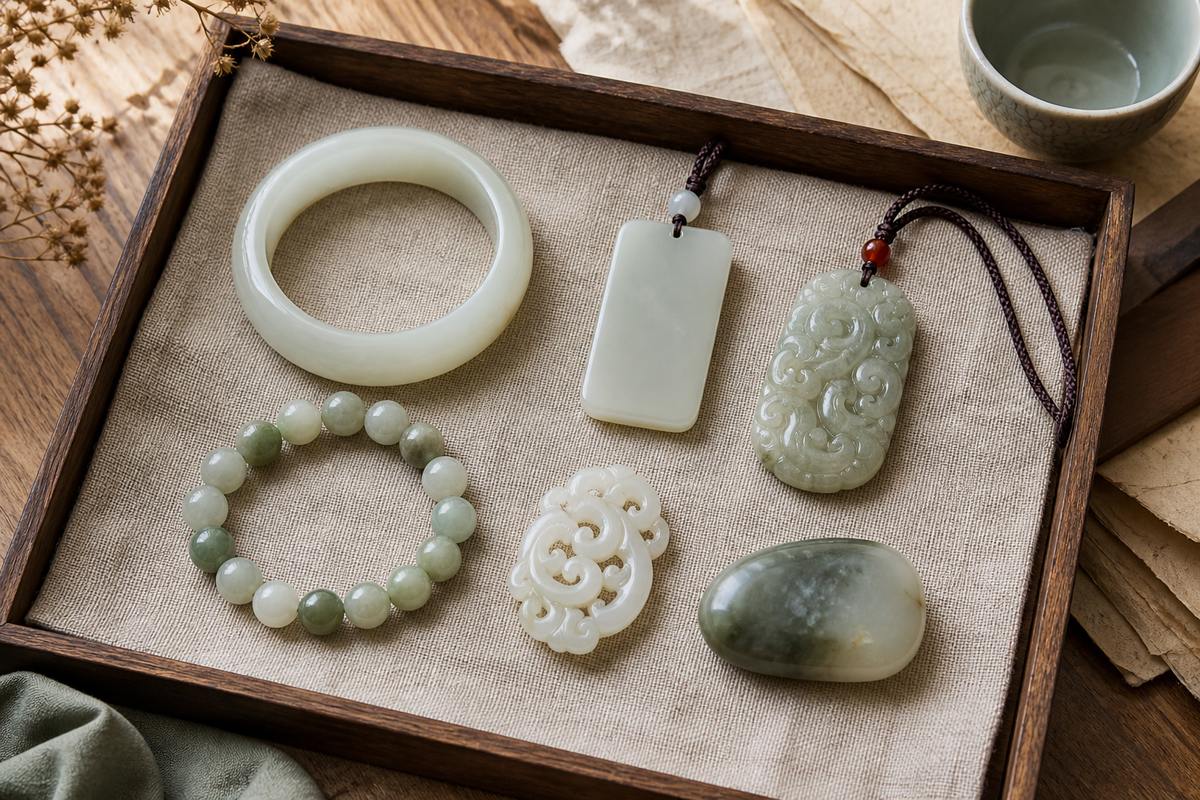
| Craft type | Meaning for the buyer |
|---|---|
| Plain work or su gong | Minimal carving that lets material, color, and polish carry the beauty. |
| Cutting, grinding, polishing | Basic craft, but not minor; a poor polish can ruin the hand feel. |
| Round carving | Three-dimensional figures or animals viewed from many angles. |
| Relief carving | Raised carving on a surface, common for plaques and pendants. |
| Openwork, piercing, and through-carving | Cut-through spaces add depth but require strength and careful finishing. |
| Thin-relief or shallow carving | Subtle surface carving that can feel literary and restrained. |
| Intaglio or incised carving | Lines cut into the surface; good line rhythm matters. |
| Inner carving and hollowing | More complex work for vessels or layered scenes. |
| Clever color carving | Uses skin color, sugar color, green patches, or natural contrast as part of the design. |
| Inlay | Combines jade with metal or other materials; setting quality and skin contact matter. |
| Machine carving | Can be affordable and consistent, but lines may look stiff or repeated. |
| Hand carving | Can show livelier line, expression, and material judgment; not every hand-carved piece is automatically high quality. |
Avoid two shortcuts: do not assume material alone is enough, and do not assume craft can rescue poor material. A strong piece has both honest material and fitting craft.
Regional Craft Language
Regional craft labels are useful, but they are not simple quality certificates. They describe art-history language, workshop habits, market style, and sometimes sales positioning.

| Term | Careful explanation |
|---|---|
| Northern or Beijing court style | Often associated with formal, weighty, court-influenced taste, substantial forms, figures, and vessels. |
| Yangzhou style | Known for layered composition, mountain scenes, refined vessels, and literati feeling. |
| Southern style | Often associated with openwork, layered carving, and lively commercial carving traditions in southern workshops. |
| Shanghai style | Modern design language, mixed influences, refined small objects, and jewelry setting. |
| Suzhou craft | Fine, restrained, elegant small works and clever use of material are often praised in market language. |
| Henan craft | Large production base with wide market coverage and many mid-market pieces. |
| Guangdong craft | Fast commercial response, small refined pieces, inlay, and jewelry-market orientation. |
| Xinjiang, Russian, Qinghai, Korean material language | Material-origin labels can point to texture tendencies, but they still require piece-by-piece inspection and documentation. |
| Han ba dao, yousi maodiao, openwork, clever color, opening jade | Special terms should be explained as techniques or historical references, not used as automatic value guarantees. |
When a seller uses regional language, ask what you can actually verify: material, treatment, workmanship, condition, certificate scope, and whether the price matches the piece.
How Craft and Quality Affect Value
Hetian jade value is best understood as material first, craft second, with condition and documentation shaping trust. The source material's phrase 'jade quality is the foundation, craft is the added value' is the right basic frame.

| Value factor | What to look for | Boundary |
|---|---|---|
| Color | Even, pleasing, not gray or dirty unless the design uses contrast intentionally. | Whiteness alone is not everything; fine texture can matter more. |
| Texture and oiliness | Fine, dense, smooth, soft luster, comfortable hand feel. | A glassy or plastic-like look can be a red flag. |
| Clarity and flaws | Fewer disruptive cracks, chips, black spots, cotton, water lines, or structural weaknesses. | Natural marks are normal; dangerous cracks need caution. |
| Material form | Seed material, mountain-water, mountain, and Gobi labels can affect value. | Origin and form claims are often abused; ask for documentation and visual consistency. |
| Size and shape | Larger clean material and complete bangle blanks can be more valuable. | Large size does not compensate for poor texture or cracks. |
| Craft | Good design follows the stone, uses color well, and finishes details cleanly. | Machine work can be fine for entry pieces; it should not be sold as full hand carving. |
| Current standards | GB/T 38821-2020 covers Hetian jade testing and classification; GB/T 44914-2024 covers Hetianyu grading. | This article does not turn official standards into a simple consumer price formula. |
Broad price bands from the source are useful only as market conversation: entry daily pieces, mid-range wearing pieces, higher-quality collector pieces, and top material with high-level craft. They are not live prices, investment advice, or a promise that a piece will hold value.
Two practical warnings are worth keeping. First, 'good material does not need heavy carving' often explains why plain bangles and plaques can be prized. Second, heavy carving can hide cracks, cotton, or awkward material, so beauty and honesty both matter.
Origin and Material Forms: Seed, Mountain, Mountain-Water, and Gobi
The source material's origin section belongs in this wearing guide because material form affects durability, price, texture, and gift value. It should not overtake the page, so the explanation stays short and buyer-focused.

| Material form | Plain explanation | Buyer caution |
|---|---|---|
| Seed material | Material weathered and transported by water, often rounded and valued for skin, texture, and oiliness. | Fake seed material, dyed skin, and artificial pores are common risks. |
| Mountain-water material | Intermediate material that has moved from mountain source but not been fully rounded like classic seed material. | Useful category, but quality still varies widely. |
| Mountain material | Mined from primary deposits, often larger and more available. | Can be excellent or ordinary; do not dismiss it automatically. |
| Gobi material | Material weathered by wind and sand, often with surface texture and playing value. | Surface story does not replace internal quality checks. |
| Xinjiang material | Culturally central and often associated with fine oily texture, especially classic Hotan material. | Strong origin claims deserve documentation. |
| Qinghai material | Often described as more watery or translucent, with qing-shui and lotus-pink tones popular. | Good for modern style, but check water lines and texture. |
| Russian material | Can be high-white or strong green; popular in the market. | High whiteness can look dry; judge texture and polish. |
| Korean material | Often lower priced and looser in texture. | May suit practice or entry pieces, not high-price claims. |
For history, this page uses conservative wording: Hetian/Hotan in Xinjiang has been a central source in Chinese jade culture since early history, with major prominence in Qing court jade after the tribute jade system in 1761. It does not repeat exact long-history numbers unless the future origin pillar page can treat them in detail.
Buying Checks: Texture, Structure, Cracks, Certificate, and Budget
A simple buying check helps readers avoid turning cultural excitement into a bad purchase. Use the five-step method as a first screen, then rely on reputable sellers and lab documentation for serious purchases.

| Check | What to do | What it can and cannot prove |
|---|---|---|
| Look at luster | Good Hetian jade often has soft, oily luster rather than harsh glass shine. | Luster helps screening but does not prove origin. |
| Feel weight | Nephrite has a dense feel compared with many glass or resin imitations. | Weight alone cannot authenticate a piece. |
| Listen carefully | Some buyers use a gentle sound test for bangles or beads. | Do not strike hard; sound tests are not proof and can damage jewelry. |
| Use side light | Look for fibrous, cloud-like, felted, or interlocking structure rather than bubbles or perfect uniformity. | Strong light inspection takes practice and does not replace lab testing. |
| Touch the surface | A good polish feels smooth, not sticky, rough, or plastic-like. | Surface feel can be altered by wax, oil, or coatings. |
| Check certificate | Use recognized labs and verify certificate numbers when possible. | A certificate may identify material but not always origin, value, beauty, or every treatment detail. |
| Check budget | Be suspicious of extremely cheap 'mutton-fat white jade' or dramatic origin claims. | A low price is not automatically fake, but high-grade labels at impossible prices are risky. |
Useful buying phrases from the source can be kept as short reminders: buy oiliness rather than shine, buy fine texture rather than coarse texture, buy lively color rather than grayness, and prefer a natural small flaw over a suspiciously perfect fake.
Treatment Risks and Red Flags
The safety and treatment section should be calm and accurate. Authentic untreated nephrite is generally a stable jewelry material, but treated, dyed, filled, coated, mislabeled, broken, or unknown items can create practical risks.

| Red flag | Why it matters | Safer action |
|---|---|---|
| Unnaturally vivid color | Bright dye, coating, or treated material may be involved, especially if price and story do not match. | Ask for treatment disclosure and lab documentation. |
| Strong chemical smell | May indicate resin, coating, glue, or storage contamination. | Do not wear against skin until clarified. |
| Visible bubbles | Glass imitations may show bubbles or overly uniform body. | Inspect with light and consider lab testing. |
| Dyed cracks or skin | Color concentrated in fissures can suggest dyeing or fake seed skin. | Avoid high prices without trustworthy evidence. |
| Blue or strange fluorescence | Some treated or resin-filled materials show unusual responses. | Treat as a warning sign, not a final diagnosis. |
| Broken or chipped jade | Edges can scratch skin and weakened pieces can break further. | Stop wearing; repair or store safely. |
| Claims of healing, radiation protection, wealth certainty, or a symbolic wish for good fortune | These are marketing claims, not material facts. | Treat the piece as jewelry and cultural symbolism. |
| Heavy-metal or radiation fears | The main practical concern is unknown dyed, coated, or fake material, not ordinary certified nephrite. | Buy from reputable sources; avoid unknown powders, liquids, or ingesting any stone material. |
If wearing causes redness, itching, swelling, rash, dizziness, panic, or persistent discomfort, stop wearing it and seek appropriate help. Do not assume the stone is 'cleansing' or that symptoms should be endured.
Everyday Wear, Fit, and Skin Comfort
Good Hetian jade is often described as warm, smooth, oily, and fine. In practical terms, it may feel cool when first touched, then gradually take on body temperature. Its smooth polish can be friendly for many wearers, but sensitive skin still needs observation.

| Comfort factor | What to check |
|---|---|
| Surface | No sharp edge, grit, unfinished hole, rough carving point, or metal burr. |
| Weight | The piece should not pull on the neck, wrist, or ear. |
| Cord or setting | Dye, metal alloy, glue, plating, and trapped detergent can cause irritation even when the jade is smooth. |
| Bangle size | A bangle should pass the hand safely but not slide off easily. Swelling and temperature changes matter. |
| Temperature | If the stone feels uncomfortably cool, wear over clothing or choose a pendant rather than a tight bangle. |
| First wear | Wear briefly, clean gently, and watch the skin before long wear. |
Do not promise that jade will become more powerful because it is worn close to skin. It is fair to say that many people enjoy the tactile ritual of wearing and handling a smooth jade piece, and that careful wear can help preserve its polish.
When to Remove Hetian Jade
Hetian jade is tough, but jewelry is still exposed to impact, chemicals, heat, water, and body movement. Removing it at the right time protects both the piece and the wearer.

| Remove it when | Reason |
|---|---|
| Showering or bathing | Soap, shampoo, cleanser residue, hot water, and cord moisture can affect surface feel, settings, or stringing. |
| Sleeping | Plain smooth pieces may be comfortable, but settings and cords can snag; heavy bangles can press the wrist. |
| Sports or gym work | Impact can chip jade or bruise skin. |
| Cooking or cleaning | Oil, detergent, heat, and knocks can damage finish or stringing. |
| Applying perfume or cosmetics | Chemicals can affect surface residue, string, metal settings, or treated materials. |
| Sauna, high heat, or strong sunlight | Heat and dryness can affect wax, cord, setting, or treated material. |
| Medical scans, procedures, or restricted work | Follow professional instructions for jewelry removal. |
If a jade bangle is hard to remove, try safe, gentle methods first: lubricant such as soap water or hand cream, a thin plastic bag over the hand to reduce friction, the string-wrap method done carefully, or cool water for a short time to reduce swelling. Place a towel underneath and stop if pain, numbness, or swelling increases. If it still will not move, ask a jeweler, store staff, or medical professional rather than forcing it.
Daily Care
Daily care should be simple. Hetian jade does not need dramatic rituals. Gentle cleaning, separate storage, impact avoidance, and honest inspection are enough for most finished jewelry.

| Care action | How to do it |
|---|---|
| Clean gently | Use clean water, mild soap if needed, and a soft cloth. Dry before storage. |
| Avoid harsh chemicals | Keep away from perfume, bleach, detergent, acid, strong cleaners, and unknown polishing liquids. |
| Store separately | Use a soft pouch or box so jade does not hit other jewelry. |
| Inspect cords and settings | Check holes, knots, metal prongs, glue, and bead stringing before long wear. |
| Avoid repeated hard impact | Nephrite is tough but can still chip or crack. |
| Use oil cautiously | Some collectors mention tiny amounts of white tea oil, but routine oiling is not necessary for most finished jewelry and may trap dirt or affect treated material. |
| Handle broken jade respectfully | Some families wrap broken jade in red cloth as a cultural ritual; this is a symbolic practice, not proof that disaster was prevented. |
The safest care message is also the most brand-aligned: treat the object as a quiet companion, not as a tool that must be activated, charged, or medically relied upon.
How This Page Relates to Future Hetian Jade Guides
This article remains a wearing and choosing guide. Several parts of the new source material are valuable but belong in future support pages where they can be expanded without bloating this page.

| Future page | Why it deserves a separate page |
|---|---|
| Hetian Jade Colors Meaning | The color list is broad enough for a full search page with photos, color families, and gift uses. |
| Hetian Jade Craftsmanship | Process, carving types, regional schools, hand carving, machine carving, and polishing deserve deeper visual explanation. |
| Hetian Jade Animal Symbols | Nine-tailed fox, elephant, rhino, bear, eagle, dragon, phoenix, pixiu, dragon turtle, toad, horse, ox, monkey, rabbit, fish, and others can form a dedicated symbolism guide. |
| Hetian Jade Identification | The five-step method, certificates, common imitations, treated materials, and lab limits need a specialist page. |
| Hetian Jade Safety and Care | Skin comfort, treatment risks, cleaning, when to remove jewelry, and broken-jade handling can be expanded responsibly. |
| Hetian Jade Origins | Kunlun, Hotan, Qing court history, names such as Kunshan jade and Yutian jade, and modern origin terminology need a historical page. |
| How to Remove a Jade Bangle | The removal methods deserve diagrams and safety warnings in a focused practical page. |
These are recorded as next-step content candidates, not linked as live pages unless they already exist. That prevents the current page from creating 404s or swallowing future topic boundaries.
Related Eastern Story Guides
For readers who want more context, this page should connect to existing Eastern Story content without overloading the paragraph with links.

- Start with What Is Hetian Jade? for a broader material and cultural introduction.
- Read Jade Meaning in Chinese Culture for symbolism beyond Hetian jade specifically.
- Use the Eastern Story material guide and care guide for site-wide material and care framing.
- Review the editorial policy for how Eastern Story separates cultural symbolism from guaranteed outcomes.
Recommended future bidirectional links: when the color, craft, identification, animal-symbol, safety, origin, and bangle-removal pages are created, link them back to this wearing guide as the practical chooser page.
Frequently Asked Questions
Most people can wear Hetian jade if the piece is comfortable, safe, honestly described, and suited to their style. Zodiac and Five Element ideas can guide meaning, but they are not strict requirements.

It is especially suitable for people who like Chinese jade culture, quiet jewelry, smooth tactile materials, symbolic gifts, refined everyday style, and objects that can be kept for a long time.
Choose white jade for refinement, green for vitality and growth symbolism, black or qinghua for depth and calm, yellow for warm abundance blessing, sugar jade for warmth, and qing-shui or lotus-pink for a softer modern look.
It can be chosen as a calming symbolic object or tactile reminder, but it should not be described as a medical treatment for anxiety, sleep, or mental health conditions.
Yes. Hetian jade is gender-neutral. Men, women, and any wearer can choose by size, color, form, and personal meaning rather than by a fixed rule.
People with sensitive skin, swelling, pregnancy-related comfort changes, physical work, sports, tight bangles, or medical restrictions should choose forms carefully and remove jade when needed.
In Chinese folk culture, some colors and symbols are associated with abundance, affection, health wishes, and protection. These are symbolic blessings, not guaranteed outcomes.
Look for soft luster, dense feel, natural structure under light, smooth hand feel, and a verifiable certificate from a reputable lab. These checks help screening but do not replace professional testing.
Remove it before heavy sport, cooking, harsh cleaning, bathing, strong chemicals, high heat, risky work, or any situation where the piece may hit hard surfaces or irritate the skin.
Yes. China's national standards platform lists GB/T 44914-2024 as Hetianyu grading, published in 2024 and implemented in 2025. This guide mentions it as a standard reference, not as a simple price guarantee.
For readers choosing a symbolic gift or wearable blessing, Eastern Story's Blessing Shop offers related pieces organized around protection, harmony, love, clarity, and good wishes.
Related Posts


