
Nirvana in Buddhism means complete liberation from suffering and the cycle of rebirth through the ending of greed, hatred, and delusion. Sanskrit nirvāṇa, Pali nibbāna, and Chinese nièpán (涅槃) name this profound freedom. Its image is a fire growing quiet: the burning of craving and resentment has ceased, opening the way to peace, clarity, and compassion.
There is a hopeful heart to this teaching. Suffering has causes, and release is possible. For a reader drawn to a gentler life, nirvana offers a horizon of freedom: less grasping, greater kindness, and wisdom that remains steady through change. Understanding the word begins with that promise of liberation, then with the distinctions that give it depth.

Nirvana, Nibbana, and the meaning of a quenched fire
Nirvana is the familiar English spelling of the Sanskrit nirvāṇa; nibbāna is its Pali counterpart, especially familiar in Theravada Buddhism. Traditional explanations use extinguishing, blowing out, or quenching. The Chinese word 涅槃 preserves the sound of the Buddhist term; expressions such as jimiè (寂灭, peaceful cessation) and mièdù (灭度, cessation and liberation) bring out its meaning.
What goes out is the fire of affliction. The three poisons (三毒) are greed, hatred, and delusion: grasping that demands satisfaction, hostility that resists what is unwanted, and misunderstanding that keeps both patterns alive. They reach beyond a passing bad mood; they are roots of the bondage Buddhist practice seeks to end.
| The three poisons | What keeps the fire burning | The direction of release |
|---|---|---|
| Greed, lobha / 贪 | Insatiable grasping and possessiveness | Generosity and freedom from clinging |
| Hatred, dosa / 嗔 | Hostility, resentment, and aversion | Goodwill and freedom from hostility |
| Delusion, moha / 痴 | Misunderstanding the changing, dependent nature of experience | Wisdom and clear seeing |
A fire burns while it has sustenance. Remove the fuel, and the burning ends. In the Aggi-Vacchagotta Sutta, the Buddha asks whether an extinguished fire has gone east, west, north, or south. Those directions no longer fit the situation. The comparison loosens the assumption that a liberated being must travel somewhere after death; it is not a map to a hidden destination.

This imagery also illuminates dependent arising: suffering continues through supporting conditions, and its causes can cease. Nirvana is called unconditioned in early Buddhist teaching. The path is cultivated, and the causes of bondage are ended; the liberation it reveals is not another temporary state manufactured by those conditions.
Liberation, craving, and the peace beyond grasping
Dukkha includes obvious pain and sorrow, as well as the strain of trying to find lasting security in things that change. Nirvana is the cessation of the causes that sustain this bondage. Its scope is deeper than relief from one disappointment: Buddhist teaching connects it with freedom from samsara (轮回), the cycle of birth, death, and renewed becoming.
“The end of desire” is a useful starting expression when desire means craving: the thirst that clings to pleasure, identity, or continued existence. A wish to understand, cultivate kindness, or help another person has a different role. Buddhist practice develops wholesome intention and effort; liberation is not indifference to every aspiration or the suppression of feeling.

The language of peace gives this teaching warmth. Ordinary quiet may depend on a peaceful room or a fortunate day. Nirvana points to freedom from the roots of disturbance themselves. Buddhist texts describe this release with words such as unbinding, the deathless, and the unborn. These name liberation from conditioned bondage, rather than a promise that an awakened person’s living body will never age or become ill.

Wisdom and compassion belong together here. Freedom from hatred makes room for goodwill; freedom from possessiveness makes generosity possible. The aspiration is a heart no longer consumed by the very fires it brings into its relationships.
Can nirvana be realized while a person is alive?
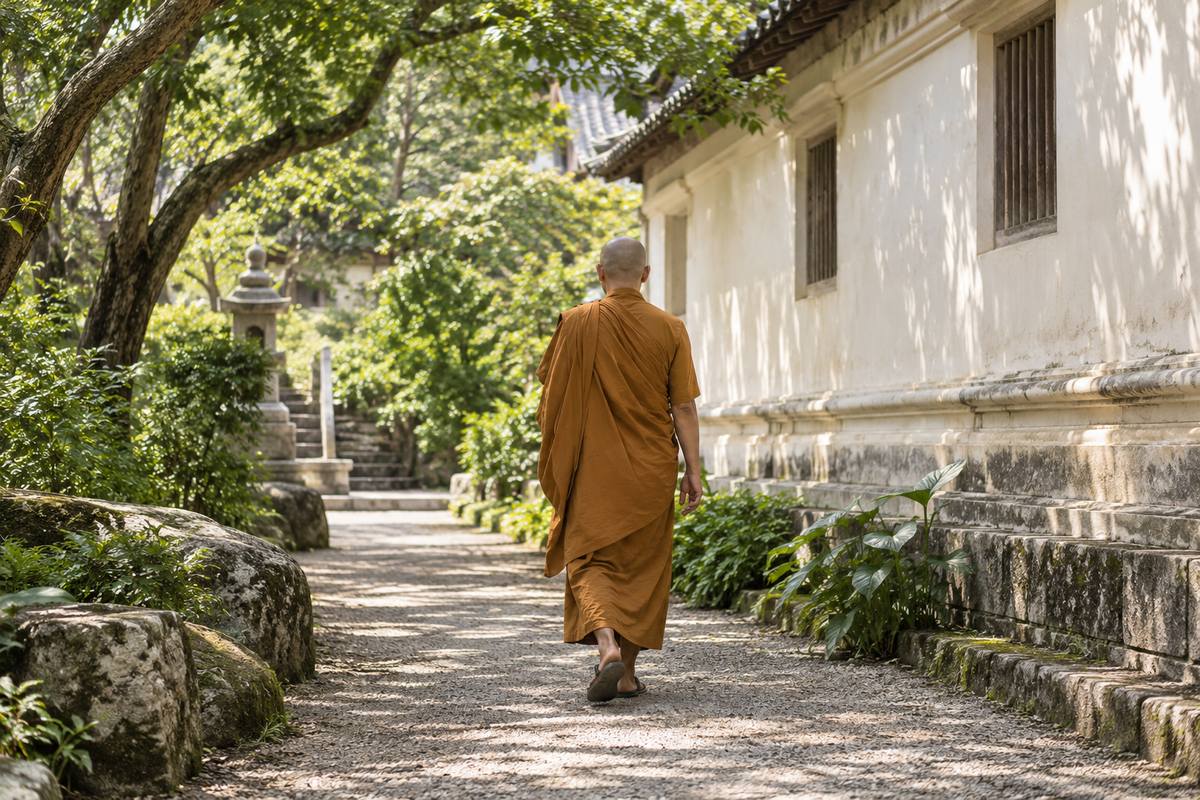
Yes. Buddhist teaching describes nirvana realized during life. The Buddha continued walking, teaching, receiving food, and caring for a community after awakening. An arhat or arahant (阿罗汉) is a liberated practitioner whose defilements have ended. A living liberated person still has functioning senses and embodied experience.
In the traditional Theravada life story, the Buddha awakens beneath the Bodhi tree at 35, teaches for 45 years, and passes into final nirvana at 80. This familiar sequence gives a clear picture of a liberated life devoted to others. The ages belong to that traditional biography; the years after awakening are years of teaching and human presence.

The Itivuttaka describes a liberated person whose senses remain intact and who experiences pleasant and unpleasant sensations. Bodily pain can still occur. What has ended is the greed, hatred, and delusion that bind experience to renewed suffering and rebirth. That distinction allows peace and bodily vulnerability to be understood together.
Nirvana with remainder and without remainder
The two nirvana elements in Itivuttaka 44 distinguish liberation during life from the ending of the remaining basis of embodied existence. They are often called nirvana “with remainder” and “without remainder.” The remainder is the continuing five aggregates (五蕴)—form, feeling, perception, formations, and consciousness—rather than a leftover portion of greed or hatred.

| Term | Meaning | How to understand the remainder |
|---|---|---|
| Nirvana with remainder / 有余依涅槃 | Defilements have ended while embodied life continues | The living body and mental aggregates remain; the practitioner can still perceive and feel |
| Nirvana without remainder / 无余依涅槃 | At a liberated person’s final passing, the remaining aggregates cease and renewed birth does not follow | The basis of the present embodied life has ended; this is not the ordinary death of someone still bound by craving |
The shorter Chinese names 有余涅槃 and 无余涅槃 are also common. These categories describe a distinction in liberation, not two doses of serenity or a progression from partial to complete removal of the three poisons. The living arhat is already free of those defilements.
“Without remainder” is sometimes reduced to a phrase about a body disappearing. Its significance is the end of the causes of renewed existence. Buddhist accounts do not make mere physical death the achievement of nirvana, nor turn this liberation into an immortal personality moving from one place to another.

Parinirvana, yuanji, and the reclining Buddha
Parinirvāṇa, or Pali parinibbāna, conveys complete or final nirvana. In accounts of the Buddha’s life, it commonly names his final passing after awakening. Mahāparinirvāṇa means great complete nirvana. The broader word nirvana can refer to realized liberation during life, while narrative context explains its use for a final passing.
In East Asian Buddhist language, yuánjì (圆寂) carries the sense of complete peaceful cessation. It is also used respectfully for the death of a Buddhist monastic. Such memorial language honors a life and its religious setting; its use alone does not establish that every person so described had realized complete liberation.
The reclining Buddha commonly portrays Shakyamuni’s parinirvana. His serene posture expresses completion, while disciples around him may express grief or attentive understanding. The scene brings human tenderness and the teaching of impermanence together. It is more than an image of rest: it recalls the completion of the path and the continuing life of the Dharma among those who receive it.

Non-abiding nirvana: wisdom joined with compassion
In Mahayana teaching, the bodhisattva’s aspiration extends toward the awakening and welfare of all beings. Non-abiding nirvana (apratiṣṭhita-nirvāṇa, 无住处涅槃, also shortened to 无住涅槃) expresses liberation that is not bound to samsara and does not settle into an isolated peace apart from others.
Its beauty lies in the union of wisdom and compassion. Wisdom releases clinging to conditioned existence; compassion keeps the welfare of beings at the heart of awakened activity. The ideal is often expressed as “not abiding in samsara, not abiding in nirvana.” In this language, freedom and compassionate response belong together.

The Yogacara or Consciousness Only tradition gives a fourfold account in the Cheng Weishi Lun (成唯识论, Demonstration of Consciousness Only): naturally pure nirvana, nirvana with remainder, nirvana without remainder, and non-abiding nirvana. This is a particular Mahayana classification, alongside the twofold account found in early texts.
Naturally pure nirvana (本来自性清净涅槃) refers in that framework to the intrinsic purity of suchness, or tathatā (真如), the true nature of phenomena. It expresses a teaching about reality’s nature; realizing liberation still has its path of wisdom. Non-abiding nirvana describes the full union of freedom and compassionate activity associated with Buddhahood in this account.
Another Mahayana expression, “samsara and nirvana are nondual,” arises in teachings on emptiness. It points to the absence of an independent, fixed nature in phenomena. Its invitation is to wisdom within life, rather than a casual equation of an ordinary troubled mind with complete awakening.
The meaning of Buddhist enlightenment brings together bodhi, liberation, and Buddhahood. Theravada teaching likewise honors the Buddha’s compassionate teaching life and the peace of liberation. These traditions can be understood in their own terms without treating one as a doctrine of numbness or destruction.
The four qualities of nirvana: permanence, bliss, self, and purity
The Mahayana Mahāparinirvāṇa Sūtra (大般涅槃经), often called the Nirvana Sutra, speaks of four qualities associated with nirvana, the Buddha’s Dharma body, and buddha-nature: permanence, bliss, self, and purity (常、乐、我、净). This affirmative language celebrates the fullness of awakening in that scripture’s setting.

| Quality | Meaning in the Nirvana Sutra’s Mahayana setting |
|---|---|
| Permanence / 常 | The enduring nature of the Buddha’s Dharma body, beyond ordinary arising and passing |
| Bliss / 乐 | The profound peace of liberation, beyond the instability of sensory pleasure |
| Self / 我 | The scripture’s language for the Tathagata and buddha-nature, distinct from the grasped personal ego |
| Purity / 净 | Freedom from defilement and the purity of awakened reality |
“Self” here needs its scriptural context. It belongs to a discussion of buddha-nature and the Tathagata, not to the everyday claim that a permanent individual soul lives unchanged inside a person. Reading it in this setting preserves its positive meaning without simply reinstating the possessive “I” that Buddhist practice examines.

The four qualities are not a universal checklist used identically by all Buddhist schools. They are a distinctive way this Mahayana scripture speaks about awakening. For a general reader, their emotional register is clear: peace is described as fullness, purity, and freedom, rather than as an empty loss of everything meaningful.
Nirvana, the Four Noble Truths, and the Three Dharma Seals
Within the Four Noble Truths, nirvana is connected with the third truth, cessation (nirodha): the causes of dukkha can end. The Noble Eightfold Path is the way of practice toward that release, joining ethical conduct, mental cultivation, and wisdom. The core ideas of Buddhism place these teachings within the larger path.

In East Asian presentations, the Three Dharma Seals (三法印) are commonly given as the impermanence of conditioned things, the absence of an independent self in phenomena, and the peace of nirvana. Their Chinese expressions are 诸行无常、诸法无我、涅槃寂静. They help orient a reader toward the character of Buddhist teaching. Other traditional lists, including the three marks of existence, have a different formulation.
The Heart Sutra (心经) also places nirvana beside wisdom and a mind released from obstruction and fear. Its language of emptiness gives this freedom a particular Mahayana setting. The Heart Sutra bracelet carries a connection to that text through an inscription that may accompany a wish for clarity and a compassionate heart.

Nirvana, heaven, and the question of disappearance
Nirvana is liberation, rather than a heavenly address. Buddhist cosmology includes heavens within samsara: their conditions may be fortunate and long-lasting, yet still change. Nirvana names freedom from that conditioned cycle.
Pure Land teaching has its own devotional and scriptural setting. Sukhavati, associated with Amitabha Buddha, is a realm supporting progress toward awakening. It is not simply another spelling of nirvana. The distinction helps readers understand a sacred realm and the liberation toward which practice is directed.

Nor does “extinguishing” settle the question of a liberated being’s final state by declaring either total annihilation or an everlasting individual entity. The Buddha’s fire comparison challenges the assumptions behind those alternatives. The emphasis returns to what can be understood about liberation: the ending of clinging and the peace of release.
| Related word | What it emphasizes |
|---|---|
| Nirvana / Nibbana | Cessation of defilements and liberation from rebirth |
| Bodhi / awakening | The liberating wisdom of awakening |
| Parinirvana | Complete nirvana; commonly the final passing of a liberated being |
| Samsara | The cycle of conditioned birth, death, and renewed existence |
| Pure Land | A sacred realm supporting progress toward awakening in its own tradition |
Modern meanings: renewal, inner peace, and “phoenix nirvana”
In everyday English, “nirvana” can mean an exceptionally happy or peaceful experience: an absorbing piece of music, an idyllic holiday, or a moment when everything feels right. In modern Chinese, 涅槃重生 often describes a profound renewal after difficulty. These uses give the word a language of hope and fresh beginnings.
“Phoenix nirvana” (凤凰涅槃) is especially evocative. Guo Moruo’s 1920 poem of that name is an important modern literary source for the image of fiery destruction followed by renewal. The Chinese phoenix, or fenghuang (凤凰), has its own traditions of auspiciousness and harmony. The modern poem’s rebirth imagery belongs to literature; it is not an account of the Buddhist definition of nirvana.

For someone rebuilding a life after disappointment, renewal can mean finding a kinder way to move forward, releasing an old resentment, or choosing what deserves care. Such moments have their own beauty. They make the direction of less grasping tangible, while complete nirvana remains the profound liberation taught in Buddhism.
A quiet afternoon, relaxed mood, or brief release from worry is a changing experience. Calling it a “small nirvana” is a poetic comparison. Buddhist realization means the ending of the roots of bondage, a depth beyond temporary ease. The distinction honors both the value of everyday peace and the depth of the religious teaching.
Symbols of peace and a wish for a gentler life
A lotus (莲花) rising clean from muddy water can carry a wish for purity and renewal. The Bodhi tree recalls awakening; the Dharma wheel points toward the teaching; an empty throne may evoke the Buddha’s presence in early Buddhist art. Each symbol opens a particular story rather than serving as a single interchangeable sign for nirvana.

Prayer beads, a mantra inscription, or a carefully chosen Buddhist necklace can accompany recollection and a wish for wisdom, compassion, and peace. Someone may choose such an object when beginning again, honoring a loved one, or inviting more steadiness into everyday life. Its meaning grows through the story and intention it carries.

In that spirit, ping an ru yi (平安如意)—peace and life unfolding as wished—can be a warm blessing offered to another person. A blessing speaks the hope of a relationship; nirvana names the Buddhist horizon of complete liberation. Both can bring attention back to kindness, while retaining their own meanings.
The heart of nirvana is freedom from the fires that consume us. Its teaching holds out peace with wisdom, and release with compassion. For a first encounter with the word, that is the most lasting image: a fire no longer fed, and a life directed toward understanding and care.
Frequently Asked Questions
Related Posts


