
Chiwen (鸱吻, chī wěn) is the great roof guardian placed at the two ends of the main ridge in traditional Chinese architecture. Often shaped with a dragon’s head, a rising fishlike tail, and a wide mouth embracing the ridge, it carries a wish for protection from fire, peace within the home, and the lasting well-being of everyone beneath its roof. The related spelling 螭吻 is also widely used.

Look up at a temple or palace and the pair seems to hold the sky between them. Their fierce faces have a tender purpose: keeping a cherished place safe. Chiwen gives a visible form to a familiar hope, whether the roof shelters a great hall, a community’s gathering place, or the idea of a home you are beginning to make your own.
What does Chiwen mean? A wish for a peaceful home
In Eastern folk tradition, Chiwen belongs to the watery world of fish, sea creatures, and rain-bringing dragons. It is believed to swallow fire or summon water to overcome it. On the skyline, that story becomes a blessing for the building and the lives, memories, and treasured things it holds.
The connection is especially moving in places built with timber frames, where fire was a serious concern. Builders gave their wish a strong and beautiful guardian: open jaws, alert eyes, and a tail rising above the tiles. The image draws on the Five Elements, or Wuxing (五行), in which water overcomes fire. It brings the calming presence of water to the very place where people hoped danger would be kept away.
Chiwen also belongs to the wider family of Chinese guardian beasts, whose watchfulness expresses care for a household or community. Its distinctive setting makes that care unusually intimate. A roof is where the outside world meets the sheltered world of meals, conversations, rest, and homecoming.
For a modern gift, this meaning can be expressed as Ping An Ru Yi (平安如意): may you enjoy peace, safety, and the fulfillment of your wishes. A small guardian chosen for a new home or studio can carry that blessing into everyday life.

How to recognize Chiwen on a roof
Start with the main ridge, called zhengji (正脊): the high horizontal line where the front and back roof slopes meet. On a roof with paired Chiwen, a large ornament stands at each end, usually with its mouth turned inward toward the ridge. The jaws may appear to swallow the roofline while the body or tail rises above it.

The outline varies. One example may have a broad dragon head and a tall finned body; another may curl into a more complete dragon. Look at the ornament’s position and its relationship to the ridge before concentrating on its horns, claws, or color. A close-up of a head alone can hide the clue that matters most.
| What you are looking at | Where to look | What distinguishes it |
|---|---|---|
| Chiwen / main-ridge end ornament | The two ends of the main horizontal ridge | A large mouth or rising tail form that finishes the ridge |
| Processional beasts, zoushou (走兽) | A line near the eave ends of sloping ridges | Several smaller figures arranged one behind another |
| Hanging-ridge or hip-ridge beasts | Individual positions along descending ridges | Separate terminal or junction ornaments, rather than the main-ridge pair |
| Eave-end tiles, wadang (瓦当) | The edge of the roof above the eaves | Decorated tile faces, often circular |
| An apex finial | The summit of a pointed roof | A central crowning ornament rather than two ridge-end guardians |
The procession and the large pair can share one roof. At the Hall of Supreme Harmony in the Forbidden City, the prominent main-ridge mouths are distinct from the 10 small beasts in each famous eave procession. The Chinese roof beasts guide explains those names, positions, and sequences.

The Four Gods tiles form another beautiful tradition. They place the directional creatures of the Four Symbols (四象) on eave-end tiles. Their images organize the surrounding directions; Chiwen’s great mouth embraces the ridge above. Recognizing both makes an old roof much richer to look at.
Chiwei, Chiwen, Zhengwen, and the ridge-swallowing beast
Several names describe this family of ornaments. They help us notice a tail, a mouth, a dragon, or a particular place on the roof. Their use overlaps across texts, regions, and periods, so the names work best as guides to what you are seeing.
| Name | What it emphasizes |
|---|---|
| Chiwei (鸱尾) | The sweeping, tail-like ridge ornament particularly associated with earlier forms |
| Chiwen (鸱吻) / Chiwen (螭吻) | The mouth of a roof beast, often combining dragon and fish features; 螭 brings a dragon association to the written name |
| Zhengwen (正吻) / Dawen (大吻) | The main-ridge end ornament, or “great mouth,” familiar in official architectural terminology |
| Longwen (龙吻) | The dragon-mouth appearance |
| Tunjishou (吞脊兽) | The memorable image of a “ridge-swallowing beast” holding the ridge in its jaws |
A tail-shaped Chiwei and a richly modeled palace Zhengwen can look very different while sharing the role of marking the ridge ends. The names do not change at a single boundary between dynasties, and an old-looking silhouette may belong to a later replacement. The building’s own history completes the picture.

The stories behind the watchful mouth
The sea creature that brings rain
An old story tells of a fire at Emperor Wu’s Bailiang Hall during the Han dynasty. A ritual specialist from Yue speaks of a sea creature whose tail can stir waves and bring rain, inspiring an image to be placed above the halls to ward off fire. Retold in later writings, the tale gives Chiwen a home in the sea before giving it a place on the roof.
Its appeal is easy to understand: bring the strength of water close to a place you love. The tale carries the wish behind the guardian, rather than a dated account of the first surviving roof ornament.

One of the dragon’s nine sons
Chiwen appears in popular accounts of Long Sheng Jiu Zi (龙生九子), the dragon’s nine sons. Each creature has a memorable temperament, and the roof guardian’s great appetite or love of looking into the distance makes its place above the building feel natural. The Eastern dragon, or Loong (龙), brings the larger associations of rain, vitality, and auspicious strength into the story.
There are several traditional lists and orders of the nine sons. Chiwen is therefore best introduced as one of them, without assigning a universal birth position. These stories let very different objects share a family resemblance while keeping each guardian’s own character.
Why is there a sword on its back?
Many later Chiwen have a sword-like ornament rising from the back, often called a jianba (剑把), or sword hilt. In one folk explanation, it keeps the water creature at its post instead of allowing it to return to the sea. Another associates the sword with the Daoist immortal Xu Xun (许逊), whose power holds harmful forces at bay.
The image gives the guardian a promise of constancy: stay here, watch over this place. The shape and attachment of the actual ornament belong to each building’s craftsmanship, while the sword story gives it an affectionate place in popular memory.

A changing silhouette across the centuries
The long history of Chiwen can be seen in the movement from sweeping ridge tails toward great open mouths and elaborate dragon forms. It is a history of overlapping designs, local workshops, religious imagery, and generations of repair. That variety is part of its beauty.
Early roof imagery preserves upturned ends and birdlike or tail-like outlines. By the medieval period, tall Chiwei forms created a striking curve against the sky. The imagery of the Makara (摩羯), an aquatic creature in Buddhist art, is also discussed in relation to these developing forms. It is one strand in a wider exchange of visual ideas, alongside local bird, fish, and dragon traditions.
Tang examples show the growing importance of the mouth and animal head. Across the Song, Liao, Jin, and Western Xia periods, dragon-headed, fish-bodied ridge ornaments became particularly expressive. The Song building treatise Yingzao Fashi (营造法式) includes Chiwen within its account of building practice. A raised tail, textured scales, and a mouth fitted to the ridge could now become a sculptural presence of considerable size.
Yuan craftsmanship explored strongly dragon-shaped bodies and richly colored glazes, including the celebrated roof ornaments of Yongle Palace. Ming and Qing workshops developed still more elaborate combinations of curling dragons, fins, horns, small attendant forms, and sword-like details. A large palace mouth and a regional temple ornament could take quite different forms within the same broad period.
When you visit an old building, you may be looking at several centuries at once: an early hall, later roof repairs, and restored ornamental sections. The most rewarding question is often how each generation cared for the place and continued its guardian story.
Clay, glaze, and the colors of the skyline
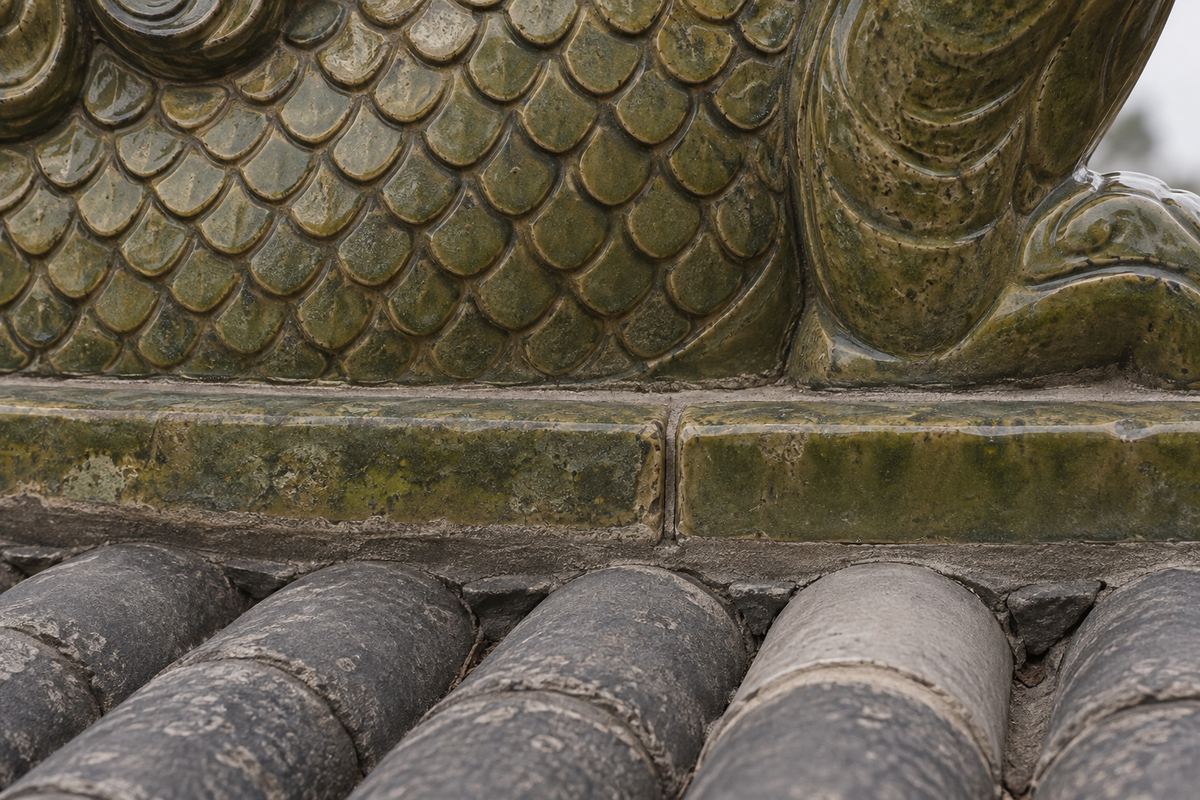
Architectural liuli (琉璃) usually means glazed ceramic: a shaped clay body covered by a colored glaze. This differs from an object formed throughout in art glass, even though the word Liuli also appears in the world of glass ornaments and jewelry. The ceramic body gives a roof guardian its volume; the glaze makes its scales, lips, and curling tail catch the light.

Traditional architectural glazes often use lead as a flux and mineral colorants to produce yellow, green, blue, and other hues. Workshops shape, dry, fire, glaze, and assemble their work according to their particular materials and methods. Firing temperatures and sequences vary with the body and glaze recipe. Large ornaments can be divided into hollow sections, making an imposing silhouette from pieces that can be fired and fitted together.

The palette is wonderfully broad. Golden-yellow glaze can warm a palace roof, green can deepen the shadows around a dragon’s face, and blue can make a curling body seem almost continuous with the sky. Unglazed gray ceramic has a quieter presence. Weathering, repairs, and replacement parts add their own history to these surfaces.

The ornament also finishes and helps seal the ridge end. Its practical contribution belongs to the whole roof, with its tiles, bedding, joints, fixings, and maintenance. The rain runs down the roof slopes; Chiwen gives the ridge its protective and decorative ending. Modern lightning protection depends on a dedicated protection system designed for the building.
Remarkable Chiwen to look for
A few well-documented examples reveal just how much feeling and craftsmanship can inhabit this one roof form. Dimensions help bring their scale down to earth: what seems like a small silhouette from a courtyard may stand taller than the people looking up at it.
The Hall of Supreme Harmony: a guardian assembled in 13 parts
The Forbidden City’s Hall of Supreme Harmony, or Taihe Dian (太和殿), has main-ridge ornaments measuring 3.4 meters high and weighing about 4.3 metric tonnes each. The Palace Museum records 13 yellow-glazed ceramic components in each assembly, using the specification called eryang, or “second pattern.” This 13-part arrangement is known as shisan pin (十三拼).
The numbers reveal the care hidden in the outline. During the 2006 conservation dismantling, workers separated the joints and removed connecting ironwork before lowering the ceramic pieces individually. Seen from the courtyard, those many parts read as one watchful creature embracing the ridge.

Huayan Temple: a monumental pair above the hall
At Huayan Temple (华严寺) in Datong, the Great Buddha Hall carries a pair of glazed Chiwen about 4.5 meters high. Their scale makes the roofline unforgettable. The northern ornament is identified with the hall’s Jin-period heritage; the pair also carries the history of later repairs and replacement work.
Their broad bodies, rising tails, and green-and-yellow surfaces reward a slow look from the courtyard. The hall’s pair should be distinguished from ornaments associated with the temple’s separate Bhagavan Sutra Repository Hall. Each building has its own roof and conservation story.

Dule Temple: the grace of an earlier roofline
The mountain gate and Guanyin Pavilion at Dule Temple (独乐寺), in Tianjin’s Jizhou district, were rebuilt in 984, during the Liao dynasty. On the gate, the inward-sweeping ridge tails retain an elegance quite different from the fuller dragon forms of many later palace roofs.
Architectural historian Liang Sicheng celebrated the temple’s connection between Tang traditions and Song building practice. Looking at the gate, the appeal is immediate: the guardians seem to extend the lift of the roof itself, giving a quiet building an alert and living outline.

Yongle Palace: dragons in peacock blue
At Yongle Palace (永乐宫) in Shanxi, Yuan-period glazed roof ornaments give each major hall its own character. The Sanqing Hall designs are famous for peacock-blue dragon bodies, curling forms, and contrasting details. The guardians on Chunyang and Chongyang halls bring other combinations of color and silhouette to the same architectural setting.

Original pieces removed during the palace’s relocation have also appeared in museum exhibitions. One especially evocative example is the western Chiwen from Chongyang Hall, removed in 1959: a printed Daoist scripture was found inside it. A blessing sheltered within a guardian adds a deeply human detail to the great roofline.
The National Museum: a green-glazed Western Xia guardian
The National Museum of China records a Western Xia green-glazed Chiwen measuring 152 centimeters high, 92 centimeters wide, and 32 centimeters thick. It was excavated in 1972 at the Western Xia imperial mausoleum site near Yinchuan. The Western Xia period spans 1038–1227.
Its dragon head and fish body were fired separately, and scales cover the green-glazed surface. The piece brings the creature’s double identity into focus: the head has a dragon’s force, while the rising body keeps the visual memory of a fish.

Jiangxi and Jiexiu: local color and imagination
Ganzhou Museum in Jiangxi catalogues a Qing blue-and-white Aoyu Chiwen (清青花大鳌鱼鸱吻). It offers a different expression of the roof guardian through blue-and-white ceramic decoration, alongside the yellow and green glazes more familiar from northern monuments.
Jiexiu Museum’s Ming yellow-, green-, and blue-glazed Chiwen shows another side of regional imagination. Its lively modeling and contrasting colors belong to Shanxi’s rich architectural ceramic tradition. Such examples make clear why a guardian can feel distinctive to a town, a workshop, or a building, while carrying a shared wish for protection.
Palaces, temples, and regional roof guardians
Roof ornaments can communicate the importance of a building through size, material, color, and the way they sit within the whole roof. Court architecture developed detailed conventions, while temples, shrines, government buildings, and regional traditions followed their own histories. A yellow palace ornament offers one familiar example; it is not a color key for every dynasty or every kind of building.
Local forms deserve attention in their own right. Aoyu (鳌鱼) is a fish-dragon image found in architectural ornament and other arts. The name may overlap with Chiwen in a particular collection record, as it does at Ganzhou, yet it has a wider life beyond main-ridge mouths. Regional Aoyu should not all be explained as substitutes invented to evade court restrictions.

In southern ceramic traditions, Shiwan ridge sculpture (石湾陶塑瓦脊) creates another expressive world of figures and ornament. Its storytelling approach shows how many voices could inhabit a roof. The joy of looking is in these differences: local makers found their own ways to place beauty and good wishes above a community.
Chiwen and Japanese shachihoko
Japan’s shachihoko (鯱) is a related point of comparison for anyone who enjoys East Asian roof guardians. Usually described as a tiger-fish creature with an arched tail, it is especially familiar from castle roofs. Nagoya Castle’s golden pair, called kinshachi (金鯱), is one celebrated example. Chiwen and shachihoko have distinct names, settings, and visual traditions.

Color alone is a poor way to decide which tradition a roof belongs to. Chinese architectural ornaments include golden-yellow glazes and examples of gilded metalwork, while Japanese roof decoration also uses other materials and finishes. Begin with the building, the creature’s form, and its local name. A golden surface may be glaze or a metal finish, and each tells a different craft story.
Keeping the guardian’s wish close
A miniature Chiwen can bring the feeling of a great roofline into a much smaller space. On a shelf in a new apartment, beside architectural books, or in a studio where someone is beginning again, its watchful face carries a wish for steadiness and belonging. A pair can echo the two ends of a ridge and the feeling of a home held together.
Museum-inspired magnets, bookmarks, and small sculptures also let people keep a memory of a place they visited. Choose the interpretation that feels connected to your own story: a sweeping tail, a bright green face, the color of a memorable temple roof. Check the maker’s material description for the actual object, since a glazed-looking souvenir may be ceramic, resin, metal, or another material.
For a housewarming, a note could say: “May this home welcome peace, shelter your dreams, and hold many happy returns. 平安如意.” For a new studio, the wish might be for a space where good work and a settled heart can grow together.

If an older architectural fragment catches your interest, its documented building history, ownership, and repairs are part of what makes it meaningful. A newly made interpretation offers its own connection to the tradition through a maker’s care and the wish you choose to give it. For a broader expression of that spirit, explore Eastern Story’s Blessing collection and find a story to keep close.
Frequently asked questions
Related Posts


