
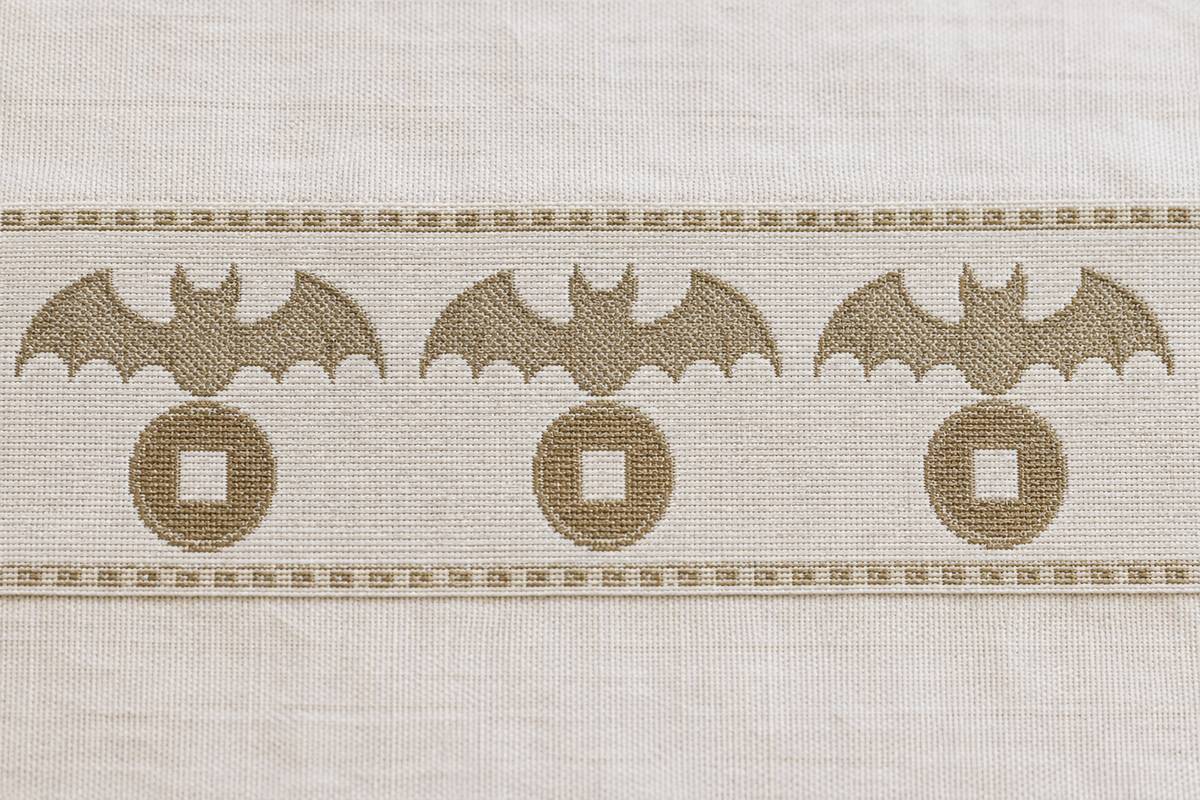
Fortune Before Your Eyes, or Fu Zai Yan Qian (福在眼前), is a traditional bat-and-coin motif carrying the wish that happiness, good luck, and prosperity are close at hand. Its wordplay joins the bat’s fú (蝠) with Fu, the blessing character (福), and the coin’s qián (钱) with “before” (前). The coin’s central opening supplies the “eye” (眼). Together, they turn a small image into a warm greeting: may good fortune be right before your eyes.

There is something especially tender about a blessing that feels near. A pendant worn against the heart, a carved detail beside a doorway, or a gift placed in someone’s hands can carry both the excitement of better days ahead and gratitude for the people already beside us. Fu Zai Yan Qian welcomes good things into life while inviting us to recognize the happiness within reach.
How a bat and a coin become a blessing
In traditional Chinese bat symbolism, the sound of the name gives the animal its joyful role. The full word for bat is biānfú (蝙蝠); its second character sounds exactly like fú, good fortune. A maker can therefore picture a blessing without writing the character itself. This kind of picture puzzle is called a rebus.
| Element | Sound or visual association | Part of the wish |
|---|---|---|
| Bat (蝠) | Fú sounds like 福, blessing | Good fortune |
| Coin (钱) | Qián sounds like 前, before or in front | Nearness; before |
| Coin opening (钱眼) | The opening is called the coin’s “eye” | Eyes; within sight |
| Bat and coin together | Image and wordplay bring the elements into one scene | Fortune before your eyes (福在眼前) |
The familiar round, square-holed form comes from traditional Chinese cash coins. The hole also had practical uses in finishing and stringing coins. In the motif, its affectionate name, “coin eye,” makes the blessing visible. The coin adds an association with prosperity too, so the design can welcome both a happier life and the means to enjoy it.

“Happiness before your eyes,” “blessings before your eyes,” and “fortune before your eyes” are natural English renderings of the same phrase. Here, fortune reaches beyond money to include contentment, opportunity, companionship, and the feeling that life is opening kindly toward you.
A hopeful future and happiness already here
For someone who has worked through a difficult season, the phrase can hold the expectation of relief: a door opening, an examination completed, a new venture finding its footing. Giving this motif says, “I am looking forward with you.” It offers a generous way to encourage someone without asking them to put their uncertainty into words.

At the same time, “before your eyes” makes room for the present. A meal shared with family, a friend who checks in, an ordinary morning at home, or the chance to begin again can all feel like Fu. Choosing the motif for yourself can become a personal way of welcoming luck and noticing these smaller forms of abundance.
Its mood can be festive or quiet. Red and gold lend themselves to New Year celebrations; pale stone, restrained metalwork, and simple lines can make the same wish feel intimate. The feeling belongs to the relationship and the moment: delight, reassurance, gratitude, or the confidence to keep going.
Recognizing the motif through different compositions
A bat carrying, hovering beside, or resting against a coin
A bat may hold a coin at its mouth, spread its wings above it, or curve around its rim. In a small carving, the bat and money shape may share one compact outline. On a flat surface, they can sit beside one another with more space between them. Look for the bat, the coin form, and the eye-like opening as a connected image.

There is no single required bat count, flight direction, or angle for the square hole. One or more bats and coins can appear, depending on the object. A pendant also turns as it is worn, so a change in viewing angle need not change the blessing. When a design is very stylized, its accompanying name and other visible details help you read it.
Curving wings, color, and repeated patterns
Decorative bats often have flowing, curled wings and a compact body. Symmetry can give a little pendant a settled feel, while an off-center bat can suggest movement toward the coin. A maker may emphasize the silhouette, the open space, or the contrast between the two forms; intricate carving is one aesthetic choice, and a simple outline can carry the wish just as clearly.

On a border, a bat-and-coin unit can repeat along a line; across a textile or decorative field, it can repeat in two directions. These are often described as two-direction and four-direction repeats in pattern design. A single medallion, a scattered arrangement, or an isolated carving is equally possible. The object’s shape gives the composition its rhythm.
Related bat motifs: which blessing do the other elements add?
Bats belong to a larger family of auspicious imagery. Additional elements can give a design a more particular greeting, especially when it is intended for a birthday or family celebration.
| Motif | Elements to notice | Wish it carries |
|---|---|---|
| Fu Zai Yan Qian (福在眼前) | Bat and coin, with the coin eye contributing to the wordplay | Good fortune close at hand |
| Wufu, the Five Blessings (五福) | A group of five bats | A full and fortunate life |
| Wu Fu Peng Shou (五福捧寿) | Five bats surrounding a longevity emblem, commonly the Shou character | The Five Blessings gathered around long life |
| Fu Shou Shuang Quan (福寿双全) | Bat imagery joined with a longevity peach (寿桃) or the Shou character (寿); some versions include a coin | Blessing and longevity together |
| Hong Fu Qi Tian (洪福齐天) | Red-bat wordplay and a composition associated with expansive, heavenly blessing | Great good fortune reaching the heavens |
| Fu Dao (福到) | An inverted bat can play on dào: upside down (倒) and arrived (到) | Good fortune has arrived |
The Five Blessings in the Hong Fan chapter of the Book of Documents are longevity (寿), wealth (富), health and peace (康宁), a love of virtue (攸好德), and completing one’s natural lifespan peacefully (考终命). Together they describe a deeply human hope: enough to live on, time with loved ones, a peaceful heart, and a life well lived.
Five bats can express this group of blessings, while five bats gathered around Shou make the specific “Five Blessings supporting longevity” composition. In a bat-and-coin piece, a peach or longevity character is what makes a direct long-life greeting especially clear. Clouds, children, flowers, and inscriptions deserve attention as part of the whole scene.
Red also participates in wordplay: hóng (红), red, echoes hóng (洪), vast or great. A red bat can therefore carry the idea of abundant blessing. A cloud or red background alone is not enough to name an entire scene Hong Fu Qi Tian. Likewise, an inverted bat can add the “fortune has arrived” pun when the design supports that reading; it is not a requirement for Fu Zai Yan Qian.

From jade ornaments to the objects around us
Jade: letting the stone take part in the story
The National Palace Museum in Taipei holds a Qing-period jade ornament called Jade ornament in the form of a bat holding a coin. The carver used the reddish-brown area for the bat and the white area for a coin inscribed “Peace under Heaven” (天下太平). It measures 4.3 × 2.5 × 0.7 cm. The color contrast lets the blessing emerge from the stone itself.
This thoughtful use of contrasting color is known as Qiaose, or color-sensitive jade carving (俏色). Relief carving (浮雕) can raise a bat above a coin-shaped surface, while openwork carving (镂雕) lets light pass around wings or through the center. Each treatment gives the small scene a different sense of movement.

Modern pendants may be made in Hetian jade (和田玉) or jadeite (翡翠), among other materials. A softly rounded carving can feel companionable and quiet; a more sculptural one makes the bat’s arrival vivid. The motif describes the wish, while the material name and the history of an individual piece belong to that particular object.

Metalwork and coin-shaped charms
A Qing-period gold fork with a jade handle in the Palace Museum offers a different example. A bat decorates the upper metal section, with a coin beneath it between the prongs. The museum identifies this combination as Fu Zai Yan Qian. The blessing has found a place in an everyday form, beyond pendants and jewelry.
In modern metal jewelry, the design can be a clean coin outline, a bat folded around a rim, or a more elaborate pierced surface. Filigree (花丝), when used, builds delicate ornament from fine metal wire. A matte or antique-style finish creates a different mood from bright polish; the finish alone does not establish how an object was made or how resistant it is to bending.

Coin-shaped folk charms, often called huaqian (花钱), also carry auspicious images and inscriptions. They were made for purposes such as blessing, protection, adornment, or presentation rather than ordinary monetary circulation. Their forms and uses vary across periods. Some mark occasions, but “commemorative coin” and “New Year money” do not describe the whole category.
A historical cash coin was money; a folk charm used a money-like form for other purposes; a modern commemorative coin has its own issuing context; and a newly made coin pendant is jewelry. A bat-and-coin design can appear across these settings. For an older object, learning its recorded history adds another story to the blessing, while appearance and patina alone do not establish its date or maker.

Textiles, carved spaces, and personal keepsakes
Bat imagery brings wishes into woven and embroidered decoration, carved wood, ceramics, paper cuts, and New Year prints (年画). Bat-and-coin compositions are one expression within that broader decorative tradition. A border can carry the wish around a fabric; a carved panel can place it beside the daily passage through a room. Painted red bats on porcelain may carry other blessings too, so enjoy the surrounding flowers, characters, and shapes as part of the story.

A Ruyi (如意) element can bring the wish that things unfold as you hope. Ruyi-shaped cloud patterns lend curling movement, while scrolling lotus ornament (缠枝莲) can create a continuous floral setting. Such companions enrich the composition without requiring every bat motif to share one name.
The same pleasure in a small, meaningful object continues in wenwan (文玩), the world of objects enjoyed for handling and appreciation. A bat-and-coin accessory may join a bead strand, serve as a hanging accent or beiyun (背云), or become a bag charm. Carved nut and seed objects, wooden combs, key charms, and contemporary graphic designs offer other ways to keep the greeting close. The appeal lies in finding the form that belongs naturally in your day.

Giving Fu Zai Yan Qian with a personal wish
The most memorable gift connects its meaning to something you share with the recipient. Choose a piece whose expression feels like them: lively wings, a calm rounded outline, a favorite color, or a form they would enjoy keeping at home. Then let your note explain why this blessing made you think of them.

| Moment | The feeling to share | A possible message |
|---|---|---|
| A birthday or New Year with a parent or elder | Gratitude, family closeness, and many happy days together | “May good fortune stay close, and may we share many more peaceful, happy days.” |
| An examination, graduation, or new venture | Encouragement and hope after effort | “May the opportunities you have worked toward come into view. I am cheering you on.” |
| A wedding or anniversary | Companionship and an abundant life together | “May you find happiness before your eyes, in each other and in the home you build.” |
| A housewarming | Welcome, belonging, and everyday comfort | “May this home be full of warmth, good company, and blessings close at hand.” |
| A gift to yourself | Renewed confidence and appreciation | “May I welcome good fortune and cherish the happiness already here.” |
For an elder’s birthday, a design that also includes a peach or Shou character can make the long-life wish part of the image. For a loved one beginning something uncertain, a simple bat and coin can say enough: good things are coming into view, and someone is beside you as you move toward them.
A newborn celebration can be marked with a keepsake stored by an adult for the child’s future. Keep jewelry, neck cords, bells, and detachable small parts away from infants and young children; choose an adult-kept memento rather than infant wear. The family can preserve both the object and the message until the child is old enough to enjoy its story.

A short card might close with “May peace and good wishes accompany you—Ping An Ru Yi (平安如意).” It can sit naturally alongside Fu Zai Yan Qian as your own greeting. A personal memory or a few handwritten words often makes the blessing feel especially close.
Choosing a form you will enjoy keeping close
Begin with the image that moves you. Some people enjoy the tiny moment of recognizing the bat and coin; others love a softly worn outline or the way the wings frame the center. A pendant can hang on a simple cord or chain, while a coin-and-bat accent on a red string bracelet brings the greeting into an everyday bracelet. A Ping An Kou, or peace buckle (平安扣), has its own rounded protective symbolism; when bat and coin details are added, read those features as well as the overall form.
For fit, check the actual height, width, thickness, weight, and hanging position of the piece. A 20 mm outline and a 40 mm outline look very different against clothing; drawing both on paper is a useful comparison, rather than treating 20–40 mm as a size rule. Include the projecting wings and suspension loop in that comparison.

Before choosing, read the stated metal or stone, any plating or treatments, and how the piece is assembled. Feel for comfortable edges and check delicate wings, pierced areas, and attachment points. Fine wirework and thin projections benefit from gentle handling. These small practical details help the object become an easy, lasting companion to its story.
Gentle care for a meaningful object
Store the piece separately so its wings and openings do not catch on other jewelry. Hold it by its main body rather than a thin edge. A soft, lint-free cloth is a gentle first step after wear; further cleaning should suit the material, treatments, cord, adhesive, and setting.
Protect carved stone from hard knocks and sudden heat, and keep metal jewelry away from harsh household chemicals and abrasive cleaners. Avoid routine soaking of mixed-material or corded pieces. For jade or crystal jewelry, ask for care instructions for that particular stone and setting before using water, steam, or an ultrasonic cleaner. The care guide offers general guidance for keeping meaningful jewelry comfortable to wear and beautiful to revisit.

Keep the blessing within sight
Fu Zai Yan Qian holds a lovely balance: anticipation for what is coming and affection for what is already here. The little bat brings the sound of blessing; the coin and its eye bring it close. Worn, kept, or given, the design can accompany a fresh beginning, a shared celebration, or the quiet happiness of an ordinary day.
Explore the Eastern blessing collection for objects that speak to your own hopes and relationships. Choose the story you want to carry, and let your wish travel with it.
Frequently Asked Questions
Related Posts


