Quick definition: Yin (寅, pinyin yín) is the third of the Twelve Earthly Branches (十二地支). It is paired with the Tiger, classified as Yang Wood in the traditional five-phase system, associated with the east-northeast direction, and used to label recurring units of year, month, day, and hour. These are different scales: a Yin year is not a Yin month, and neither is the same thing as the Yin hour.

This guide focuses on the branch itself: how to read 寅, how it works in calendars, and how later astrology describes it. For the full animal cycle and broader Tiger culture, begin with Eastern Story’s guide to the twelve Chinese zodiac signs.
How to Pronounce and Write 寅
The character is 寅. In standard Mandarin pinyin it is written yín, with the second, rising tone. English pages often omit tone marks and write “Yin,” but the mark matters when explaining the term.

| Term | Chinese | Pinyin | Meaning |
|---|---|---|---|
| Earthly Branch Yin | 寅 | yín | The third branch; paired with Tiger |
| Yin in yin-yang | 阴 / 陰 | yīn | The yin principle; a different character, tone, and concept |
| Yi Wood | 乙 | yǐ | The second Heavenly Stem, classed as Yin Wood |
This distinction prevents a common English-language error. Yin Wood can mean the branch 寅 in loose marketing copy, but in technical stem language “Yin Wood” usually refers to Yi (乙). The branch 寅 is classed as Yang Wood. Keeping the Chinese character visible is the simplest way to avoid ambiguity.
Position in the Twelve Earthly Branches
The Earthly Branches are a fixed twelve-part cycle: Zi, Chou, Yin, Mao, Chen, Si, Wu, Wei, Shen, You, Xu, and Hai. Yin comes after Chou and before Mao. Branches have long been used in Chinese calendrical notation for years and days, and later for months, traditional double-hours, directions, zodiac animals, and astrological classifications.

| Traditional correspondence | Common value for 寅 | System or variation note |
|---|---|---|
| Order | Third of twelve | Fixed branch sequence |
| Zodiac animal | Tiger (虎) | Standard twelve-animal pairing |
| Yin-yang and phase | Yang Wood | Five-phase correspondence used in later cosmology and astrology |
| Direction | East-northeast, often shown around 60° | Traditional branch-direction diagrams vary in wording and precision |
| Seasonal position | Opening of spring | Most precise in solar-term month systems |
| Double-hour | About 3:00–5:00 a.m. | Modern clock conversion of a historical time division |
| Month branch | From Lichun to before Jingzhe | Astrological solar-term convention, not simply lunar month one |
| Hidden stems | Jia, Bing, Wu (甲、丙、戊) | Later BaZi classification, not an astronomical measurement |
Why Yin Is Paired With the Tiger and Yang Wood
The established zodiac pairing is Yin–Tiger (寅虎). Early texts and excavated materials show that animal–branch correspondences developed over time; the familiar twelve-animal list was not created by one documented race or one simple observation. The popular explanation that tigers were most active before dawn is a memorable folk rationale for the 3:00–5:00 association, not a proven account of how the pairing originated.
Yang Wood belongs to a separate layer of classification. In five-phase language, Wood is associated with spring and growth, while yang suggests outward, initiating movement. Traditional writers therefore compare 寅 with early-spring emergence, a trunk, or a forest beginning to stir. These are cosmological images. They describe the place of 寅 within a symbolic system; they are not measurable energy emitted by a person, hour, ornament, or direction.

Yin Year, Month, Day, and Hour Are Four Different Scales
| Scale | What “Yin” means | How it repeats | Important boundary |
|---|---|---|---|
| Year | A year whose Earthly Branch is 寅; popularly a Tiger year | Every 12 branch years; the full stem-branch name repeats every 60 years | Everyday zodiac use commonly changes at Lunar New Year; some BaZi schools use Lichun |
| Month | The 寅 month in a branch-month sequence | Once each solar year | Usually Lichun to before Jingzhe in BaZi solar-term practice |
| Day | A day labeled with the branch 寅 | Every 12 days as the branch cycles; the complete stem-branch day repeats every 60 days | Calendar calculation and day-boundary conventions must be specified |
| Hour | The 寅 double-hour | Once each day | Commonly mapped to about 3:00–5:00 a.m.; historical local time and modern time zones complicate exact conversion |
The Yin Hour: About 3:00–5:00 a.m.
Traditional Chinese timekeeping divided the day into twelve branch periods, each roughly equivalent to two modern hours. In the common modern conversion, Chou covers about 1:00–3:00 a.m., Yin about 3:00–5:00 a.m., and Mao about 5:00–7:00 a.m. Yin hour is therefore a pre-dawn period, also described in older vocabulary with words connected to daybreak.

The two-hour clock table is a practical modern guide, not a claim that every historical community used identical numbered-clock boundaries. Local solar time, seasonal light, time-zone policy, and different calculation traditions can matter in specialist charting.
Some traditional-medicine charts connect hours with channels or organs. That framework belongs to the history and theory of Chinese medicine. Waking between 3:00 and 5:00 a.m. is not, by itself, a diagnosis of lung disease, weak qi, liver trouble, or any other condition. Persistent sleep or health concerns call for a qualified healthcare professional rather than a branch-hour interpretation.
The Yin Month, Lichun, and “Establishing Yin”
In the solar-term month convention used by many BaZi calendars, the Yin month begins at Lichun (立春, Start of Spring) and ends when Jingzhe (惊蛰, Awakening of Insects) begins. On the Gregorian calendar, those terms usually fall near February 3–5 and March 5–6, but the exact instant changes by year and time zone.

Jian Yin (建寅), “establishing Yin,” means assigning 寅 as the branch of the first month. This is why traditional tables often label 寅 as month one and connect it with the opening of spring. The phrase “the Dipper handle points to Yin and spring is everywhere” belongs to a traditional astronomical and calendrical image in which the orientation of the Big Dipper helped articulate seasonal direction.
Why the Yin month is not always the first lunar month
A lunar month begins at a new moon. A solar-term branch month begins at a defined seasonal term. Because these are different rules, Lunar New Year and Lichun do not always occur on the same date. The Hong Kong Observatory gives a clear example: in 2018, Lichun fell on February 4, while the first day of the first lunar month fell on February 16.
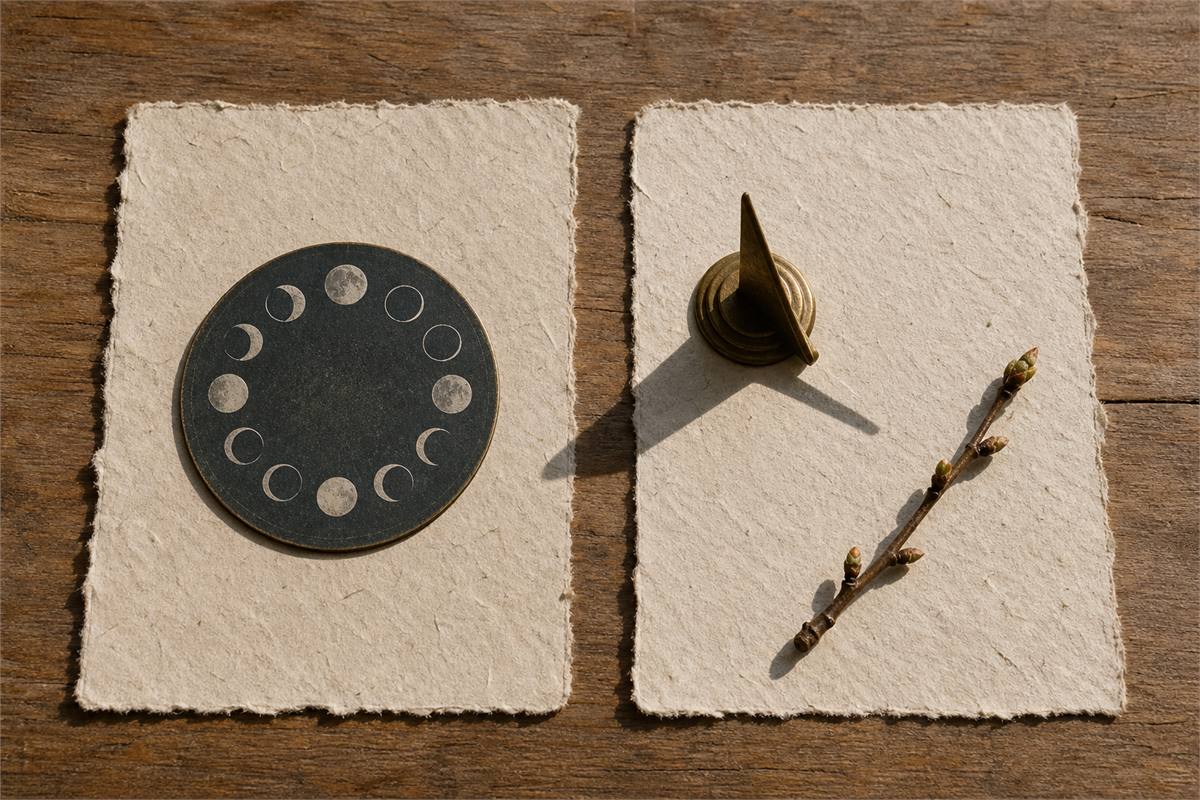
It is therefore useful to say “the first lunar month is traditionally associated with 寅” while still distinguishing the actual dates in a chosen calendar. The broad claim that Emperor Wu of Han single-handedly fixed the Yin month as New Year and that one unchanged rule then continued for two millennia compresses a much more complicated history of calendar reforms, month numbering, and year boundaries.
Yin Years in the Sexagenary Cycle
A branch year returns every twelve years, so recent Tiger or Yin years include 1986, 1998, 2010, and 2022; the next is 2034. But a year’s full traditional name combines one Heavenly Stem with one Earthly Branch. The pairing advances through a 60-term cycle, producing names such as Bing Yin (丙寅), Wu Yin (戊寅), Geng Yin (庚寅), Ren Yin (壬寅), and Jia Yin (甲寅).

This explains why “Tiger year,” “Yin year,” and a full name such as Ren Yin are related but not interchangeable. It also explains why calling every Tiger year a “Wood Tiger year” is incorrect: 寅 has a traditional Wood correspondence, while the popular year element comes from the year’s Heavenly Stem.
Hidden Stems of Yin: Jia, Bing, and Wu
In later BaZi vocabulary, each branch can “contain” or “hide” one or more Heavenly Stems. The standard list for 寅 is Jia Wood (甲), Bing Fire (丙), and Wu Earth (戊). Manuals often call Jia the principal qi, with Bing and Wu as secondary components.

“Hidden” is technical language inside the model. It does not mean that a physical hour or compass sector contains detectable Wood, Fire, and Earth. A personal BaZi reading also considers all four pillars, calendar conversion, seasonal context, and interpretive rules; one 寅 in a birth time cannot establish a personality, career, health condition, or future event.
Combinations, Clashes, Harms, and Punishments
Later astrology organizes branch relationships with a specialized vocabulary. The table below records the common classifications involving 寅 without turning them into promised outcomes.

| Traditional term | Branches involving 寅 | Meaning inside the system | Evidence-based boundary |
|---|---|---|---|
| Liuhe, six combination | 寅–亥 (Yin–Hai) | A paired relationship in branch astrology | Does not establish a benefactor, wealth event, or relationship outcome |
| Chong, clash | 寅–申 (Yin–Shen) | An opposed pair in the twelve-branch circle | Does not predict conflict, injury, liver trouble, or bad luck |
| Sanhe, three-harmony group | 寅–午–戌 (Yin–Wu–Xu) | The Fire trine in later phase-based interpretation | Does not promise fame, promotion, or “career explosion” |
| Hai, harm | 寅–巳 (Yin–Si) | A named relational category | Does not prove betrayal, anxiety, or interpersonal damage |
| Xing, punishment | Often discussed in the 寅–巳–申 set | A school-dependent astrological pattern with detailed conditions | Not a medical, legal, or behavioral forecast |
Traditional Claims and Evidence-Based Boundaries
- Traditional image: Yang Wood suggests spring growth and outward movement. Boundary: it is a cosmological category, not a measurable force.
- Popular astrology: people born in a Yin month or hour may be described as bold, impulsive, protective, or suited to leadership. Boundary: birth timing does not scientifically determine personality or career fit.
- Branch relationships: combinations and clashes help practitioners read a chart. Boundary: they do not forecast illness, injury, wealth, marriage, or guaranteed luck.
- Traditional medicine: some hour and five-phase correspondences appear in medical theory. Boundary: a clock time is not a diagnosis or treatment plan.
- Modern lifestyle symbolism: green, wood grain, Tiger forms, or spring motifs may express the idea visually. Boundary: colors, crystals, and jewelry are aesthetic or personal symbols rather than remedies for “missing Wood.”
Common Misconceptions About 寅
- “寅 is the yin of yin-yang.” The characters and tones differ: 寅 is yín; 阴 is yīn.
- “The Yin month is a fixed Gregorian month.” It is a solar-term interval whose exact start and end times move slightly each year.
- “The Yin month always equals the first lunar month.” Their boundaries follow different astronomical rules and can be separated by days or weeks.
- “Tiger was assigned to Yin because tigers are scientifically most active at 3:00 a.m.” Pre-dawn tiger activity is a folk explanation, not established origin evidence.
- “Waking during Yin hour identifies an organ disorder.” Sleep disruption has many possible causes and needs ordinary medical assessment when persistent.
- “Missing Wood means wearing green crystals.” That is a modern symbolic prescription, not a scientific or universally traditional rule.
- “正月不剃头” comes from the Huangdi Neijing or from Metal overcoming Wood. Reliable discussions treat the haircut taboo as later folklore with disputed origins; the often-repeated “remembering the old” story is itself documented late. It is not a medical consequence of the Yin month.
- “寅如虎枝” is an old idiom. It is not a recognized fixed expression in standard references. It may be a typo, modern creative phrase, or marketing language, so it should not be given an invented ancient meaning.
How 寅 Appears in Calendars, Art, and Jewelry Design
In calendars and almanacs, 寅 may appear inside a year, month, day, or hour label. In calligraphy, seals, paintings, and contemporary jewelry, the character can stand alone or be paired with a Tiger. Keeping 寅 visible emphasizes the calendrical branch; using only a Tiger shifts attention toward the zodiac animal and its wider folk symbolism.
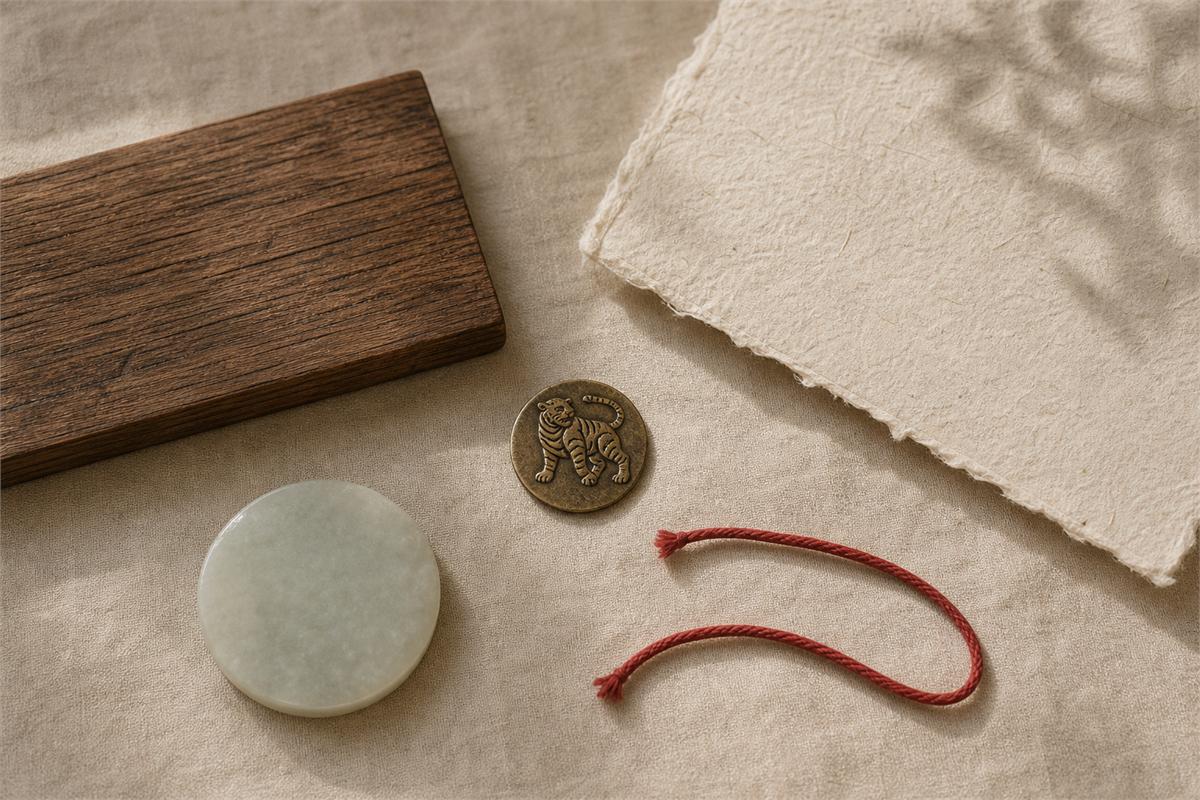
Designers can draw from the branch’s established visual vocabulary without turning it into a personal prescription: an angular 寅 seal, restrained Tiger linework, east-northeast compass geometry, early-spring buds, wood grain, or dawn colors. Green stones, wood, jade, red cord, or dark metal can be chosen for color, texture, craft, and personal taste. They need not be matched to a birth chart, and there is no reason for Tiger-born wearers to avoid Monkey or Snake motifs or to select Pig, Horse, or Dog jewelry as a rule.
For a broader view of how animals, branches, years, and gifts fit together, return to the twelve-animal zodiac guide. For symbolic objects chosen as cultural keepsakes rather than astrological remedies, explore Eastern Story’s Blessing collection.
Frequently Asked Questions
Related Posts