
Tai Sui (太岁) is a layered Chinese cultural concept: it began as an ancient calendrical counterpart to Jupiter, later became the yearly deity of a 60-year cycle in Daoist and popular religion, and now also appears in customs connected with Fan Tai Sui (犯太岁) and Benmingnian (本命年). These traditions express respect for time, order, change, and blessing. They do not provide a testable guarantee of luck, health, wealth, or misfortune.
Tai Sui Meaning at a Glance
| Context | What Tai Sui means | How to understand it today |
|---|---|---|
| Ancient astronomy and calendar | An idealized counter-Jupiter used in a 12-part system of years and directions | A historical method for coordinating celestial observation and calendrical naming |
| Sexagenary cycle | The yearly position identified through Heavenly Stems and Earthly Branches | Part of the 60-combination cycle still used in traditional date language |
| Daoist and popular religion | The yearly Tai Sui deity, one of 60 figures associated with the cycle | A living religious and folk tradition whose names and rites vary by institution |
| Zodiac custom | The annual branch compared with a person’s birth-year branch | The basis of folk labels such as value, clash, punishment, harm, and break |
| Modern design | A symbol of annual reflection, steadiness, blessing, or cultural identity | Aesthetic and emotional language, not a promise of a particular outcome |
English sources sometimes translate Tai Sui as “Grand Duke Jupiter.” That phrase is convenient but incomplete. Tai Sui is not simply the physical planet Jupiter, and the religious figure is not reducible to an astronomical object. The meaning changed as calendrical ideas, astrology, state ritual, Daoist practice, temple culture, and household custom interacted over many centuries.

From Jupiter to the Virtual Tai Sui
Sui Xing: Jupiter as the Year Star
Ancient observers called Jupiter Sui Xing (岁星), the “Year Star.” Jupiter completes an orbit in about 11.86 years, close enough to 12 years to support a cycle divided into 12 stations. Its observed position could therefore help name or distinguish years. This celestial framework is one reason the number 12 became important in later explanations of Earthly Branches and zodiac years.

The system was not a modern scientific calendar built from an exact 12-year Jovian orbit. Jupiter’s real period is not exactly 12 years, and its apparent direction did not align conveniently with the established sequence of the 12 terrestrial branches. Ancient calendrical thought answered this problem with an idealized counterpart.
Sui Yin: an Idealized Counter-Jupiter
The virtual Tai Sui, also discussed under names such as Sui Yin (岁阴), was imagined as moving opposite Jupiter through a regular 12-year cycle. It was not an undiscovered planet. It was a conceptual time-and-direction marker that made the sequence easier to coordinate with Earthly Branches.

Traditional year names also used a paired system of “year-yang” and “year-yin” designations. Over time, sexagenary stem-branch dating became the more familiar way to express the cycle. The historical development was gradual, so it is more accurate to describe Tai Sui as one strand in the evolution of calendrical and astrological thought than as the single invention that directly created the modern zodiac.
The 60-Year Cycle and the Yearly Tai Sui Deity
The sexagenary cycle combines 10 Heavenly Stems with 12 Earthly Branches in sequence. Because the two sequences repeat together after 60 pairings, the complete cycle runs from Jiazi (甲子) through Guihai (癸亥). A zodiac animal identifies the Earthly Branch, but a full sexagenary year also has a Heavenly Stem. This is why two years with the same animal, 12 years apart, are related but not identical within the 60-year system.

In Daoist and related popular traditions, the cycle was personified as 60 Tai Sui deities or generals. One is said to be “on duty” for each stem-branch year and is called the yearly Tai Sui (值年太岁). The belief turns an abstract calendar into a sacred annual relationship: the year has a name, a place in a repeating order, and a figure to whom worshippers may express respect and hopes for peace.
Lists of personal names, titles, images, and ritual sequences are not perfectly uniform across periods, temples, regions, and lineages. A current-year name or ritual instruction should therefore be taken from the specific temple or Daoist institution conducting the observance, not treated as one universal national rule.
What Does Fan Tai Sui Mean?
Fan Tai Sui (犯太岁) literally suggests offending, encountering, or coming into a difficult relationship with Tai Sui. In common zodiac explanations, a person’s birth-year Earthly Branch is compared with the branch of the current year. Certain patterned relationships receive names such as value, clash, punishment, harm, or break.
These are categories within folk astrology and traditional metaphysical systems. They are not diagnoses and do not establish that someone will become ill, lose money, face a lawsuit, have an accident, or experience relationship failure. Different practitioners may also apply the categories differently, especially when moving from a simple birth-year zodiac comparison to a complete birth chart.

Value, Clash, Punishment, Harm, and Break Compared
| Folk category | Chinese term | Structural idea | Cultural reading, not a prediction |
|---|---|---|---|
| Value Tai Sui | 值太岁 | Birth-year branch matches the current-year branch | A return to one’s own zodiac position; often linked with Benmingnian and annual self-reflection |
| Clash Tai Sui | 冲太岁 | The two branches form one of the six oppositions | A symbolic language of facing, movement, contrast, or reorientation |
| Punishment Tai Sui | 刑太岁 | The branches enter one of several traditional “punishment” patterns | A symbolic language of friction, constraint, or repeated tension; the exact pattern depends on the system used |
| Harm Tai Sui | 害太岁 | The branches form one of six “harm” pairings | A symbolic language of indirect incompatibility or difficulty in coordination |
| Break Tai Sui | 破太岁 | The branches form a traditional “break” pairing | A symbolic language of loosening, separation, or a structure needing review |
The English words “punishment,” “harm,” and “break” can sound more alarming than the underlying classificatory role. They translate compact technical terms used to describe relationships among branches; they are not verdicts about a person. A responsible explanation identifies the relationship without attaching a guaranteed event to it.

Is Benmingnian the Same as Fan Tai Sui?
Benmingnian is the return of a person’s birth-year zodiac branch, normally every 12 years. In the five-category model, that matching relationship is called value Tai Sui. Benmingnian is therefore commonly treated as one form of Fan Tai Sui, but the two expressions are not exact synonyms: Fan Tai Sui is the broader umbrella, while Benmingnian describes the person’s own zodiac-year return.
A zodiac animal alone also does not reproduce every detail of a full sexagenary birth year. Someone born in a Horse year, for example, meets another Horse year every 12 years, while the exact stem-branch pairing returns only after 60 years. For a clear overview of the animals and their visual language, see Chinese Zodiac Symbols.

“Digging on Tai Sui’s Head”: History and Modern Meaning
The saying Tai Sui tou shang dong tu (太岁头上动土), “to move earth on Tai Sui’s head,” comes from the traditional association between the annual Tai Sui position and a direction that should not be disturbed. In building and geomantic customs, excavation in that direction could be framed as an act of disrespect toward the year’s authority.
In modern Chinese, the expression is usually figurative. It describes someone recklessly challenging a powerful person, violating a serious boundary, or provoking trouble. The idiom survives even when speakers are not discussing construction, astrology, or religious practice.
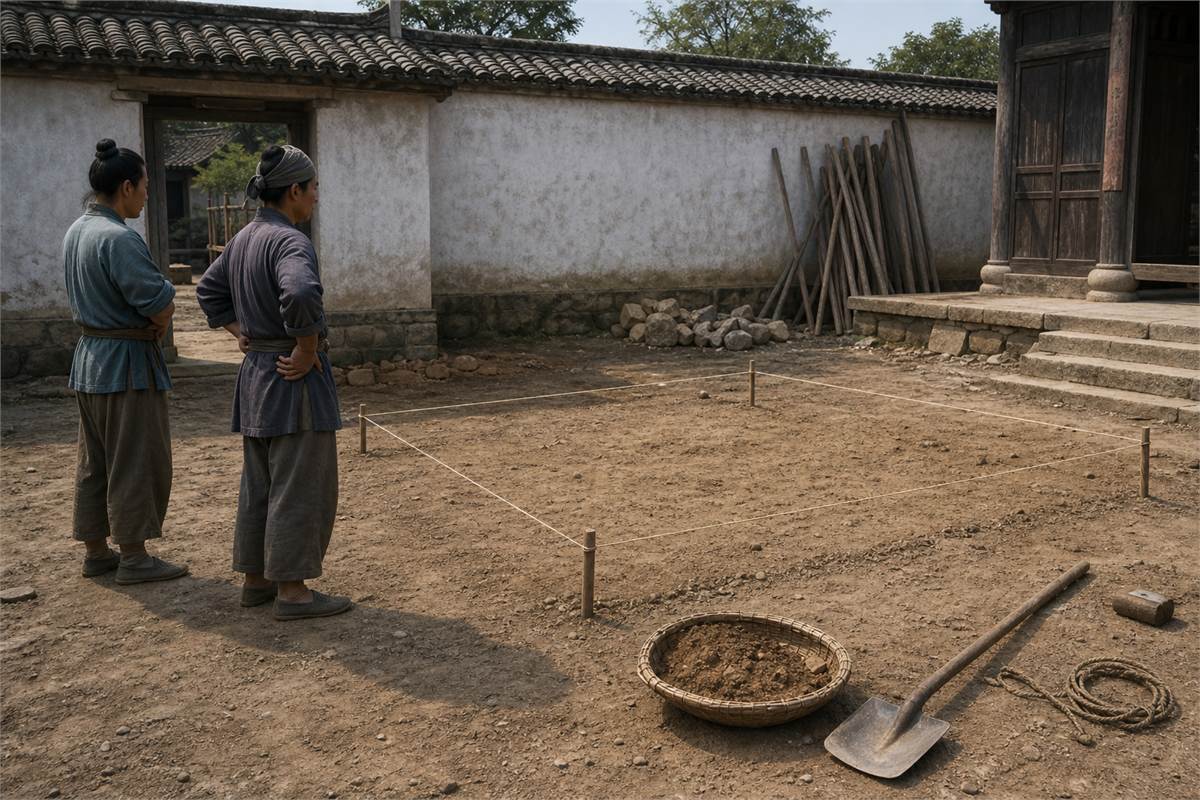
This history does not mean every household must stop repairs in a prescribed direction. Annual directions and construction taboos belong to particular geomantic systems, while safe building work depends on engineering, permits, contractors, budgets, and the physical condition of the property. A family that follows a local custom can ask a trusted tradition holder how that custom is practiced without turning it into a universal safety rule.
Bai Tai Sui, An Tai Sui, Xie Tai Sui, and Wearing Red
Temple and Household Observances
Bai Tai Sui (拜太岁) means paying respects to Tai Sui. An Tai Sui (安太岁) can refer to enshrining or ritually settling the annual relationship, while Xie Tai Sui (谢太岁) expresses thanks later in the year. These practices may include prayer, incense, written petitions, lamps, offerings, talismans, or charitable giving, but the details depend on the Daoist temple, local shrine, community, and family.
There is no need to combine every custom into one mandatory sequence. A Daoist rite should be understood on its own terms; a temple that serves several religious communities may have a different local practice; and a household observance may be much simpler. Visitors should follow the instructions of the institution they actually attend, including its calendar, etiquette, offerings, accessibility, and fire-safety rules.

Red Clothing and Red String
Red is widely associated with celebration, vitality, blessing, and protection in Chinese festive culture. In some families, a person in Benmingnian receives red clothing, a belt, socks, or a bracelet. The gift itself can matter as much as the color: it communicates that relatives are thinking of the wearer as a new cycle begins.
Wearing red is optional. There is no evidence-based requirement to use a particular shade, cover the whole body, wear a bracelet on the left hand, or balance the color with a prescribed gemstone. Readers interested in the broader history and varied meanings of the material can explore Red String Bracelet Meaning.

How to Respect the Tradition Without Anxiety
- Name the framework. Say “in a folk zodiac system” or “in this temple’s practice” instead of presenting a belief as an unavoidable natural law.
- Separate category from outcome. A branch relationship can be explained without predicting illness, lawsuits, accidents, financial loss, or family conflict.
- Choose a meaningful level of participation. Learn the history, visit a temple respectfully, wear a gifted red item, make a charitable donation, or simply mark the year in a journal.
- Keep ordinary decisions evidence-based. Moving, renovating, traveling, exercising, seeking medical care, or investing should be decided with relevant practical information and qualified advice.
- Reject urgency and fear. Be cautious when a seller claims that everyone is endangered, a purchase must be made immediately, or a costly object guarantees protection.
- Allow regional difference. Dates, offerings, names, directions, and etiquette can differ. Ask the actual community rather than combining online lists into a supposed national rule.
- Use the annual theme constructively. Reflection, gratitude, careful planning, and kindness are valuable in any year without needing a supernatural guarantee.
Tai Sui Symbols in Modern Jewelry and Gifts
Contemporary jewelry may translate Tai Sui culture through red cord, a zodiac animal, a small inscribed plaque, circular cycle imagery, or restrained geometric references to the annual branch. Some pieces retain devotional language; others use the symbol more broadly as a reminder of steadiness during change. Neither approach should be assumed from appearance alone.
Modern design can make the subject wearable without erasing its source. A minimal pendant may emphasize the 60-year cycle, a zodiac charm may mark Benmingnian, and a red bracelet may carry a family blessing. Materials such as gold, silver, wood, stone, enamel, cord, pearls, or glass affect appearance, price, durability, and care—not the certainty of a spiritual result.

A Rational Selection Checklist
- Ask what the visible symbol is and whether the design is religious, zodiac-based, or simply decorative.
- Choose an object that fits the recipient’s own beliefs; do not surprise someone with a fear-based “remedy.”
- Confirm dimensions, weight, clasp or cord construction, metal contact surfaces, and material care.
- Prefer clear descriptions over claims about magnetic fields, crystal healing, automatic wealth, or guaranteed protection.
- Do not assume a left-wrist rule, a compulsory zodiac ally, or a required birthstone.
- For a temple-issued item, follow that temple’s guidance and treat the object respectfully.
- For a fashion piece, judge comfort, workmanship, finish, return terms, and how naturally it fits daily clothing.
Gift Language That Does Not Promise an Outcome
| Occasion | Cultural emphasis | Simple gift message |
|---|---|---|
| Benmingnian | Beginning another 12-year zodiac cycle | “A red reminder that you are loved as a new cycle begins.” |
| Lunar New Year | Renewal, peace, and good wishes | “Wishing you a steady, joyful year and confidence through every change.” |
| Career or life transition | Reflection and composure | “For clear choices, patient progress, and a strong sense of direction.” |
| Cultural jewelry collector | Calendrical history and symbolic design | “A contemporary piece inspired by the rhythm of the 60-year cycle.” |
A gift can express care without claiming to control another person’s future. The Blessing collection offers additional symbols for recipients whose tastes may be better matched by peace, longevity, love, protection, or another auspicious theme.

Is “Natural Tai Sui” or Rou Lingzhi the Same Thing?
No. Objects popularly called “natural Tai Sui,” “Tai Sui meat,” or Rou Lingzhi (肉灵芝) belong to a separate modern vernacular topic. The shared name does not make them the calendrical Tai Sui, a yearly deity, or the source of Fan Tai Sui customs.
Reports under the Rou Lingzhi label describe unusual gelatinous or fleshy masses, but the label does not by itself establish one uniform species or biological composition. Public explanations and individual studies have proposed slime-mold-like material or complex microbial communities, yet it is unsafe to turn those limited descriptions into the universal claim that every specimen is one “fourth form of life,” always contains the same bacteria, fungi, archaea, and slime molds, or necessarily regenerates after cutting.
Historical longevity stories are cultural history, not evidence that an unidentified mass is edible or medicinal. Do not eat or self-medicate with an unknown specimen. This article uses “Tai Sui” for the astronomical, calendrical, religious, and folk-cultural concept; Rou Lingzhi is mentioned only to prevent a common name confusion.

Tai Sui as a Cultural Guide to Time
Tai Sui endures because it connects several ways of understanding a year. It recalls ancient observation of Jupiter, the orderly language of stems and branches, the 60-year religious cycle, family customs around Benmingnian, and the human wish to meet change with respect rather than panic.
The most balanced modern approach is neither mockery nor fear. Learn which tradition is speaking, recognize the difference between symbolism and verifiable outcomes, participate at a level that feels sincere, and make real-life decisions with real-world evidence. In that form, Tai Sui becomes a rich cultural language for annual reflection, blessing, and continuity.
Frequently Asked Questions
Related Posts


0 Comments