
Ancient Chinese coins are historical money, archaeological evidence, works of casting and calligraphy, and—through later use—powerful cultural symbols. The best-known type is the Chinese cash coin: a round cast coin with a square central hole, usually bearing an inscription. Its practical design made casting, finishing, counting, and carrying easier. Later generations also read the round-and-square form as an image of heaven and earth, balance and principle, but that symbolism should be understood as a cultural interpretation rather than the documented reason a Qin mint chose the form.
This guide follows Chinese coin history from early cowries, spade money, knife money, ant-nose money, and ring-shaped coins to the Qin Ban Liang coin (半两), Han Wu Zhu coin (五铢), Tang Kaiyuan Tongbao (开元通宝), Song copper and iron cash, paper money, silver, and the machine-made copper coins of the late Qing. It also explains Chinese charm coins, Five Emperors coins, red-cord ornaments, collecting, lawful provenance, jewelry reuse, and how to store ancient coins without damaging their surfaces.
In This Guide
- What Chinese cash coins are
- Why the coin is round with a square hole
- Chinese coin history from the pre-Qin era to the late Qing
- Inscriptions, casting, alloys, strings, and economic use
- Circulation and influence across East Asia
- Charm coins, Five Emperors coins, and red cords
- Coin patterns in art and decoration
- How to identify Chinese coins and verify provenance
- Safe storage, corrosion, jewelry, gifts, and display
What Are Chinese Cash Coins?
Chinese cash coins are cast, usually round coins with a central hole, most famously a square one. In Chinese, the form is commonly called a round coin with a square hole, fangkong yuanqian (方孔圆钱), or simply square-holed money, fangkong qian (方孔钱). English-language collectors use “cash” for the small base-metal denomination and the broader coin tradition; the word is not a reference to modern paper cash.
The design existed in changing forms for roughly two millennia. It was not one unchanging coin, one alloy, or one fixed value. Authorities altered weight standards, inscriptions, metal recipes, denominations, mint systems, and accounting practices. Old issues often remained in circulation beside newer ones. Some regions relied heavily on iron cash, some used paper, and large transactions increasingly involved silver in later periods.
It is also important to distinguish money from coin-shaped objects. A genuine circulating cash coin was issued or accepted as money. A Chinese charm coin—often called a “flower coin,” huaqian (花钱), or a victory-suppression charm, yasheng qian (压胜钱)—was made primarily for ritual, commemorative, decorative, festive, or auspicious use. A modern replica may copy either category but remains a reproduction unless it is clearly documented as an original historical object.

Round Coin, Square Hole Meaning: Function First, Symbolism Second
Why the square hole was practical
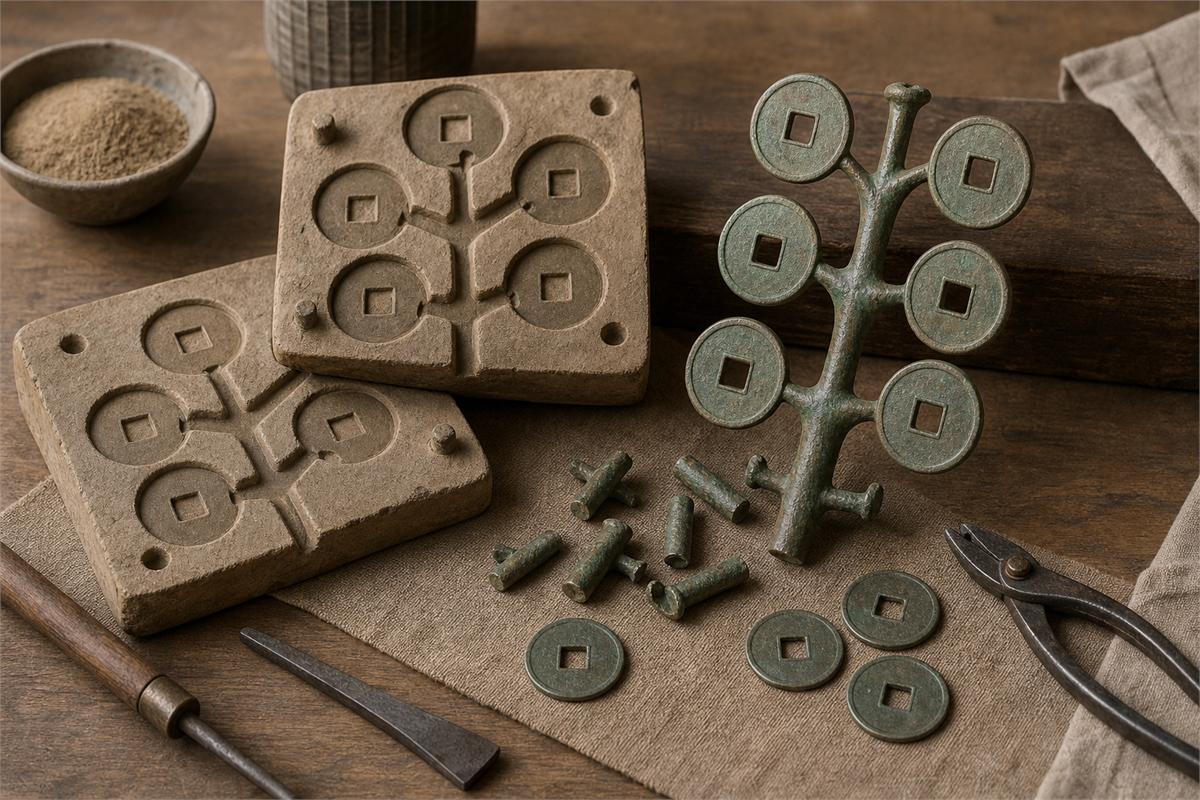
The square hole had clear manufacturing and handling advantages. Cash coins were normally cast in moulds that produced branching “coin trees.” After cooling, individual coins were broken from the casting and their rough edges finished. A group could be fitted onto a square rod or mandrel; because the coins could not rotate freely, workers could file their outer edges more efficiently. The hole also allowed coins to be threaded on cord, fibre, wood, or metal rods for carrying, counting, storage, and transport.

These uses explain the form without requiring a philosophical origin story. Earlier Warring States coinages already included round pieces with central holes, including round-hole and square-hole varieties. Qin unification made the round, square-holed Ban Liang a national standard in 221 BCE; it did not create every element of the design from nothing.
Heaven, earth, and “outer round, inner square”
Later cultural readings linked the round exterior with heaven and circulation, and the square opening with earth, order, and boundaries. The form also became a model for the ethical phrase “outer round, inner square”: adaptable and courteous in dealing with others, yet principled at the centre. This is the familiar round coin square hole meaning in modern cultural explanation.
Such interpretations are meaningful, but their evidence belongs to a different layer from minting technology. Claims that the outer circle, square hole, and reign inscription were deliberately designed as heaven, earth, and humanity—or that a coin can literally “turn heaven and earth”—are later symbolic or folk explanations. They should not be presented as engineering specifications from Qin court records or as measurable physical energy.
The nickname Kongfang xiong (孔方兄), “Brother Square-Hole,” comes from a satirical literary tradition associated with Lu Bao’s Western Jin essay Qian Shen Lun (钱神论), not from an official mint name. Likewise, later phrases about strings of wealth evoke the social memory of cash, but a “string” did not always equal a physically complete and universally accepted 1,000 coins. Counts, discounts, and conversion rates varied by place and time.
Chinese Coin History: From Cowries to Machine-Made Copper Coins
A reliable history avoids a tidy map in which one coin type belonged permanently to one direction. Early currencies overlapped, changed, travelled, and were copied. Political authority, access to metal, military needs, local markets, and taxation all shaped what circulated.
| Period | Key developments | What to remember |
|---|---|---|
| Shang and Zhou eras | Natural cowries, imitation cowries, and other value media; later metal coinages developed. | Cowries matter to the history of value and language, but they were not the only money used across every region. |
| Spring and Autumn–Warring States | Spade, knife, ant-nose, bridge, and ring-shaped money appeared in changing regional systems. | Types coexisted and moved; simple “central/east/south/west” labels hide chronology and overlap. |
| Qin, from 221 BCE | The Ban Liang standardized the round, square-holed coin within the unified empire. | The inscription named a weight standard, though surviving pieces vary. |
| Han and later dynasties | Wu Zhu began in 118 BCE; central minting was consolidated in 113 BCE. Wu Zhu-type coinage continued through later regimes. | The often-cited 700-plus years describes a long coin tradition with many issues, not one unchanged emission. |
| Tang, from 621 | Kaiyuan Tongbao replaced weight-unit naming with a treasure inscription and became a major model. | Tang Gaozu initiated it; “Kaiyuan” here means the opening of a new era, not the later Kaiyuan reign title. |
| Song, 960–1279 | Large copper output, regional iron cash, many reign-title varieties, and expanding paper money. | Private jiaozi preceded the official issue; government-issued jiaozi began in 1024 after the bureau was established in 1023. |
| Yuan, 1271–1368 | Paper money dominated official policy; metal cash issues were limited and older coins could circulate. | Paper, copper cash, and silver did not function in a single simple ratio throughout the dynasty. |
| Ming and Qing | Early Ming paper and cash; later silver grew central in taxation and large payments while cash served smaller transactions. Qing markets used cash, silver by weight, and silver dollars. | “Large in silver, small in cash” is a useful summary, not a universal rule for every market. |
| Late Qing–early Republic | Machine-struck copper coins and silver dollars spread while cast cash declined. | The transition overlapped; square-holed cash did not vanish on one date. |
Pre-Qin money: diversity before unification
Cowries were important early valuables and helped give Chinese characters such as cai (财, wealth), huo (货, goods), and gui (贵, valuable) their shell radical. During the first millennium BCE, metal money became increasingly important. Spade-shaped pieces were associated with several states and changed from tool-like forms to more abstract coinage. Knife money circulated in states including Qi and Yan. Chu used distinctive small bronze forms often called ant-nose money. Round or ring-shaped coins were produced by more than one authority.

These were not merely miniature tools used everywhere in the same way. Inscriptions, weights, find contexts, and issuing authorities matter. A collector should identify a particular type and series rather than assigning it to a broad compass direction from shape alone.

Ban Liang coin: Qin standardization
After Qin unified the competing states in 221 BCE, the Ban Liang coin became the empire’s standard base-metal coin. Ban liang (半两) means “half liang,” a weight designation. The National Museum of China describes the Qin issue as a milestone because it unified the basic round, square-holed form for imperial coinage.
That does not mean every surviving Ban Liang weighs an identical theoretical half-liang. Standards, production, wear, later issues, and imitations produced variation. Attribution requires comparison with the correct period and subtype, not a single number copied from a general chart.
Wu Zhu coin: a long-lived standard
Emperor Wu of Han introduced the Wu Zhu coin in 118 BCE. In 113 BCE, the Shanglin Three Offices brought production under tighter central control. Wu zhu (五铢) means “five zhu,” again naming a weight. The system proved extraordinarily durable: Wu Zhu and related issues were cast under different governments until Tang reforms in 621.
The famous figure of 739 years is useful only with this context. It refers to the long life of Wu Zhu-type coinage from Han adoption to Tang replacement. It does not mean the same mint, alloy, calligraphy, diameter, weight, or purchasing power continued unchanged for seven centuries.
Kaiyuan Tongbao: a new naming system
Tang Gaozu ordered the casting of Kaiyuan Tongbao in 621. The inscription Kaiyuan Tongbao (开元通宝) can be understood as “circulating treasure of the new beginning.” It moved coin names away from the old habit of stating a weight such as liang or zhu and established the influential tongbao, yuanbao, and zhongbao treasure-inscription tradition.
Early Kaiyuan calligraphy is traditionally associated with the Tang calligrapher Ouyang Xun. The coin’s proportions and production standards influenced later East Asian currencies. The term should not be confused with Emperor Xuanzong’s Kaiyuan reign, which began more than a century later.

Song cash and paper, then Yuan, Ming, and Qing systems
Song markets demanded enormous quantities of small money. Copper cash predominated in many areas, while iron cash was especially important in Sichuan and in other regional circumstances. Song coins are celebrated for multiple scripts, paired inscriptions, imperial calligraphy, reign titles, denominations, and an immense number of varieties. This richness also makes casual attribution risky.
Heavy iron cash helped create demand for lighter payment instruments. Private merchant notes called jiaozi appeared in Sichuan before the state established an issuing office in 1023 and released official jiaozi in 1024. It is accurate to describe this as the world’s earliest known government-issued paper currency in its specific institutional context, while recognizing that private certificates and earlier paper instruments preceded it.
Yuan rulers made paper money central to official policy and cast relatively few new cash issues. During the Ming, early paper policy gave way to a growing silver economy. By later Ming and Qing times, silver—often weighed as bullion—and silver dollars served many taxes and larger payments, while strings of copper-alloy cash remained important for everyday purchases. In the late Qing, machine-struck copper coins and silver dollars spread through new minting technology. Cast square-holed cash and modern coins overlapped before the old form receded.
Inscriptions, Casting, Alloys, Strings, and Economic Use
How to read the coin
Begin with the inscription, not the patina. Ban Liang and Wu Zhu have two-character legends. Many later cash coins have four characters around the hole. They may be read top–bottom–right–left, clockwise, or according to a series-specific order. The reverse may be blank or carry a denomination, mint, script, dot, crescent, numeral, or other control mark.
The words can name a weight, reign, treasure designation, denomination, or issuing authority. A reign title is a dating clue, but old inscriptions were copied on later charms and replicas. Zhengde Tongbao, for example, appears on later coin-shaped charms even though standard circulating coins with that Ming reign inscription were not issued. Reading characters is therefore the beginning of identification, not the final verdict.
Cast, not struck
Most traditional Chinese cash coins were cast. Molten alloy flowed into clay, stone, bronze, sand, or other mould systems, creating connected coin trees. Individual pieces were separated and finished. Authentic casting can leave small gates, file marks, irregularities, and series-specific surfaces, but genuine coins were made in many mints and qualities. A visible seam or grainy surface may raise concern on a modern copy, yet no single casting mark proves age.
Were all ancient Chinese coins copper?
No. “Copper coin” is convenient everyday language, but the metal varied. Many cash coins are copper alloys: bronze can contain tin and lead, while brass combines copper and zinc. Recipes changed by period, mint, available supply, official regulation, recycling, and debasement. Brass became increasingly common in later imperial coinage, but the change was gradual rather than a clean line before and after one reign.
Iron cash was important in Song regional economies and appeared in other periods. Lead, tin, and mixed alloys also occur. Color alone cannot date a coin, because burial, corrosion, cleaning, soil chemistry, and surface enrichment can make the visible layer differ from the interior alloy. The rule “yellow before Jiajing means fake” is therefore unsafe.

Strings, accounting, and daily exchange
Small cash coins served everyday trade, tax, wages, market exchange, savings, temple offerings, and long-distance commerce. The hole allowed many pieces to be strung. A nominal string or guan (贯) might be reckoned as 1,000 cash, yet real strings could contain fewer coins, and accounting values varied. Exchange between cash, silver, paper, grain, and other media changed with region, date, coin quality, and market conditions.
That flexibility is why an old coin cannot be given one universal modern price or purchasing-power equivalent. A common worn Qing cash, a rare mint variety, an excavated Song hoard coin, and a documented charm are different objects. Value depends on exact type, variety, condition, rarity, authenticity, provenance, legal status, and the market at a stated date.
Chinese Cash Coins Across East Asia and Maritime Trade
Chinese cash travelled through tribute, migration, merchant shipping, diplomacy, warfare, and border exchange. Chinese issues circulated in Japan, the Ryukyu Islands, the Korean peninsula, Vietnam, and parts of maritime Southeast Asia. Local authorities and private producers also made their own square-holed coins, sometimes copying Chinese inscriptions, calligraphic conventions, or weight systems and sometimes developing distinctive national traditions.
Kaiyuan Tongbao provided an especially influential model. Early official coins in Japan, Vietnam, and Korea drew on the Tang format, while later Song cash and imitations became deeply embedded in regional trade. Archaeological finds from shipwrecks and ports show Chinese coins beside silver ingots, gold coins, local money, barter, and commodity exchange.
This was a connected currency sphere, not one uniform “hard currency” imposed on all of Southeast Asia. Acceptance depended on market, metal, political authority, local shortage, and trading network. On the ninth-century Belitung ship, for example, Tang cash represented low-value money alongside valuable silver ingots and other exchange media; the find does not show that every Southeast Asian economy used Chinese cash in the same way.

Chinese Charm Coins, Five Emperors Coins, and Red-Cord Traditions
Flower coins and victory-suppression charms
Chinese charm coins form a wide family of coin-shaped objects that were not ordinary circulating currency. They can carry wishes for long life, rank, marriage, children, peace, examination success, prosperity, protection, calendrical order, or religious aid. Some reproduce coin legends; others show animals, constellations, deities, trigrams, zodiac signs, or narrative scenes.
Modern collectors often group these as huaqian (花钱). The terms yasheng qian (压胜钱) and yansheng qian (厌胜钱) overlap in historical and collector usage but do not mean that every charm was a household exorcism device. Museum collections include marriage charms, spring or erotic charms, treasury coins, temple pieces, child-protection objects, and coin swords. Their iconography and archaeological context should determine interpretation.
New Year money and the story of “sui”
New Year money for children has multiple historical strands: gifted coins, coin-shaped amulets, red cord, seasonal blessing objects, and later red envelopes. The popular story of a demon named Sui (祟) touching children’s heads explains the pun between “suppressing Sui” and “age money,” but it is a folk narrative, not the only documented origin of today’s red envelope.
The enduring cultural message is easier to state with confidence: elders give younger family members money at the New Year as a wish for safety, growth, and a good year. Red intensifies the festive and protective symbolism. The form evolved with social practice, so modern banknotes in envelopes belong to the tradition even when no coin or cord is present.
What are Five Emperors coins?
Five Emperors coins usually means five Qing cash coins from the reigns of Shunzhi (1644–1661), Kangxi (1662–1722), Yongzheng (1723–1735), Qianlong (1736–1795), and Jiaqing (1796–1820). Today they are commonly tied in sequence with red cord and used in folk-inspired jewelry, household decorations, and gift objects.
This five-coin set is a later folk and collecting category, not an official fixed combination issued by those emperors as one ancient object. Labels such as “Big Five Emperors,” “Three Emperors,” or pun-based commercial sets are even more dependent on later or modern usage. They can be explained as cultural beliefs and design traditions, but they should not be sold as devices that guarantee wealth, cure sleep problems, neutralize architecture, or keep a vehicle safe.

What does a red string with a coin mean?
Red cord makes a small coin wearable, hangable, and giftable. In Eastern folk tradition, red expresses celebration, vitality, protection, and good wishes; the coin contributes the language of prosperity, continuity, and circulation. Knots can add craft, rhythm, and a sense of connection. A red-cord coin bracelet or pendant is therefore best understood as a visible blessing and a personal reminder.
Rules such as “left receives, right releases,” “red is fire that activates metal,” or “hang it only between 7 and 9 a.m.” are modern folk prescriptions, not universal historical law. For a broader account of red-cord customs, read the red string bracelet meaning guide. When protective symbolism is the reader’s main interest, the guide to protective jewelry traditions offers a wider comparison.

Coin Patterns in Textiles, Architecture, Ceramics, and Jewelry
Once the square-holed cash became visually familiar, it entered the decorative vocabulary of buildings, windows, paving, ceramics, metalwork, lacquer, embroidery, woven silk, furniture, and jewelry. As money, the cash motif naturally suggested wealth and plenty. As a geometric form, it also offered an elegant contrast between circle and square.

| Term | What it usually describes | Why context matters |
|---|---|---|
| Cash or coin motif, qianwen (钱纹) | A single square-holed coin form or a general coin-derived pattern. | The motif can symbolize wealth, but a circle alone is not automatically a coin. |
| Linked-cash pattern, lianqianwen (连钱纹) | Repeated or interlocking coin forms, often used as a border or all-over design. | The exact layout varies across textiles, ceramics, windows, and paving. |
| Double-cash motif, shuangqianwen (双钱纹) | Two linked or overlapping coin forms. | It can be auspicious, but it is not governed by a universal rule that every pair must remain physically attached. |
| Ball-route pattern, qiuluwen (毬路纹/球路纹) | A geometric network of intersecting circles or medallions. | It may resemble linked coins, but specialists do not use it as a synonym for every cash pattern. |
| Qingfu pattern, qingfuwen (青蚨纹) | A term tied to the literary image of the qingfu insect and the return of money. | It should be used only when the object, inscription, or documentation supports that identification—not for any two coins. |
Rebus pictures add another layer. “Blessing before your eyes,” fu zai yanqian (福在眼前), commonly joins a bat—fu, sounding like “blessing”—with an eye-shaped or square-holed coin, yanqian, sounding like “before the eyes.” Other blessings such as “year after year of abundance” depend primarily on fish and wordplay, not on adding a random coin. A design should be read element by element rather than assigned a lucky phrase because it contains money.
Modern jewelry expands the vocabulary further. Designers may use a real historical coin, a faithful replica, an abstract square-hole disc, a gold cash motif, or a coin-shaped jade carving. These objects can share a visual language without sharing the same age, material, authenticity, or conservation needs.
How to Identify Chinese Coins Without Damaging Them
How to identify Chinese coins: establish the type, then compare multiple independent features with documented examples. No sound, smell, color, rust, or “ancient feeling” can authenticate a coin by itself. A convincing identification aligns inscription, calligraphy, diameter, weight, thickness, rims, central hole, casting method, edge finishing, alloy, patina history, variety diagnostics, and provenance.
A non-destructive evidence checklist
- Record both sides. Photograph the obverse, reverse, edge, and square hole in neutral light with a scale.
- Transcribe the inscription. Identify every character and its reading order before assigning a dynasty.
- Find the exact series. Compare with museum records, recognized catalogues, excavation reports, and known genuine examples—not a generic marketplace photo.
- Measure carefully. Record diameter, thickness, and weight with suitable equipment. Compare with the range for that precise type and variety.
- Examine manufacture. Look at rims, hole, casting gates, file marks, relief, fields, and any repeating depressions or tooling under magnification.
- Assess the metal. Visual color is preliminary. For valuable or disputed pieces, non-destructive elemental analysis can help test whether composition is plausible.
- Check provenance. Ask where, when, and from whom the coin was acquired and retain invoices, old labels, collection records, export documents, and prior photographs.
- Consult expertise. Use a specialist in Chinese numismatics or a reputable third-party service that accepts the specific cash-coin category.

Weight and diameter are necessary but not decisive. Genuine cast cash can vary, corrode, clip, or lose metal; modern copies can be made to the expected dimensions. Casting seams, porous surfaces, soft characters, repeating marks, and wrong calligraphy may be warning signs, yet authentic environmental damage can imitate some of them. The conclusion should come from the whole pattern.
Tests to avoid
Do not tap or drop a coin to hear its ring. Do not scrape the edge, pierce corrosion with a needle, sniff for “earth aroma,” wet the patina to see if it lifts, or judge age from a bright yellow or dark green color. Do not apply vinegar, lemon juice, polish, strong acids, alkalis, or commercial rust removers. These actions can erase file marks, characters, patina, residues, and archaeological information while lowering value and exposing lead-bearing corrosion dust.
Original, replica, fantasy piece, or design motif?
A seller should state what an object is. “Qianlong-style brass charm,” “museum-inspired replica,” “modern cast Five Emperors set,” and “Qing Qianlong Tongbao cash coin” are different claims. A replica can be attractive and culturally meaningful when it is permanently documented as modern. Removing that disclosure and selling it as ancient is misrepresentation.
Certificates also require verification. Match the coin, holder, label number, photographs, and issuing organization. A label cannot replace the object, and counterfeit holders exist. For an important purchase, obtain a written invoice with authenticity, material, condition, return, and provenance terms.
Lawful and ethical provenance
Coins are regulated differently across countries. Before buying, selling, importing, exporting, or keeping a find, check the laws of the place where it was discovered, the seller’s country, the destination country, and any transit jurisdiction. Archaeological discoveries may belong to the state or require prompt reporting. Export licences may be necessary even for common-looking coins.
The UNESCO 1970 Convention includes certain coins and archaeological material within the cultural-property framework when designated by states, while ICOM emphasizes due diligence and complete provenance. A freshly surfaced “excavated” group with no find record, ownership history, or legal export trail is a reason to walk away. Responsible collecting preserves context rather than rewarding looting.
How to Store Ancient Coins and Respond to Green Corrosion
The safest principle is preservation, not improvement. Stable patina can be brown, black, red, blue, or green. A smooth, coherent layer may protect the metal and preserve evidence. Cleaning an ancient coin until it shines removes surface material and can make its inscription harder—not easier—to study.
Safe handling and individual storage
- Work over a clean, padded surface so a dropped coin cannot roll away or strike a hard floor.
- Follow the holding institution’s protocol. Clean, dry hands may be suitable for some stable coins; well-fitting powder-free nitrile gloves may be preferred for others. Avoid loose gloves that reduce grip.
- Hold a stable coin by the edge and support fragile or corroded pieces in a tray rather than gripping them.
- Place each coin in its own inert capsule, archival coin flip, or compartment with an acid-free identification label.
- Avoid soft PVC flips, ordinary vinyl bags, acidic paper, rubber bands, adhesive tape, untested foam, fresh paint, and unknown wooden boxes that may release harmful vapours.
- Keep temperature steady and humidity low and stable. Avoid bathrooms, kitchens, damp basements, windowsills, direct sun, and rapid temperature swings.
- Store provenance documents and photographs separately and back them up digitally so object identity survives a lost label.

For wider jewelry and object-care principles, the Eastern Story care guide provides a useful starting point. Ancient and archaeological metal still deserves specialist advice because its corrosion chemistry and historical surface are not equivalent to a modern polished brass accessory.
Is green rust dangerous?
Green color by itself is not a diagnosis. Stable copper patina can be green. Active corrosion, often called bronze disease on archaeological copper alloys, is more concerning when pale green powder forms or reappears in spots, loose material gathers around an undisturbed object, or the surface begins flaking. Chloride-contaminated copper alloys can deteriorate quickly in humid air.
Isolate the coin from the collection, keep the environment dry and stable, photograph the change, and contact a metals conservator. The Canadian Conservation Institute advises low relative humidity—typically below 42% for objects affected by bronze disease. Do not treat the coin with vinegar or acetic acid, dig into the corrosion with a needle, or attempt home chemical “neutralization.” Treatment choices depend on the alloy, chloride level, surface, significance, and prior conservation.

Some historical copper alloys contain lead. Avoid creating or inhaling dust, wash hands after handling if gloves were not used, and keep coins away from food preparation and children’s mouths. A child should not wear or play with a loose ancient coin, corded charm, or small replica because of swallowing, heavy-metal, and entanglement risks.
Chinese Coin Jewelry: Ancient Coin, Replica, or Motif?
Chinese coin jewelry includes several very different products:
- Jewelry made with a genuine historical coin: the coin itself is the central object and needs provenance, authentication, condition disclosure, and conservation-sensitive mounting.
- Replica or antiqued coin jewelry: a modern cast copy provides the historical look while allowing stronger, safer, and more replaceable construction.
- Coin-pattern jewelry: gold, silver, brass, or other metal is shaped with the round-and-square motif without claiming to be ancient.
- Jade or stone coin motifs: the material carries its own history and care requirements while the opening refers visually to cash coins.
- Printed or engraved cultural designs: the coin appears as an image on a pendant, charm, textile, or decorative object.
A historically significant true coin should normally be kept intact. Drilling, soldering, gluing, polishing, plating, and tight bezels can cause irreversible loss. A custom reversible mount that supports the edge without abrasion is preferable when display is appropriate. Rare, archaeologically documented, fragile, or actively corroding pieces belong in conservation-grade storage, not daily-wear jewelry.
Modern replicas and abstract motifs are often the thoughtful choice for daily wear. They allow secure bails, smooth edges, known metal composition, and clear replacement if the piece is lost. The Eastern Story material guide can help readers compare contemporary jewelry materials. Gold content and craft quality should be assessed through hallmarking, weight, workmanship, seller terms, and testing; a decorative technique is not a promise of investment return.

Choosing an Ancient Chinese Coin Gift
Begin with the recipient rather than a fixed lucky formula. A numismatist may value an attributed coin with documented provenance. A design lover may prefer a reversible replica pendant, jade cash motif, or red-cord ornament. A history reader may enjoy a clearly labelled reproduction paired with a book or museum catalogue. For a housewarming or business milestone, a modern coin-pattern object can express continuity, responsible prosperity, and a new beginning without risking an antiquity.
| Recipient | Good choice | Check before giving |
|---|---|---|
| Coin collector | Authenticated coin of a known type or a specialist reference. | Exact attribution, provenance, condition, legal export/import, return terms, and independent opinion. |
| Jewelry wearer | Replica, abstract cash motif, or reversible mount using a common documented coin. | Metal disclosure, allergies, secure setting, sharp edges, cord strength, and whether alteration occurred. |
| Culture and design enthusiast | Jade, gold, silver, ceramic, textile, or print using a correctly described coin motif. | Material identity, maker, design source, motif accuracy, and care. |
| Child or family gift | A book, framed image, large sealed display, or age-appropriate modern object. | No loose small parts, accessible lead-bearing metal, long cords, sharp edges, or unverified antiquities. |
| Housewarming or business gift | Stable modern décor with reversible wall or case display. | Secure mounting, no adhesive on coins, no damp placement, and no promised supernatural outcome. |

Price alone cannot authenticate a gift. Common cash coins may be inexpensive; rare varieties can be heavily counterfeited. The honest identity of the object is more important than a dramatic story. If the goal is symbolic blessing rather than collecting, explore the Eastern Story blessing collection for modern objects designed for daily life.
Safe and Reversible Display
Display coins in a closed case, inert capsule, archival mount, or stable frame that can be opened without damaging the object. Support weight mechanically and keep original labels nearby. Use security screws or a locked case for valuable pieces. Avoid gluing coins to boards, sealing them in unknown resin, placing them under a door mat, or burying them beneath a threshold where moisture, abrasion, and loss of provenance are likely.
For hanging décor, choose a location away from damp air, cooking vapour, direct sun, active door swing, pets, and small children. Check cord, knots, hooks, and mounts regularly. In a vehicle, use a secured compartment; do not hang a coin ornament where it can obstruct the driver’s view, strike the glass, interfere with controls, or become a projectile.

A Small Coin With Several Histories
An ancient Chinese coin can be read on several levels at once. Its alloy and casting record technology. Its inscription records authority and monetary language. Wear and corrosion record circulation and environment. Its square hole records practical handling. Later charms, red cords, Five Emperors sets, and decorative patterns record how money became a symbol.
The most respectful approach keeps those layers distinct. Learn the exact coin before repeating a story, preserve the surface before trying to improve it, and choose lawful provenance before a tempting bargain. Whether the object is a museum-grade antiquity, a humble cash coin, or a modern motif, its meaning becomes richer when history, craftsmanship, symbolism, and care remain visible together.
Frequently Asked Questions
Related Posts


