
Rudraksha is the hard, sculptured inner stone of a blue-fruited Elaeocarpus tree, commonly called a seed or pit and strung as prayer beads or collectible bracelets. In Chinese collector culture, it is called Jingang Bodhi (金刚菩提): jingang evokes indestructible resolve, while bodhi means awakening, although Rudraksha has a different Sanskrit origin. Hindu tradition connects the beads with Shiva; Buddhist malas use beads for counting and concentration. Collectors brush and handle them to remove residue, distribute skin oils, deepen color, and build an even patina slowly.
A good strand is chosen first for mature material, sound skin, and density—not for the loudest sales name or the rarest face count. From there, texture, shape, size, and a patient rhythm of brushing, clean handling, and rest determine how comfortable the beads feel and how gracefully they age.
What Rudraksha Actually Is
Rudraksha comes from evergreen trees in the genus Elaeocarpus, a tropical and subtropical group in the Elaeocarpaceae family. The trade and older literature often use Elaeocarpus ganitrus. Current botanical references also use Elaeocarpus angustifolius and Elaeocarpus sphaericus, and taxonomic treatments do not always place these names in exactly the same way. That is why a careful description identifies the genus and the hard fruit stone instead of presenting one market label as the only possible botanical name.

The tree bears blue to blue-purple drupes. Beneath the fleshy outer fruit is a hard, stony endocarp—the deeply ridged structure collectors clean, drill, string, and handle. It is casually called a seed, bead, nut, or pit, but the carved-looking exterior is the fruit's hardened inner wall; actual seeds sit within its chambers.

Rudraksha is not the seed of the Buddhist Bodhi tree, Ficus religiosa. The two plants are botanically unrelated. “Bodhi” entered the Chinese collector name as a cultural word for awakening and bead practice, while Rudraksha is the established South Asian name for this Elaeocarpus material.
Rudraksha Meaning in Hindu, Buddhist, and Chinese Collector Culture
Hindu tradition: Shiva's tears
The Sanskrit name Rudrākṣa joins Rudra, a name associated with Shiva, and akṣa, commonly understood as “eye.” Hindu devotional tradition tells of Shiva's tears falling to earth and becoming Rudraksha trees. The image holds compassion together with Shiva's power of destruction and renewal: tears arise from deep awareness, while the hard bead becomes a companion for prayer, repetition, restraint, and remembrance.

This is the proper home for the familiar phrase “Shiva's tears.” It is a Hindu mythic and devotional interpretation, not a botanical claim and not the source of every later Buddhist or collector meaning.
Buddhist mala practice: counting and attention
In Buddhist practice, a mala helps count recitations, return attention to a phrase or Buddha-name, and give the hands a steady rhythm. Rudraksha may be used as one bead material among many, but the Buddhist use of prayer beads should be kept separate from Shiva mythology. Rudraksha is not one of a universally defined “Buddhist Seven Treasures,” and its meaning does not depend on claims that the historical Buddha held this exact bead type.

Readers interested in the full structure and traditional count can continue to Eastern Story's guide to why mala beads have 108 beads.
Jingang Bodhi meaning in Chinese collector culture
In the Chinese name Jingang Bodhi (金刚菩提), jingang draws on the vajra image of diamond-like firmness and thunderbolt force. Collectors read it as indestructible resolve (金刚意志)—the steadiness to meet pressure without losing one's center. Bodhi points to awakening (菩提觉悟) and the patience of cultivation. Rudraksha itself is not etymologically derived from vajra or bodhi; the Chinese name is a later cultural interpretation of the bead's hard form and contemplative use.
Modern handling adds a visible metaphor. A fresh bead begins dry, rough, and dusty in its deepest grooves. With clean brushing, handling, and rest, it can move toward jujube red, an oxford-red patina(牛津红包浆), a glassy base(玻璃底), or a jade-like finish(玉化). The change rewards patience and companionship: the bead records repeated care rather than instant transformation.

What does “Jingang language” mean?
“Jingang language” is not a standard term for Rudraksha. A seller or collector may be loosely referring to the Diamond Sutra, a Vajrasattva mantra, a blessing phrase, or collector jargon about faces, skin, texture, and patina. These are different religious texts and modern speech habits, so the phrase needs context instead of being treated as a single Rudraksha teaching.
Rudraksha Mukhi Types and Bead Counts
Natural grooves divide the hard stone into longitudinal sections called mukhi, meaning “faces” or “mouths.” A five-faced bead(五瓣)has five natural sections running around the stone. Face count affects rarity and devotional interpretation, but rarity is not the same as quality. A common five-faced bead with mature skin, strong density, full texture, and no structural damage is a better long-term choice than a rare bead with cracks, weak tissue, heavy treatment, or artificial carving.

| Mukhi type | Availability and collector reading | Traditional or gift interpretation |
|---|---|---|
| Three-faced(3瓣) | Less common than five-faced beads; inspect natural continuity of all three grooves. | Hindu sources associate it with sacred fire; modern gifts often translate this as renewal, courage, and clearing a path forward. |
| Four-faced(4瓣) | Less common and often priced above ordinary five-faced material. | Traditionally linked with Brahma; commonly chosen as a blessing for learning, expression, and creative thought. |
| Five-faced(5瓣) | The most familiar and beginner-friendly type, with the broadest choice of sizes and textures. | Associated with the fivefold form of Shiva in Hindu Rudraksha tradition; in modern gifts it conveys balance, steadiness, and everyday protection language. |
| Six-faced(6瓣) | Less common than five-faced beads but still practical for a wearable strand. | Traditionally associated with Kartikeya, and in some versions Ganesha, with emphasis on intellect and discipline. As a gift, it suits study, career focus, or a new undertaking. |
| Seven faces and higher | Increasing rarity can raise the price, but natural grooves, mature material, and structural soundness still come first. | Associations vary across Hindu texts, regional traditions, and modern sellers. Choose the meaning only after checking the actual tradition being cited. |
| Thirteen-faced(13瓣) | Rare and collector-oriented; provenance and careful inspection matter more than a dramatic sales story. | Traditional texts connect it with desire, attraction, or fulfillment. A modern gift can frame it as confidence and presence, without turning those themes into promised status or wealth. |
Bead count has its own layer of meaning. A full 108-bead mala is widely used in Buddhism and is often explained through the 108 afflictions or defilements. A 54-bead strand is half of 108, 36 is one-third, and 27 is one-quarter, making shorter counting cycles easier to carry. Twenty-one-bead and 18-bead strands appear in some prostration, short-practice, wrist-mala, and collector formats. Their exact explanations differ by school and region, so they are better presented as practice-specific counts than as one universal doctrine.
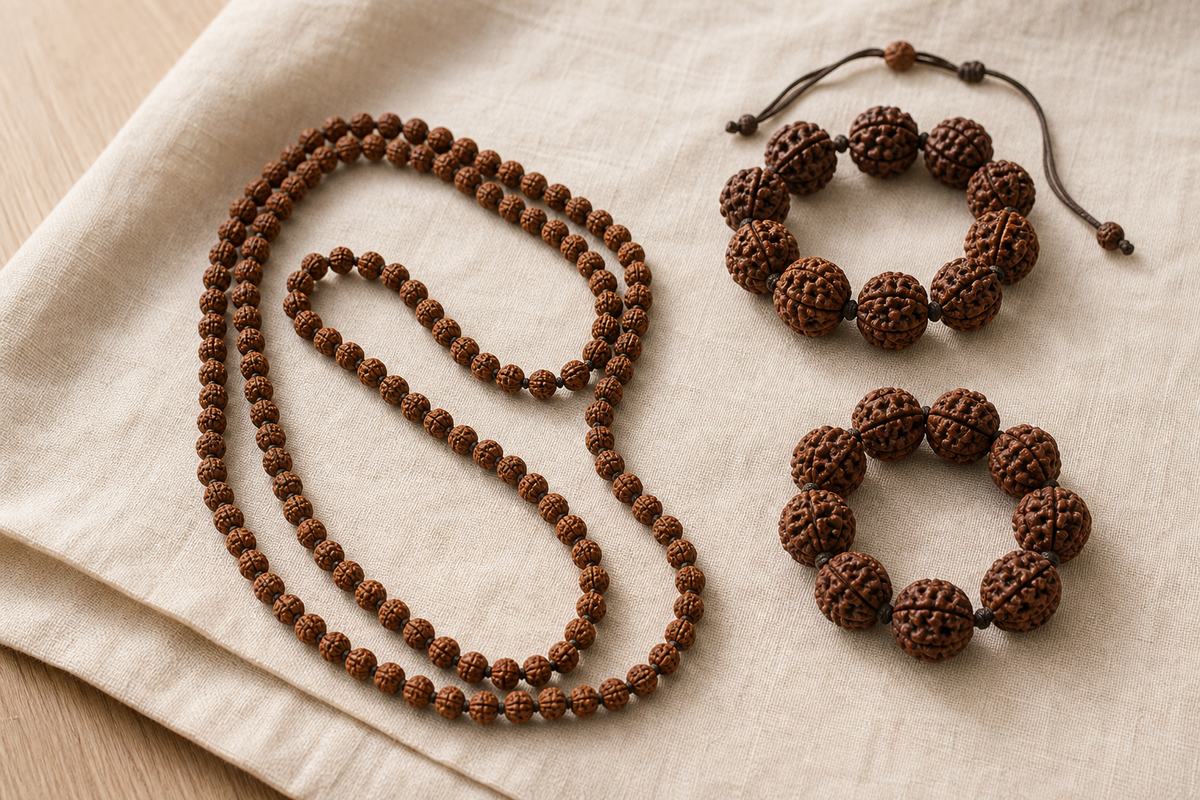
Large and Small Jingang Bodhi: Size, Origin, Texture, and Shape
Chinese collectors often divide the market into large Jingang Bodhi(大金刚)and small Jingang Bodhi(小金刚). The categories combine size, sourcing, texture, and customary use rather than describing two perfectly fixed botanical groups.
- Small beads around 10 mm: comfortable for multi-wrap bracelets, long 108-bead strands, commuting, and people who prefer a lighter, more detailed rhythm.
- Large beads from about 18 mm: visually bold and tactile, usually suited to a single wrist strand or hand-held bracelet.
- Large beads around 20 mm: often fit larger hands and collectors who want strong texture in the palm, but weight and edge comfort should be checked before purchase.

Nepalese large Rudraksha and Indonesian small Rudraksha are familiar market classifications. Nepal is known for many bold, deeply grooved large beads, while Indonesian supply is often associated with smaller, finer-textured beads suited to long strands. These are useful shopping categories, not absolute grades. Mature harvest, density, skin quality, natural texture, treatment history, and consistency across the strand are more reliable than a claim that one country is the only source of good material.
Texture terms collectors use
| Collector term | What it looks and feels like | Care consequence |
|---|---|---|
| Explosive flesh(爆肉) | Very full, raised ridges with strong visual volume. | Impressive in the hand, but inspect valleys for hidden residue and broken teeth. |
| Full flesh(满肉) | Rounded, substantial ridge tissue with fewer dry, needle-like projections. | Usually comfortable and easier to brush evenly. |
| Honeycomb(蜂窝) | Dense, cell-like texture. Shallow honeycomb forms are especially approachable. | Shallower valleys are easier for a beginner to clean than deep, sharp patterns. |
| Coiling dragon(盘龙) | Ridges appear to turn and link around the bead in a flowing pattern. | Judge natural continuity and avoid examples whose “flow” comes from heavy machine reshaping. |
| Connected flesh(连肉) | Raised sections join into broader, continuous bands. | Can feel smooth and substantial, provided the joins are not chipped. |
| Dry wood grain(柴纹) | Fine, sharp, deep, and relatively lean texture. | More likely to trap dust and grime; demands careful brushing and often feels harsher. |

Shape and matching
A short stack(矮桩)looks compact because its height is shorter than its width. A flying-saucer shape(飞碟桩)is flatter and more dramatic. A stout shape(闷墩桩)feels dense and rounded, while a tall stack(高桩)looks longer and narrower. None is automatically superior; choose the shape that sits comfortably and keeps its ridges intact.

For a matched strand, compare both diameter and stack height. An overall difference of about 0.5–1 mm is a practical matching reference, especially for larger beads where uneven height is easy to see. Also compare skin tone, face count, drill position, ridge fullness, and treatment state. One perfect bead cannot rescue a visibly inconsistent strand.
How to Choose Real, Mature Rudraksha
Use this priority order: skin quality, maturity, and density > ridge fullness and texture > shape and strand consistency > face count and size. This prevents a rare mukhi number or fashionable pattern name from distracting you from the material that will actually be handled for years.
Skin tone and maturity
Ginger-yellow skin(姜黄皮)usually changes color more slowly, giving the owner time to keep the surface even; mature examples can develop a clear, translucent red-brown character. Red skin(红皮)shows color sooner, which is satisfying but makes dirty sweat, overhandling, and uneven brushing more visible. Neither color excuses weak material. Avoid light, floury beads(糠籽)that feel insubstantial for their size, as well as black skin, patchy skin, yellow tips, or obviously immature tissue when these signal uneven maturity rather than natural minor variation.
Inspect every bead
- Follow each mukhi groove around the bead and check that it is natural and continuous.
- Look for cracks, missing flesh, broken ridge teeth, insect holes, crushed areas, and deep dark debris.
- Check whether the drill channel is centered, clean, and large enough for the intended cord without removing too much material.
- Compare weight among beads of the same size rather than relying on weight alone.
- Smell the strand and feel the surface. A sharp chemical odor, abnormal slickness, or greasy residue deserves caution.

Why a water-sink test is only supporting evidence
A mature, dense bead may sink quickly, but a “second sink” or instant sink is not proof of authenticity or quality. Oiled, soaked, filled, or otherwise treated beads may also sink. A sound bead can behave differently because of trapped air, dryness, size, internal chambers, or prior storage. Use same-size hand weight, mature skin, crisp natural grooves, odor, residue, and seller disclosure together.
Do not soak a strand for 12–24 hours as a routine authenticity test. Long immersion introduces water into grooves and internal chambers, increasing the risk of cracking, white mineral bloom, uneven drying, and mold.
Signs of dyeing, oiling, acid washing, and over-machining
- Dead, uniform color: every surface and deep groove has the same flat tone, with pigment collecting in crevices.
- Rounded ridge edges: tumbling or aggressive machine work has erased the crisp, natural transitions.
- Sharp odor: sour, solvent-like, or perfumed smells can indicate chemical cleaning or masking.
- Abnormal slickness: heavy oiling creates a greasy sheen and can trap dust before a stable patina forms.
- Strained geometry: a dramatic flying-saucer form or “explosive” texture looks cut into shape rather than grown naturally.
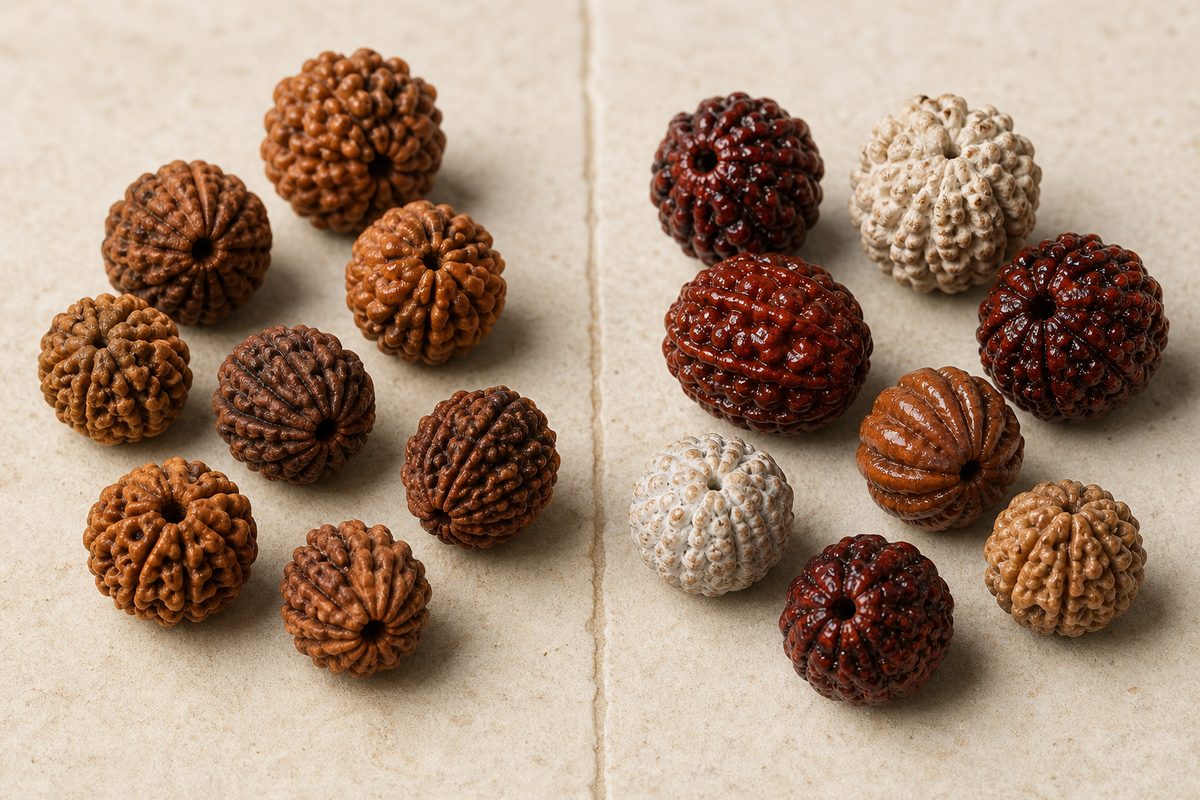
Marketing phrases such as “century-old mother tree,” “pure bloodline,” or “untouched original genetics” cannot replace clear photographs, individual bead inspection, treatment disclosure, and return terms.
Rudraksha Bead Care: Cleaning and Building an Even Patina
Patina is not a single coating applied in one session. It develops through surface cleaning, gentle polishing, repeated contact, and periods of rest. The exact color depends on the original material, skin tone, hand moisture, climate, frequency, and cleanliness. The aim is an even, healthy surface—not a race toward the darkest possible red.

- Initial cleaning and stabilization: Use a firm boar-bristle brush or a dense synthetic “nano” brush to remove dried fruit residue, loose dust, and white bloom. Work along the grooves from several angles. A steel brush can cut ridge edges and should not be the long-term default. After cleaning, leave the strand in a shaded, ventilated place for 2–3 days; avoid sun, hot air, radiators, and abrupt temperature changes.
- Foundation phase, about 1–2 months: Brush more than you handle. About one hour a day can be divided into short sessions so every bead and valley receives attention. The goal is even cleanliness and the first smooth luster, not grinding pores flat. This is the practical meaning of three parts handling and seven parts brushing(三分盘七分刷)in the early stage.
- Color-building phase: Handle with clean, dry hands. A workable rhythm is 10 minutes of handling, 3 minutes of brushing, and half a day of rest. After any longer session, brush for about 5 minutes to spread surface moisture and oils and to clear residue from the grooves. Rotate the strand so the same few beads are not always pressed by the palm.
- Patina phase: Once color and luster are even, reduce intense brushing and handling. More rest allows the surface to stabilize and oxidize gradually. The early “three parts handling, seven parts brushing” balance can move closer to equal handling and brushing later, with longer clean rest between sessions.

Do not oil a healthy strand simply to speed the process. Extra oil can darken high points, collect grime in low points, and produce a sticky shine that looks different from a clear, layered patina. For broader jewelry storage and material-care principles, use the Eastern Story care guide.

Green Mold or “Verdigris” on Jingang Bodhi
Green material on a Rudraksha bead is usually not copper verdigris. If the strand has no copper spacer, three-way bead, cap, or charm, green dust, spots, or fuzz more often point to moisture, mold growth, fruit or pectin residue, or degraded external oil mixed with dirt. When copper fittings are present, inspect whether the green deposit begins on the metal and transfers to the bead; true copper corrosion and biological growth need different cleanup.

Immediate mold response
- Stop wearing the strand and isolate it from other beads. Put on disposable gloves, especially when you see green fuzz or smell a musty odor.
- In a ventilated area, use a clean dry brush to remove loose surface growth. Work gently so spores and debris are not driven deeper into the grooves.
- For stuck residue, soften only the affected spot with a barely damp cotton swab or cloth, then use a boar-bristle or soft nylon brush. Avoid long whole-strand immersion and do not seal damp beads in a wet towel or plastic bag.
- Wipe away loosened material and let the strand dry completely in stable shade with airflow. Do not use direct sun, a hair dryer, a heater, or a blind coat of oil.
- Recheck odor, color, and groove cleanliness over the following days before restringing or wearing.

Deep recurring mold, a persistent internal odor, softened or cracked material, or skin irritation calls for replacement of the affected bead or help from an experienced bead restorer. This is the article's necessary health boundary: visible mold should be handled as contamination, not as a desirable color stage. A sealed bag is suitable only for short-term crack protection after the strand is fully dry and stable; sealing moisture inside creates the conditions for mold to return.
A Practical $200–$500 Beginner Budget
For a first serious bracelet, a practical budget is $200–$500 for a five-faced strand with ginger-yellow skin, a short or round shape, mature material, solid density, and careful matching. Spend on the base material and the consistency of the whole strand before paying for a rare mukhi count, an oversized diameter, or a fashionable texture label.

Ask for close photographs of every bead, side views that show stack height, the narrowest grooves, the drill channels, and the strand under neutral light. Confirm whether the beads have been dyed, oiled, acid washed, tumbled, filled, or heavily reshaped. A seller who explains natural variation clearly is more useful than one who offers only dramatic ancestry claims.
If you are comparing Rudraksha with other seed materials, the White Jade Bodhi bracelet guide explains a very different smooth-bead surface and patina experience, while the material guide helps place seed, wood, stone, and metal jewelry in context.
Rudraksha Gift Meaning and Who It Suits
Rudraksha carries a strong gift vocabulary: courage, resilience, safe passage, steady work, wisdom, and inner composure. The religious language comes from Hindu and Buddhist contexts; the modern gift language turns those traditions into a personal wish without promising a particular exam score, promotion, fortune, or social result.
Its rugged texture and deep red-brown aging make it a thoughtful gift for a boyfriend, husband, father, male partner, colleague, or collector. It also suits someone approaching a major entrance examination, postgraduate exam, first job, business launch, relocation, recovery period, or another life transition. The message is not “success is guaranteed,” but “may you meet this season with patience and a steady hand.”

- Five-faced: the most versatile gift—recognizable, comfortable, and associated with balance and everyday steadiness.
- Six-faced: a thoughtful choice for study, disciplined work, a new role, or entrepreneurship because traditional associations emphasize intellect and focused effort.
- Thirteen-faced or another rare mukhi: better for an informed collector who understands the specific lineage of the interpretation and values provenance.
- Finished strand for a beginner: a coordinated design with amber, turquoise, or Nanhong agate(南红)can feel complete and gift-ready.
- Fine raw strand for an experienced collector: prioritize untreated beads, strong matching, and excellent base material so the recipient can choose the cord, spacers, and handling routine.

A simple note gives the gift its emotional center: “As these beads deepen with time, may your courage and work grow steadier too.” Readers looking for other symbolic objects can explore the Eastern Story blessing collection or browse more cultural guides in the Story library.
Frequently Asked Questions
Choose the Bead You Can Care For
Begin with maturity, skin quality, and density. Then choose the texture, stack shape, size, and mukhi count that fit your hand and purpose. Clean the grooves thoroughly, brush more than you handle at first, and let rest do part of the work. That slow cycle of brushing, clean contact, and time is what gives Rudraksha its most convincing beauty: a patina earned by attention, not forced by treatment.

Related Posts


0 Comments