
An evil eye amulet is a protective symbol used to turn away envy, harmful attention, and the fear of a damaging gaze. In Turkish culture it is closely associated with the blue-and-white Nazar Boncuğu, while related evil eye beliefs also appear across the Mediterranean, West Asia, the Middle East, North Africa, South Asia, and parts of Europe. The amulet itself is not “evil.” In jewelry and home decor, the eye is usually understood as a watchful counter-symbol: it looks back at the harmful gaze before that gaze reaches the person, home, child, vehicle, or gift it is meant to bless.
Eastern Story treats the evil eye as cultural language, folk belief, and symbolic jewelry rather than a guaranteed spiritual tool. This guide explains what the evil eye amulet means, where the Nazar Boncuğu fits within the wider tradition, how different colors are interpreted in modern folk and accessory culture, how people wear or place the charm, and how to choose one respectfully without flattening several traditions into the same object.
Evil Eye Amulet at a Glance
- Core meaning: a protective folk symbol against envy, hostile attention, jealousy, and the fear of misfortune caused by a harmful gaze.
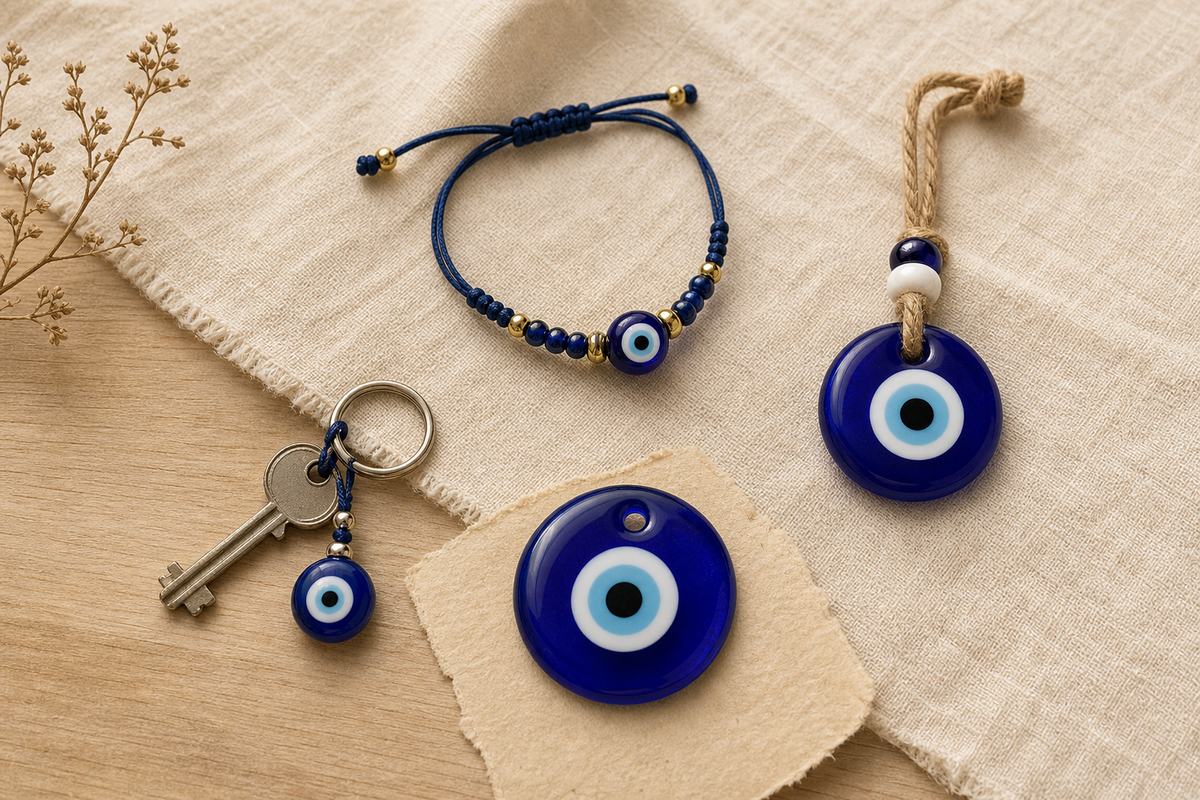
- Best-known form: the Turkish Nazar Boncuğu, usually a blue glass bead or disc with white, light blue, and dark center circles resembling an eye.
- Important wording: “evil eye” usually names the harmful gaze; the amulet is the protective answer to that gaze.
- Common uses: bracelets, necklaces, rings, earrings, key charms, wallet charms, baby-cradle charms, car ornaments, doorway hangings, and home talismans.
- Modern role: both a cultural blessing and a fashion symbol, especially in jewelry and digital culture after the 🧿 nazar amulet emoji entered Unicode 11.0.
- Boundary: it can express protection, blessing, and care, but it should not be presented as a guaranteed cure, wealth tool, relationship fix, or substitute for practical safety.
What Is an Evil Eye Amulet?
An evil eye amulet is an eye-shaped charm used in many cultures as a symbolic shield against the “evil eye”: a harmful look believed to be driven by envy, admiration, resentment, or ill will. In this belief system, attention is not always neutral. A child who receives too much praise, a new home, a successful business, a beautiful object, a newly married couple, or a person who has become highly visible may be thought to attract unwanted gaze energy.

The amulet answers that fear with another eye. In many evil eye traditions, the watchful symbol is placed where it can be seen: on the wrist, near the chest, at a doorway, on a vehicle mirror, beside a cradle, or on a bag or keychain. The idea is sometimes described as “eye against eye” or “returning the gaze.” More carefully, it represents awareness, deflection, and a wish for protection.
The most recognizable version is the blue-and-white Turkish Nazar Boncuğu. “Nazar” comes through Arabic and Turkish usage with the sense of looking, sight, attention, or gaze, while boncuk means bead. Together, the phrase is commonly translated as “evil eye bead” or “nazar bead.” In Turkish travel and cultural sources, it is also called a blue bead, mavi boncuk, and is described as one of the country’s most recognizable protective ornaments.
For Eastern Story readers, the closest comparison is the way a red string bracelet can carry a protective wish in Chinese folk tradition. The symbols are not the same, and their origins should not be mixed, but both show how people turn blessing, care, and vulnerability into something visible and wearable.
Names, Appearance, and Why “Evil Eye” Does Not Mean the Amulet Is Evil
In English, “evil eye” can sound confusing because it may refer to two different things. First, it can mean the harmful gaze itself. Second, in modern jewelry language, it can mean the protective eye-shaped charm used against that gaze. That is why a necklace, bracelet, or blue glass bead called an “evil eye” is not meant to bring evil. It is usually worn as a protective sign.
| Name or phrase | Where it belongs | How to explain it clearly |
|---|---|---|
| Evil eye | English umbrella phrase | The harmful gaze, or the protective symbol used against that gaze, depending on context. |
| Nazar Boncuğu | Turkish / Anatolian context | The blue eye bead or ornament associated with warding off nazar. |
| Mati | Greek context | Literally “eye”; often used for Greek evil eye belief and related charms. |
| Cheshm nazar | Persian and Afghan usage | A regional term connected with the evil eye or gaze-based protection. |
| Blue eye / guardian eye | Modern descriptive language | Useful for explaining the design without making it sound hostile. |
| “Devil’s eye” or “demon eye” | Some Chinese translations and marketplace wording | Can be misleading in English; explain that jewelry use usually means a protective charm, not worship or evil power. |
| Eye of Medusa | Modern comparison, not a standard origin label | May be used as a mythic analogy for gaze power, but should not be presented as the direct source of all evil eye amulets. |

Visually, the classic nazar bead is often made from glass and built from concentric circles: deep blue, white, pale blue, and a dark center. Other forms may be tear-shaped, round, oval, set into metal jewelry, woven into bracelets, printed on textiles, or combined with a hamsa hand. The blue-white eye is the best-known version, but modern accessories also use red, green, gold, white, black, purple, pink, and multicolor designs.
Where Does the Evil Eye Amulet Come From?
The evil eye does not have one single origin story. It is better understood as a family of related beliefs about gaze, envy, protection, and visible blessing. The Turkish Nazar Boncuğu is one of the most famous modern forms, but eye-shaped protective imagery and evil-eye beliefs appear in several ancient and regional traditions.

| Tradition or evidence layer | What can be said responsibly | What should not be overstated |
|---|---|---|
| Turkey and Anatolia | Nazar Boncuğu is a major Turkish cultural object, often made as a blue glass eye bead and used on clothing, homes, vehicles, shops, and jewelry. | Do not claim every evil eye object in the world is Turkish; Turkish nazar is a major branch within a wider belief system. |
| Mediterranean, Middle East, West Asia, North Africa, South Asia | Evil eye belief and protective amulets are widespread, with local names, rituals, religious framings, and household customs. | Do not collapse Greek mati, Turkish nazar, Arabic, Persian, South Asian, Jewish, Christian, and Islamic contexts into one identical practice. |
| Mesopotamia / Tell Brak eye idols | Ancient eye-shaped objects from Tell Brak, dated around the fourth millennium BCE in museum records, show the deep age of eye symbolism in West Asia. | Do not describe every Tell Brak eye idol as a direct evil-eye amulet; museums often explain them as votive offerings and signs of attentiveness to the gods. |
| Ancient Egypt / Wedjat Eye | The Wedjat, or Eye of Horus, was an Egyptian amulet associated with restoration, protection, and regeneration. | Do not say the modern Turkish blue nazar simply “comes from” the Eye of Horus. It is a related eye-protection comparison, not the same object. |
| Greek and Roman worlds | Classical texts and Mediterranean folk practices include concern with harmful gaze, envy, and protective countermeasures. | Do not turn the Medusa story into the single source of evil eye jewelry; it is a useful analogy for gaze power, not a complete history. |
| Religious texts and interpretive traditions | “Evil eye” language or belief appears in biblical and Islamic contexts, including discussions of envy, harmful gaze, and protection. | Do not present a modern commercial amulet as a universal religious requirement or guaranteed religious protection. |
| Modern emoji and fashion culture | The 🧿 nazar amulet emoji appears in Unicode 11.0, and the motif is common in contemporary jewelry, souvenirs, textiles, and social media. | Do not use modern fashion popularity as proof that every color meaning or product claim is ancient. |
The “Evil Eye” symbol appears in Spanish rock art dating back ten thousand years.
Although motifs depicting eyes or gazes are abundant in ancient ruins, such images in rock art do not directly prove a connection to the later tradition of “Evil Eye” amulets.
The symbolism of the eye has a long history; beliefs regarding the “Evil Eye” are extensively documented across various cultures in the Mediterranean and West Asia, while the Turkish glass “nazar” bead has become one of the most recognizable forms of this symbol.
Core Meaning: Protection, Balance, Blessing, and the Return Gaze
The core meaning of the evil eye amulet is protection from the harmful gaze. In many traditions, envy is not only an emotion; it is imagined as something that can disturb balance. A person may become vulnerable when they are admired, praised, newly successful, visibly happy, newly married, newly born, or surrounded by good fortune. The amulet gives that fear a visible answer.

Three ideas appear again and again. First is watchfulness: the eye keeps attention on the unseen. Second is reflection: the protective eye symbolically turns harmful attention away. Third is balance: the charm marks a wish that envy, praise, and visibility will not disturb the wearer’s peace. In everyday jewelry language, this becomes a blessing for safety, calm, steadiness, and good fortune.
These meanings can be stated clearly without turning them into product promises. It is appropriate to write that the evil eye is commonly associated with protection, peace, good wishes, and the deflection of jealousy in many folk traditions.
What Do Different Evil Eye Colors Mean?
Blue is the classic color of the Turkish nazar bead, but modern evil eye jewelry often uses many colors. These color meanings should be treated as modern folk and accessory interpretations rather than fixed ancient rules. They are helpful for choosing a bracelet, necklace, or gift with intention.

| Color | Common symbolic meaning in modern folk / jewelry use | Careful wording |
|---|---|---|
| Blue / royal blue | Classic protection, calm, purity, peace, and deflection of envy. | The most recognizable nazar color; often worn as a protective blessing. |
| Red | Courage, vitality, passion, and strength. | Often chosen as a symbol of confidence and life force. |
| Green | Hope, growth, renewal, health, and fresh beginnings. | Aspiration for growth and stability |
| Yellow / gold | Light, success, abundance, optimism, and prosperity. | Use as an abundance symbol. |
| White | Purity, cleansing, clarity, innocence, and new starts. | A clean symbolic color for balance and fresh intention. |
| Multicolor | Harmony, balance, broad blessing, and joyful protection. | Often works as an expressive fashion choice with layered meanings. |
| Pink | Love, kindness, affection, and gentle emotional connection. | Appropriate as a romantic or caring gift. |
| Black | Grounding, strength, seriousness, and absorbing or turning away negativity in some modern crystal and accessory language. | Keep this as symbolic grounding. |
| Purple | Spiritual reflection, intuition, emotional depth, and inner calm. | Use as a contemplative or emotional symbol. |
What Does an Evil Eye Bracelet Mean?
An evil eye bracelet means the protective eye symbol is carried on the body in daily life. Because the wrist is visible, the bracelet makes the blessing easy to see without becoming formal or ceremonial. It can be worn alone, layered with simple chains, combined with beads, or given to someone as a small sign of care before travel, a new job, a move, a marriage, a new baby, or another visible life change.

In Turkish and many Mediterranean or Middle Eastern contexts, evil eye objects may be given as protective gifts. A gifted bracelet can feel especially meaningful because the object is not only decorative; it says, “I wish you safety,” “I hope envy does not disturb you,” or “I want you to be watched over.” In modern jewelry culture, that message can sit comfortably beside style, color, and personal taste.
When a bracelet breaks, some Turkish and related folk explanations say the charm has completed its protective work and should be replaced. The respectful way to write this is to describe it as a folk belief: “In some traditions, a broken nazar bead is interpreted as having taken or deflected the bad gaze.” It should not be written as proof that a real disaster was prevented.
Readers comparing different symbolic bracelets can also read Eastern Story’s guide to good-luck bracelet meaning, which explains broader symbols and materials without making outcome guarantees.
How to Wear or Place an Evil Eye Amulet
There is no single universal rule for wearing an evil eye amulet. Customs vary by country, family, religion, and personal practice. Still, several common patterns appear across modern use: wear it where it is visible, keep it clean, treat it respectfully, and choose a placement that fits the object’s form.

- Necklace: worn near the chest or heart, often as a quiet personal symbol. Some folk advice prefers the pendant above the waist rather than hanging low on the body.
- Bracelet: often worn on the wrist for daily visibility. Some traditions or sellers recommend the left wrist for receiving blessing or protection, but this is not a universal rule.
- Ring or earrings: useful when the eye motif is part of a more fashion-forward design.
- Bag, backpack, wallet, or keychain: common for a portable charm that follows the person without being worn on the body.
- Home or doorway: often placed near an entrance, wall, window, or visible high point as a household blessing.
- Car or travel use: commonly hung as a vehicle charm in some regions, especially where nazar beads are part of everyday visual culture.
- Baby cradle or nursery: appears in some Turkish and Mediterranean contexts, though any object near a child should be placed safely and out of reach.
For practical care, remove delicate evil eye jewelry before bathing, swimming, heavy exercise, intimate situations, or work that may expose it to chemicals, sweat, impact, or snagging. Glass beads can chip or break, metal can discolor, elastic can weaken, and plated components can react to perfume, alcohol, lotion, chlorine, or salt water. A soft dry cloth is usually safer than soaking or harsh cleaning.
Customs, Broken Beads, and Ritual Language
Certain customs surrounding the evil eye amulet are deeply rooted in local, familial, or religious traditions. These customs may be mentioned to preserve their cultural significance.

| Custom or belief | How it is often understood |
|---|---|
| A broken nazar bead | In some Turkish and related folk contexts, breakage means the bead has taken or deflected the harmful gaze. |
| Receiving it as a gift | A gifted charm may feel more meaningful because it carries another person’s blessing. |
| Not giving away one you wore | Some people avoid passing on a personal amulet once it has been worn. |
| Keeping it clean | Cleanliness may be practical, symbolic, or both. |
| Avoiding strangers touching it | Some traditions treat touch as a transfer of personal energy or attention. |
| Placing it under a pillow on the first night | Modern folk or seller language may describe this as bonding with the object. |
| Blessing, consecration, or religious ritual | May belong to a specific religious or local practice. |
| “Sincerity makes it work” | A common folk way to emphasize intention and personal meaning. |
How to Choose an Evil Eye Amulet or Bracelet
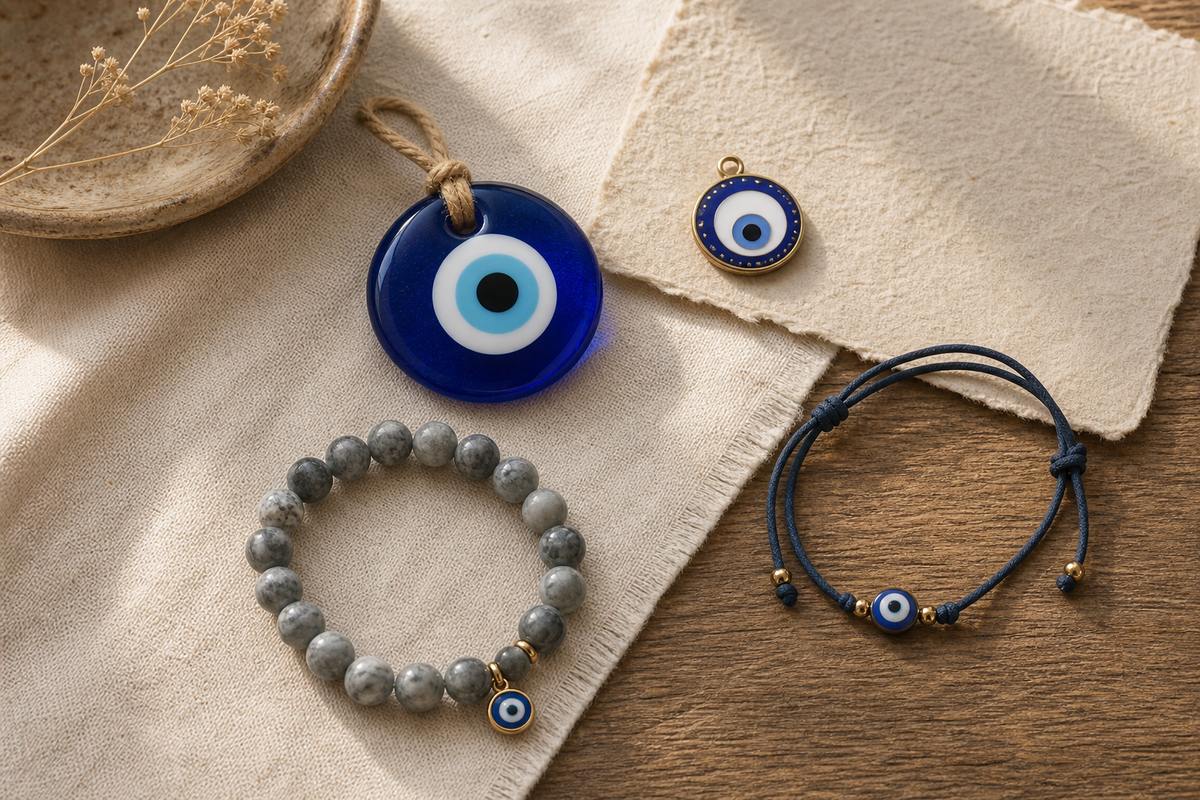
Choose an evil eye amulet by looking at cultural context first, then material, eye pattern, comfort, budget, and care needs. The best descriptions explain what the object is: a Turkish-style nazar bead, a modern evil eye bracelet, a glass pendant, an eye motif charm, a home ornament, or a different protective-symbol tradition. Be careful with sellers who treat every eye-shaped stone, Tibetan bead, Turkish glass charm, and crystal bracelet as if they all came from the same culture.
| Type | What it is | Best use | Boundary |
|---|---|---|---|
| Turkish Nazar Boncuğu | Usually a blue glass eye bead, disc, drop, keychain, wall charm, or jewelry component. | Classic evil eye symbolism, travel gifts, home protection symbols, daily accessories. | Do not call every protective eye object a Turkish nazar if it belongs elsewhere. |
| Modern evil eye jewelry | Bracelets, necklaces, rings, earrings, or charms using the eye motif in metal, enamel, glass, resin, crystal, or beads. | Wearable blessing, style, gifting, symbolic protection. | Fashion versions may use modern color meanings rather than inherited rules. |
| Obsidian or black-stone bracelets | Volcanic glass or black stone jewelry sometimes marketed with grounding or protective language. | Minimal, dark, grounding style; often paired with personal strength symbolism. | Obsidian is not automatically a nazar; “cleansing” or “energy” language is folk or spiritual. |
| Dzi beads | Tibetan and Himalayan-region bead traditions, often with eye-like patterns and strong religious or cultural associations. | For readers specifically interested in Tibetan-style symbolic beads. | Do not merge Dzi beads with Turkish evil eye beads; they are different traditions. |
| Mongolian or Gobi eye-pattern stones | Natural agate, jasper, or other stones with eye-like patterning, sometimes described as “eye stones.” | Collectors or symbolic-stone wearers who like natural eye patterns. | Verify material claims and avoid turning geological patterns into guaranteed effects. |
| Red tiger eye | A chatoyant stone with a banded optical effect, often used in courage and confidence jewelry. | Style linked with warmth, action, and strength symbolism. | It may be a protective-style bracelet, but it is not the same cultural object as a nazar bead. |
- Check the eye pattern: handmade glass and natural stones may vary; mass-produced designs can be perfectly uniform. Variation is not automatically proof of value, and uniformity is not automatically fake.
- Check the material: glass, enamel, plated metal, stainless steel, sterling silver, resin, stone, and cord all wear differently.
- Check comfort: bracelet size, cord strength, clasp quality, bead weight, metal sensitivity, and snag risk matter more than mystical claims.
- Check documentation: for expensive stones, ask for credible gem or material verification. Avoid vague certificates that do not identify the actual material.
- Match the budget: simple nazar souvenirs can be inexpensive; handmade glass, precious metal, antique beads, and rare stones can cost much more. Price should match material, craft, provenance, and seller transparency.
Care Tips for Glass, Metal, Stone, and Crystal Evil Eye Jewelry
Most evil eye jewelry should be cared for like delicate symbolic jewelry. Glass can chip, cords can stretch, elastic can weaken, and plated metal can react to water, sweat, perfume, sunscreen, alcohol, and cleaning chemicals. Remove bracelets and necklaces before showering, swimming, sleeping, heavy exercise, or applying fragrance and lotion.

Use a soft dry cloth for routine cleaning. Avoid soaking unless the seller clearly says the material is safe for water. Store the piece in a dry pouch or jewelry box away from direct sun, extreme humidity, and hard impact. If the charm includes a natural stone, verify the stone’s care rules separately because porous, dyed, treated, or softer materials may need extra caution.
Some communities that prize crystals and black stones use terms such as “cleansing,” “charging,” or “purifying.” These practices can be maintained as folk traditions or spiritual care rituals.
Evil Eye, Hamsa, Red String, Dzi Beads, and Other Protective Symbols
The evil eye amulet belongs to a larger world of protective symbols, but each symbol needs its own boundary. A hamsa hand may include an eye; a red string may carry a protective wish in Chinese, Jewish, Kabbalistic, or other contexts depending on the tradition; a Pixiu (貔貅) bracelet belongs to Chinese auspicious-beast and feng shui symbolism; a Dzi bead belongs to Tibetan and Himalayan bead culture; and a black stone bracelet may be marketed for grounding or strength. They can all speak about protection, but they are not the same story.

| Symbol | Primary association |
|---|---|
| Evil eye / Nazar Boncuğu | Deflecting envy and harmful gaze; Turkish and wider Mediterranean / West Asian evil-eye traditions. |
| Hamsa | Hand-shaped protective symbol, often with an eye in the palm, used in several Middle Eastern and North African contexts. |
| Red string bracelet | Protective, blessing, connection, love, or folk-symbolic bracelet depending on tradition. |
| Dzi bead | Tibetan / Himalayan bead tradition with eye-like patterns and religious or protective associations. |
| Obsidian or tiger eye bracelet | Modern gemstone symbolism around grounding, courage, and strength. |
What the Evil Eye Amulet Can—and Cannot—Do
An evil eye amulet can carry a protective story, mark a wish for safety, connect the wearer to a tradition, and make care visible. It can also help a gift feel more personal because the object expresses attention, blessing, and emotional steadiness. As a piece of jewelry, it can be beautiful, meaningful, and easy to wear.

It cannot replace medical care, mental health support, legal advice, financial planning, safety precautions, or the wearer’s own effort. It should not be sold as a guaranteed shield against danger, a promise of wealth, a tool that forces love, a cure for illness, or a religious effect that applies to every tradition. Its strongest role is symbolic: a watchful reminder to move through the visible world with balance, humility, and protection in mind.
Frequently Asked Questions
The evil eye amulet survives because it speaks to a familiar human concern: how to move through visible life without being damaged by envy or hostile attention. Its eye does not need exaggerated mystical claims to matter. In a bead, bracelet, pendant, home charm, or gift, it turns watchfulness into a quiet language of care.
Related Posts




4 Comments