
Baltic amber is fossilized tree resin associated with the Baltic region, best known in the form called succinite. Its honey light, creamy clouds, and tiny traces of an ancient forest make it a beautiful companion for wishes of warmth, protection, and lasting connection. A pendant can recall a place you love; a strand of amber beads can carry the hope that brighter days stay close.

Known in Chinese as Boluodi Hai Hupo (波罗的海琥珀), Baltic amber belongs to a much older forest story than the shoreline where some pieces are found. It can be collected from beaches or mined on land, and it ranges from transparent gold to opaque white. Understanding those differences makes its beauty more personal: you can choose the color, natural history, and form that speak to you.
Amber’s warm light, stories, and blessings
Amber seems to hold light gently rather than throw it back. That quality gives it an intimate place in jewelry: a little warmth at the wrist, a golden drop beside the heart, or a keepsake passed between people whose lives are connected. In modern Eastern gift language, hupo (琥珀) carries wishes for peaceful days, protection, vitality, and memories worth keeping.
Sunlight and enduring love
In the Greek story of Phaethon, his sisters, the Heliades, weep tears that become amber. The story joins the gem to the sun, grief, and love that outlasts separation. The familiar image of amber as sunlight held in the hand feels especially moving when a piece is chosen to remember someone.
Along the Baltic, the Lithuanian legend of Jūratė and Kastytis tells of a sea goddess who falls in love with a mortal fisherman. Her amber palace is shattered, and fragments reach the shore. It is a story of devotion and longing—a lovely companion to an anniversary gift or a memory of the sea.

Amber in Eastern treasure traditions
Amber appears among the precious materials in the Chinese Sutra of Infinite Life, where treasures give visible form to a radiant Buddha realm. The Buddhist seven treasures, or qibao (七宝), vary across scriptures and translations. Within that world of sacred beauty, amber’s warm color lends itself naturally to wishes for serenity, wisdom, and protection.
For a new beginning, a gift note might say, “May warmth and peace accompany your next chapter.” For someone cherished, ping’an ruyi (平安如意)—peace and fulfillment—gives the gift a gentle Eastern blessing. A simple bead or pendant can hold that intention without an elaborate design.

From an ancient forest to the Baltic coast
Amber begins as resin, the sticky substance trees produce for protection. With burial and geological change, resin matures into a durable fossil material. It is an organic gem, rather than a crystalline mineral or hardened tree sap. Baltic amber is associated with Eocene forests, tens of millions of years old; ages assigned to particular deposits differ, so one exact birthday does not describe every piece.
Ancient conifers are central to its botanical story, although the precise resin-producing trees remain a subject of research. Calling every piece the resin of one known pine species makes the story too narrow. What remains wonderfully tangible is the forest itself: flowing resin, bubbles, tiny plant fragments, and occasional insects held in three dimensions.

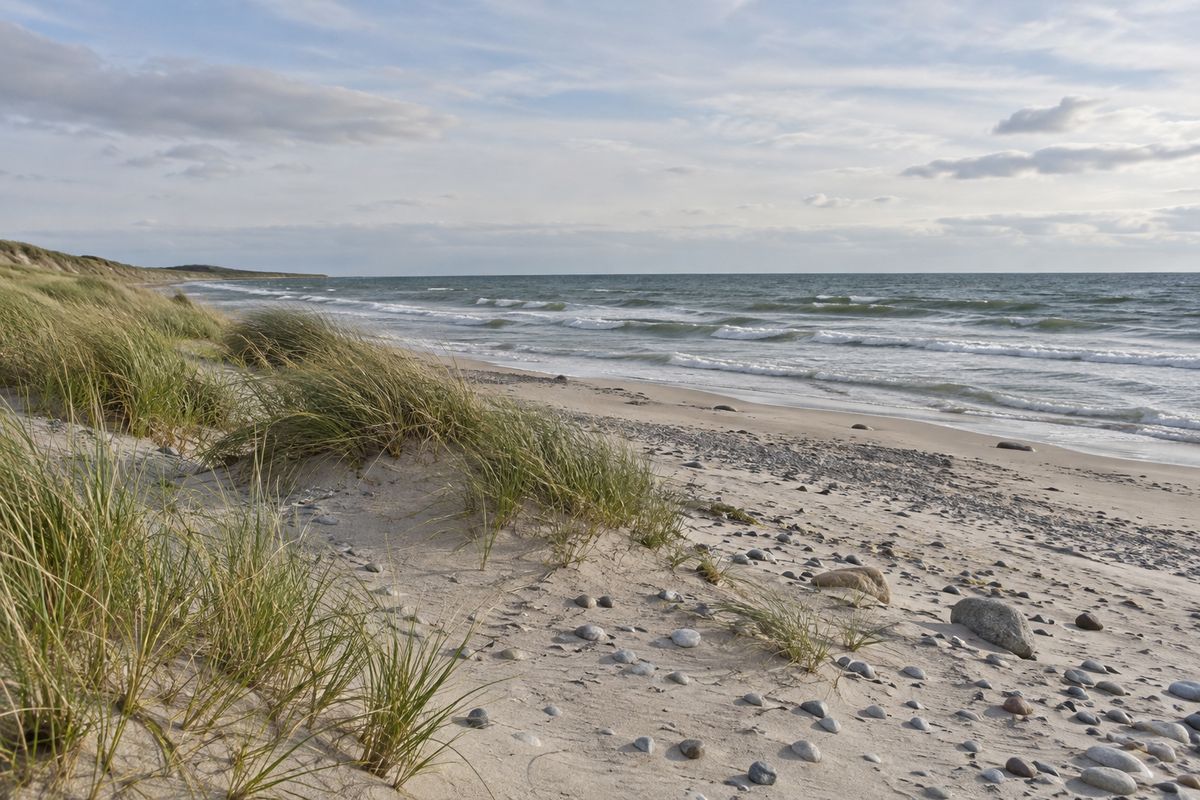
The Samland Peninsula in Russia’s Kaliningrad region is a major source, with amber-bearing deposits also associated with Poland and other parts of northern Europe. Beach finds occur around shores including Lithuania, Latvia, Germany, Denmark, and southern Sweden. The city where a pendant was carved or bought may differ from the place where its resin was recovered.
Ukraine also has important amber deposits, including Rovno amber, but it has no Baltic coastline. Related fossil resins occur beyond the Baltic shore, so a chemical resemblance and a geographical origin are different pieces of information. Baltic amber is a major commercial amber source; the story of an individual jewel is best told through its actual material and locality.
Sea amber, mined amber, succinite, and beeswax amber
| Name | What it describes | How to understand it |
|---|---|---|
| Baltic amber | A regional amber name | Most familiar Baltic jewelry amber is succinite; Baltic does not mean beach-collected. |
| Succinite | A fossil-resin variety | A compositional name strongly associated with Baltic amber, also found in other deposits. |
| Sea amber / haipo (海珀) | Recovery from shore or sea | Waves and sand may smooth or wear the surface. The resin originally came from trees. |
| Mined amber / kuangpo (矿珀) | Recovery from buried deposits | The term describes extraction, not a separate age, hardness, or quality grade. |
| Beeswax amber / mila (蜜蜡) | A cloudy to opaque appearance used in the jewelry trade | Amber with a waxlike look, not beeswax made by bees; often associated with Baltic material. |
Sea amber and mined amber can come from the same ancient geological story. Erosion frees pieces from deposits, and water moves them onward. Wave-worn surfaces may be smoother and have a thinner weathered skin, while excavated pieces may retain a thicker crust. Neither route tells you whether the interior will be clear, cloudy, richly colored, fractured, or full of inclusions.

The lightness of amber helps water transport it, but “all amber floats in seawater” is too simple. GIA lists a typical specific gravity of about 1.08, equivalent to a density around 1.08 g/cm³; bubbles and inclusions affect individual pieces. Baltic seawater is not a saturated salt solution. Shoreline finds do not require every piece to be lighter than the surrounding water.

The sea does not make amber younger, and mining does not automatically make it older, harder, or several times more valuable. Those qualities depend on the actual resin, geological history, condition, and finished object.
What succinic acid and the “Baltic shoulder” mean
Succinite is known for its succinic-acid-related chemistry. The often-quoted 3–8% figure belongs to descriptions and analyses of succinite; much of that chemistry is bound into the resin structure rather than present as free acid. It is not a dosage, a quality grade, or a measurement of what a necklace releases onto skin.
A characteristic feature in an infrared spectrum is nicknamed the “Baltic shoulder.” This helps specialists study the material, alongside the rest of its chemical fingerprint. It is invisible to the eye and is not the same as the blue or green glow seen under ultraviolet light.
Amber can be a comforting object to hold during a quiet moment, with a color that invites thoughts of sunshine and renewal. Its appeal in jewelry rests in that beauty and personal meaning; succinic-acid content is not a basis for using jewelry to treat anxiety, pain, or illness.

Baltic amber colors: clear gold, creamy honey, and white
Some pieces look like a pool of honey; others resemble pale clouds suspended in golden light. Tiny internal bubbles scatter light and can make amber cloudy or opaque. Thickness, weathering, inclusions, and treatments also shape its appearance. Color and clarity are separate qualities: pale amber may be transparent, while a rich yellow piece may be opaque.

| Color or trade name | The appearance people enjoy | What the name does—and does not—tell you |
|---|---|---|
| Golden amber / jinpo (金珀) | Transparent yellow to golden amber | A color and clarity description, not a promise that the color or clarity is untreated. |
| Honey, butterscotch, or jiyouhuang (鸡油黄) | Creamy yellow through saturated buttery yellow | Trade vocabulary for warm color and opacity; wording and grades vary between sellers. |
| White amber / baimi (白蜜) | Milky, bone-white, or porcelainlike opaque amber | Dense microscopic bubbles can produce natural whiteness; appearance alone does not establish treatment history. |
| Jin jiao mi (金绞蜜) | Transparent golden areas interwoven with cloudy amber | A mixed clear-and-opaque look whose flowing patterns are often the main attraction. |
| Cognac, cherry, or blood amber / xuepo (血珀) | Warm brown, reddish brown, or red | Weathering, oxidation, heating, or added color may contribute; the name alone does not identify origin or age. |
| Flower amber / huapo (花珀) | Bright, flowerlike flashes or “sun spangles” | Commonly disk-shaped stress features associated with heating, rather than preserved flower petals. |
White-and-yellow mottling, tigerlike bands, and landscape-like patterns can be delightful reasons to choose a piece. Names such as “porcelain white,” “tiger skin,” or “cavern amber” describe a look in the marketplace; they are not separate mineral species or universal grading standards. “Fragrant amber” is also not a dependable identity for every white piece.

Sun spangles and real forest inclusions
The sparkling disks in flower amber catch light as a pendant moves. Heating can create these internal stress features, often called sun spangles or sun sparks. A seller should explain the treatment history instead of describing every shining disk as a prehistoric blossom.

Actual botanical and insect inclusions belong to a different story. They may preserve a fragment of leaf, a small creature, or a trace of forest life. Their interest depends on what is preserved, how clearly it can be studied, and whether it is naturally enclosed. An attractive scene or a dramatic insect is not, by itself, proof of a rare fossil.
Blue fluorescence and blue amber
Many ambers fluoresce, and blue or greenish fluorescence under ultraviolet light is not the same thing as a blue appearance in ordinary viewing. The striking blue of some Dominican amber is a fluorescence effect visible in suitable reflected light, especially against a dark background; transmitted light may still reveal a yellowish body color. A blue glow alone establishes neither Dominican nor Baltic origin.
How Baltic amber relates to other amber origins
Different amber regions preserve different forests. Burmese amber is particularly known for Cretaceous inclusions; Fushun amber from Liaoning, China, preserves an early Eocene forest; Dominican amber is associated with resin from relatives of Hymenaea, a flowering-tree genus. Baltic succinite has its own conifer-associated history and familiar golden-to-creamy palette.
These are origins, not a ladder of better and worse gems. For someone drawn to pale, cloudlike beads, opaque Baltic amber may be especially appealing. A fossil enthusiast may care more about a particular inclusion, while another person falls in love with a clear golden pendant. Treatment, condition, and the individual piece matter more than a blanket claim that the oldest region always produces the hardest or most valuable jewelry.

Treatments and material descriptions worth understanding
A beautiful amber jewel may have been shaped, polished, and further enhanced. Knowing which changes were made lets you appreciate the object on clear terms. “Natural resin,” “natural color,” “single-piece amber,” and “untreated” describe different things. The broader amber vs copal guide explains how mature amber and less mature resins differ.

Heat, clarification, and a waxy appearance
Controlled heating can deepen yellow amber toward red or brown. Heat and pressure can reduce the visible cloudiness caused by bubbles, while other treatment conditions create spangles. Clarification is not a process that simply removes every impurity from a piece.
Hydrothermal treatment uses controlled water, heat, and pressure to change the internal bubble structure and can create a more opaque, beeswax-like appearance. Both natural and treated amber can look creamy or white. This is an industrial process, not a cleaning or care method.
Pressed amber, added color, and repairs
Pressed amber, also called reconstructed amber or ambroid, is made by consolidating amber fragments under heat and pressure. It contains amber material but differs structurally from a jewel cut from one continuous piece. Plastics, glass, and other imitation resins are separate categories.
Dyes can change color; surface coatings can alter gloss or color; fillers and adhesive repairs may conceal or stabilize damage. Ask for each applicable change to be described, including whether the object is pressed or assembled. A pleasant appearance and a familiar trade name are not substitutes for that information.

Choosing a piece with a story you can cherish
Begin with the feeling that draws you in: the clarity of a golden drop, the softness of white beads, or the meeting of light and cloud in jin jiao mi. Then look at the actual piece in neutral daylight and ask how its material, origin, treatments, and repairs are described. Photographs from several angles are more useful than one heavily lit image.

A close view can help you notice a crack, chipped drill hole, uneven finish, or loose setting. It cannot settle every question of identity. Fluorescence, bubbles, scent, warmth, weight, and surface patterns overlap among natural resin, treated material, and imitations. Some plastics are lightweight and warm to the touch, so a single sensory rule can be misleading. Keep the jewel intact and use non-destructive professional examination when a material question remains unresolved.
Why there is no universal amber price per gram
Amber is sold as rough material, individual beads, strands, carvings, and finished jewelry. Each price reflects a different object. Size, condition, transparency or attractive opacity, treatment, inclusion quality, matching, and artistic work can all matter. Metal settings and design also affect a finished jewel’s price.

Full opacity is not automatically better than transparency, white is not always worth more than gold, and mined amber has no fixed premium over sea amber. A small clear piece with an unusual, well-preserved inclusion and a carefully matched creamy strand answer different desires.
When comparing a quotation, keep the currency, date, weight, dimensions, treatment description, and whether the amount is per gram or per item together. Consider the piece’s personal and artistic value, and ask about return terms. A color ranking or an unusually high asking price is not a reliable forecast of future resale value.
Wearing Baltic amber in a modern wardrobe
A clear golden pendant against a white shirt or dark jacket brings a small point of light to everyday clothes. Creamy honey beads suit the quiet textures of linen and knitwear. White amber feels especially gentle beside oatmeal, soft grey, or muted blue, while a freeform piece can lend a personal, collected-over-time character to a simple outfit.

For a more expressive look, coordinate amber with dark or cool colors elsewhere in the outfit. Keep harder beads, metal edges, and neighboring bracelets from rubbing directly against it. Layers at different necklace lengths or pieces worn on opposite wrists can create contrast while giving the amber room.
Silver or gold settings change the mood: cool silver frames the warmth, while gold tones continue it. A subtle pendant may accompany a new job or a daily ritual; a patterned bead strand may recall a journey or an anniversary. Our amber bracelet guide explores bracelet forms, fit, and gift ideas in more detail.
Gentle care for a jewel made from ancient resin
Amber has a Mohs hardness of about 2–2.5 and can scratch or chip. Give it a soft place to rest and remove it before sport, housework, bathing, or tasks that expose it to knocks and chemicals. Put it on after perfume, hairspray, and cosmetics have been applied.

- Clean gently. Use a clean, soft cloth for light surface dirt. When needed, clean with lukewarm water and a small amount of mild soap, remove soap residue, and promptly pat dry with a soft cloth.
- Consider the whole jewel. Thread, elastic, adhesive, plating, and settings may need additional care. Avoid soaking assembled jewelry; allow damp stringing to dry fully before storage.
- Keep away from heat and harsh products. Avoid radiators, hot car dashboards, prolonged strong sun, solvents, bleach, steam, and ultrasonic cleaners.
- Store separately. Use a soft pouch or padded compartment, away from hard stones and exposed metal edges. A stable, shaded storage place is preferable to a windowsill.
- Check wear. Inspect cords, clasps, drill holes, and settings. Have damaged stringing or a loose setting repaired before wearing the piece again.
Routine oiling, wet wrapping, and “rehydration” are unnecessary. If the surface is scratched, avoid toothpaste or abrasive polishing at home; a jeweler experienced with amber can advise on repair. Gradual darkening can reflect oxidation and light exposure, but it does not establish an antique age. The Eastern Story care guide offers more guidance for caring for jewelry made with several materials.

Frequently asked questions
A little warmth to carry forward
The most memorable amber piece is often the one that feels connected to your life: the color of a late afternoon, the memory of a shoreline, or a gift given with a wish for peaceful days. Let its story, appearance, and clearly described material come together in something you will enjoy keeping close. Explore the Blessing collection for more objects chosen to carry good wishes.
Related Posts


