
The Sanxingdui sacred tree is an ancient Shu bronze that brings birds, fruit, a descending dragon, and a rising tree into one extraordinary vision of connection between earth and heaven. Its imagery is often understood through solar worship and the longing to reach the divine. For a modern admirer, those spreading branches can also carry a beautiful wish: to keep growing, welcome light, and remain connected to the people and stories that nourish a life.
The most celebrated example, Bronze Sacred Tree No. 1, stands 3.96 meters tall. Excavated in 1986 from Pit 2 at Sanxingdui (三星堆) in Guanghan, Sichuan, it belongs to the Bronze Age world of ancient Shu (古蜀). Three levels of branches lift nine birds above a mountain-like base. Even in a photograph, the shape invites the eye upward. In person, its scale makes that invitation almost physical.
A tree that reaches toward light
A living tree holds two directions together: its roots belong to the earth, while its branches open toward the sky. The bronze sacred tree makes that familiar relationship magnificent. Flowers and fruit gather along its branches, birds inhabit its upper spaces, and a dragon moves down beside the trunk. The result feels like a world in which different realms can meet.
This helps explain the enduring appeal of the phrase tongtian shenshu (通天神树), a sacred tree reaching heaven. Museum interpretations connect the object with ancient Shu ritual and a desire to communicate with divine powers. Its branches give that desire a visible form, turning a natural image into a setting for wonder, reverence, and hope.
The ancient ritual meaning and the feelings the tree awakens today belong to different moments in its story. A person choosing a tree-inspired keepsake may see family connection, a fresh start, or the courage to grow beyond familiar ground. These present-day wishes draw their warmth from an old image of life reaching upward.
Reading the form: three tiers, nine birds, and one dragon
The mountain-like base and rising trunk
No. 1 rises from an openwork base with three arching sides above a circular ring. Its form evokes connected mountain peaks, giving the tree a landscape of its own. From that base, the main trunk rises through three tiers, each with three branches. The repeated arrangement creates order without losing the curves and movement of a living tree.

The reconstructed overall height is 3.96 meters; the surviving trunk height is 3.59 meters. These measure different parts of the same object. The top remains incomplete, so the tree’s original full height is still an open question. The surviving bronze already conveys its extraordinary ambition.

Flowers, fruit, and the nine perched birds
Each of the nine main branches divides into an upward and a downward fruit-bearing shoot. Birds stand on the upward forms, surrounded by flowers, curling foliage, and rounded, peach-like fruit. Close views reveal how much life is gathered into the ends of the branches: a bird’s silhouette, a swelling bud, an openwork detail, the sweep of a leaf.

The birds make the tree feel inhabited. Their place above the ground suits an image of movement between earth and sky. Bird forms also appear on other Sanxingdui objects, and the Hong Kong Palace Museum describes their possible role as intermediaries between spiritual and mortal realms. On the tree, that idea becomes especially easy to imagine: the birds occupy the place where growth meets open air.
The dragon moving downward
Beside the trunk is an Eastern dragon, or loong (龙), with its head directed downward and its tail upward. Its long, twisting body has an unusual braided, rope-like appearance. Follow it with your eye and you travel in the opposite direction to the rising trunk.

This downward movement is one reason the tree is interpreted as a link between heaven and the human world. The dragon seems to bring the upper realm closer to the ground. Its distinctive ancient Shu form is part of the pleasure of looking: it belongs to the broad Eastern dragon imagination while retaining a character all its own.
Fusang, Ruomu, and Jianmu: the stories behind the comparison
Three great trees in Eastern mythology offer a rich way to approach the bronze: Fusang (扶桑), Ruomu (若木), and Jianmu (建木). Their stories place trees within a larger landscape of sunlight, divine journeys, and the meeting of different worlds. They are interpretive comparisons for the Sanxingdui object; its original ancient Shu name has not been established.
Fusang and the resting place of the suns
Fusang is associated with the eastern sun. In the Shanhaijing (山海经), the Classic of Mountains and Seas, the “Overseas East” chapter describes the great tree at Tang Valley and the ten suns: nine occupy its lower branches and one the upper branches. That unforgettable image gives the bronze birds a place within a much wider story of daylight returning to the world.
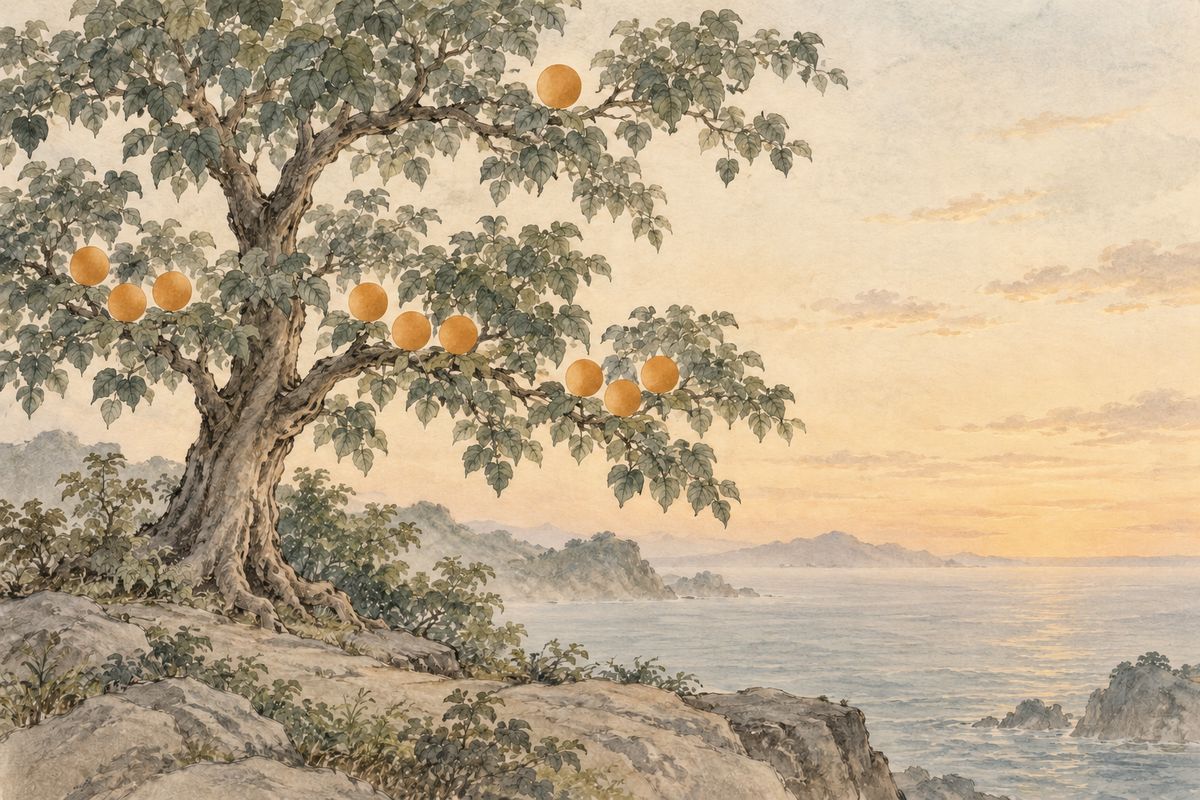
The comparison is compelling because No. 1 has nine perched birds and an incomplete top. One proposal places a tenth bird in the missing upper section; another reading imagines the absent sun already making its journey across the sky. Both are ways of interpreting the surviving design. The nine visible birds remain the starting point, while the missing crown leaves room for discovery.
For today’s viewer, the solar story has a gentle emotional force. Light returns. A difficult season gives way to another morning. A small tree or bird motif can carry that wish for someone beginning again, without needing to reproduce the entire ancient scene.
Ruomu and the western horizon
Ruomu is associated with the western side of the mythic world and, in later interpretations, the setting sun. Together, Fusang and Ruomu offer the image of a journey from one horizon to the other. Scholars have used this pairing when comparing differences among the Sanxingdui trees, including the positions of their birds and branches.
Seen through that story, a sacred tree holds more than a single brilliant moment. It belongs to a rhythm of departure and return, rest and renewal. That rhythm is a particularly tender association for a keepsake exchanged before a journey or kept as a reminder of home.
Jianmu and the path between heaven and earth
Jianmu brings the idea of connection into sharper focus. The Huainanzi (淮南子), in its geographical chapter, places Jianmu at Duguang and describes it as a route used by divine sovereigns between realms. This is the source of a familiar heaven-and-earth comparison, distinct from the Fusang passage about suns resting in branches.
The tall trunk, mountain-like base, birds above, and dragon descending make the Sanxingdui tree a powerful companion to that image. A viewer can read its form as a connected cosmos: earth below, living growth rising through the middle, and the sky opening overhead. The appeal lies in the relationship among those elements, the feeling that the world has pathways through which an offering or a hope may travel.

How ancient craftspeople gave the vision a body
The tree was made from separately cast bronze components that were joined together. A nearly four-meter structure with projecting branches and delicate birds demanded a different approach from a simple solid shape. The makers had to imagine both the finished silhouette and the connections that would hold it together.

Research on Sanxingdui bronze-tree fragments has identified joints formed through successive pours of molten metal, as well as connecting holes and internal pin-like structures. Industrial CT studies have also revealed reinforcing rods inside the clay cores of some branch fragments. Several appear to have been made from wood or bamboo; one studied example used metal. Such supports helped slender clay cores keep their form during manufacture.

These discoveries make the craft story more human. Someone planned a bend in a branch, protected a narrow core, and worked out how one section would meet another. The elegance of the final tree grew from many practical decisions. Its technical ingenuity served an imaginative purpose: giving birds, flowers, and a pathway to heaven a lasting form in bronze.
The patient work of bringing the tree back
No. 1 emerged from Pit 2 broken and distorted. Its trunk was in three sections, branches had snapped, and the base and smaller ornaments lay in pieces. The excavated material showed damage from blows, burning, and burial pressure. Restoring the tree meant recovering its shape from fragments whose original relationships were often difficult to see.

Yang Xiaowu (杨晓邬) and Guo Hanzhong (郭汉中) are central to that restoration story. The formal restoration plan was reviewed in March 1990. Fragments were sorted and matched; the team used a tall outdoor shelter to trial-assemble a structure too large for an ordinary workroom. The task required attention to both the individual joins and the overall living curve of the branches.
The modern restoration included reinforcement and joining methods chosen to support the damaged bronze. The tree standing before us is therefore also a testament to patient care across generations: ancient makers first gave the vision its form, and conservators made it possible for us to encounter that form again.

The story continues through new discoveries. In a July 2024 interview, museum conservation director Yu Jian described matching dragon-tail fragments from Pit 8 to No. 1. A piece buried apart can reconnect with its old place after thousands of years. That is one of the most moving things about this tree: its return has been made possible one careful connection at a time.
The other bronze sacred trees at Sanxingdui
No. 1 is the best-known member of a larger group. In July 2024, Yu Jian reported approximately eight bronze trees represented among finds from Pits 1–8, with three providing enough surviving structure for substantial reconstruction work. The examples differ in size and design, opening more than one view of ancient Shu imagination.
| Tree | Height and reconstruction context | Distinctive form |
|---|---|---|
| No. 1 | 3.96 m overall; reconstructed bronze, with an incomplete top | Three tiers, nine main branches, nine birds, and a descending dragon |
| No. 2 | About 2.88 m in the digital reconstruction presented in July 2024 | Branches spread outward and upward; three kneeling figures occupy the sides of the base |
| No. 3 | About 1.1 m in the reconstructed form described in 2024 | Three twisting stems and three human-headed bird figures at the top |
No. 2 shows how digital work can help bring scattered pieces into relationship before a complete physical assembly. Its fragments have been recognized across several pits. Its upward-reaching branches give it a different energy from No. 1’s softer downward curves.

No. 3 offers a more intimate scale and a strikingly different silhouette. Gold foil survives on parts of its stems, while hooks suggest that ornaments once hung from the structure. Its human-headed birds bring human and avian forms together, adding another way to imagine the meeting of realms. Each tree rewards attention on its own terms.

Looking at the tree in the museum or in a photograph
The Sanxingdui Museum in Guanghan is the home of No. 1. Begin with the whole silhouette before moving into the details. The contrast between the upright trunk and the downward dragon becomes clearer when you let your gaze travel from base to crown and back again.
- Start with the base. Notice how its openwork mountain-like shape supports the world above it.
- Follow one branch. Trace its curve, the upward and downward shoots, and the bird on its perch.
- Find the dragon. Look for its braided body and the way its downward motion answers the rising trunk.
- Change your viewpoint. A side view separates branches that overlap from the front and reveals the depth of the design.
- Look again at the whole. Let the small details return to a single image of growth, light, and connection.
If you are planning a visit, consult the museum’s current official visitor information for admission and opening arrangements. For the broader setting, nearby masks, human figures, and other ritual objects help convey the range of ancient Shu art. The delicate objects discussed in our carnelian bead guide offer another scale on which to appreciate the same civilization’s fascination with meaningful materials.
A modern keepsake for growth, connection, and a bright beginning
The sacred tree offers a distinctive visual language for contemporary design: branching levels, a perched bird, a curling dragon, a flower opening at the edge of a stem. A small artwork or keepsake can focus on one of those details and still recall the feeling of looking upward into the great bronze.
A print might preserve the branching silhouette; a pendant might draw the eye to a single bird; a small decorative object might echo the tree’s rising form. These are ways a designer can translate the motif into daily life. The most meaningful choice is often the detail that connects with the person receiving it.

For a graduation or a new venture, the branches can carry a wish for steady growth and room to flourish. Before a move or a journey, the meeting of earth and sky can speak of keeping one’s roots while welcoming a larger world. For someone who loves history, the tree may hold the memory of a shared museum visit, a conversation, or the first moment an ancient object felt unexpectedly close.
Its restoration story adds another layer: patience, care, and the strength of being brought back into connection. A gift inspired by that story can accompany a period of rebuilding, with a simple message such as “May your next chapter grow toward the light.” The wish belongs naturally to the present relationship between giver and recipient.

Another fitting blessing is ping’an ruyi (平安如意): peace, safety, and life unfolding as you hope. Paired with the tree, it becomes a warm wish for a path that reaches outward while remaining grounded in care. Explore the Blessing collection for objects chosen to carry a personal story and a heartfelt intention.
Frequently Asked Questions
Related Posts


