
Agarwood’s most meaningful benefits are its evolving aroma, the calm rhythm it brings to personal rituals, its place in hospitality and contemplative traditions, and its beauty in incense, oud oil, beads, and small carvings. Called chenxiang (沉香), or “sinking fragrance,” in Eastern fragrance culture, agarwood is resin-rich wood formed in certain Aquilaria and Gyrinops trees. Each form offers a different experience: a heated chip opens slowly, an incense stick scents a room, oil rests close to the skin, and a bracelet becomes a quiet companion carried through daily life.
For many people, agarwood is chosen to welcome clarity, peace, and an atmosphere of thoughtful presence. Its value is not captured by one dark color, one country name, or whether a piece sinks. Understanding how the resin forms, how trade names are used, and how each product is made helps you choose material that carries both a beautiful scent and a responsible story.

What agarwood is and how it forms
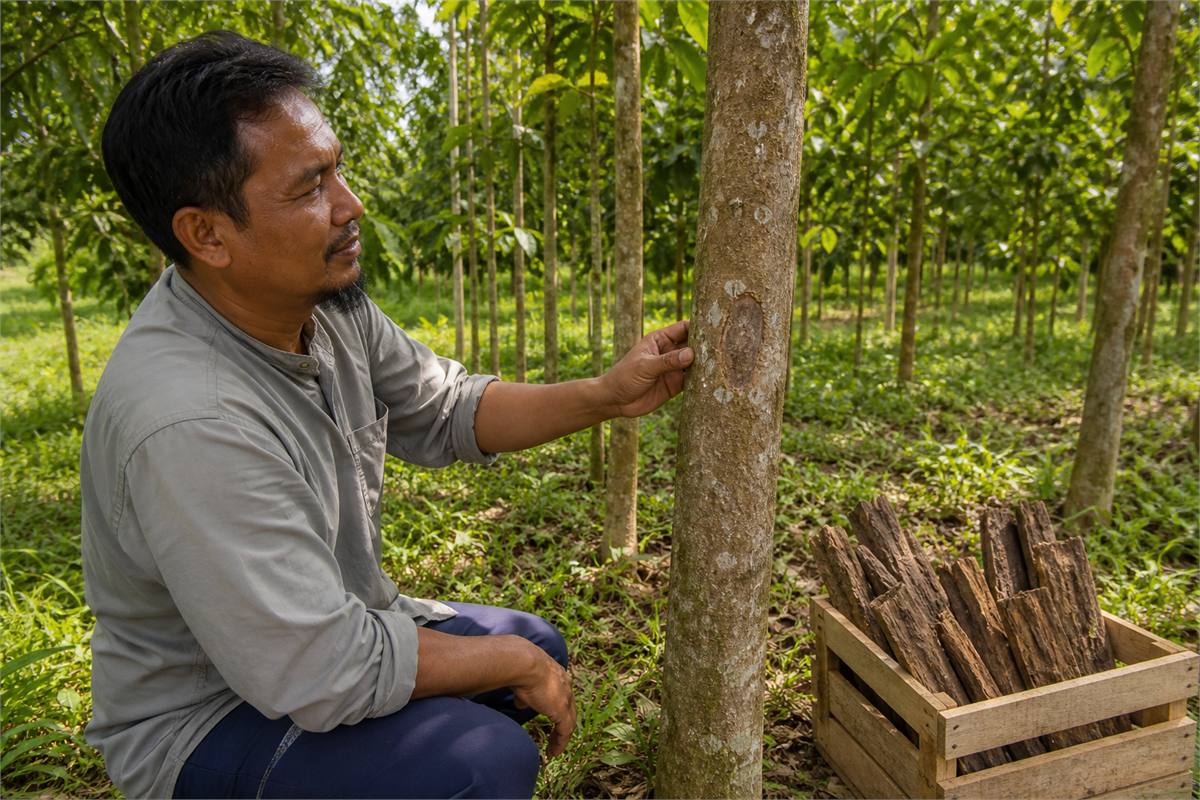
Agarwood is not a separate kind of ordinary dark timber. It develops when a suitable tree responds to injury and biological stress by depositing aromatic resin in parts of its wood. Storm damage, broken branches, insects, microbes, and deliberate cultivation methods can all be involved. The response is uneven: one tree may contain pale unresinated wood beside darker, fragrant zones, and many trees never develop valuable material at all.
Natural forest formation and human-induced formation should be described separately. Growers may wound trees or use controlled inoculation and other induction systems to encourage resin production. Cultivated, induced agarwood can be genuinely resinous and aromatic; “wild” is not a synonym for better, older, or legal, and “plantation” does not by itself describe scent quality. Species, growing environment, resin distribution, induction method, harvest timing, storage, and processing all shape the result.

The name chenxiang is often translated literally because highly resinous pieces can become dense enough to sink, but buoyancy was never a complete definition of quality. Resin-rich wood is valued above all for fragrance, material character, and the patience embodied in its formation.
Agarwood, oud, aloeswood, gaharu, and chenxiang
Agarwood travels under many names. Aloeswood and eaglewood are older English trade terms; gaharu is widely used in Indonesia and Malaysia; chenxiang is common in Chinese-language contexts; jinkō is familiar in Japan; and oud is central to Arabic and global perfumery. In everyday commerce, “oud” may mean resinous wood, distilled agarwood oil, or simply an oud-style perfume accord. Always identify the physical form before comparing two products.

| Name on a listing | What it may mean | What to clarify |
|---|---|---|
| Agarwood / aloeswood | Resin-bearing wood, chips, powder, oil, incense, beads, or carvings | Exact form, species or trade identification, source, and treatments |
| Oud | Agarwood wood or oil, natural perfume material, diluted oil, or a composed fragrance accord | Whether natural agarwood is present and in what form |
| Chenxiang (沉香) | A broad Chinese term for fragrant resinous wood and products made from it | Whether the item is raw wood, incense, jewelry, powder, or oil |
| Gaharu | A Southeast Asian trade name for agarwood | Country, species, cultivation or harvest context, and product form |

Where agarwood comes from: useful trade regions, not a strict three-part botany
Market conversations often group agarwood into Guanxiang, Hui’an, and Xingzhou traditions. These are useful cultural and trade vocabularies, but they are not three exclusive botanical species groups. Borders, historic ports, scent styles, commercial routes, and modern seller habits overlap.
- Guanxiang (莞香) is closely associated with southern China, especially Guangdong and the historic cultivation and trade of Aquilaria sinensis. Hainan and Guangxi also appear in broader Chinese agarwood discussions. Honeyed, clean, and gently sweet descriptions are common, but a regional name alone cannot establish origin or species.
- Hui’an is used in trade for material linked with parts of mainland Southeast Asia, including Vietnam, Cambodia, and Laos. Sellers often describe floral, fruity, sweet, or cooling profiles. These are scent expectations, not fixed guarantees attached to every piece from the region.
- Xingzhou, historically related to maritime Southeast Asian trade, is often applied to material from Indonesia, Malaysia, Brunei, and nearby areas. Rich woody, resinous, spicy, leathery, creamy, or balsamic notes may appear. The name spans multiple islands, species, and processing traditions.
Country and regional names can help describe a seller’s sourcing story, yet they cannot be confirmed from color, scent, an image, or buoyancy alone. A careful listing connects the name to a supplier, cultivation or harvest location, product form, and traceable trade path.

What kinam, kynam, qinan, and kyara mean
Kinam, kynam, and qinan—often written 奇楠 in Chinese—are market and cultural terms for exceptionally prized agarwood associated with an unusually rich aroma and distinctive resinous texture. Kyara is the Japanese term most often encountered in high incense culture. The words overlap, but their use is not governed by one universal international grade.
Material sold under these names is often described as softer, more pliable, or more resin-rich than ordinary agarwood, with sweet, cooling, creamy, spicy, bitter, or herbal facets unfolding in close succession. Modern sellers also use phrases such as cultivated kinam or grafted kynam for plantation material produced through selected propagation and induction. That product should not be silently presented as ancient wild kyara.
Because the terminology is inconsistent and the material is costly, the name alone should never carry the purchase. Compare aroma in a non-destructive way, examine the disclosed form and treatment, and understand what the seller means by the term. Historical anecdotes about tasting kinam belong to specialist literature, not home testing: do not chew, taste, or prepare agarwood for internal use.

The central benefit: an aroma that changes with form and heat
Agarwood is treasured because its scent moves rather than staying flat. Depending on the wood, oil, temperature, and processing, it may pass through dry wood, honey, flowers, ripe fruit, cool camphor, herbs, spice, leather, balsam, cream, earth, smoke, or animalic depth. Not every sample contains every note, and none of these descriptors functions as a universal grade.

Gentle heating can reveal delicate sweet, floral, green, or cooling facets before heavier wood and resin appear. Direct-burning incense includes the aroma of combustion and any base materials in the formula. Distilled oil can be more concentrated and may reflect fermentation and distillation choices. Beads remain comparatively subtle at skin temperature. These experiences should not be treated as interchangeable.

| Form | Experience | Important distinction |
|---|---|---|
| Resin-bearing chips | A slow aromatic progression under controlled heat | Wood structure, resin distribution, moisture, and heat all affect scent |
| Powder | Quick release for incense making or measured heating | Pure powder, spent material, blends, and added fragrance can look similar |
| Incense sticks or coils | A convenient room ritual with a consistent burn | Usually a formula containing wood powders, binder, and sometimes added fragrance |
| Oud oil | Concentrated personal fragrance with batch-specific character | Pure distillate, diluted oil, and synthetic or composed oud accords are different products |
| Beads and carvings | Tactile grain, a gentle scent, and a meaningful object to keep close | Solid wood, compressed powder, coatings, dyes, and scented substitutes must be distinguished |
Incense, meditation, hospitality, and the wish for a peaceful space
Agarwood has accompanied prayer, hospitality, tea, study, poetry, and attentive fragrance appreciation across Eastern, South Asian, Japanese, and Middle Eastern traditions. Its smoke or gently heated aroma can mark a transition: from work to rest, from conversation to reflection, or from an ordinary room to a moment prepared with care.
For meditation, fragrance works best as a quiet sensory anchor rather than a promise of a medical result. Prepare the burner, use a small amount, notice the scent’s changes, and return attention gently when the mind wanders. A 15–20 minute personal ritual can be enough to create a clear beginning and ending without filling the room with dense fragrance.

In a welcoming ritual, oud can express generosity and respect. In a reading room or tea setting, chenxiang may carry a wish for clarity and inner steadiness. It becomes a medium through which people hope to bring about peace, health, virtue, harmony, or a specific outcome in life—a fragrant reminder to meet the moment with intention.
Use incense in a ventilated space and begin with less than you think you need. Keep hot burners, embers, flames, and oils away from children, pets, fabrics, and unstable edges, and never leave burning or heated material unattended. Stop if anyone experiences irritation or discomfort. The incense lighting guide explains safe ignition and extinguishing, while the lotus incense burner guide explores the meeting of practical design and symbolic calm. Homes shared with animals can also use the incense and dogs guide to plan distance, ventilation, and observation.
Traditional medicine belongs in its professional context
Agarwood has a long history in Chinese medicine, Ayurveda, and other traditional medical systems. In Chinese materia medica, chenxiang is associated with classical functions described as moving qi, warming the middle, easing vomiting, and helping qi descend. Those terms belong to trained diagnostic and dispensing traditions; medicinal preparations are not the same as scented bracelets, perfume, or household incense.

Laboratory and preclinical studies have examined sesquiterpenes, 2-(2-phenylethyl)chromones, and other agarwood constituents, but smoke exposure, a commercial fragrance, and a professionally prepared medicine are different routes with different risks. Do not make agarwood tea, food, or home remedies from incense, beads, chips, oil, or unidentified material. Questions about internal or therapeutic use belong with a qualified clinician who understands the exact preparation.
Agarwood beads and carvings: fragrance carried close
An agarwood bracelet offers a quieter relationship with the material than incense does. The warmth of the hand may release a faint aroma, while grain, weight, texture, and daily handling make the piece personal over time. In modern wearing culture, chenxiang beads are often chosen for calm, auspiciousness, and companionship—a wish for qingjing (清净), an inner sense of clarity and peaceful order.

The experience depends on construction. Solid fragrant wood, low-resin plantation wood, compressed powder, a wood composite, dyed material, oil-infused beads, surface coatings, and artificially scented substitutes can all be sold under similar names. The agarwood bracelet guide goes deeper into bead construction, wearing, meaning, and care without confusing a bracelet with heated incense material.

Small carvings and pendants join aroma with craftsmanship. Their value may lie in the object’s story, the way the maker works around irregular resin lines, and the blessing it carries as a gift. Choose through scent, provenance, personal resonance, and the life moment you hope the piece will accompany—not through a gender rule.
How agarwood incense and beads are made
From resinous wood to beads
Bead makers first study an irregular piece of wood and decide how to preserve attractive grain and resin-bearing areas. The material is cut into blanks, drilled, rounded, dried when needed, and progressively sanded. Offcuts and clean powder may be saved for appropriate fragrance uses, though a buyer should not assume every bead workshop or every powder product follows the same process. Heavy dyes, oil loading, glue, and opaque coatings can conceal the wood rather than honor it.

From powder to incense
Incense makers grind aromatic materials, combine them with a combustible plant binder, add water, form sticks or coils, and dry them carefully. Some recipes highlight agarwood; others are balanced blends in which sandalwood, herbs, spices, or additional fragrance play major roles. “Agarwood incense” therefore describes a formulated product, not automatically a stick made from nothing but rare resinous wood.

How to choose agarwood without destructive tests
No home test can prove species, exact origin, age, natural formation, or legality. Color varies from pale streaks to deep brown and black resin zones; genuine material is not required to be uniformly black. Scent varies by form and temperature; one “cool-sweet” profile is not mandatory. Sinking relates partly to density, but moisture, shape, trapped air, mineral matter, coatings, and composites also change buoyancy.
- Identify the form. Decide whether you are buying wood chips, powder, incense, oil, perfume, beads, or a carving. The right questions change with the form.
- Read the material disclosure. Look for solid wood versus compressed material, natural distillate versus perfume accord, and pure powder versus a formula with binder or added fragrance.
- Ask how the trade name is being used. A regional name, “kinam,” “sinking grade,” or “old material” needs a plain explanation from the seller.
- Observe under neutral conditions. Look for believable grain and uneven resin distribution, and smell the item at room temperature without rubbing, cutting, burning, soaking, or applying chemicals.
- Compare a small amount first. A modest chip sample or clearly formulated incense lets you learn the seller’s vocabulary before committing to rare material, a large strand, or expensive oil.
- Keep the paper trail. Retain the invoice, species or trade description, source details, batch information, and any permits needed for the transaction or border crossing.
Price follows form, resin content, aroma, rarity, size, workmanship, legal sourcing, and seller reputation. A claim of high-resin, sinking-grade material offered for only a few hundred US dollars should be judged against all of those facts, not accepted because the piece is black or heavy. At the highest end, kinam and historic wild-material labels can command extraordinary premiums, but a high price is not proof of identity. Compare like with like: a milliliter of oud oil, a gram of chips, a finished bracelet, and a compounded incense box are four different markets.


Legal and traceable sourcing is part of the beauty
International trade in agarwood-producing Aquilaria and Gyrinops species is governed through CITES Appendix II listings and national law. Appendix II trade is regulated rather than universally prohibited, and the rules can depend on species, origin, product form, quantity, destination, and the current annotation or exemption. A finished perfume, oil, powder, chip, bead strand, and carving may not be treated identically.
Before crossing a border, check the current requirements with the relevant CITES management and customs authorities for the exact object. Avoid material described as secretly harvested, smuggled, impossible to trace, or newly taken from protected wild populations. Responsible plantations, well-managed induction, careful processing, and transparent trade can help preserve both livelihoods and living forests.
Traceability adds meaning. It connects the fragrance in your hand with a place, a grower, a craft practice, and a future in which agarwood trees remain part of the landscape. That story is more enduring than a dramatic grade name.
Care depends on the form
| Form | Everyday care | Avoid |
|---|---|---|
| Beads and carvings | Wipe gently with a dry soft cloth; let incidental moisture dry promptly; store in a clean, shaded place with reasonable air exchange | Soaking, showers, perfume, soap, sanitizer, prolonged sun, high heat, hard impacts, and airtight storage while damp |
| Wood chips | Keep dry, clean, and separate from strong odors; use a suitable container in a stable environment | Humidity swings, damp sealing, kitchen odors, unnecessary handling, and destructive testing |
| Powder and incense | Protect from humidity and crushing; close the container after use and keep it away from ignition sources | Bathrooms, steamy rooms, open flame during storage, and mixing unknown powders |
| Oud oil | Keep the bottle upright, tightly closed, and away from heat and direct light; use clean applicators | Water in the bottle, contaminated applicators, hot windowsills, and assuming every oud fragrance is pure oil |
| Finished perfume | Follow the perfume maker’s storage and skin-use directions | Treating it as interchangeable with wood chips, incense, or medicinal material |

“Never let agarwood touch water” is too broad: brief accidental contact is different from soaking or wearing beads through a shower. Likewise, permanent airtight sealing can trap moisture and encourage damage. Clean, dry, shaded, odor-controlled storage is the shared principle; the container and level of ventilation should suit the object and local climate.
A fragrant wish for clarity, peace, and companionship
Agarwood benefits are best understood as a relationship between material, aroma, ritual, and meaning. A chip may open a slow interval of attentive listening. Oud oil may become a personal fragrance memory. A bracelet can carry a wish for peace and auspicious companionship. A carefully chosen incense can welcome guests, mark tea or reading time, and bring a gentle sense of order to the room.

Choose the form that matches the experience you want, learn the seller’s vocabulary, favor a traceable source, and care for the object according to what it actually is. In that measured approach, chenxiang retains what has made it precious across cultures: an aroma that unfolds slowly and a story worth carrying forward. For more objects chosen to welcome peace, protection, and beautiful wishes, explore the Eastern Story Blessing collection.
Frequently Asked Questions
Related Posts


