
Quartz gravel landscaping works best when the stone and the layers beneath it are chosen for one clear purpose: a quiet garden view, a secondary path, a planted-bed surface, a decorative dry creek, or a designed drainage feature. The same pale gravel can behave very differently in each setting. Particle size and shape affect walking and raking; the base, soil, slope, outlet, edging, climate, and maintenance routine decide whether the finished ground stays calm and inviting.
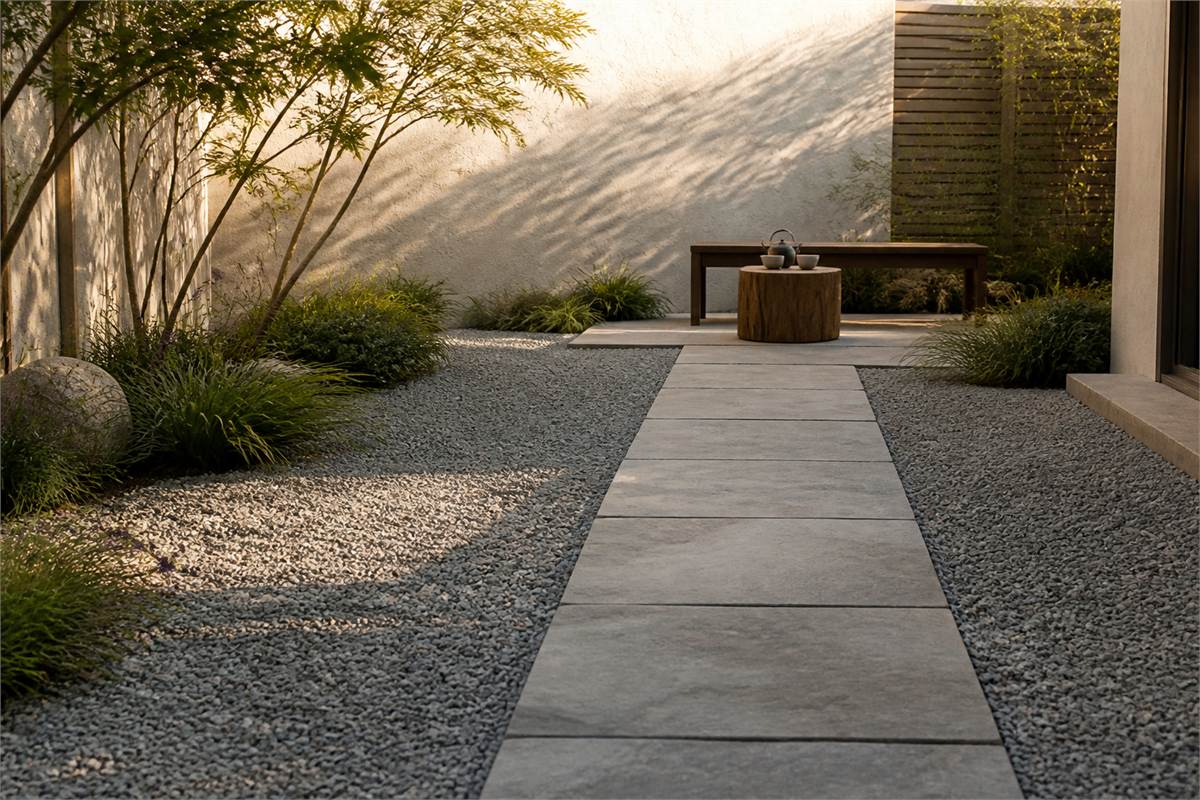
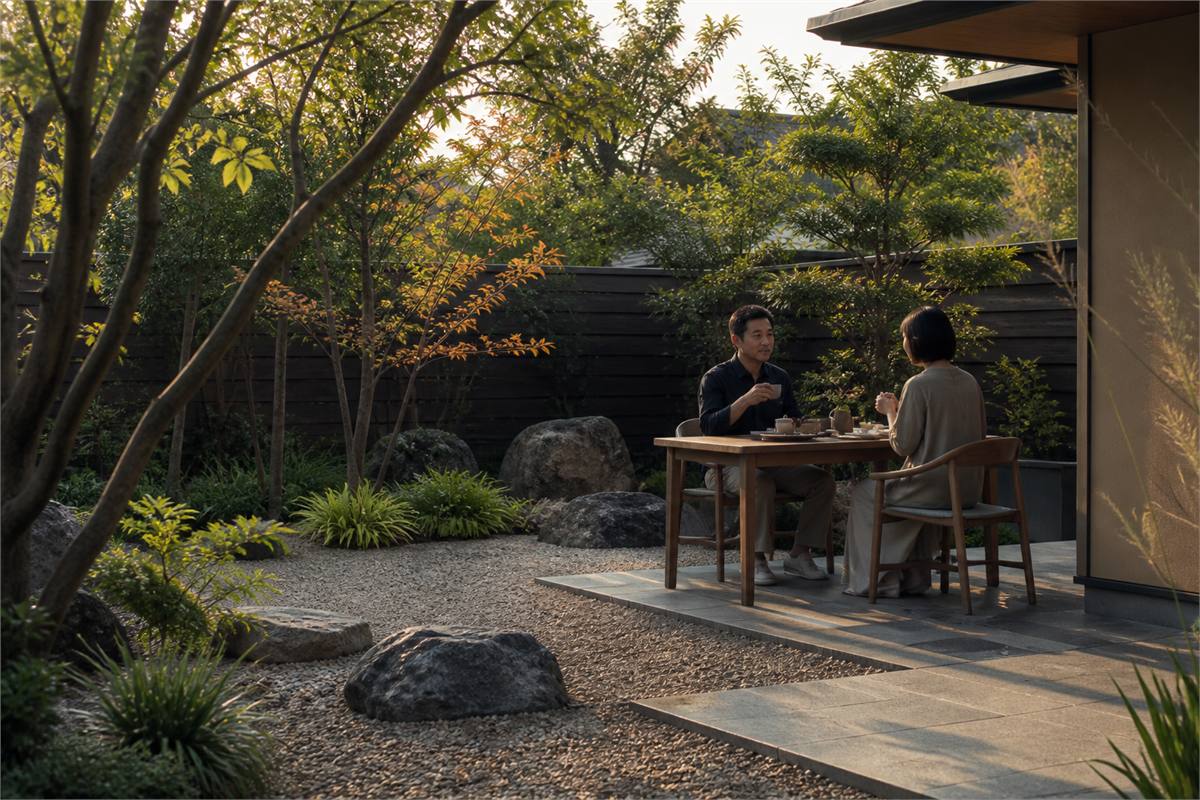
A gravel garden can change the feeling of daily life. It can brighten a shaded corner, make the walk to a tea table feel deliberate, frame a place to pause, or turn the view from a window into a small landscape of stone and open space. The practical details matter because they protect that experience: a surface that scatters, ponds, glares, or traps debris soon stops feeling restful.
Start by identifying what the supplier calls quartz gravel
Quartz Shiying (石英) is a mineral, while landscape yards often use “quartz gravel” as a broad market description. A bag or bulk pile may contain crushed vein quartz, quartzite gravel, naturally rounded pebbles, mixed decorative aggregate, or another pale rock sold for a similar visual effect. White, gray, yellow, and black stones are not automatically the same material, and black aggregate may be basalt rather than quartz.
| Landscape name | What it may describe | What to confirm |
|---|---|---|
| Quartz gravel | Quartz-rich crushed or rounded aggregate | Actual rock or mineral, grading, fines, source, and finish |
| Quartzite gravel | Aggregate made from quartzite rock | Color range, fracture shape, durability data, and batch variation |
| River pebble | Naturally or mechanically rounded stone of mixed geology | Rock types, smoothness, rolling behavior, and size distribution |
| Granite or basalt gravel | Crushed igneous rock used for darker or speckled ground | Angularness, fines, color change when wet, and staining |
| Limestone gravel | Calcium-carbonate-rich decorative or base aggregate | Dust, local weathering, cleaner compatibility, and color |
| Quartz sand | Fine quartz-rich particles, sometimes much finer than gravel | Whether it compacts, tracks, crusts, drains, or holds rake marks |
| Resin-bound aggregate | Stone combined with a specified resin and installed as a system | Aggregate-resin compatibility, UV stability, permeability, slip finish, base, and repair method |
| “Quartz tile” or “quartz brick” | A rigid paving product, not loose gravel | Product category and exterior installation system |
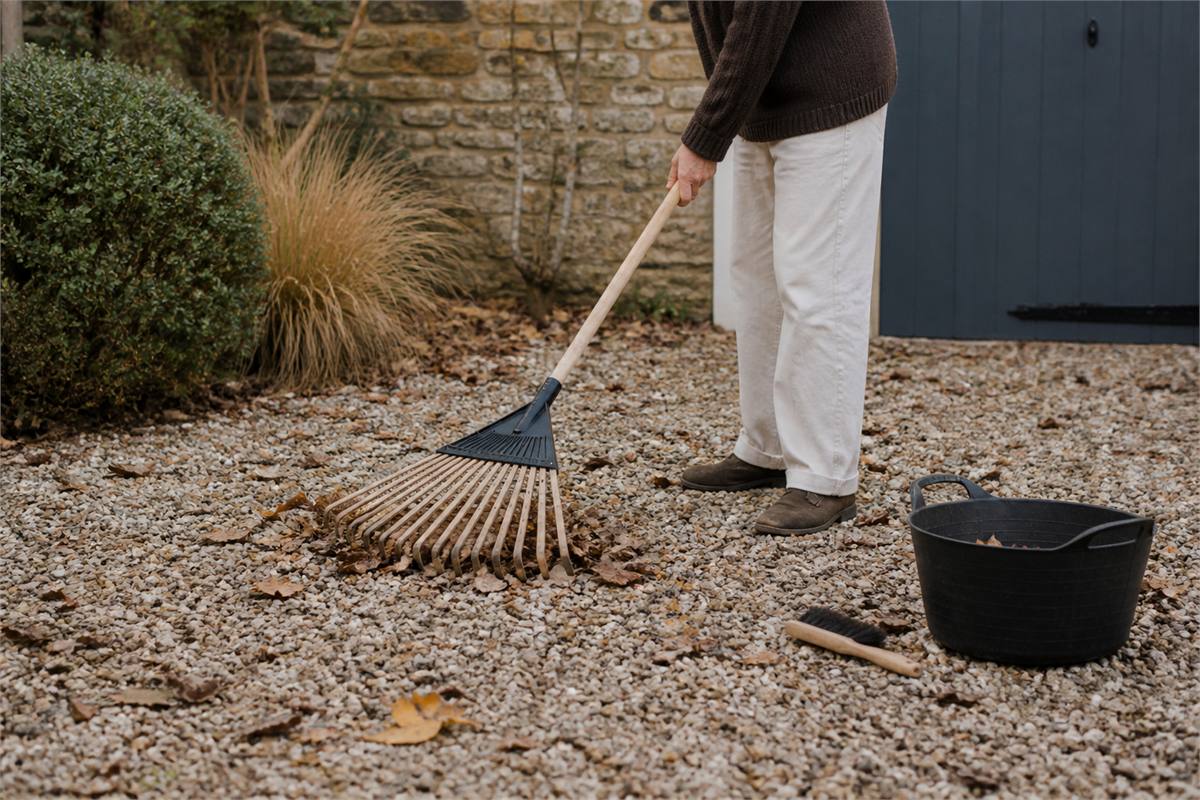
Ask for a representative sample rather than choosing from a photograph. Spread it at the proposed depth, walk or rake it, wet it, let it dry, and view it at midday and in evening light. Check dust, sparkle, glare, sharp fragments, leaf removal, and the amount that moves beyond an edge. Keep the approved sample and the quarry or batch name for future top-ups. For a closer look at quartz as a crystal and the miniature landscapes carried by inclusions, visit the garden quartz and lodolite meaning guide.

Choose particle size and shape for the garden experience
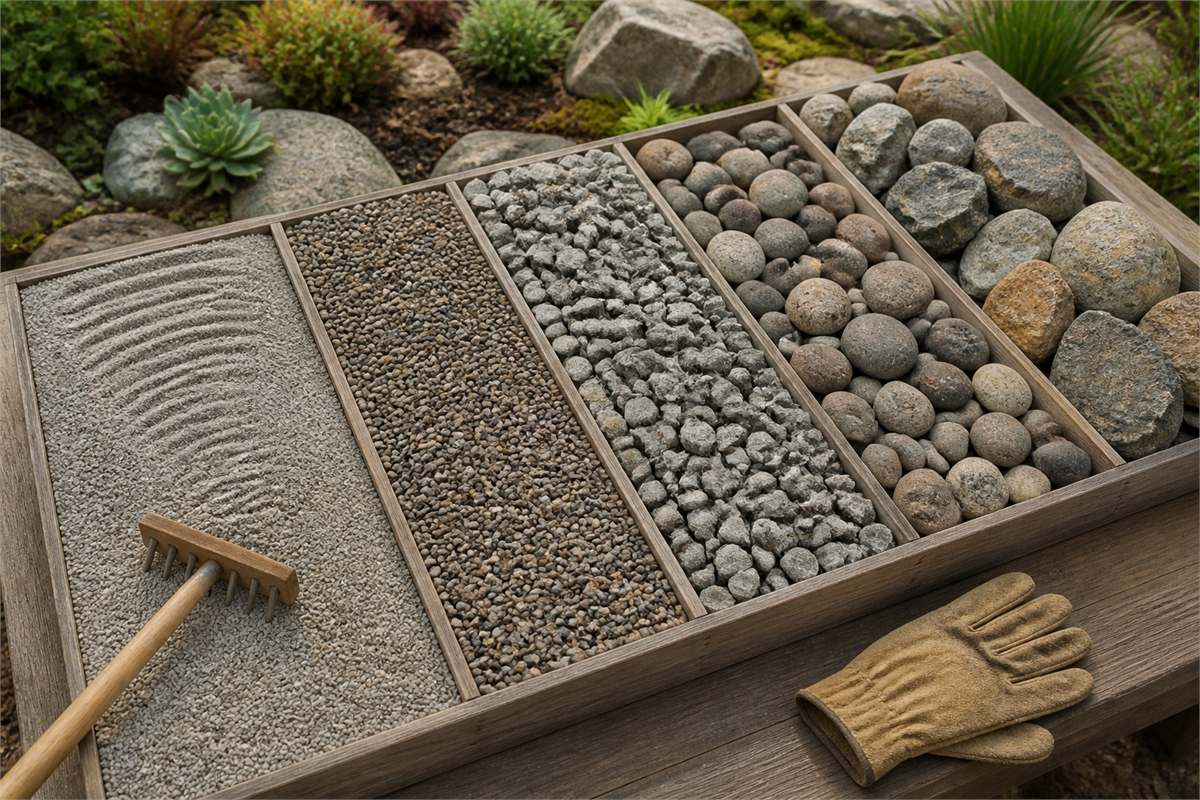
Angular gravel tends to interlock and stay where it is raked, although very sharp pieces can feel harsh under thin footwear. Rounded pebbles bring a softer river-worn appearance but roll under concentrated foot traffic. Fine material can record graceful lines and small shadows; it also tracks more readily and can seal or clog when it contains too many fines. Coarser stone gives bolder texture and resists tracking, but it is harder to walk across and cannot hold delicate rake marks.
| Design task | Useful sample range | What the trial area must prove |
|---|---|---|
| Fine raked field | 2–5 mm is a common sample range | Marks hold without crusting, excessive dust, or wind movement |
| Decorative planted bed | 3–10 mm can create a refined surface | Stone stays clear of crowns, soil remains healthy, and heat is acceptable |
| Secondary garden path | About 5–20 mm or 10–30 mm may be trialed, depending on shape | Footing is stable, comfortable, and contained at edges |
| Dry creek surface | Mixed sizes, including 20–60 mm accents, can suggest a channel | The composition looks natural and any real flow remains stable |
| Drainage aggregate | A clean, specified open grading | Void space, filtration, pipe compatibility, and outlet design suit the site |
These dimensions are starting points for samples, not universal specifications. A product described as 5–20 mm can contain a different balance of particle shapes and fines from another supplier’s 5–20 mm product. Final grading and depth must follow the intended use, base, rainfall, soil infiltration, freeze-thaw exposure, maintenance method, accessibility requirement, and the complete supplier or designer detail.
Compose a quiet dry garden with viewpoint and restraint
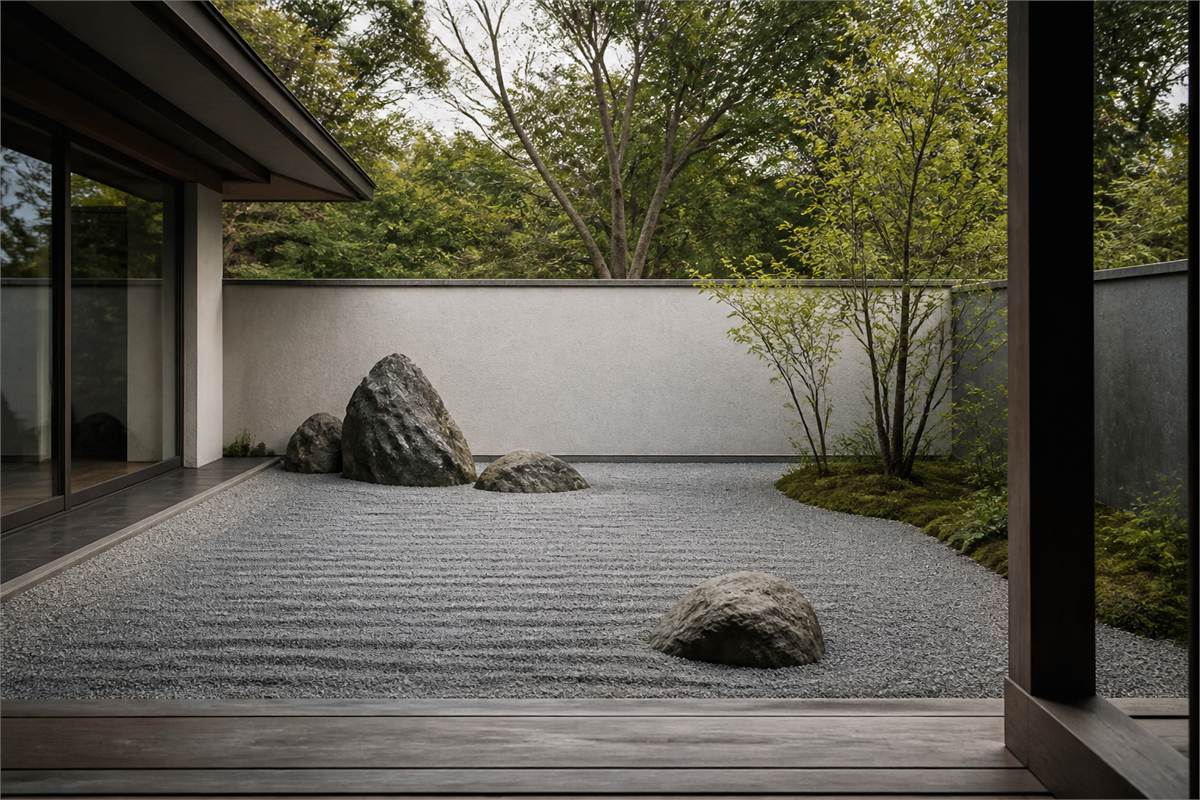
The Japanese dry landscape Karesansui (枯山水) brings stone, gravel or sand, empty space, proportion, viewpoint, and repeated care into one composed scene. A gravel field may evoke open water, mist, distance, or simply a spacious ground against which larger stones become vivid. The strength comes from the whole relationship, not from a fixed meaning assigned to every line or a required number of rocks.
Not every white-gravel courtyard is a traditional karesansui garden. “Japanese-inspired dry garden” or “mineral garden” is often the more respectful description for a contemporary home. Begin with the mood you want to welcome: stillness after work, a calm view at breakfast, a place for gentle raking, or an uncluttered setting for conversation. That intention gives the design coherence without turning cultural references into decoration.
Place the view before the stones
Choose the primary viewpoint—from a window, terrace, seat, doorway, or turn in a path—and arrange the largest stones before spreading gravel. Partially bury each stone so it feels grounded. Vary height, direction, spacing, and overlap, then look again from eye level. A cluster of three or five stones can be an attractive design choice, but it is not a religious rule. Open space is as important as the objects placed within it.

Let raking become a gentle garden rhythm
A 2–5 mm sample may hold fine lines, while a somewhat coarser angular gravel may produce deeper, longer-lasting shadows. Parallel lines can extend a quiet field; curves can move around a stone; concentric rings can suggest ripples. These are expressive design choices rather than a fixed spiritual vocabulary. Choose a pattern that suits the aggregate, scale, wind exposure, nearby trees, and the time you genuinely want to spend maintaining it.
Raking can become a small ritual of return: smoothing yesterday’s marks, noticing the weather, and restoring an orderly place with your own hands. A simple pattern renewed occasionally often carries more peace than an elaborate design that becomes a burden after every leaf fall.

Build a comfortable secondary path from the ground up
Loose quartz gravel is best treated as a secondary garden path or a decorative field beside a firmer route. Most loose gravel does not provide the stable, firm surface expected on an accessible route unless it is stabilized and maintained as a complete system. For wheelchairs, strollers, mobility aids, older visitors, children, and the main route to a door, specify a continuous firm, stable, slip-resistant surface. Stepping stones can add comfortable footfalls for some users, but they do not replace an accessible route.
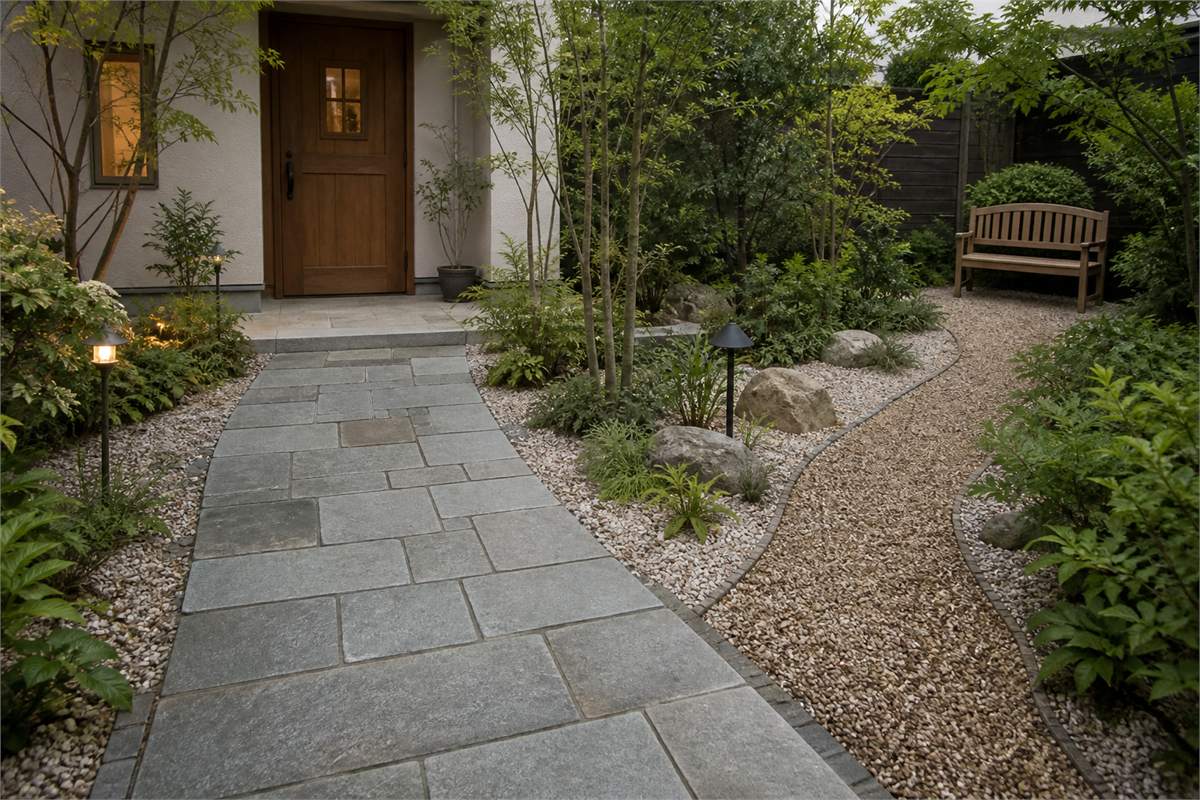
- Walk the proposed route and mark gates, thresholds, turns, steps, seating, desire lines, service access, and drainage crossings.
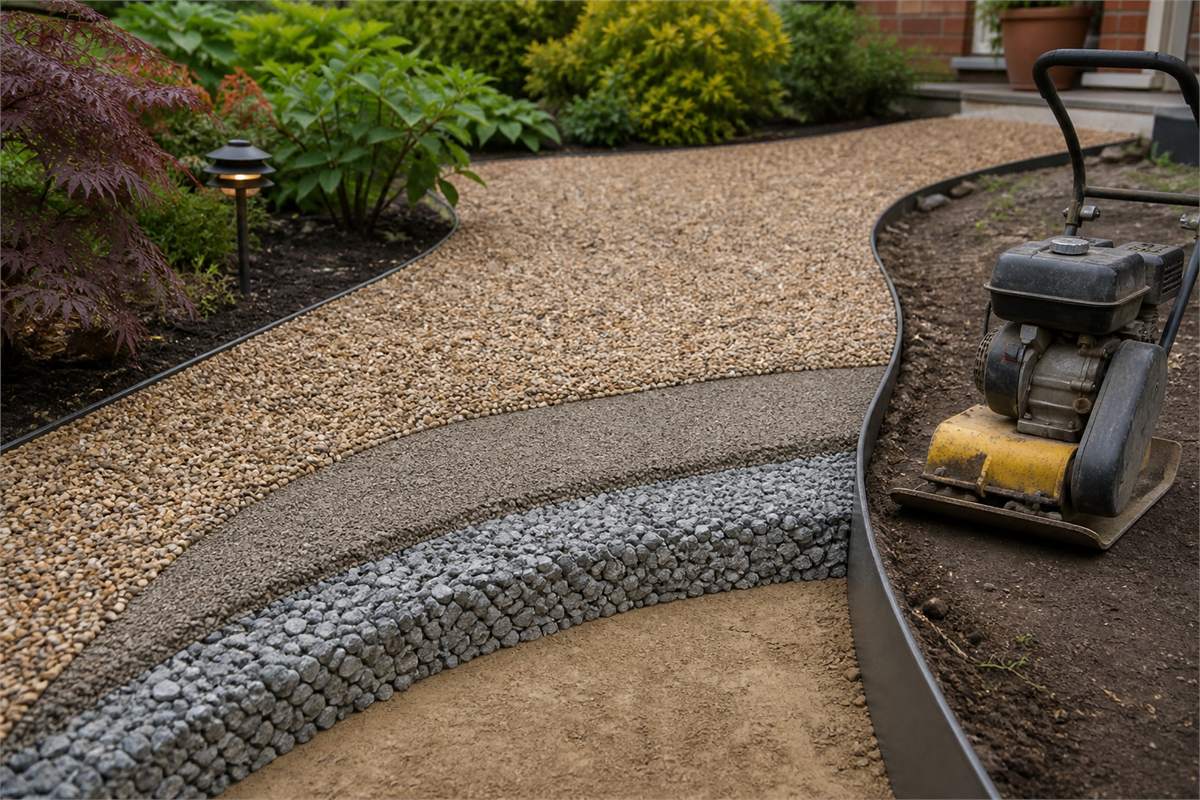
- Remove organic topsoil and weak material to a depth determined by soil, traffic, frost, and local construction practice.
- Shape and stabilize the subgrade so water has a deliberate destination.
- Place the specified load-bearing aggregate base in controlled lifts and compact it to the project requirement.
- Add the bedding or surface course called for by the chosen gravel or stabilization system.
- Install continuous edging deep and strong enough to resist feet, wheels, maintenance tools, runoff, and seasonal ground movement.
- Spread the tested surface gravel to its system depth, then rake or compact as specified.
- Check gates, thresholds, edging, drains, and migration points after the first significant rain and again after a season of use.
A surface layer around 3–5 cm may be a useful trial for some decorative or lightly used systems, while other paths and stabilization systems require a different depth. Simply making loose gravel 10 cm deep does not make it firmer; it can make wheels and feet sink more deeply. The stable path comes from the designed assembly, not a single thickness number.
Use grids, binders, and resin only as complete systems
Gravel-retention grids, compacted fines, binders, and resin-bound aggregate can make a surface more stable when the product, base, edge, drainage, installation, slip finish, and maintenance are designed together. Resin-bound and resin-bonded finishes are different constructions, and permeability depends on the entire installed system. Confirm aggregate compatibility, resin ratio, curing conditions, UV performance, wet slip characteristics, freeze-thaw suitability, repair method, and the approved base rather than relying on the phrase “eco-friendly glue.”

Treat geotextile as filtration or separation, not a weed promise
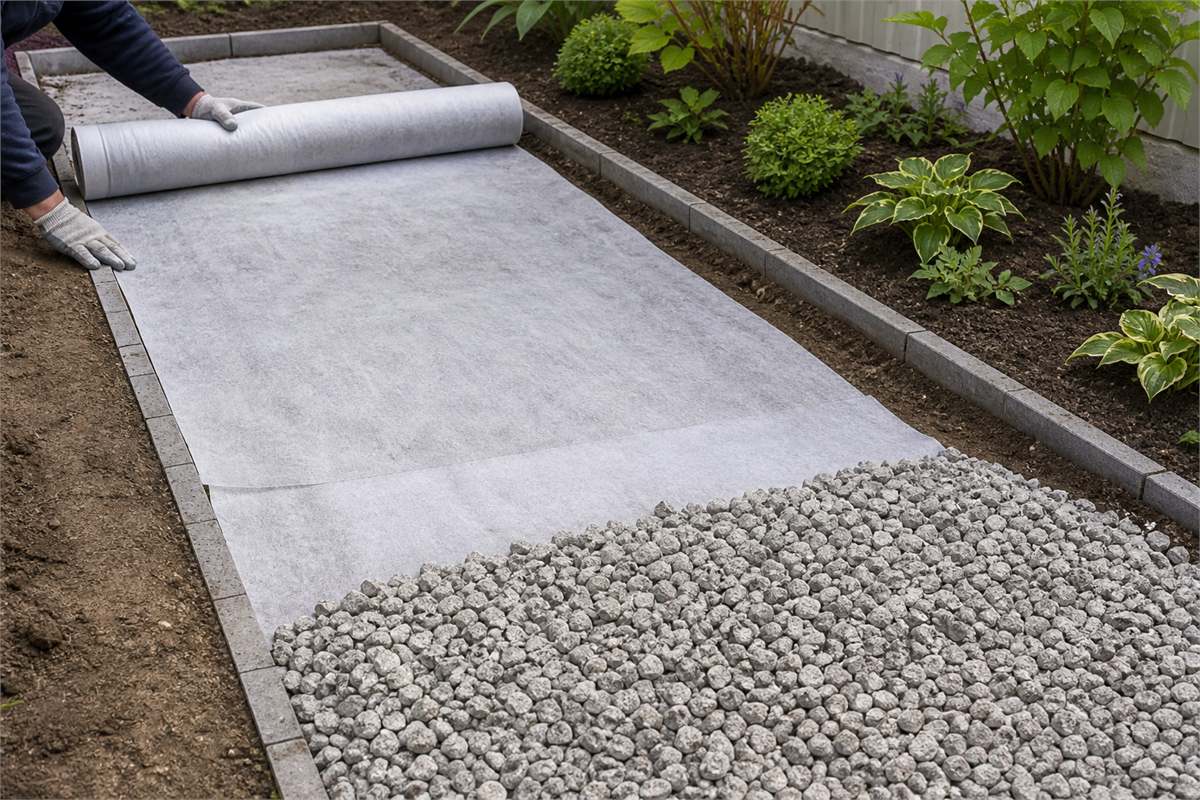
Geotextile is a family of engineered fabrics used for functions such as separation, filtration, drainage, and reinforcement. A permeable separator can help keep soil fines from contaminating clean aggregate; a filter around a drainage trench can retain soil while allowing water to reach the drain. Its opening size, permeability, strength, survivability, and placement must suit the soil and aggregate. A generic “200 g fabric” description or a fixed 30 cm overlap does not establish that suitability by itself.
Landscape fabric can reduce mixing and make some installations easier to renew, but airborne seeds still germinate in dust and organic matter above it. Roots also enter from edges. Plastic weed membrane is not interchangeable with a permeable geotextile, and an impermeable sheet can redirect or trap water. In planted beds, avoid casually sealing broad root zones: preserve soil exchange, leave suitable space around trunks and crowns, and coordinate fabric with the planting and irrigation plan.
Design drainage as a continuous path for water
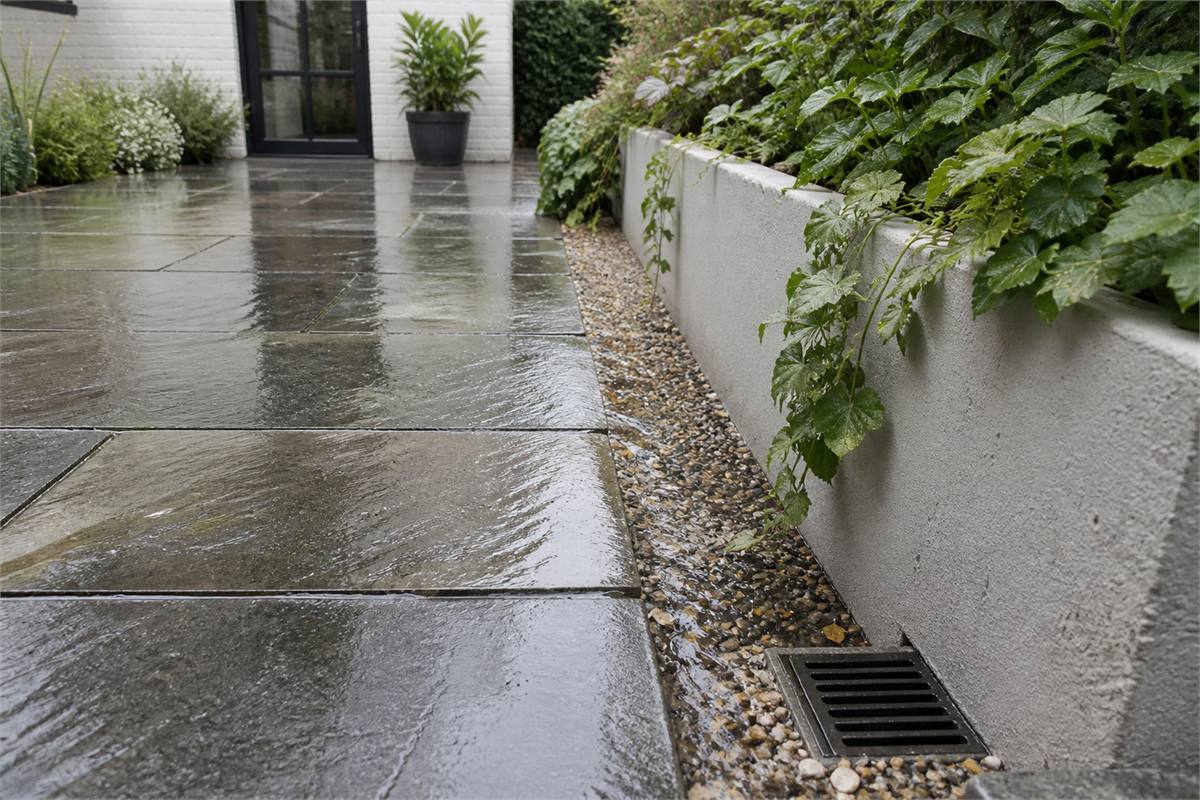
Clean gravel contains voids through which water can move, yet a decorative gravel surface is not automatically permeable paving and it does not create a complete “sponge city” solution. Performance depends on grading, fine sediment, surface contamination, base layers, compaction, geotextile selection, subgrade infiltration, groundwater, slope, storage volume, outlet, overflow, and maintenance. Clay below an open gravel layer can still hold water; an edge without a weep route can turn the gravel into a shallow basin.
A French drain is more than a gravel-filled trench
A French drain or gravel trench may include a shaped trench, a selected filter or separator, clean drainage aggregate, and a perforated pipe where the design calls for one. Pipe position, perforation orientation, fall, aggregate grading, filter arrangement, cleanouts, outlet, and overflow route depend on soil, groundwater, contributing area, rainfall, nearby foundations, utilities, and local requirements. Wrapping every pipe in the same fabric “sock” or prescribing one universal slope can cause clogging or trap water when the detail is wrong for the soil.
Route water only to a lawful, approved destination. Verify whether the property uses separate or combined storm and sanitary systems, whether infiltration is permitted, and whether a municipal connection requires approval. Coordinate finished levels with damp-proofing, doors, basement windows, walls, neighboring property, and emergency overflow. Never assume a convenient yard inlet is suitable merely because it is nearby.

Distinguish a decorative dry creek from a runoff channel
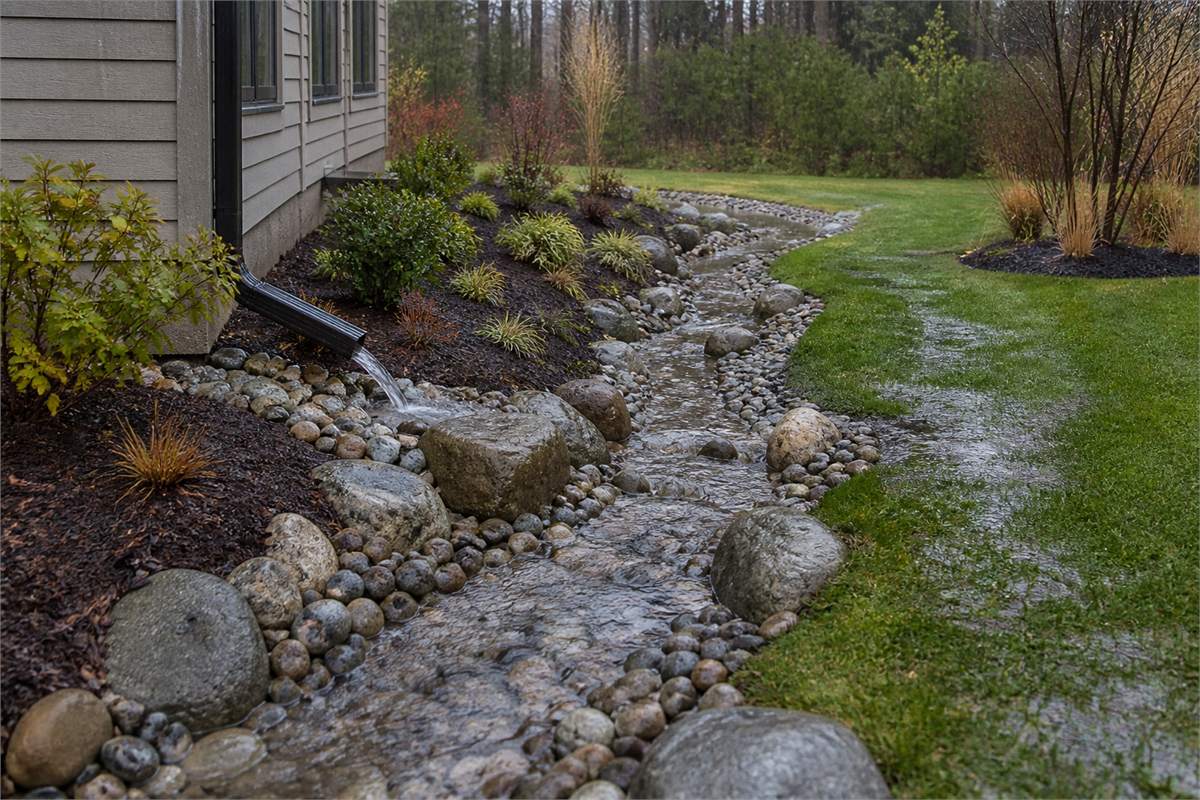
A decorative dry creek bed is a visual composition. It can curve through a planting, narrow toward the distance, and use mixed scales to suggest a riverbed without carrying meaningful storm flow. A drainage dry creek is infrastructure as well as landscape. Its cross-section, slope, inlet, stone stability, erosion protection, vegetation, crossings, outlet, and overflow must be sized for the contributing catchment and local storms.
Ranges such as 40–80 cm wide for a small decorative feature, 20–30 cm of excavation, or 20–60 mm surface stone can help a designer build a mock-up. They cannot prove hydraulic capacity. For a working channel, use site levels and runoff calculations. Place larger stabilizing stone where water enters, turns, narrows, or drops, and keep any overflow away from buildings and unsafe walking areas.
Use gravel in planted beds without losing the living garden
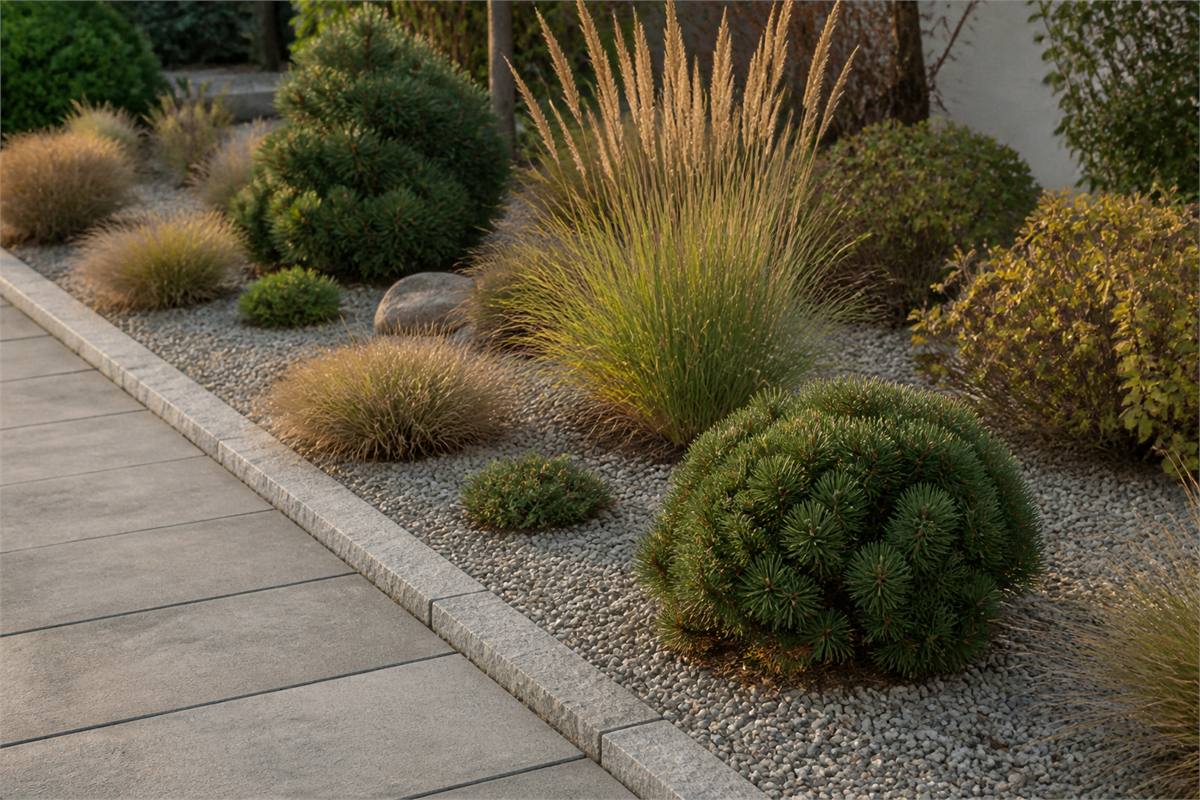
Mineral mulch can sharpen foliage shapes, make a small border feel spacious, and connect a planting to nearby stonework. A 3–10 mm decorative sample may suit a refined bed; larger mixed gravel can feel more natural. Keep the stone away from plant crowns and tree trunks, and check how its color changes soil temperature and reflected light. Pale stone can create glare and strong reflection, while dark stone can absorb considerable heat. Neither has one universal cooling or warming effect.
Choose plants from the site outward: climate, sun, soil, water, mature size, maintenance, local invasiveness, and household safety. Moss asks for shade, moisture, and the right substrate; it will not thrive in every dry, sunny garden. Pines, maples, bamboo, ferns, ornamental grasses, agaves, rosemary, nandina, and other often-photographed companions each have regional limits. In homes with pets or young children, check toxicity, irritation, sharp leaves, loose-stone throwing, swallowing, and fall hazards before deciding what belongs near an activity area.
Create depth with color, scale, light, and open space
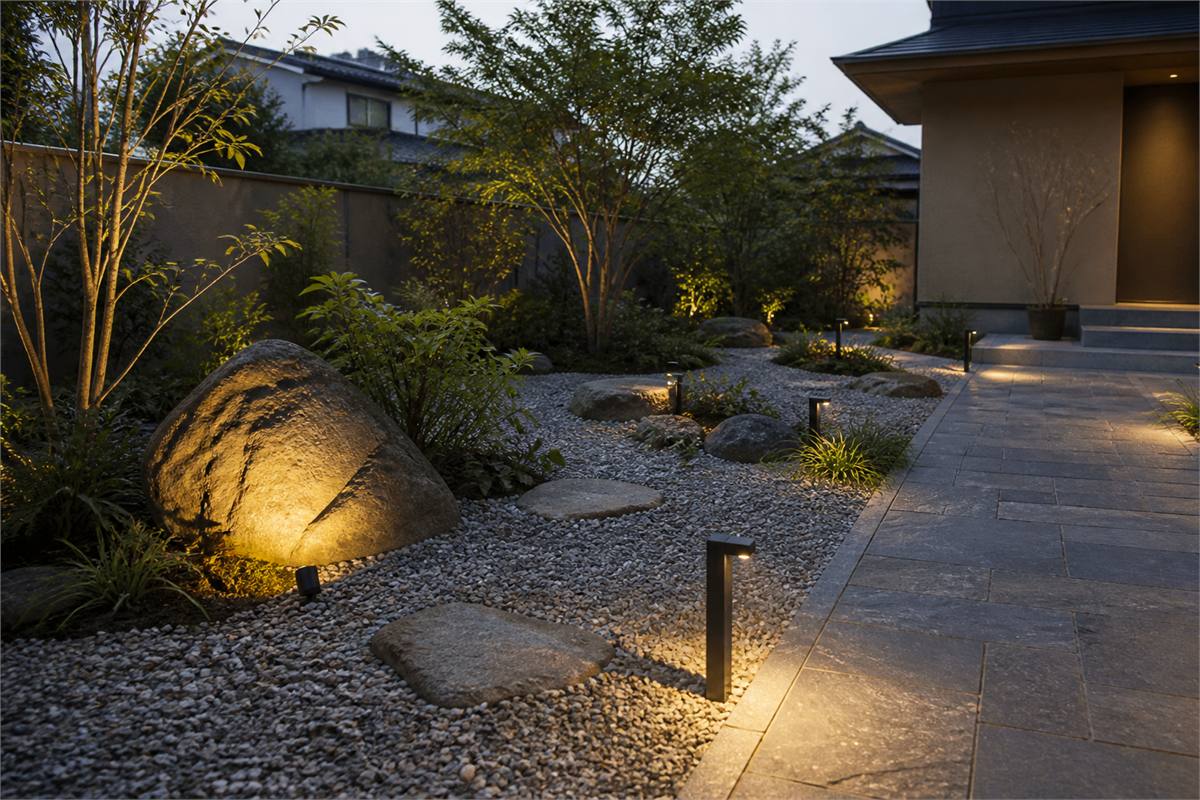
Use larger, darker, or more textured stones as anchors and let smaller particles recede. A gently curving path can reveal the garden in stages; a subtle narrowing toward the background can lengthen the view. Repeat one mineral tone in a step, wall, basin, or vessel so separate zones feel related. Warm low-level lighting can reveal texture at night, but fixtures, cable routes, glare, drainage, and outdoor electrical safety should be designed for the site.
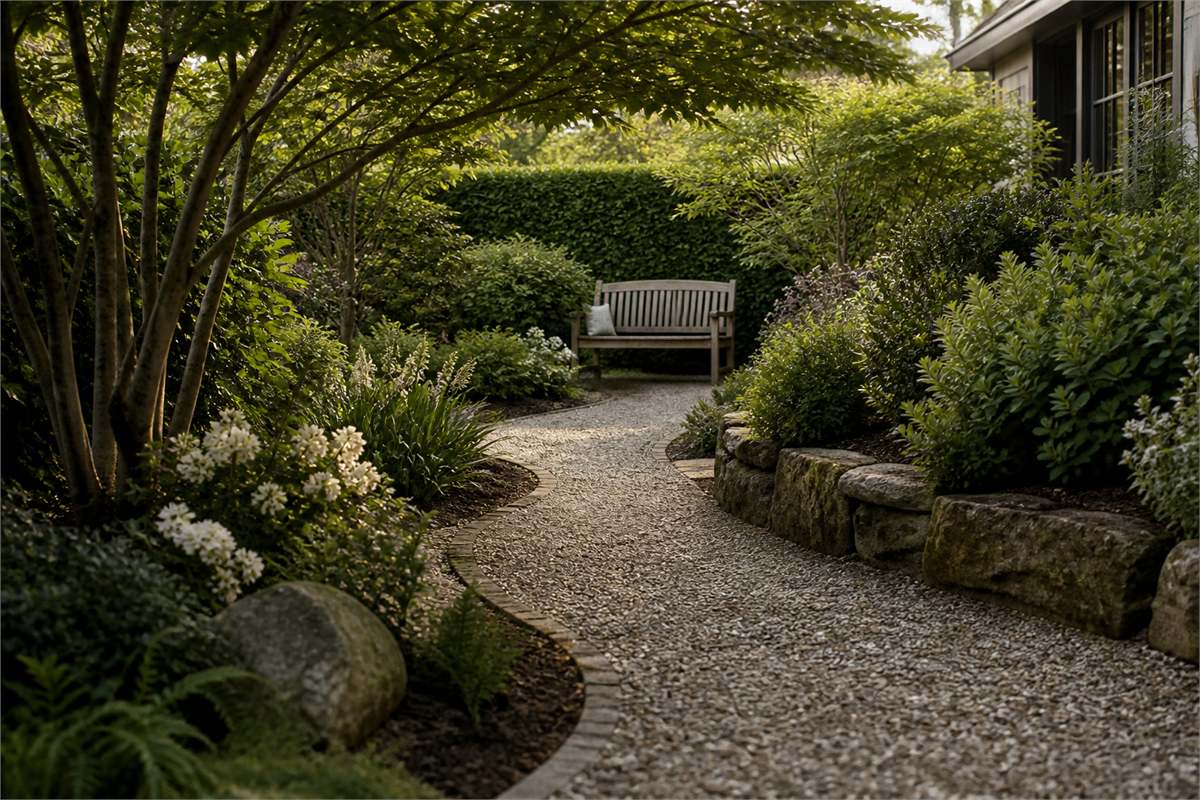
Pure white quartz is visually powerful. In strong sun it can be dazzling, show every leaf, and compete with pale walls. Warm gray, beige, salt-and-pepper, or locally mixed stone often settles more gently into daily life. Black material may be basalt or another rock rather than “black quartz.” Place wet and dry samples beside the building and plants before choosing the final palette.
Estimate quantity from volume and the actual product
For a rectangular area, multiply length by width by the specified compacted or settled depth to estimate volume. Divide an irregular garden into simple shapes and calculate each one separately. Then convert volume to mass with the supplier’s bulk density for that exact grading. Moisture, particle shape, voids, and fines change the conversion, so a generic “tons per cubic meter” figure can create a large ordering error.
Add a measured allowance for irregular edges, settlement, grading variation, spillage, and a small reserve for future repair. Keep the takeoff, delivery tickets, batch information, and sealed sample. Before blending a later delivery, test it in an inconspicuous area; even stone from the same named source can vary in tone and grading.

Make maintenance part of the peaceful composition
| What changes | Why it happens | A restrained response |
|---|---|---|
| Leaves and needles | Open mineral fields collect organic material | Remove them while dry with a soft rake, hand tools, or an adjustable blower used gently |
| Surface weeds | Seeds germinate in dust and leaf matter above the gravel | Remove young plants early and reduce the organic layer; protect nearby roots |
| Mud or fines | Soil crosses weak edges or runoff carries sediment | Correct the source, strengthen separation, and replace contaminated stone locally |
| Algae or darkening | Shade, moisture, dust, and slow drying | Improve drainage and airflow; use a cleaner approved for every nearby material |
| Migration and ruts | Feet, wheels, runoff, slope, or weak edging | Repair the traffic line, base, grade, or edge before repeatedly topping up |
| Lost rake marks | Wind, rain, animals, and normal use | Simplify the pattern or choose a realistic renewal rhythm |
| Slow drainage | Fine sediment clogs voids or the outlet is restricted | Inspect the whole water path and use the maintenance method specified for that system |
Do not leave fine leaves to decay into the surface. Avoid casually applying weed-control chemicals, pet deterrents, acid, or aggressive high-pressure cleaning. Follow local rules and product labels, protect people, pets, plants, waterways, metals, wood, grout, resin, and adjacent stone, and begin with the gentlest effective method. The Eastern Story care guide offers a material-first approach to thoughtful upkeep.

Let the mineral ground hold a beautiful everyday life
The best quartz gravel garden is not the one with the whitest stone or the most complicated construction. It is the one that welcomes the life meant to happen there: a sure walk to the door, a quiet place viewed from a window, a dry garden renewed by hand, a planting framed with light, or rain guided safely through the landscape.
Choose the material slowly, build a small mock-up, and let base, water, boundary, light, plants, and maintenance belong to one design. Then the gravel becomes more than a surface. It becomes a calm background for shared tea, solitary mornings, changing seasons, and the wish for a home that feels settled, harmonious, and cared for. For smaller objects that carry blessings and personal meaning, explore the Eastern Story blessing collection.
Frequently Asked Questions
Related Posts


