
Dzi beads are patterned beads most closely associated with Tibet and the wider Himalayan world. Usually made from agate or chalcedony, they are recognized by eyes, circles, bands, waves, lotus-like forms, tiger-tooth triangles, and other light-and-dark designs. People wear and give them as meaningful jewelry: a way to carry wishes for clarity, peace, courage, harmony, abundance, protection, and a beautiful path ahead.

The English spelling Dzi is familiar in the jewelry market, while the Tibetan spelling is gzi (གཟི།), commonly pronounced closer to “zee.” Related Tibetan usage carries a sense of brilliance, radiance, or splendor. In Mandarin, Tianzhu (天珠) literally means “heavenly bead.” That poetic name expresses the esteem surrounding these beads; it should not be read as a literal claim that the stone fell from the sky.
What makes a bead a Dzi?
Dzi is best understood as a cultural bead tradition and visual family, not as one material, one date, or one workshop. Many familiar examples are long, barrel-shaped agate beads with pale motifs against brown, black, gray, or reddish fields. Others are rounder, shorter, or set into pendants, bracelets, and necklaces.
Agate and chalcedony are the most characteristic materials, but the modern market also uses glass, resin, ceramic, bone, carved stone, and composites. Naturally banded or spotted stones are sometimes sold under Dzi-related names, including “natural Dzi,” “nine-eye stone,” or regional trade labels. These are not automatically the same as patterned agate made through an etched or chemically altered process. A clear description should name both the material and the category—for example, “modern patterned agate Dzi-style bead” or “naturally patterned stone bead inspired by Dzi designs.”

Why Dzi beads carry such deep meaning
Across Himalayan jewelry traditions, beads can hold more than decoration. They may accompany family memory, dress, exchange, devotion, travel, and important transitions. A bead passed from one generation to another can gather a biography: who wore it, which journeys it witnessed, and what hopes were entrusted to it.
Dzi designs are often chosen as a visible promise to oneself or a blessing for someone loved. An eye can invite wakefulness and clear intention. A lotus-like motif can welcome renewal. Repeated bands can suggest steadiness and continuity. They express a wish—a medium through which people hope to bring about wealth, health, virtue, longevity, or a specific outcome in life.

Meanings are not identical in every region, family, spiritual community, or jewelry shop. Dzi beads can appear in Buddhist, Bon, folk, family, and contemporary fashion settings, but those contexts should not be collapsed into a single doctrine. A modern bracelet may carry a sincere wish for ping’an ruyi (平安如意)—peace and fulfillment—without claiming to be a formal ritual object.
A brief history: ancient beadmaking and Himalayan inheritance
Patterned and etched stone beads have a long history across South Asia, Central Asia, West Asia, and the trade routes between them. Archaeological finds show that carnelian and agate beads moved widely in the ancient world. Makers in different places developed ways to lighten, darken, heat, mask, polish, and decorate chalcedony.

This wider history helps explain the technical family to which many Dzi belong, but it does not prove one simple route from Mesopotamia to Persia, the Indus region, Zhang Zhung, imperial Tibet, and the Silk Roads. The origin of a specific heirloom bead depends on its own material, workmanship, ownership history, and archaeological context.
Tibet and neighboring Himalayan regions became the enduring cultural home of the beads now known internationally as Dzi. There they were treasured, worn, exchanged, and handed down. Because many survived as portable heirlooms rather than excavated objects, exact dates and workshops are often difficult to establish. Family memory can still be meaningful even when a laboratory cannot assign a precise century.
How patterned agate Dzi beads are made
Agate is a compact, microcrystalline form of quartz that can respond to controlled heating, staining, alkaline treatment, masking, polishing, and related surface processes. Historical beadmakers used more than one method. Some treatments created pale designs on a darker body; others darkened selected areas or worked with the stone’s existing color.

The familiar idea of “white the bead, reserve the design, darken the ground, heat, polish, and drill” is a useful way to visualize one broad method, but it is not a universal seven-step recipe for every old Dzi. Exact formulas involving plant juices, mineral pigments, acids, alkalis, firing temperatures, and sequence vary in modern descriptions and cannot safely be assigned to every period or workshop.
Modern makers use controlled processes to create crisp, repeatable patterns, sometimes deliberately softening the finish for an aged look. A new bead can be beautiful and emotionally resonant when it is honestly presented. “Old-looking” is a design choice; it is not proof of antiquity.
Dzi eye meanings from one eye to nine eyes
Eye motifs are the best-known Dzi designs. Their common modern meanings offer a language for choosing a wish, not a rigid religious code. A seller may use different wording, and the same count can support more than one heartfelt interpretation.

| Eye pattern | Wishes it commonly carries | A meaningful moment for choosing it |
|---|---|---|
| One eye | Clarity, focus, insight, a single intention | Beginning a study, practice, or personal goal |
| Two eyes | Partnership, harmony, mutual understanding | Honoring love, friendship, or cooperation |
| Three eyes | Abundance, well-being, and the fullness of life | Welcoming steady growth and shared good fortune |
| Four eyes | Balance, stability, and peace in every direction | Moving home, traveling, or entering a calmer chapter |
| Five eyes | Opportunity, support, and resources coming together | Building a project or accepting new responsibility |
| Six eyes | Ease, resilience, and the wish to move through obstacles | Regaining confidence during change |
| Seven eyes | Completion, reflection, and many parts of life held together | Marking an achievement or meaningful anniversary |
| Eight eyes | Open paths, connection, and welcome from many directions | Travel, networking, or a wider life horizon |
| Nine eyes | Dignity, fullness, broad blessing, and expansive vision | Choosing a powerful centerpiece or significant gift |

Nine-eye beads receive special attention in today’s market, but more eyes do not automatically mean greater age, better workmanship, or a more suitable blessing. The best pattern is the one whose wish, color, scale, and story feel right for the wearer. Readers comparing a specific nine-eye piece can use the separate nine-eye buying guide once that draft is published; this page remains the broader cultural guide.

Tiger tooth, lotus, vase, heaven-and-earth, and other patterns
| Motif family | How it may look | Common wish |
|---|---|---|
| Tiger tooth | Rows of triangular or tooth-like forms | Courage, resolve, protective strength |
| Lotus | Petal-like geometry or a floral arrangement | Renewal, purity of intention, growth through change |
| Vase or treasure vase | A vessel-like outline or rounded panel | Abundance, nourishment, a life that feels full |
| Heaven-and-earth | Round and square forms placed together | Harmony between aspiration and everyday foundations |
| Tortoiseshell | Linked polygonal cells | Longevity, endurance, continuity across generations |
| Wave or water | Flowing curves and repeated bands | Adaptability, movement, and a path that continues |
| Vajra-inspired geometry | Angular, crossed, or diamond-like forms | Steadfastness and indestructible resolve |
| Stripes | Simple transverse bands | Rhythm, boundaries, order, and steady progress |
Names such as lotus, vase, tortoiseshell, or vajra should follow what the pattern actually resembles. Religious letters, mantras, swastika forms, and ritual implements require particular care in naming and handling. When the design is uncertain, a visual description is more respectful than forcing it into a sacred category.

Old, vintage, modern, natural-pattern, and jewelry-set Dzi
The market uses overlapping labels, so begin with plain descriptions rather than a hierarchy of prestige.

| Category | What the description should tell you | What matters most |
|---|---|---|
| Old heirloom or antique bead | Why age is claimed and what ownership history survives | Lawful provenance, condition, repairs, and independent specialist assessment |
| Vintage Dzi jewelry | An older wearable object whose exact workshop or date may be approximate | Construction, prior ownership, wear, repairs, and honest dating language |
| Modern patterned agate | A contemporary stone bead with an applied design | Material, treatment disclosure, workmanship, fit, and fair return terms |
| Antiqued reproduction | A new bead intentionally finished to resemble age | Clear disclosure that the aging effect is modern |
| Naturally patterned stone | A stone whose bands, spots, or “eyes” come mainly from natural structure | Accurate mineral name and no confusion with an ancient etched bead |
| Jewelry-set or composite Dzi | A bead combined with gold, silver, enamel, gems, or other materials | Separate disclosure for the bead, metals, settings, adhesives, and repairs |
“Pure,” “Chung Dzi,” “Chong Dzi,” “Tso Dzi,” “Taiwan bead,” and regional workshop labels belong to particular collector or commercial vocabularies. They can help describe a seller’s category, but they are not universal scientific grades. A regional name should never replace a factual account of material, method, age claim, and condition.
How to choose a Dzi bead with confidence
- Begin with the wish. Choose clarity, harmony, courage, renewal, abundance, continuity, or another meaning that belongs to this season of life.
- Choose the category before comparing details. Decide whether you want daily modern jewelry, a naturally patterned stone, a vintage object, or an antique-level purchase.
- Ask for an exact material description. “Natural agate” identifies a stone body; it does not establish when the pattern was made.
- Ask how the pattern and finish were produced. Heating, dyeing, coating, filling, antiquing, repair, and repolishing should be disclosed when relevant.
- Check every side. Request neutral-light photographs of the pattern, ends, drill holes, cracks, chips, repairs, and setting.
- Confirm size and wearability. A long tubular bead needs enough space and curvature to sit comfortably without striking hard neighboring pieces.
- Inspect the stringing. Check hole edges, cord thickness, knots, spacers, and whether metal components can rub the stone.
- Match the seller’s words to the invoice and return policy. Modern, vintage, antique, material, treatment, dimensions, condition, and repair descriptions should remain consistent.
- Use independent expertise for exceptional age or value claims. A qualified bead specialist can assess history and workmanship; a gemological laboratory can help identify material and some treatments. These are different questions.
- Protect provenance. For an old object, lawful ownership and export history matter as much as an exciting story.
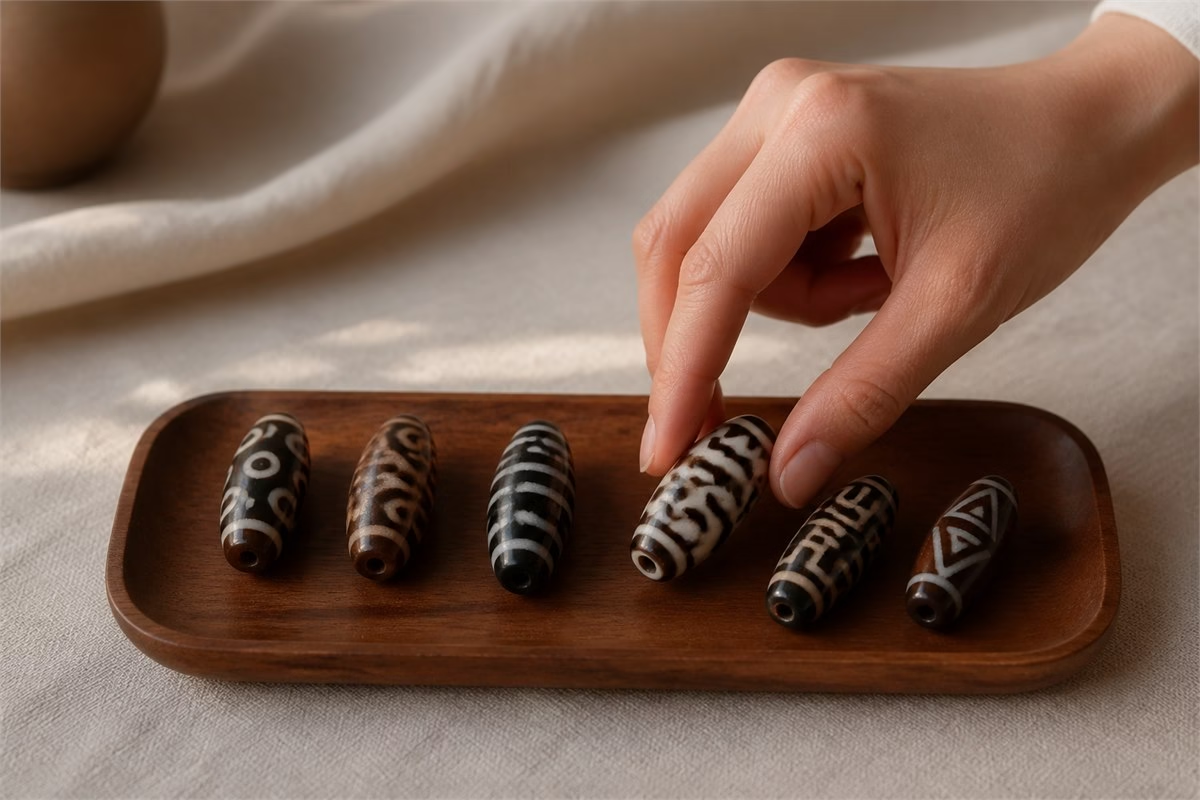
Surface shine, “cinnabar” spots, patina, weathering lines, drill shape, color, weight, and photographs can all contribute observations, but none can establish age or authenticity alone. Avoid household tests involving acid, flame, aggressive scraping, heating, or chemical corrosion. They can damage the bead and create a safety risk.

Eastern Story’s Material Guide helps separate stone, glass, wood, metal, and composite descriptions. For beads set with Himalayan-style metalwork, the Tibetan silver guide explains why the alloy and the bead should be assessed separately.
Wearing or gifting Dzi by wish, story, and life stage
A one-eye bead can accompany a new course of study. Two eyes can honor a partnership. Tiger-tooth geometry can be chosen when someone needs courage for a demanding transition. A lotus can celebrate renewal after a difficult season. A vase pattern can welcome a home filled with nourishment and generosity.

Let the wish and relationship guide the gift: a quiet bead for someone seeking clarity, a harmonious pair of motifs for a marriage, a strong geometric design for a traveler, or a family piece whose greatest value is continuity.
Wear a bracelet on the hand that feels comfortable and safe in daily activity. For a necklace, choose a length that lets the bead rest without swinging into hard surfaces. The Blessing collection offers another way to explore jewelry through intention rather than fixed rules.

Care for old beads, modern beads, settings, and cords
Care should follow the actual object. A loose modern agate bead, an old heirloom, an antiqued surface, a gold-set pendant, and a corded bracelet do not always tolerate the same treatment.
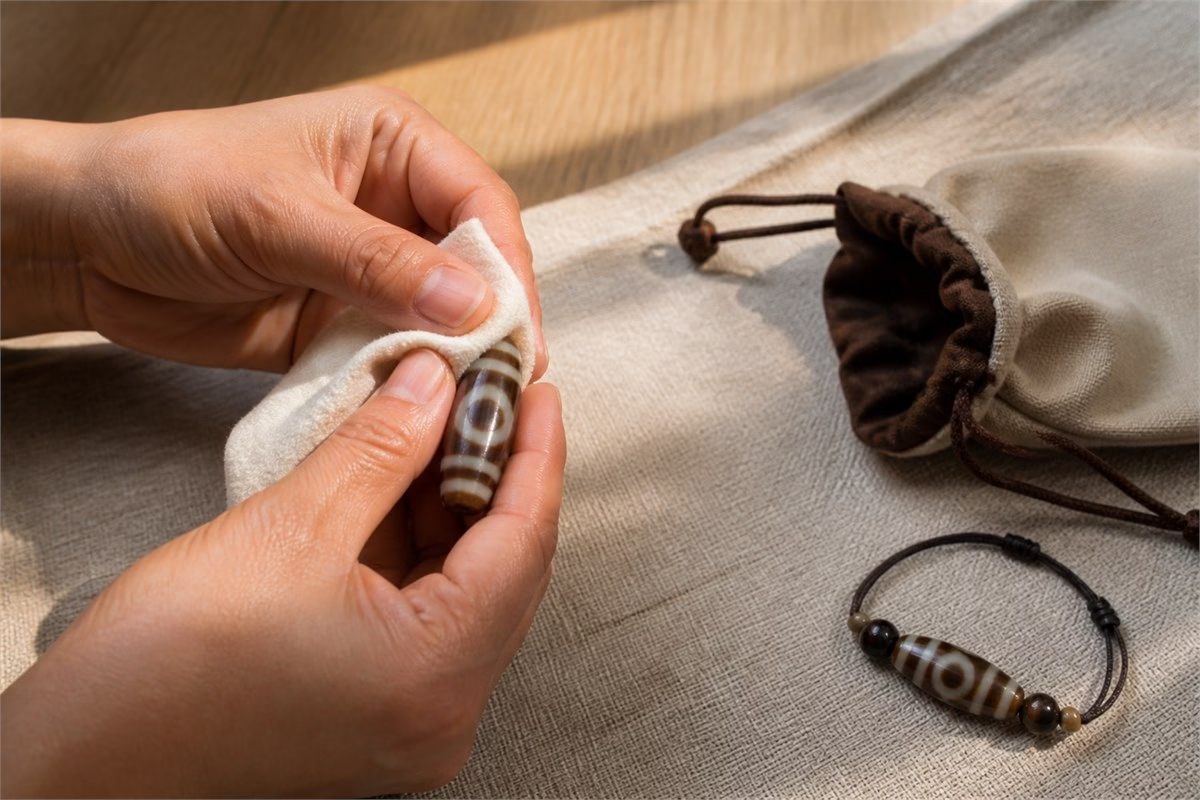
- Wipe gently with a soft, dry cloth after wear.
- Avoid sudden heat, prolonged strong sunlight, steam, ultrasonic cleaners, strong acids or alkalis, perfume, and hard impact.
- Do not routinely soak, salt-soak, oil, or “feed” the bead with sweat. Surface treatments, old repairs, adhesives, metals, and cords may react differently.
- For an old or high-value bead, follow the advice of the seller, conservator, or specialist familiar with its construction.
- Store pieces separately in a soft pouch or lined box so agate does not strike metal, glass, or another stone.
- Check cords and knots regularly. Replace a cord when it becomes fuzzy, thin, stiff, discolored, or loose.
- If restringing at home, choose cord that passes without force, protect sharp hole edges, and use spacers where hard components would collide. Avoid open flame near the bead, old coatings, adhesives, or unknown materials.
Photograph an important bead before and after repair or restringing, and keep its purchase record, measurements, prior photographs, repair notes, and ownership history together. The general Care Guide offers a useful starting point for mixed-material jewelry.

A bead of radiance, memory, and good wishes
Dzi beads bring together patterned stone, Himalayan memory, skilled making, personal taste, and the human desire to carry a blessing close. An old heirloom may speak through the lives it has accompanied. A new agate bead may begin that story today. Both can be chosen with respect when their material, age, and making are described truthfully.
Choose the motif that names your hope, the scale that feels natural to wear, and the bead whose story you understand. In that meeting of beauty and intention, a Dzi becomes more than a pattern: it becomes a companion for clarity, courage, harmony, and yiqie ruyi (一切如意)—the wish that all may unfold as hoped.
For a respectful introduction to the broader religious setting, read Eastern Story’s introduction to Tibetan Buddhism.
Frequently Asked Questions
Related Posts


