
Dragon and snake symbolism is connected, but the two figures are not the same. In Chinese culture, the dragon (龙, lóng) is a changing mythical and artistic being associated with clouds, rain, rising movement, vitality, dignity, and auspicious hopes. The snake (蛇, shé) is a real reptile whose quiet movement and skin shedding have inspired ideas of patience, alertness, adaptation, and renewal. Together, they can suggest ambition guided by timing: one reaches toward cloud and rain, while the other stays close to earth and subtle change.

Their long, scaled forms help explain why they are often linked in art and folklore, and why the snake is affectionately called a “little dragon” (小龙, xiǎolóng) in some regional and zodiac settings. Yet this relationship should not be reduced to a single origin story. Dragon imagery developed over many centuries, while the snake retained a rich cultural identity of its own.
Dragon and snake symbolism at a glance
| Theme | Dragon | Snake |
|---|---|---|
| Nature | A mythical, composite being whose appearance changes by period and medium | A real, limbless, ectothermic reptile in the order Squamata |
| Visual clues | Usually serpentine, often with horns, whiskers, feet, claws, clouds, waves, or a pearl | A naturalistic head and unlimbed body, often shown on the ground, in plants, or beside water |
| Cultural direction | Clouds, rain, ascent, authority, vigorous life, and auspicious movement | Earth, concealment, careful timing, adaptation, shedding, and watchfulness |
| Jewelry wishes | Courage, aspiration, vitality, dignity, and a bright path ahead | Renewal, patience, perception, elegance, and readiness for a new chapter |
| Zodiac place | Fifth animal, associated with the branch Chen (辰) | Sixth animal, associated with the branch Si (巳) |
These are broad cultural directions rather than personality rules. A person born in a Dragon year is not automatically forceful, and a person born in a Snake year is not automatically secretive or strategic. The symbols are best read through the object, story, period, and personal wish in front of you.

Why are dragon and snake connected?
The most immediate connection is visual. Many dragons in Chinese art have an elongated, bending body covered with scales. That body can coil through water, curl around a jade pendant, or rise through cloud bands. A snake offers a living example of the same fluid line, but dragon images often add legs, claws, horns, whiskers, and features borrowed from other animals.
The second connection is environmental. Snakes can live around fields, forests, caves, wetlands, and water edges. Dragons in myth and ritual are frequently associated with rain, rivers, seas, and seasonal change. Their shared relationship with water helped artists and storytellers place them near one another without making them interchangeable.

The third connection is transformation. Snakes shed an old outer layer as they grow. People have long turned that visible event into an image of transition and renewal. Dragon stories add a more dramatic kind of transformation: a being may change size, move between water and sky, or appear in different forms. Both therefore speak naturally to change, but in different registers—the snake through a real biological process, the dragon through mythic imagination.
Why is the snake called a “little dragon”?
“Little dragon” is a warm nickname used in some Chinese folk and zodiac contexts. The Shanghai Museum used it in its 2025 Year of the Snake exhibition while describing the snake as one possible prototype within the larger history of dragon imagery. The phrase reflects resemblance, cultural closeness, and a wish to greet the Snake with auspicious language.
There is no need to force the nickname into one universal origin. The Dragon and Snake do stand next to one another in the twelve-animal cycle, but zodiac order alone does not prove that the Snake is a young Dragon. Nor is there one accepted explanation based on the written form of Si (巳), a fetus, or a fixed belief that every snake eventually becomes a dragon. Such explanations belong to particular interpretations, modern retellings, or wordplay—not a single historical rule.
What the nickname does well is preserve affection. It lets the Snake share some of the Dragon’s festive brightness while keeping its own gifts: stillness, flexibility, measured movement, and the courage to leave an old layer behind.

Did the Chinese dragon originate from a snake?
A snake-based origin is an influential interpretation, not a settled archaeological fact. The scholar Wen Yiduo argued in his twentieth-century study Fuxi Kao that the dragon was built around a snake body and absorbed features of other animal emblems. His idea shaped later popular explanations, but it should not be retold as a witnessed sequence in which conquering tribes literally attached deer antlers, horse hair, fish scales, and dog claws one by one.
Museum and archaeological evidence encourages a wider view. The Shanghai Museum notes that the source of the dragon remains debated, with interpretations involving reptiles, astronomical observation, totemic thinking, insects, and other aspects of nature and imagination. Early dragon-like images are remarkably varied rather than steps in one neat evolutionary chart.

What early dragon images can tell us
The C-shaped jade dragon associated with Hongshan culture is usually dated to the Neolithic period, roughly five thousand years ago. Its curved body and distinctive head have generated labels and interpretations, but the formal object name and archaeological context matter more than deciding that it is definitely a “pig-dragon” or “snake-dragon.”
At Xishuipo in Puyang, Henan, shell arrangements placed in a Neolithic burial include figures conventionally identified as a dragon and tiger. Shang and Zhou bronzes later display many coiled, crested, horned, and abstract dragon patterns. These objects show that dragon imagery was already plural: different communities and periods created different bodies, heads, postures, and meanings.

Later descriptions such as the “nine resemblances” are useful for understanding certain mature dragon conventions, but they do not describe every ancient dragon. Claw number also gained political importance in particular periods and settings; the famous five-clawed dragon became closely associated with imperial rank, especially in later court culture, yet rules varied by era, object, and audience. Context is more reliable than an absolute formula.
Fuxi and Nüwa: intertwined bodies in art
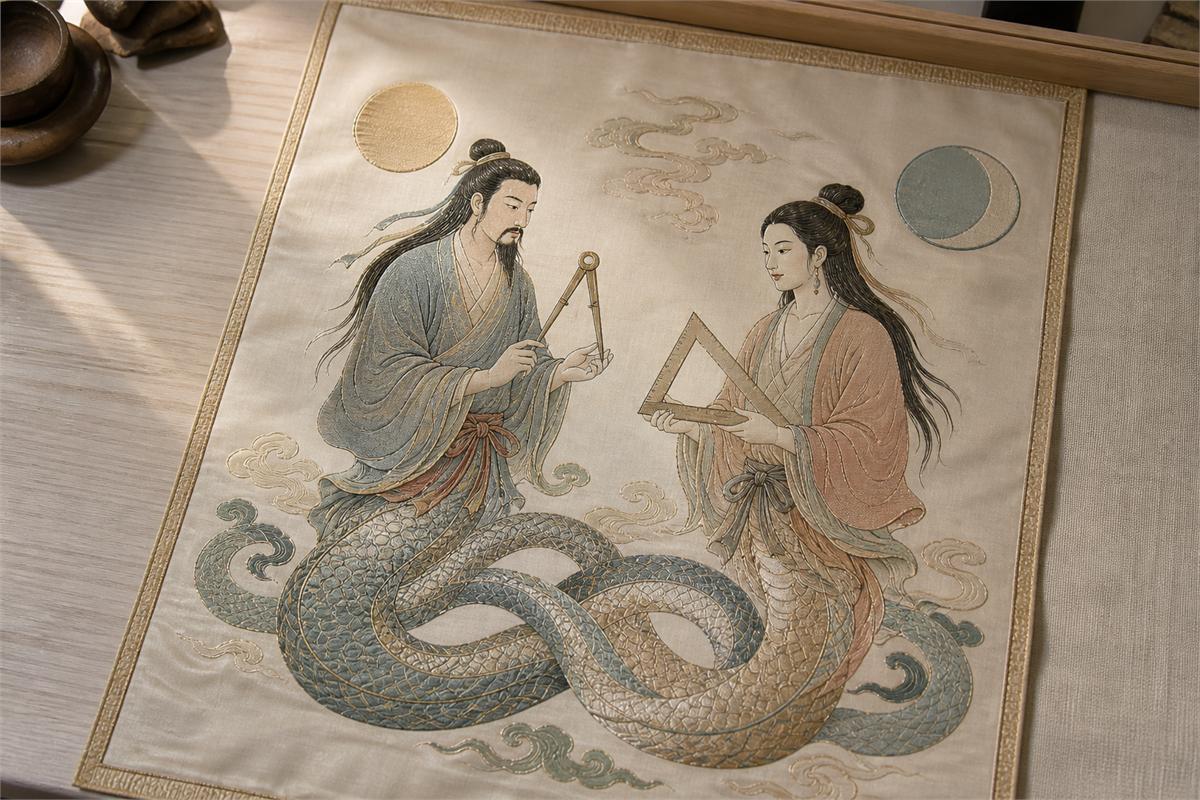
Fuxi (伏羲) and Nüwa (女娲) appear across layered bodies of myth, ritual, and art. In Han-period reliefs and later works, they may have human upper bodies and intertwined serpent-like lower bodies. Some images place a compass and set square in their hands; others add the sun, moon, or stars. These details can evoke creation, order, ancestry, complementary powers, and the shaping of a human world.
Tang-period paintings excavated in the Turfan region of Xinjiang are among the best-known examples of the paired figures with intertwined tails. They should be read as objects from a specific funerary and cultural setting, not as proof that ancient people foresaw the DNA double helix. The visual rhyme is striking to modern eyes, but resemblance is not scientific prediction.
Fuxi and Nüwa also gathered different stories over time: creation, repairing the sky, ordering society, music, fishing, marriage, and other civilizing acts. Those traditions did not begin as one seamless biography. Their interlaced bodies therefore invite a cultural reading—life joined to order and continuity—without requiring us to label them as ordinary snakes or as one fixed species of dragon.
From water serpent to dragon in later stories
Chinese literature includes hui (虺), jiao (蛟), and other names for serpentine or water-associated beings. A passage attributed to the later collection Shuyi Ji describes a water hui becoming a jiao after five hundred years and a jiao becoming a dragon after one thousand years. It is a memorable literary image of slow transformation, but versions and dating of the text require care.
This passage does not establish a universal ladder from snake to python, boa, jiao, hornless dragon, horned dragon, and winged dragon. Nor does it create a standard system of heavenly trials at fixed intervals. Later storytellers expanded transformation motifs because they make powerful metaphors: patience accumulates, hidden potential matures, and a life close to the water can one day rise into cloud.

A real snake and a mythical dragon are fundamentally different
A snake is a vertebrate reptile within Squamata. It is ectothermic, meaning its body temperature depends strongly on environmental heat. Its many vertebrae, ribs, muscles, and specialized scales work together to produce several forms of movement. Snakes are not mollusks, and they do not move simply by “sliding on their bellies.” Their anatomy is highly adapted to a limbless life.

A dragon belongs to myth, religion, literature, performance, and art. Its anatomy is whatever a particular tradition and artist require: it can coil like a snake, leap like a beast, swim, fly, carry horns, display claws, or dissolve into cloud and rain. Its connection with rain also changes by period, region, ritual, and story; it should not be presented as one uniform belief held in exactly the same way throughout history.
What is a “dragon snake” in zoology?
The common name “dragon snake” usually refers to Xenodermus javanicus, a small Southeast Asian snake with distinctive rows of raised scales. It is different from the Javan file snake or elephant trunk snake, Acrochordus javanicus, an aquatic species in another family. Common names can overlap, so the scientific name is the safest way to identify an animal.

This zoological name is separate from Chinese dragon symbolism. Unusual wild reptiles also have specialized environmental and welfare needs; a cultural article is not a reason to buy a rare species as a pet.
Dragon and Snake in the zodiac: neighbors, not a compatibility verdict
The Dragon is fifth and the Snake sixth in the twelve-animal cycle. Traditional systems may further discuss the earthly branches Chen and Si, stems, elements, directions, combinations, clashes, and a full set of birth information. These are cultural frameworks with their own rules; adjacency does not by itself prove that two people are naturally compatible, destined for a certain marriage, or suited to fixed roles.
For the two signs separately, see the Dragon zodiac guide and Snake zodiac guide. This page stays with the relationship between the symbols rather than predicting character or fortune. It also does not map Chinese zodiac animals to Western sun signs: the two systems organize time in different ways.

Dragon and snake in language and art
The compound “dragon and snake” can praise lively movement, especially in calligraphy. Bi zou long she (笔走龙蛇), literally “the brush moves like dragons and snakes,” describes vigorous, flowing writing. The image works because both creatures turn a line into motion: the dragon supplies sweep and spirit, while the snake supplies sinuous continuity.

Other expressions are not interchangeable. Long she hun za (龙蛇混杂) refers to a mixed company of good and bad or worthy and unworthy elements. Classical phrases about dragons and snakes lying dormant or changing with circumstances belong to their own passages and meanings. A beautiful idiom should be used accurately rather than treated as a general claim about zodiac personality.
When identifying an artwork, look beyond the long body. Horns, whiskers, limbs, claws, cloud bands, waves, and a flaming pearl usually support a dragon reading. A naturalistic head, forked tongue, limbless body, and earthly habitat support a snake reading. In ambiguous works, the inscription, museum title, date, and regional context may be more useful than counting features.
Dragon and snake jewelry meaning
Dragon jewelry can carry a wish for courageous movement, vitality, dignity, and an auspicious road ahead. Snake jewelry can mark a thoughtful transition, patience, perceptiveness, adaptation, or the elegance of a continuous line. They express a wish—a medium through which people hope to bring about wealth, health, virtue, longevity, or a specific outcome in life. The symbol gives that hope a form you can remember and share; its meaning grows through the wearer’s own choices and story.

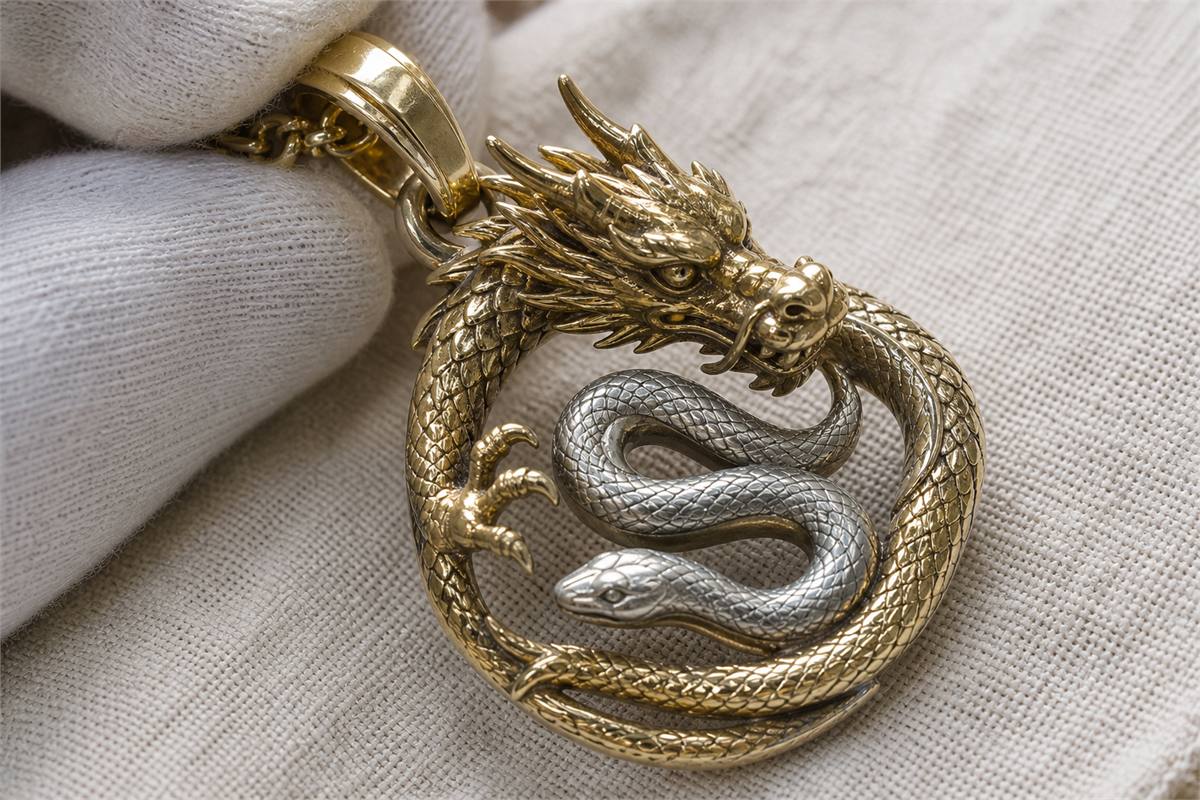
When dragon and snake appear together, the design may suggest bold aspiration guided by careful timing, visible energy accompanied by quiet attention, or two loved ones whose ways of moving through life are different but connected. It does not automatically create “yin-yang balance,” combine zodiac luck, or assign one figure to masculinity and the other to femininity.
| Design | A natural symbolic reading | What to inspect |
|---|---|---|
| Dragon pendant | Aspiration, courage, vitality, auspicious movement | Horns, claws, whiskers, bail, sharp projections, chain weight |
| Snake ring or bracelet | Renewal, patience, sensitivity to change, elegance | Head and tail tips, comfort, flex points, solder joins, stone settings |
| Dragon and snake together | Different strengths joined by one story | Whether both animals are clearly identifiable and well proportioned |
| Transformation scene | Growth through time and sustained effort | Whether the maker explains the visual narrative without invented lore |
The dragon pendant guide and snake bracelet guide explore each motif in greater depth. If the Snake’s independent story draws you, the Legend of the White Snake opens a different world of love, identity, devotion, and transformation.
Choose the design before prescribing a material
Gold, 18K gold, sterling silver, plated metal, jadeite, nephrite, agate, emerald, wood, and enamel behave differently. No material universally “adds wisdom,” “boosts career luck,” or repairs an element in a birth chart. Choose according to the design, disclosed composition, workmanship, comfort, budget, and the personal wish the piece will carry.

Inspect projecting dragon horns, claws, snake heads, scales, and tail tips for places that could scratch skin or catch knitwear. Check the bail, chain links, clasp, prongs, solder points, ring shank, and any moving joints. A sculptural piece should still feel smooth where it touches the body. For a gift, ask about size, preferred metal color, allergies or sensitivities, daily routine, and whether the recipient enjoys a bold or quiet motif—not their gender.

Material-specific care
- Gold and silver: wipe after wear with a soft cloth. Use a cleaner only when it is suitable for the exact metal, finish, plating, stones, and adhesives.
- Plated pieces: reduce friction, sweat, cosmetics, and long contact with water because the surface layer can wear.
- Jadeite, nephrite, agate, and emerald: protect from knocks and sudden temperature change. Treatments, fractures, fillings, and settings can change what cleaning method is safe.
- Wood and enamel: keep away from soaking, strong heat, and harsh chemicals. Wipe gently and dry promptly.
- Complex or unknown pieces: do not treat salt water, smoke, oil, toothpaste, alcohol, ultrasonic cleaning, steam, or strong heat as universal care. Ask a qualified jeweler when the construction or material is uncertain.
If a piece contains cinnabar-colored material, ask what it actually is. Modern products may use lacquer, resin, mineral pigment, or composites. Avoid grinding, heating, or creating dust from an unknown material, and keep small or damaged components away from children’s mouths.
A shared symbol for a beautiful way forward
The Dragon and Snake meet through the beauty of the curved line, a closeness to water, and the human desire to imagine change. Then they take different paths. The Dragon rises into cloud, rain, ceremony, and expansive movement. The Snake remains near earth, attentive to warmth, shelter, timing, and the quiet work of leaving an old layer behind.
Worn alone or together, they can carry wishes for wisdom and courage, patience and renewal, protection and peace, and a future approached with both aspiration and care. Choose the image that feels true to your story, then let its details—posture, material, craft, and relationship—make that wish visible. You can also explore the broader Blessing collection for symbols of peace and good wishes.

Frequently Asked Questions
Related Posts


