
An agarwood bracelet is made from resin-bearing wood formed within certain Aquilaria, Gyrinops, and related trees after injury and biological response. It is valued for a scent that can shift with temperature and airflow, natural variation in the wood, and its long place in incense, religious, gift, and decorative traditions. A good bracelet is chosen by looking at the material disclosure, bead dimensions, total weight, construction, finish, scent treatment, comfort, and seller terms together—not by trusting one dramatic feature.
This agarwood bracelet guide explains the material before the symbolism. It then covers aroma, commercial origin names, bead shapes and sizes, non-destructive buying observations, common imitations, wearing, styling, gifting, and care. The goal is a bracelet that suits your wrist and expectations, whether you value it primarily as fragrant wood, understated jewelry, a culturally meaningful gift, or a personal sensory object.
Agarwood bracelet essentials at a glance
| Question | What to know | What to check |
|---|---|---|
| What is agarwood? | Resinous wood formed in certain trees through a complex injury-and-response process | How the seller describes the base wood, resin development, and any treatment |
| What affects scent? | Tree material, resin distribution, temperature, airflow, storage, wear, and added fragrance | Smell briefly at low intensity and compare the seller’s description with the actual strand |
| What affects price? | Usable material, resin distribution, bead diameter, matching, waste, workmanship, design, disclosure, and market | Diameter, total weight, bead count, construction, finish, and return terms |
| What proves origin or quality? | No single color, oil line, scent note, weight, or floating behavior gives a complete answer | Use several observations and judge whether the listing is specific and internally consistent |
| How should it be worn? | Choose the wrist and fit by comfort, dominant hand, collision risk, and activity | Wrist circumference, bead size, string tension, spacer edges, and snag points |
| How should it be cared for? | Limit moisture, chemicals, heat, strong odors, abrasion, and impacts | Wipe with a dry odor-free cloth and store only after the bracelet is fully dry |
What agarwood is—and how it differs from ordinary wood
Agarwood is not the name of a separate tree species. It is resin-enriched wood that can develop in certain trees, especially species of Aquilaria and Gyrinops, after physical injury and a continuing biological response. The tree’s chemistry, microorganisms, environment, time, and the location of the affected wood all influence the result. Not every wound produces usable agarwood, and not every dark section in a host tree is resinous material of bracelet quality.

Ordinary wood beads are shaped from relatively uniform wood whose main appeal may be color, grain, hardness, or polish. Agarwood beads add another variable: aromatic resin is distributed within the wood rather than simply painted onto its surface. That distribution can be uneven. One bead may show more dark resin lines, another may be lighter, and the strand may release aroma differently as warmth and air change. This natural variability is important, but variability by itself is not proof of identity.

Wild growth, cultivated trees, and human-induced resin formation describe different production histories; they are not automatic labels for real versus fake or superior versus inferior. A cultivated source can yield genuine resinous wood, while an impressive wild-source story can still be poorly disclosed. Responsible buying also matters because agarwood-bearing trees face conservation pressure and international trade controls. Avoid material presented as illegally harvested or obtained through destructive wild collection, and favor sellers who explain sourcing and treatment without romanticizing forest damage.
How agarwood scent changes on a bracelet
A bracelet at room temperature may smell faint, intermittent, or noticeably aromatic. Skin warmth, movement, humidity, and fresh airflow can make different notes easier to notice. Market descriptions often use words such as woody, sweet, cool, floral, balsamic, leathery, spicy, medicinal, or smoky. These are sensory comparisons, not a fixed formula, and two people may describe the same strand differently.
The aroma can seem stronger after the bracelet moves from a closed container into open air, softer after frequent exposure, or different in warm weather. This does not require a story about the bracelet “recognizing” an owner or needing a ritual to “return” its scent. It reflects the interaction of volatile aromatic compounds, temperature, airflow, surrounding odors, surface condition, and individual perception.
Use scent gently when shopping. Smell the strand for a short period in clean air rather than pressing it to the nose for a long session or heating it. A forceful perfume-like opening may indicate added fragrance, but intensity alone is not a verdict. Natural material can be subtle or expressive, and treated material can be made to imitate familiar market notes. Compare the aroma with the seller’s treatment disclosure and with the physical condition of the beads.

Origin names, density terms, and qinan
Commercial source names
Nha Trang, Hội An, Hainan, Cambodia, Laos, Indonesia, Malaysia, Brunei, Tarakan, and Kalimantan are among the geographic or trading names used in agarwood markets. Sellers may associate these names with familiar scent profiles—for example, a cooler or sweeter impression in one trading group and a deeper spicy or resinous impression in another. Such descriptions are useful vocabulary for preference, but color, aroma, oil lines, and weight cannot reliably establish geographic origin on their own. Treat origin wording as part of the seller’s account, not as something a bracelet’s appearance can independently settle.

Sinking, semi-sinking, and floating
Terms translated as sinking, semi-sinking, and floating describe how a particular sample behaves in particular density conditions. They do not establish natural formation, origin, age, or absolute quality. Bead holes, trapped air, coatings, fillers, moisture, and the test setup can affect behavior. Because soaking can alter a bracelet and still gives a limited answer, a water test is not an appropriate home buying method.

Qinan or kinam
Qinan, also written kinam, is a high-value and complex agarwood category without one uniform commercial standard. Soft or waxy texture, a tingling impression, strong room-temperature aroma, and particular scent changes are often discussed in the market, but none can identify qinan alone. The name should be supported by a detailed, coherent material story and priced with the understanding that market terminology varies. It is better approached as a specialist category than as a promised investment.

Bead shapes, sizes, and bracelet construction
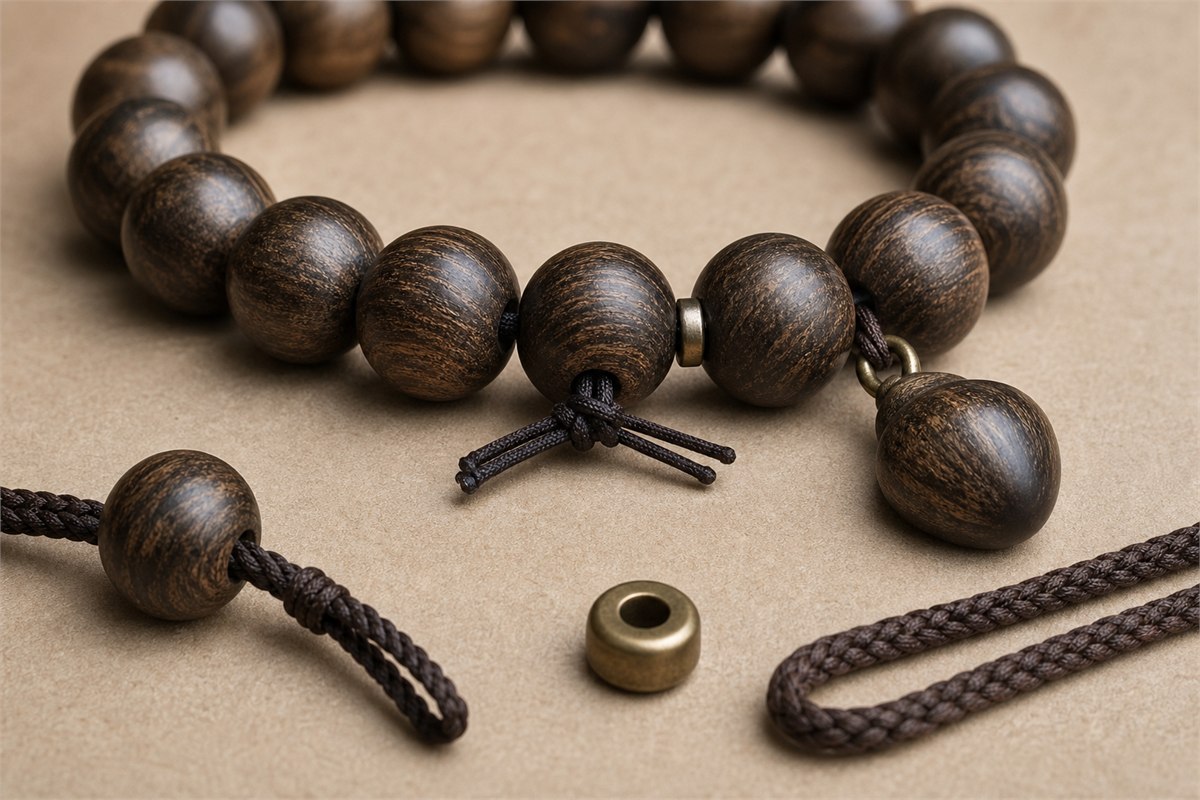
Round beads are classic and easy to rotate around the wrist. Barrel beads create a longer visual line. Abacus beads make a flatter, more articulated strand. Bamboo-section, carved, and freeform beads add design character. No shape is naturally the most valuable: price depends on the starting material, resin distribution, cutting loss, bead diameter, matching, workmanship, design, source disclosure, and current demand. Large round beads may require more usable material, but a well-matched small strand can still represent careful work.

Single-wrap bracelets commonly use beads around 8–15 mm. Smaller 5–6 mm beads create a lighter line and are easier to layer, while a 108-bead strand may wrap around the wrist three or four times depending on bead size, cord, spacers, and wrist circumference. These dimensions describe visual scale, not gender. A 14 mm or 16 mm bead can feel commanding on any wearer who likes the weight and spacing; a fine strand can suit any wrist that needs lower bulk.
Measure the wrist where the bracelet will sit, then compare the seller’s inner circumference or finished length rather than relying only on bead count. Larger beads need extra room because their inner curve reduces usable space. Also ask for total weight: it lets you compare bracelets with similar bead diameter and count without pretending that heavier always means better.
- Elastic cord: convenient, but it should retract evenly without visible fraying or an exposed knot that rubs the skin.
- Braided cord: adjustable or fixed constructions can reduce sudden elastic failure, but knots and sliders should remain comfortable.
- Drill holes: inspect the rims for chipping, filler, dark transfer, rough edges, and inconsistent alignment.
- Spacers and pendants: check that hard edges do not grind against the wood and that added weight does not pull the bracelet off balance.
- Hooks and projections: carved details, tassel fittings, and dangling charms should not catch clothing or equipment during daily use.
- Roundness and matching: roll the strand gently in the hand and look for obvious flat spots, irregular gaps, and beads that pull the line out of shape.
How to inspect an agarwood bracelet before buying
The safest buying check is comparative and non-destructive. It will not turn one photograph or one smell into a complete material identification, but it can reveal whether the listing, object, and price make sense together.

- Read the material wording. Look for a clear distinction among resinous agarwood, low-resin host wood, other aromatic wood, scented wood, filled material, and composite beads.
- View in natural light. Compare grain, resin lines, color transitions, drill holes, and the consistency from bead to bead. Perfectly repeated patterns or color concentrated around holes deserve questions.
- Smell briefly and gently. Notice whether the aroma is only on the surface, changes rapidly in clean air, or leaves an oily perfume impression on nearby packaging.
- Compare dimensions and total weight. Use bead diameter, bead count, and weight as a set. An unusual figure is a reason to ask about construction or filling, not a stand-alone conclusion.
- Inspect the surface. Look for gloss that pools in recesses, greasy residue, tackiness, color transfer, clogged holes, bubbles, or a coating that masks the grain.
- Check workmanship. Review roundness, matching, drill alignment, cord quality, knot security, spacers, pendants, and sharp contact points.
- Read the seller’s disclosures and return terms. The listing should state additions or treatments, give measurable specifications, and provide a workable inspection period.
A listing for “wild old agarwood” at $99 deserves especially close comparison between the dramatic source story and the disclosed material, size, weight, treatment, and construction. The price alone does not decide the answer, but highly specific prestige claims paired with very limited object detail are a meaningful buying risk.
Common imitations and treatments
Marketplace substitutes are not all the same. Ordinary wood may be sold under an agarwood-style name. Another aromatic wood may provide a naturally pleasant smell but a different material identity. Dye can deepen color; surface oil or oil soaking can add weight and gloss; fragrance can create an immediate scent; resin or adhesive can fill pores and cavities; and pressed or composite material can combine wood particles with binders. Several treatments may also appear together.

These categories should be described accurately instead of collapsed into one idea of a “fake.” A scented decorative wood bracelet can be wearable when it is sold that way and priced accordingly. The problem is mismatch: a treatment or composite construction presented as naturally resinous solid wood. Likewise, commercial names such as “flower qinan” are used inconsistently and should not be treated as the fixed name of one vine, one species, or one uniform imitation.
A very dark color, strong aroma, faint aroma, visible oil lines, smooth touch, dry touch, heavy weight, or light weight can each occur for more than one reason. Build a judgment from multiple observations and the seller’s disclosure. Avoid fire, heated needles, scraping, cutting, alcohol wiping, soaking, prolonged heating, or any density experiment that can damage the bracelet or create misleading results.
Meaning, religion, and modern wearing customs
Agarwood has a long place in incense culture, hospitality, religious settings, poetry, perfumery, and gift exchange. On the wrist, its quieter meanings often include patience, cultivated taste, attention, and respect for fragrant materials. Some people use the sensory act of touching or smelling the beads as a personal pause in the day. That is an individual experience, not a health treatment.
Buddhist prayer beads may contain 108 beads, and agarwood can be used in sacred or devotional objects. A religious mala or rosary should be understood within its tradition and practice, not reduced to a generic luck accessory. Daoist practice, Buddhist practice, regional folk customs, and modern jewelry marketing also have different histories; they do not create one universal rule for every agarwood bracelet.

“Left in, right out,” receiving on the left, dispersing on the right, avoiding bracelets on both wrists, a broken strand taking away misfortune, scent “returning,” and a bracelet recognizing its owner are common modern folk or commercial sayings. There is no single traditional requirement shared across contexts, and the sayings do not describe objective material effects. Choose the wrist by dominant hand, comfort, collision risk, and the activity ahead. Our broader left-or-right wrist guide explains the same practical decision for wrist jewelry.
How to wear and style agarwood beads
For frequent desk work, wear the bracelet on the hand that strikes the desk less often. Remove it for exercise, bathing, swimming, cooking with heavy oil smoke, and hands-on work where the cord can catch. Sleeping in the bracelet can compress the strand, trap perspiration, or snag the cord; taking it off protects the object rather than serving as a sleep ritual.

Styling works best through color temperature, proportion, surface contrast, and friction. Dark brown agarwood pairs easily with warm neutrals, linen, cotton, knitwear, and restrained tailoring. Jade adds a cool or soft green contrast; gold adds warm brightness; silver creates a cleaner contemporary edge; amber adds translucent warmth; and turquoise creates a stronger blue-green accent. One or two focal components often keep the wood visible better than a crowded mix.
Hard stones and metals can abrade softer wooden beads, especially when their edges, clasps, or carved points rub at every movement. Use smooth spacers or a separate wrist when necessary. Match the scale as well: a fine 5–6 mm agarwood strand can sit beside a thin metal chain, while larger beads usually need more visual space. For broader comparisons among wood, stone, metal, and cord, see the Eastern Story material guide.

Giving an agarwood bracelet as a gift
An agarwood bracelet suits someone who enjoys subtle fragrance, wood grain, tea or incense culture, understated jewelry, or objects that reward close attention. It can mark a birthday, anniversary, mentorship, work transition, or private moment of appreciation. Gift language can focus on enduring friendship, patience, warmth, and refined presence without assigning the recipient a promised outcome.
Before buying, learn the recipient’s wrist circumference, fragrance sensitivity, daily routine, and preference for elastic or braided construction. Round beads are versatile; barrels feel more architectural; abacus beads sit flatter; freeform beads feel organic; and carved motifs should match the recipient’s cultural interests. Include simple care notes and leave room for an exchange if the fit or scent is not right.

Agarwood bracelet care
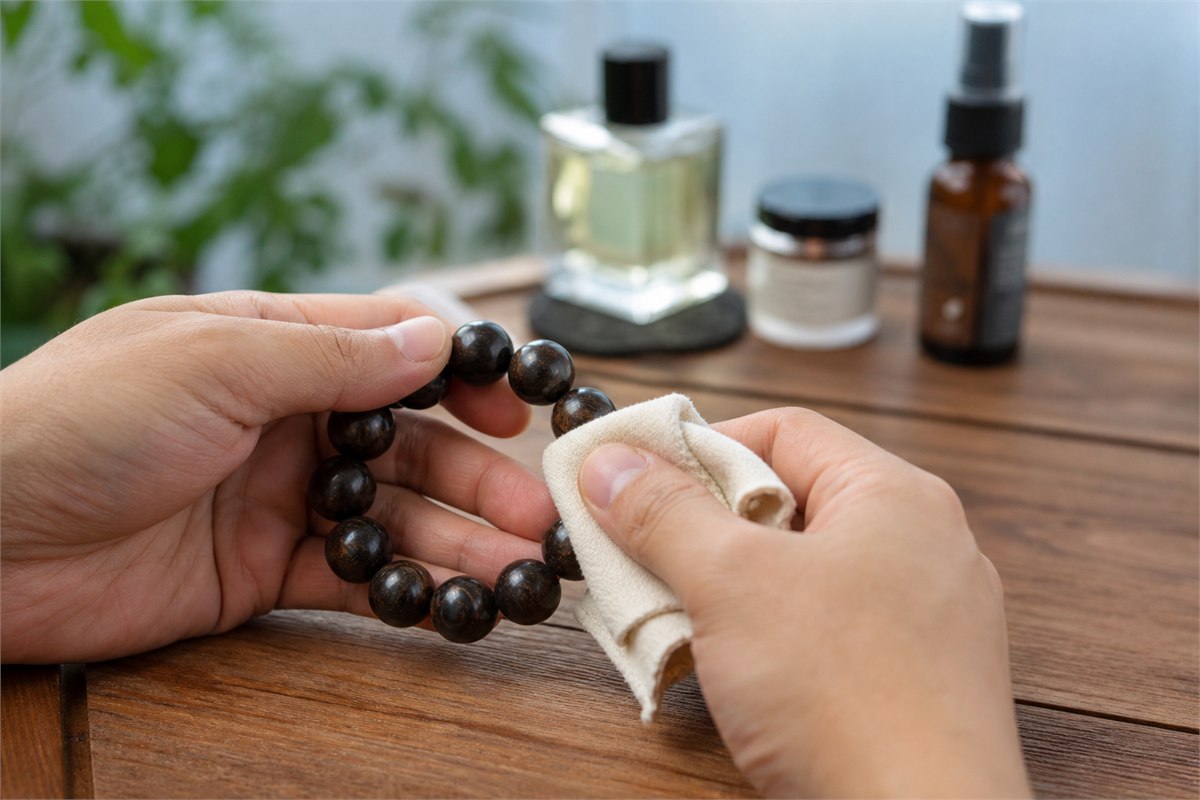
- Avoid prolonged soaking and remove the bracelet before bathing or swimming.
- Do not let perspiration remain on the strand after exercise or hot-weather wear.
- Keep perfume, skin-care products, sanitizer, detergent, and household cleaners away from the beads.
- Remove it around heavy cooking smoke, incense clouds, and strong ambient odors that may cling to the surface.
- Protect it from extreme heat, direct sun, heaters, hot cars, hard knocks, and rough jewelry.
- Wipe lightly with a dry, soft, odor-free cloth. Do not scrub or use wet cleaning methods.
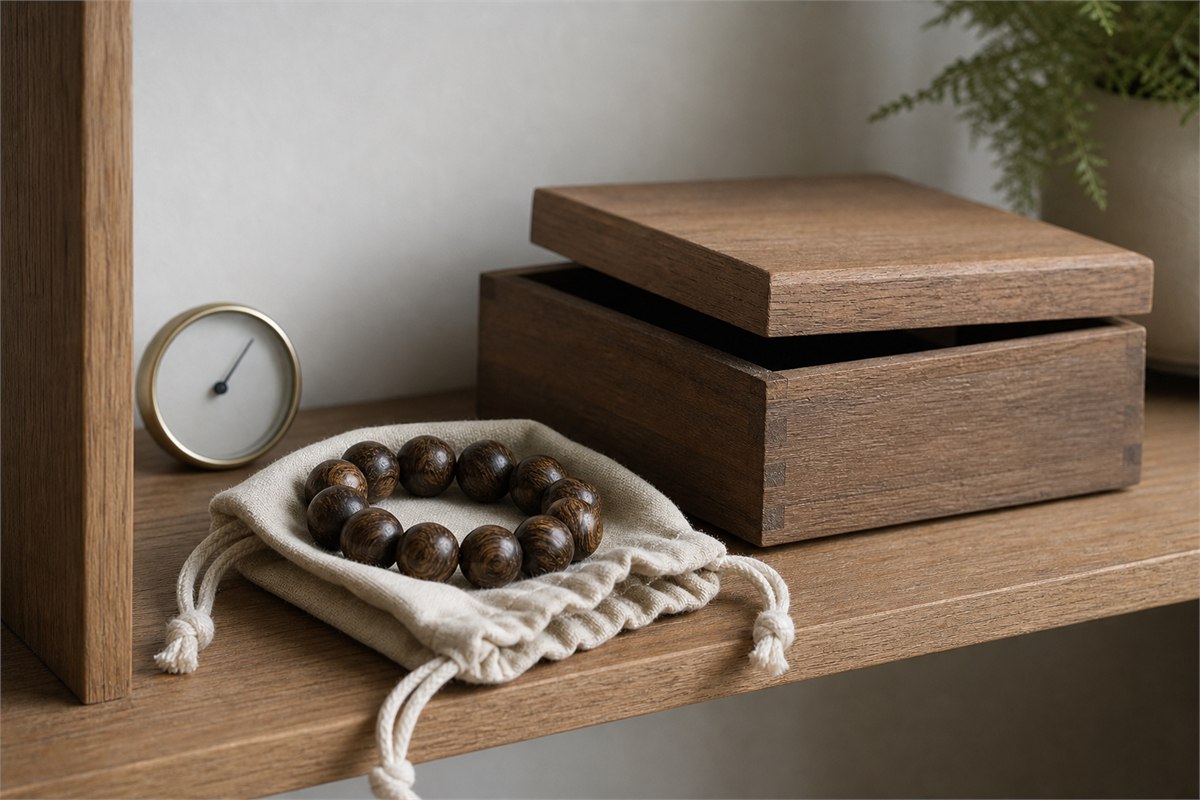
- Let the bracelet dry completely after incidental moisture before storing it separately.
- Store in a clean, shaded place with sensible airflow or moderate enclosure; avoid persistent high humidity that encourages mold.
- Do not apply oil, wax, fragrance, steam, or ultrasonic cleaning.
Normal contact with a clean, dry wrist can gradually change surface sheen, but there is no required rubbing schedule. Forceful polishing and repeated handling add grime and wear without revealing material quality. If the cord loosens, frays, or exposes a knot, restring the bracelet before beads are lost. The Eastern Story jewelry care guide offers additional storage and construction reminders.
Frequently Asked Questions
Related Posts


