
Rutilated quartz is quartz (SiO₂) containing natural rutile—mainly titanium dioxide (TiO₂)—as needles, fibers, rods, or broader plates. Gold rutilated quartz (金发晶) usually shows warm golden needles; titanium quartz, a Chinese-market trade term (钛晶), usually describes thicker, denser, more metallic gold rutile; red or copper rutilated quartz (红发晶 / 铜发晶) shows copper-red, reddish-brown, or dark red inclusions. Before choosing a rutilated quartz bracelet, inspect the quartz body, rutile color and composition, fractures, polish, drill holes, bead matching, treatment disclosure, report, size, and comfort. Wear it on either hand, protect it from impact and chemicals, and clean it gently with a soft cloth or brief mild-soap wash when the construction is water-safe.
The most useful buying order is material first, appearance second. Confirm that the host is quartz and ask what, if any, treatment has been used; then judge clarity, rutile brightness, the three-dimensional inclusion scene, bead or bangle size, workmanship, price, and how comfortably the piece sits on the hand. That sequence keeps a dramatic market name from outweighing the jewelry itself.
What Rutilated Quartz Is
Quartz forms the transparent to translucent host. It has a Mohs hardness of about 7, a specific gravity near 2.65, and a vitreous surface luster. Rutile is a distinct, much denser titanium-oxide mineral with a high refractive index and an adamantine to metallic appearance. Its sparkle can be intense, but the overall weight of a bracelet still depends mainly on the quartz volume, bead diameter, bead count, bangle dimensions, stringing, and metal fittings—not on a simple claim that “more titanium makes it heavy.” For a broader introduction to the host mineral, see the clear quartz guide and the Eastern Story material guide.
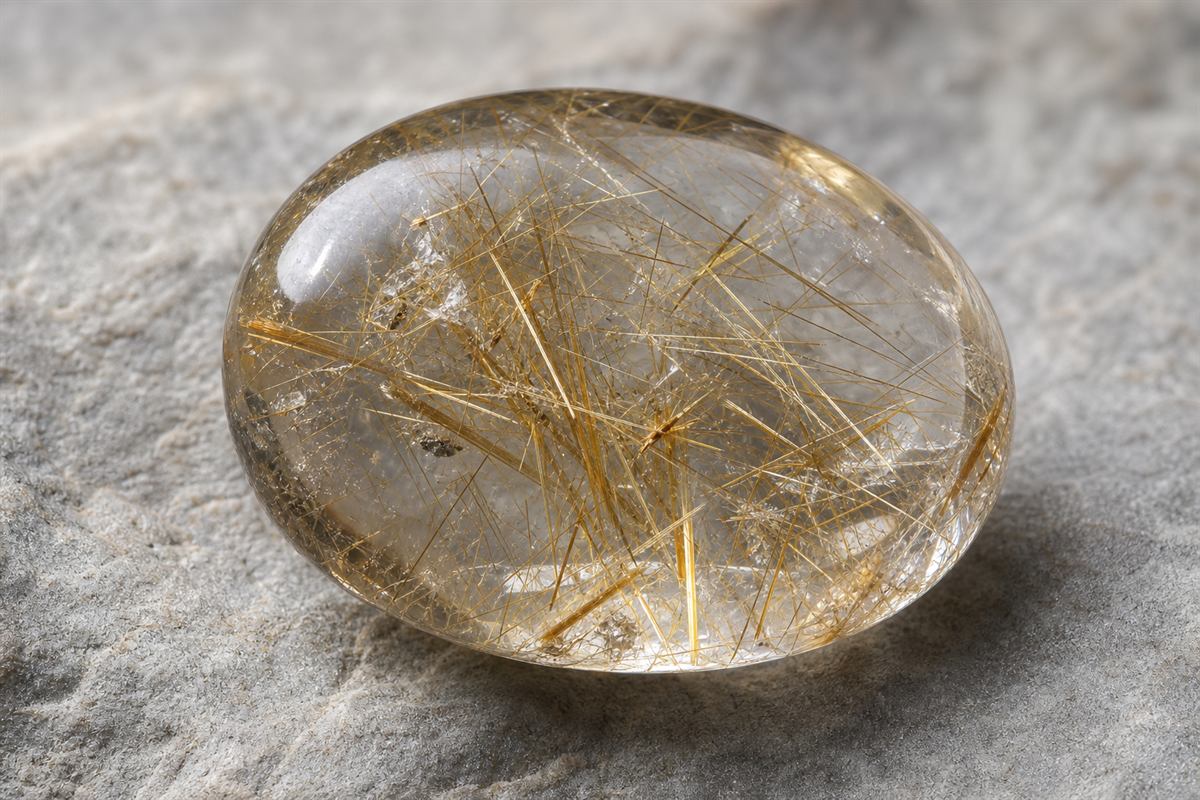
How rutile becomes enclosed in quartz
Rutilated quartz is not best explained as lava trapping golden hairs and then cooling. Quartz can crystallize in hydrothermal veins, pegmatitic systems, and metamorphic environments. Rutile may already be present and become enclosed as quartz grows, may grow at the same time as its quartz host, or may participate in more complicated intergrowth and exsolution relationships. Different specimens therefore preserve different growth histories. The visible “hairs” are mineral crystals inside another mineral, not literal fibers and not a decorative substance injected into a finished bead.

The jewelry nickname “Venus’ hair stone” describes the graceful visual effect and is useful as modern market language. The natural formation is already remarkable without attaching an unverified royal owner, mythic artifact, or historical date.
Gold, Titanium, Red, Copper, and Pattern Names
| Market name | What it usually looks like | How to interpret it |
|---|---|---|
| Gold rutilated quartz (金发晶) | Fine to medium warm-gold rutile needles, from sparse lines to dense sprays | A widely used jewelry name for golden rutile in quartz; suitable for subtle or dramatic daily bracelets |
| Titanium quartz (钛晶) | Thicker, denser, plate-like, or strongly metallic golden rutile | A Chinese-market trade term within rutilated quartz, not a separate mineral species or standardized international grade |
| Red or copper rutilated quartz (红发晶 / 铜发晶) | Copper-red, red-brown, brick-red, or dark red rutile needles and rods | A color-based market group; the inclusion identity should still be checked because not every red ‘hair crystal’ contains rutile |
| Aligned needles (顺发) | Many inclusions run in a similar direction | A visual arrangement that can produce a clean sweep of light; price still depends on the whole stone |
| Scattered or firework-like inclusions (乱发 / 火树银花) | Needles cross, radiate, or burst in several directions | A natural-looking, layered composition valued by buyers who prefer movement and depth |
| Plate-like rutile (板钛) | Broader blades or plates with bold metallic reflection | A morphology and trade description commonly associated with titanium quartz |
| Treasure-bowl distribution (聚宝盆) | Rutile is concentrated in one zone, often low or to one side | A composition and cultural trade name, not a mineralogical category |

Aligned needles are not automatically more valuable than scattered needles. A vivid firework composition in clean quartz can be more desirable than a dull, fractured aligned strand. Likewise, a “titanium” label cannot turn dark rutile, weak polish, chips, unstable filling, or mismatched beads into high quality. Compare the complete object.
When a cat’s-eye effect appears
A moving cat’s-eye band needs abundant, similarly oriented inclusions plus a suitable curved cut and directional light. Parallel rutile can help create chatoyancy, but not every aligned-rutile bead or titanium-quartz piece will display a sharp eye. Judge the effect by rotating the actual bracelet under one moving light source: a genuine band should travel coherently across the curved surface rather than appearing only in a seller’s fixed spotlight.
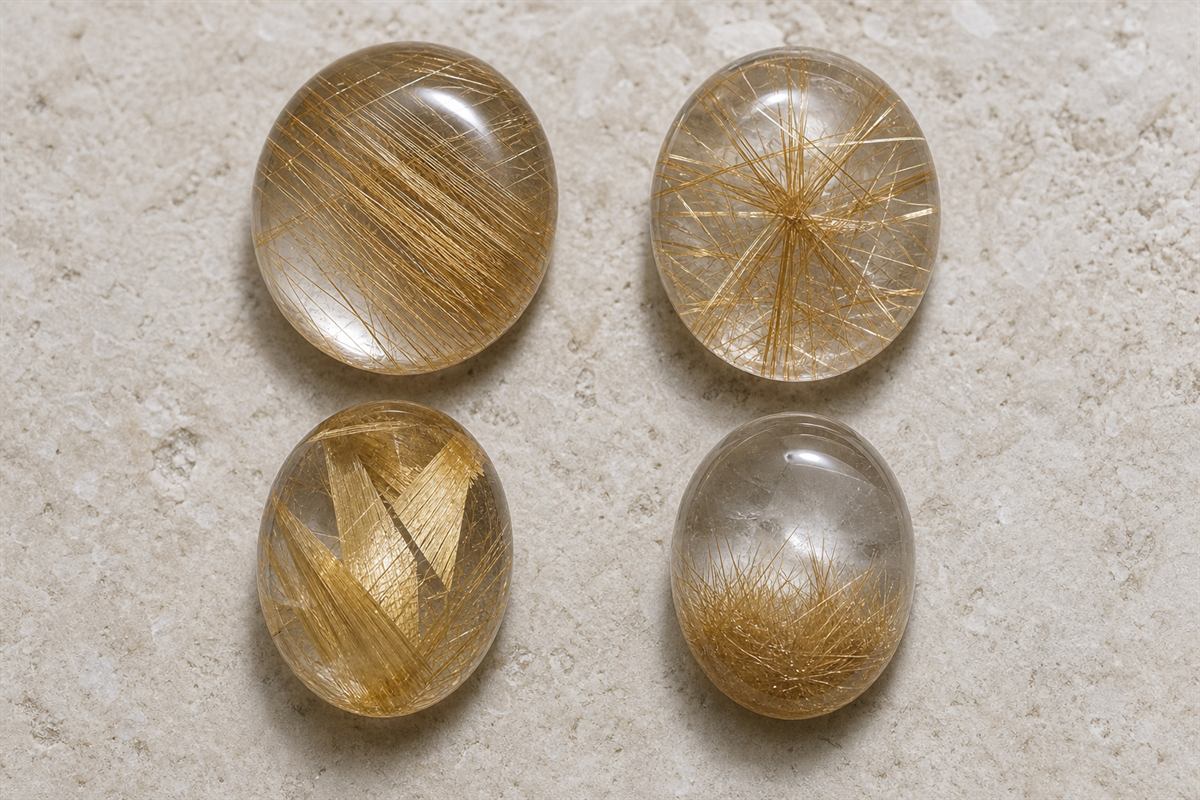
“Hair crystal” is broader than rutilated quartz. Some hair-like inclusions in quartz are tourmaline, actinolite, amphibole, hematite, or other minerals. Super Seven is also not a synonym for rutilated quartz. A color nickname such as red rutilated quartz is a useful starting point, but mineral identity belongs to observation and testing.
How the Quartz Body and Rutile Inclusions Determine Quality Together
Begin with the quartz host. Look through each bead in daylight and side light. Strong transparency makes the inclusion scene easy to read, while a faint smoky or warm base can create a deliberate mood. Cottony clouds, veils, healed fractures, open fractures, black or red companion minerals, and growth features are common in natural quartz. Their effect depends on position and severity: a soft veil behind bright rutile may be attractive; a surface-reaching crack at a drill hole may threaten durability.
- Quartz clarity and base color: judge transparency, haze, color cast, internal veils, and whether the body supports the desired visual contrast.
- Rutile color and brightness: compare warm gold, pale gold, copper, red-brown, or dark tones; turn the piece to see whether the metallic reflection remains lively.
- Composition: evaluate negative space, direction, depth, density, balance, and how the inclusion scene changes from front to back.
- Integrity: distinguish harmless internal features from open cracks, chips, deep drill-hole fractures, repaired areas, and surface-reaching filling.
- Finish: look for round beads, even polish, smooth holes without breakout, secure stringing, and comfortable fittings.
- Matching: a strand can be intentionally graduated or varied, but color, bead size, luster, and overall visual rhythm should feel coherent.

Light clouds, fractures, and mineral inclusions can support a natural growth story, but “having flaws” is not proof of natural origin. Natural quartz can be remarkably clean; glass and assembled imitations can be given deliberate defects. A break or interruption in a visible rutile needle is also not a stand-alone authenticity test. Curvature, refraction, crossing planes, and fractures can make a continuous three-dimensional crystal look segmented from one viewing angle.
Chinese-market terms such as ice-like clarity, glass-like body, full-mineral coverage, or dragon-robe titanium quartz—often expressed as 冰种, 玻璃体, 满矿, and 龙袍钛晶—describe a seller’s visual impression. They can help two people discuss appearance, but they are not uniform laboratory grades. Ask for measurable size, untreated daylight video, treatment disclosure, and a report before paying a premium for a poetic label.
Rutilated Quartz Bracelet Price and Value
Rutilated quartz bracelet price spans several market levels. An entry gold rutilated quartz bracelet commonly sits in the tens to hundreds of dollars. A better-matched mid-range gold rutilated quartz bracelet can be around $1,000. Fine titanium quartz with large beads, clean quartz, vivid metallic rutile, strong composition, and consistent matching can reach $10,000+. A one-piece rutilated quartz bangle cut from a large suitable section of rough can range from several thousand to tens of thousands of dollars.

| Value driver | What raises confidence and desirability | What can reduce value |
|---|---|---|
| Size | Larger bead diameter or a substantial, well-proportioned bangle with usable clarity | Large size with dead color, weak polish, uncomfortable weight, or severe fractures |
| Quartz body | Good transparency, attractive base tone, controlled veils, clean surface | Heavy milkiness, distracting dark zones, open cracks, chips, or unstable repairs |
| Rutile | Bright color, metallic reflection, complete crystals, compelling three-dimensional composition | Dull, blackened, muddy, or visually congested inclusions without contrast |
| Matching and cut | Consistent bead size and polish, smooth holes, balanced strand, comfortable bangle profile | Poorly matched beads, drill breakout, flat spots, uneven bangle thickness, sharp inner edge |
| Disclosure and report | Clear treatment statement, sample-report match, verifiable independent laboratory | Vague naming, reused report, concealed filling or coating, identity mismatch |
| Sales channel | Traceable seller, natural-light media, inspection period, clear return and treatment policy | Beauty filters, spotlight-only video, pressure selling, incomplete terms |
Certificates can identify material and record detectable treatments within the laboratory’s service scope; they do not assign beauty, retail fairness, rarity language, or future investment performance. Compare the report number, photograph, weight or dimensions, item type, natural or synthetic conclusion, treatment comments, and the physical sample in front of you.
Real vs Fake Rutilated Quartz: A Safe Buying Check
Natural rutile needles often vary in thickness, length, direction, termination, intersection, and depth. Some grow as stars, sprays, or dense parallel groups, so “too orderly” cannot identify an imitation by itself. The best first screen combines daylight, side light, 10× magnification, a slow rotation video, drill-hole and fracture inspection, seller disclosure, strand matching, and an independent report for a high-value piece.

- Check the object in neutral daylight. Compare seller photos with the actual color. Strong warm spotlights can make pale inclusions look richer and hide haze or filling.
- Rotate it through three dimensions. Follow several needles through the quartz, observe intersections and terminations, and note whether the scene has depth rather than a flat printed or assembled look.
- Use 10× magnification around holes and fractures. Look for pooled color, waxy or resinous areas, flash effects, repair lines, surface coatings, chipped drill edges, and unnatural repetition between beads.
- Separate glass clues from natural fluid inclusions. Isolated, perfectly round gas bubbles and flow lines can support glass identification, but natural quartz can contain fluid-filled negative crystals with gas bubbles, including mobile bubbles. Professional microscopy distinguishes the structures.
- Evaluate the strand as a set. Perfectly cloned inclusion scenes, identical bead defects, or implausibly uniform internal patterns deserve closer scrutiny; natural beads can still be carefully matched in color and overall density.
- Read the report line by line. In China, look for a verifiable CMA/CNAS laboratory and services such as NGTC; elsewhere, choose a reputable gemological laboratory appropriate to the market and value. Confirm report scope and sample identity.

Cool touch, warming speed, “heft,” tapping sound, UV fluorescence, a wet tissue, or a single flashlight view can provide limited clues, but each is affected by bead size, room temperature, fittings, surface treatment, resin, glass composition, and the observer. The hair-line doubling test is especially unreliable on a curved bead because magnification, curvature, viewing direction, and quartz’s optical orientation change the image. Alcohol wiping is also a poor home test: it can damage elastic, silk, resin, filling, coating, dye, or surface finish.
High clarity is not an imitation signal. The useful warning combination is a large, exceptionally clean piece with attractive rutile and a price far below comparable material, especially when the seller avoids daylight video or treatment disclosure. The natural vs artificial crystal guide provides a wider framework for glass, synthetic material, treatments, and seller evidence.
Elastic Bead Bracelet vs One-Piece Rutilated Quartz Bangle
An elastic rutilated quartz bracelet is assembled from drilled beads on elastic or cord. It is flexible, easy to size by wrist circumference, and can combine graduated beads or fittings. A hard rutilated quartz bangle (硬镯) is cut and polished from one large piece of rough. The bangle demands enough continuous material for its inner opening, wall thickness, polish, and structural stability. That larger raw-material requirement makes good examples scarce, but rarity alone does not make every finished bangle beautiful or safe.

| Format | Measure before buying | Inspect closely | Main wear risk |
|---|---|---|---|
| Elastic bead bracelet | Actual wrist circumference plus preferred ease; bead diameter affects inner fit | Elastic or cord, knot, bead count, hole edges, fittings, bead matching | Cord fatigue, hole breakout, bead impact, snagging, chemical damage to elastic or metal |
| One-piece hard bangle | Hand compression and bangle inner diameter; common market references include 54–60 mm | Through-cracks, hidden cracks, filling or repair, stress points, inner and outer polish, consistent width and thickness | Drop impact, side strike, forcing over the hand, existing fracture propagation |

Do not order a hard bangle from wrist circumference alone. Measure the compressed hand or compare with a well-fitting rigid bangle using the seller’s exact method. A 54–60 mm inner diameter is only a market reference, not a universal size. Quartz resists scratching well but is brittle; a drop onto tile or a side blow against a counter edge can break a bangle. The practical risk is impact to the quartz, existing fractures, drill holes, setting, or string—not an internal rutile hair being “shaken apart.” For bead sizing and fit, use the crystal bracelet size guide.
Rutilated Quartz Meaning, Left or Right Hand, and Gifts
In modern crystal culture and Chinese-market jewelry language, golden rutile symbolizes wealth, career momentum, action, confidence, sunlight, and distinction. Earned income symbolism (正财) points to salary, business revenue, and steady work; windfall or speculative-gain symbolism (偏财) points to opportunity and risk-taking. These are cultural associations and gift wishes, best expressed as reminders of steady progress rather than forecasts about money.
Gold rutilated quartz is often associated with the solar plexus, personal presence, courage, helpful connections, protective intention, and the five-element language of metal. Red or copper rutile adds warmth, movement, and the visual pun of “red fortune.” Zodiac and astrological associations vary between modern systems, so personal resonance and accurate material naming are more useful than treating one bracelet as mandatory for a sign or animal year.
Left in, right out (左进右出)
A common wearing custom is “left in, right out” (左进右出): the left hand symbolizes receiving good fortune, support, or constructive energy, while the right hand symbolizes release, protection, and letting pressure go. It is a personal ritual, not a material requirement. Choose the non-dominant hand when it reduces collisions, switch hands for comfort, and remove the bracelet for lifting, sports, housework, bathing, sleep, or any task that strains the strand or bangle.

Choosing a rutilated quartz gift
- Gold rutilated quartz: a versatile choice for daily wear, graduation, promotion, a new role, a business opening, or encouragement to act with clarity.
- Titanium quartz: suited to someone who enjoys bold metallic texture, large-scale inclusions, and a strong collector look.
- Red or copper rutilated quartz: suited to someone who prefers warm copper-red color and the Eastern gift language of red fortune and forward movement.
- Hard bangle: best for a recipient whose exact hand size is known and who is comfortable caring for a rigid, impact-sensitive piece.

Use clean, restrained packaging and include an accurate care card. Disclose dyeing, filling, resin, coating, impregnation, or other treatments when present. A natural message is enough: “May your path shine with clarity, courage, and steady progress.” Browse the Eastern Story blessing collection for jewelry organized around intention and gift meaning.
How to Clean and Store Rutilated Quartz Jewelry
Quartz at Mohs 7 can scratch many softer materials, but it can still be scratched by diamond and corundum and chipped by impact. Other quartz jewelry and metal watches can also knock against bead edges. Put the bracelet on after makeup, lotion, hair spray, and perfume have dried, and remove it before exposure to household cleaners, chlorine pools, hot springs, acids, alkalis, or sustained heat.
- Start dry. Wipe skin oil and dust with a clean, soft, lint-free cloth. Inspect holes, cord, cracks, settings, and fittings before adding water.
- Use water only when the construction allows it. For stable, unfilled quartz without open fractures, and with water-safe cord and fittings, use room-temperature or slightly warm water with a tiny amount of mild unscented soap. Keep contact brief.
- Rinse and dry completely. Remove soap, blot with a soft cloth, and air-dry in shade. Do not leave an elastic or silk strand soaking.
- Skip ultrasonic and steam cleaning when condition is uncertain. Fractures, filling, dye, adhesive, drill holes, settings, and stringing can be damaged by vibration, heat, and cleaning solution. Ask a jeweler or gemologist first.
- Store separately. Use a soft pouch or divided jewelry box and keep the piece away from harder gems, sharp metal, and loose keys.

Normal light does not make quartz “lose water.” The practical concerns are high heat, thermal shock, a sun-heated vehicle, fading of dyes or coatings, and aging of elastic, adhesives, or metal fittings. Store the bracelet in a stable, clean, dry room environment. It does not need special humidity, distance from a computer’s magnetic field, or a mysterious moisture source. Check elastic, silk, knots, clasps, hole edges, and metal oxidation regularly; restring before wear becomes breakage.
Cultural cleansing and personal rituals
Some wearers place the bracelet near a crystal cluster, leave it in gentle moonlight, or use sage smoke as a personal cleansing ritual. These practices belong to crystal culture and can mark a fresh intention, but they do not replace physical cleaning or change the mineral structure. Keep smoke away from sensitive finishes, avoid prolonged running-water rituals that weaken stringing, and choose a method that respects the actual materials. The Eastern Story jewelry care guide covers everyday mixed-material care in more detail.

Frequently Asked Questions
Choose the Material Before the Market Name
Start by confirming the quartz, the inclusion identity, and the treatment status. Then compare the quartz body, rutile color and composition, bead size or bangle opening, structural condition, workmanship, price, report, and comfort. Gold, titanium, red, copper, aligned, scattered, plate-like, and treasure-bowl labels can help describe what you see, but the strongest rutilated quartz bracelet is the one whose material, construction, price, and daily wear all make sense together. Continue exploring materials in the material guide, compare inclusion-rich quartz with the green phantom quartz guide, or browse more cultural jewelry research in the Story library.
Related Posts


