
Lucky symbols around the world turn hope into something visible: a character on a door, a knot on a gift, a cat at a shop entrance, an eye-shaped amulet, a scarab seal, a horseshoe above a doorway, or a rare clover pressed into a card. Across cultures, these symbols give form to wishes for protection, prosperity, love, continuity, courage, safe travel, and a favorable beginning.
This guide compares cultural good luck symbols without flattening them into one universal meaning. A symbol becomes lucky through language, color, ritual use, story, placement, material, and memory. Some are worn as jewelry, some are displayed at home, some appear during festivals, and some belong to public events as modern mascots or shared signs of welcome.
Lucky Symbols Around the World at a Glance

- Eastern symbols often use language: sound, wordplay, color, and paired motifs turn ordinary shapes into blessings.
- Protective amulets are not the same everywhere: eye charms, hands, scarabs, knots, and animal figures each come from different histories.
- Animals carry local meaning: dragons (龙), bats, cats, elephants, condors, bulls, fish, and owls can represent strength, welcome, wisdom, abundance, or renewal depending on context.
- Modern mascots are public symbols: sports and civic mascots use friendly figures to express welcome, energy, identity, and shared celebration.
- Respect matters: before wearing sacred or community-specific imagery, learn the name, origin, and everyday use of the symbol.
What Are Lucky Symbols?
Lucky symbols are objects, images, numbers, words, colors, animals, plants, or patterns that a community associates with good fortune or blessing. They may appear as household decoration, festival paper-cuts, jewelry charms, embroidered motifs, carved seals, coins, amulets, wedding signs, New Year displays, shop figures, or personal keepsakes.

Their meaning usually comes from repeated use. A horseshoe becomes more than iron because it is hung at a threshold; the character fu (福) becomes more than a written word because families display it during New Year; a maneki-neko becomes more than a cat figure because it greets guests and customers. The object is small, but the cultural story around it is large.
Why Every Culture Creates Lucky Symbols
People face uncertainty in every period: illness, harvests, travel, marriage, business, exams, childbirth, weather, war, migration, and ordinary daily risk. A lucky symbol gives those hopes a shape. It can be touched before a journey, placed on a door before a festival, given to a loved one, worn as a bracelet, or set beside a doorway as a quiet welcome.

Good luck symbols also compress complex ideas into memorable forms. A bat can carry a blessing through sound. A scarab can speak of sunrise and renewal. An eye amulet can watch against envy. A knot can suggest connection and continuity. A four-leaf clover can turn rarity into good fortune. The symbol works because story, form, and social use reinforce one another.
Major Good Luck Symbols by Culture

| Symbol | Cultural setting | Common meaning | Typical use |
|---|---|---|---|
| Fu character | Eastern / Chinese New Year tradition | Blessing, happiness, good fortune | Door signs, wall decor, festival paper, gifts |
| Five bats | Eastern decorative arts | The Five Blessings: longevity, prosperity, health, virtue, and a peaceful completion of life | Textiles, porcelain, carving, jewelry motifs |
| Red knot | Eastern folk craft | Connection, continuity, blessing, celebration | Home decor, gifts, pendants, bracelets |
| Gold ingot (元宝) | Eastern prosperity symbolism | Wealth, abundance, harvest, prosperous beginning | New Year decor, shop displays, gift objects |
| Maneki-neko | Japan | Welcome, customers, opportunity, prosperity | Shop counters, entrances, homes, souvenirs |
| Eye amulet / nazar | Mediterranean, West Asian, and wider modern use | Protective watchfulness against the harmful gaze | Jewelry, doors, vehicles, textiles |
| Scarab | Ancient Egypt | Renewal, sunrise, regeneration, protective blessing | Amulets, rings, seals, funerary objects |
| Horseshoe | European folk tradition | Threshold protection, good fortune, safe passage | Above doors, wedding gifts, home objects |
| Four-leaf clover | Irish and wider Western popular culture | Rare good fortune, hope, love, luck | Jewelry, cards, keepsakes, seasonal decor |
| Elephant | South and Southeast Asian contexts and global popular use | Strength, wisdom, favorable beginnings | Home figures, temple imagery, gifts |
| Andean condor | Andean cultural symbolism | Power, freedom, connection with high places | Regional art, textiles, public symbols |
| Torito de Pucara | Peru and Bolivia | Household blessing, prosperity, protection | Rooftop figures, ceramics, gifts |
Eastern Lucky Symbols: Words, Colors, and Blessings
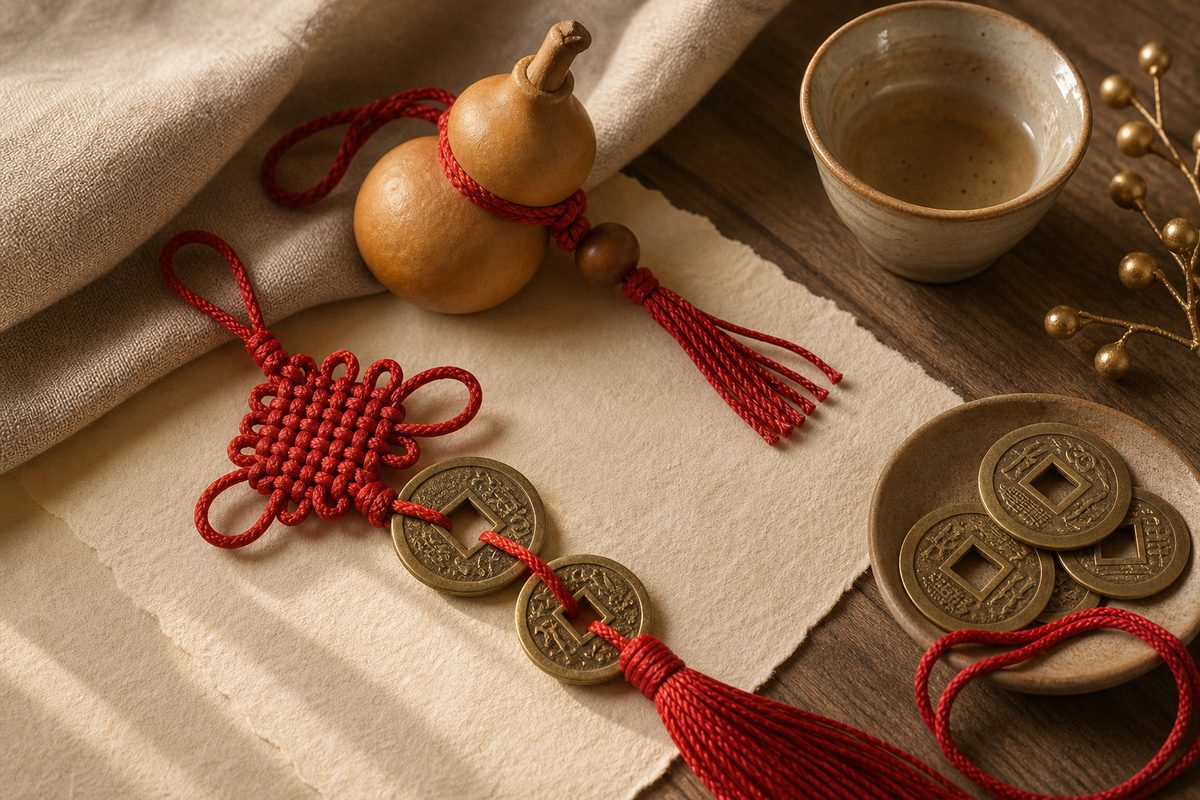
Eastern good luck symbols often depend on a close relationship between image and language. A sound-alike word can turn an animal, plant, number, or object into a blessing. This is why many traditional motifs are not only decorative; they are visual phrases.
Words and Sound-Alike Blessings
The character fu is one of the clearest examples. It means blessing, happiness, or good fortune, and it is widely displayed during New Year and other festive moments. When the character is placed upside down, the visual joke depends on a sound connection: the phrase for “upside down” sounds like “arrives,” so the display suggests that blessing has arrived.
Other motifs work in similar ways. A bat is associated with blessing because the word for bat sounds like fu. Fish suggest abundance because the word for fish sounds like surplus. Deer can point toward rank or good livelihood through a sound connection with lu. Persimmon motifs can join wordplay around “things” and “as wished,” helping create phrases such as “may everything go smoothly.”
Red, Gold, and Festive Color
Red is one of the strongest festive colors in Eastern symbolism. It appears in wedding signs, New Year paper-cuts, red envelopes, red cords, knots, lanterns, and protective wrist threads. In this setting, red speaks of warmth, celebration, welcome, vitality, and blessing.
Gold and yellow tones often connect with abundance, dignity, harvest, brightness, and prosperity. Gold ingots, coins, golden fish, and warm metallic details are common in decorative objects and gift language. The effect is not only visual luxury; it is a way of making abundance visible.
The Five Blessings
The Five Blessings are a classic Eastern way to describe a complete good life: longevity, wealth or sufficiency, health and peace, love of virtue, and a peaceful natural completion of life. Designs with five bats around a longevity character are especially famous because they turn the words into a compact visual blessing.
Common Eastern Symbols and Their Meanings
| Symbol | Meaning | Where it appears |
|---|---|---|
| Dragon | Strength, authority, auspicious power, renewal | Art, festivals, architecture, jewelry motifs |
| Phoenix (凤凰) | Grace, nobility, renewal, harmonious pairing | Wedding imagery, textiles, decorative art |
| Fish | Surplus, abundance, continuity | New Year images, bowls, paintings, pendants |
| Lotus | Purity, renewal, spiritual clarity | Buddhist art, jewelry, home decor |
| Bat | Blessing through wordplay | Court dress, porcelain, carving, textiles |
| Double happiness (囍) | Wedding joy and paired celebration | Wedding signs, gifts, paper-cuts |
| Chinese knot | Connection, balance, continuity | Hanging decor, cords, pendants |
| Auspicious clouds | Favorable signs, heavenly blessing, graceful movement | Textiles, borders, ceramics, architecture |
| Pixiu (貔貅) | Wealth-guarding creature in Eastern folk jewelry | Bracelets, pendants, home figures |
| Coins | Circulation, sufficiency, prosperity | Charms, tassels, home decor |
| Gourd (葫芦) | Blessing, protection, fullness, health symbolism in folk language | Home objects, pendants, paintings |
| Number 8 | Prosperity and smooth growth through sound association | Dates, phone numbers, addresses, gifts |
| Number 6 | Smoothness and ease in popular number language | Everyday choices and blessings |
| Number 9 | Longevity and lasting connection | Wedding language, gifts, symbolic counts |
For readers choosing a wearable or giftable symbol, Eastern Story's Blessing collection gathers pieces around protection, harmony, love, clarity, renewal, strength, and good wishes. Related guides such as Good Luck Bracelet Meaning, What Is Pixiu?, and Red String Bracelet Meaning continue the same symbolic approach.
Japan's Maneki-neko: The Beckoning Cat
The maneki-neko, often called the beckoning cat or lucky cat, is one of the most recognizable Japanese good luck figures. It is commonly placed near shop entrances, counters, restaurants, and homes as a welcoming symbol connected with customers, opportunity, and prosperity.

Its raised paw gives the figure its name and character. In common modern explanations, one raised paw is associated with inviting people or good fortune, while the other is associated with money or prosperity. Some figures raise both paws, turning welcome and fortune into a paired blessing. The collar, bell, coin, and color choices can add further layers of meaning.
The symbol also shows how good luck objects travel. The maneki-neko is rooted in Japanese visual culture, but it now appears around the world in restaurants, shops, home decor, toys, and jewelry. Its global popularity works best when the object is still recognized as a Japanese cultural figure rather than a generic cat charm.
Protective Amulets Across Cultures
Many lucky symbols are also protective. They do not only invite favorable conditions; they help people express a wish for safety, steadiness, courage, or watchfulness. This is why eyes, hands, knots, scarabs, animal guardians, and doorway objects appear so often across cultures.

Eye Amulets and the Evil Eye
The blue eye amulet, often called a nazar in Turkish and Mediterranean contexts, is connected with the idea of the harmful gaze. People wear or display it as a protective symbol, especially around homes, vehicles, babies, businesses, and jewelry. Its round blue form is meant to watch, reflect, and hold protective attention.
In a cultural symbolism guide, the relevant topic is the eye-shaped amulet and its folk meaning. Health tools, remedies, and vision-care products belong to a different page boundary, so this section stays with the cultural amulet tradition.
Hamsa, Hands, and Watchful Protection
Hand-shaped amulets such as the hamsa appear across several North African, Middle Eastern, and Mediterranean communities. Meanings vary by community and context, but the hand form is widely associated with protection, blessing, and benevolent presence. When paired with an eye, the design joins watchfulness with an open protective hand.
Ancient Egyptian Scarabs and Eye Symbols
The scarab is one of ancient Egypt's most enduring symbols. Its form is connected with the dung beetle, whose rolling ball was associated with the movement of the sun. In Egyptian religious imagination, this became a symbol of sunrise, self-renewal, regeneration, and the daily return of light.

Scarab amulets appeared as seals, rings, pendants, and funerary objects. Heart scarabs could be placed with the dead, while smaller scarabs could be worn or carried. In modern jewelry and decor, the scarab often carries the language of renewal, protection, transformation, and continuity.
Eye symbols also appear in ancient Egypt, especially the Wedjat or Eye of Horus, a protective and restorative sign. This is different from the Greek myth of Medusa, whose gaze belongs to another mythological world. Both eyes can become protective imagery in modern design, but their original stories should not be merged into one source.
European Horseshoes and Four-Leaf Clover
The horseshoe began as a practical object for protecting a horse's hoof and improving movement. In European folk practice, its iron material, crescent shape, association with horses, and doorway placement helped it become a threshold symbol for protection and good fortune. Some traditions hang it with the open end up to “hold” luck; others hang it downward as a blessing that pours out.

The four-leaf clover has a different kind of luck. Its power comes from rarity. Most clovers have three leaflets, so finding a four-leaf clover feels like encountering a small exception in ordinary life. In popular Western explanations, the leaves are often associated with hope, faith, love, and luck.
Together, horseshoes and clovers show two common paths into symbolism: one object becomes lucky through household placement and protective use, while another becomes lucky through scarcity and surprise.
Lucky Animals and Creatures
Animals become lucky when a culture links their behavior, sound, appearance, environment, or mythic role with human wishes. Some are guardians; some are messengers; some represent abundance, fertility, wisdom, speed, freedom, or household prosperity.

| Animal or creature | Cultural setting | Symbolic direction |
|---|---|---|
| Dragon | Eastern symbolism | Strength, renewal, authority, auspicious power |
| Phoenix | Eastern and wider mythic traditions | Renewal, grace, harmony, noble beauty |
| Bat | Eastern wordplay and decorative arts | Blessing and the Five Blessings |
| Fish | Eastern wordplay and festival imagery | Surplus, abundance, continuity |
| Cat / maneki-neko | Japan | Welcome, business opportunity, prosperity |
| Elephant | South and Southeast Asian contexts | Wisdom, strength, favorable beginning |
| Owl | Several global traditions, including modern sports mascots | Wisdom, watchfulness, night vision |
| Condor | Andean cultures | Freedom, power, high mountain presence |
| Llama and alpaca | Andean regional culture | Household livelihood, regional identity, gentleness |
| Bull | Andean ceramic rooftop tradition | Household blessing, protection, prosperity |
These meanings are not interchangeable. An Andean condor, an Eastern dragon, a Japanese cat, and an Egyptian scarab all speak through different cultural histories. A thoughtful gift or decor choice should keep that difference visible.
Modern Mascots as Public Good-Luck Symbols
Sports and civic mascots are modern relatives of older symbolic figures. They are usually not sacred amulets; they are public characters created to express welcome, energy, identity, and shared celebration. Olympic, Paralympic, and tournament mascots often use animals, children, regional objects, colors, and friendly gestures to make a large event feel approachable.

For example, a panda, tiger, eagle, beaver, owl, or lantern-inspired figure can represent hospitality, local wildlife, national identity, courage, warmth, or a festive beginning. Because mascot facts change by event and organizing body, this guide treats them as modern public symbols rather than building a full event-by-event mascot encyclopedia.
How to Choose a Lucky Symbol as a Gift or Decor
A good lucky symbol choice starts with meaning, not quantity. Instead of collecting every famous charm, choose one symbol that fits the recipient, the moment, and the cultural context.

- For a new home: doorway symbols, knots, horseshoes, protective eyes, or household blessing objects feel natural.
- For a business opening: maneki-neko, gold ingots, coins, fish, or prosperity colors can express welcome and abundance.
- For a wedding: double happiness, red knots, paired phoenix imagery, lotus, and lasting-number symbolism can carry gentle blessing language.
- For personal courage: scarabs, tiger-related symbols, eagles, condors, or protective bracelets can become daily reminders.
- For a culturally respectful gift: include the symbol's name and meaning, and avoid treating sacred imagery as a random decoration.
For wearable gifts, keep the wording calm: “chosen as a blessing,” “a reminder of steadiness,” “a symbol of welcome,” or “a wish for a smooth beginning.” This fits Eastern Story's broader language of meaningful objects, personal reminders, and cultural symbolism.
How to Use Lucky Symbols Respectfully
Respect begins with naming. Learn whether the object is a bat motif, a five-bat blessing, a nazar, a hamsa, a maneki-neko, a scarab, a horseshoe, a clover, or a red knot. Then learn where it is usually placed, when it is given, and what meaning a community connects with it.

Avoid mixing sacred or community-specific symbols only because they look attractive together. A table setting, bracelet stack, or gift box can compare cultures thoughtfully, but it should not erase the differences between religious signs, folk charms, public mascots, and decorative motifs.
The most meaningful use is often simple. Place a symbol where it belongs, wear it with awareness, or give it with a short note explaining the blessing. The symbol then becomes part of a lived action: welcoming guests, remembering family, beginning a new season, saving steadily, traveling carefully, or carrying courage through a difficult period.
Related Eastern Story Guides
Lucky symbols belong naturally beside Eastern Story's blessing and symbolic jewelry content. Continue with the Blessing collection, compare wearable meanings in Good Luck Bracelet Meaning, explore protective wealth symbolism in What Is Pixiu?, read the Evil Eye Amulet Meaning guide, or use Chinese Zodiac (生肖) Symbols for the broader twelve-animal tradition.
Frequently Asked Questions
Lucky symbols endure because they make human hopes visible. Whether the form is a red knot, a bat, a lucky cat, an eye amulet, a scarab, a horseshoe, a clover, a condor, or a modern mascot, its meaning grows from story, use, and care. Choose one with context, give it with thought, and let the symbol carry a clear and respectful blessing.
Related Posts


2 Comments