
Why are mala (念珠/佛珠) beads 108? A full mala commonly contains 108 counting beads because 108 represents a complete cycle of practice. In Buddhist traditions it is closely associated with the 108 afflictions or forms of mental confusion that practice seeks to transform. Across Hindu, yogic, Chinese, and wider Asian traditions, the same number also gathers meanings connected with sacred names, ritual completeness, the calendar, temple bells, cosmology, and the rhythm of returning to one attentive action again and again.
The strand is practical as well as symbolic. A practitioner moves one bead for each recitation, mantra, Buddha-name (佛号), prayer, breath, or prostration. The fingers keep the count so the mind can remain with the sound and meaning of the practice. A complete Chinese-style 108-bead strand can also include a Buddha-head or mother bead, top and waist beads, separators, soft spacers, counters, a movable clip, a back pendant, and disciple beads. Most of these fittings sit outside the count of 108.
108 Mala Beads at a Glance
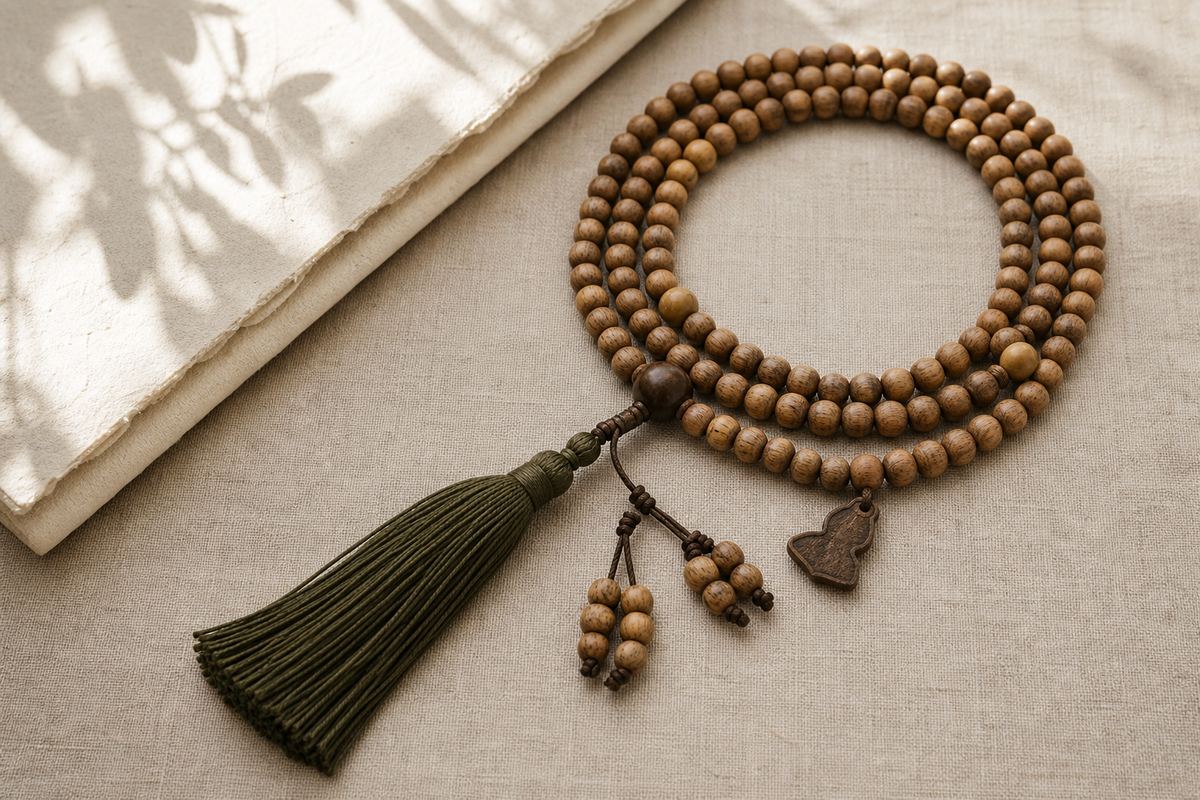
- Working count: 108 base beads usually make one complete round.
- Boundary bead: the Buddha-head, three-way bead (三通), guru bead, or mother bead marks the beginning and end and is generally outside the 108.
- Quarter divisions: a top bead and two waist beads can divide the strand into four sections of 27.
- Long-count system: two ten-bead counters plus a movable clip can record hundreds, thousands, ten-thousands, and larger totals.
- Core purpose: counting supports concentration, remembrance, prayer, and steady practice; the richness of the fittings never replaces the practice itself.
What Is a Mala, and What Is It For?
A mala is a strand of beads used to count repeated devotional or contemplative actions. The Sanskrit word mālā means a garland. In Chinese Buddhist contexts, the strand may be called fozhu (佛珠, Buddha beads), nianzhu (念珠, recitation beads), or shuzhu (数珠, counting beads). The names emphasize slightly different aspects of the same object: its connection with the Buddha, its use in recitation, and its role in keeping count.

The basic motion is simple. One recitation, prayer, mantra, or breath corresponds to one bead. Touch gives the mind a physical rhythm; the quiet movement of the beads gives the hands a task; and the count continues without a separate mental calculation. In Buddhist practice, this helps gather a scattered mind and return it to the Buddha-name, mantra, vow, teaching, or quality being cultivated.
In many Buddhist communities, a mala is also a practice object with spiritual weight. A strand used for years of recitation can become inseparable from the practitioner’s memory of teachers, vows, difficult seasons, and moments of clarity. A blessed mala or one connected with a specific practice is handled with the respect given to its religious context. The beads become a reminder to return to the Dharma (法), to keep a commitment, and to carry attention into daily life.
Outside formal practice, people also wear mala-inspired strands as bracelets, necklaces, or hanging ornaments. In modern Chinese bead culture, material, color, carving, patina, and composition express taste and cultural identity. Handling a wooden or seed strand slowly can itself become a discipline of patience. The most balanced understanding holds all these roles together: counting tool, practice support, symbolic object, tactile aid, personal reminder, crafted accessory, and sometimes a collectible work.
Why 108 Carries So Many Meanings
Sacred numbers rarely belong to only one explanation. As a number travels through scriptures, schools, temples, calendars, stories, and everyday customs, each setting gives it another layer. The meaning of 108 therefore resembles a woven cord: Buddhist doctrine, Hindu devotion, Chinese number culture, annual time cycles, ritual sound, mathematical pattern, and modern symbolic imagination all meet in the same count.

The Buddhist 108 Afflictions
One of the best-known Buddhist explanations is the group of 108 afflictions, defilements, or forms of mental confusion. A commonly repeated teaching calculation begins with the six sense faculties—eye, ear, nose, tongue, body, and mind. These meet experience through pleasant, unpleasant, and neutral feeling, and through relationships with past, present, and future. Different schools organize the combinations in different ways; the central image remains the same. Human confusion takes many forms, and a complete round of 108 gives practice a form large enough to face that complexity.

Each bead can be understood as one moment of meeting distraction, attachment, aversion, or ignorance and returning to the path. The practitioner does not need to assign one named affliction to every bead. The full circle itself expresses completeness: the mind wanders in countless directions, and the practice patiently brings it home.
The number also appears in practices such as 108 prostrations or repeated invocations. In these settings, completion is felt bodily. The count is long enough to move beyond the first burst of enthusiasm, through fatigue and restlessness, toward steadier attention. One hundred and eight therefore symbolizes both the breadth of what is being transformed and the completeness of the effort offered.
Chinese Time, Temple Bells, and the Number 108
In Chinese number symbolism, 108 can be read through the sum of thirty-six and seventy-two. The Thirty-Six Heavenly Spirits and Seventy-Two Earthly Fiends are familiar groupings in religious, literary, and folk imagination; together they suggest a complete field joining heaven and earth. This is a symbolic correspondence rather than the single historical origin of every 108-bead strand, yet it helps explain why the number feels culturally expansive.

Another Chinese calendar interpretation adds the twelve months, twenty-four solar terms, and seventy-two seasonal periods, producing 108. The sum turns the number into an image of the whole year: major seasonal thresholds, subtle changes in climate, and the circular passage of time. A strand of 108 beads can thus be imagined as a portable cycle, held and completed in the hands.
Temple bells deepen this association. In East Asian Buddhist custom, bells may be struck 108 times at the turning of the year, each sound marking the release of old afflictions and the opening of a new cycle. In Japan, the New Year’s Eve ringing known as Joya no Kane is especially well known; Chinese Buddhist communities also connect repeated bell sounds with clearing the mind and welcoming the year. The sound travels outward while the bead moves inward—two forms of counting that return attention to renewal.
Hindu and Yogic Meanings of 108
In Hindu traditions, 108 appears in lists of divine names, devotional recitations, sacred places, and ritual repetitions. A japa mala commonly carries 108 working beads plus a larger meru or guru bead. A practitioner repeats a mantra once per bead and turns the strand at the meru when beginning another round.
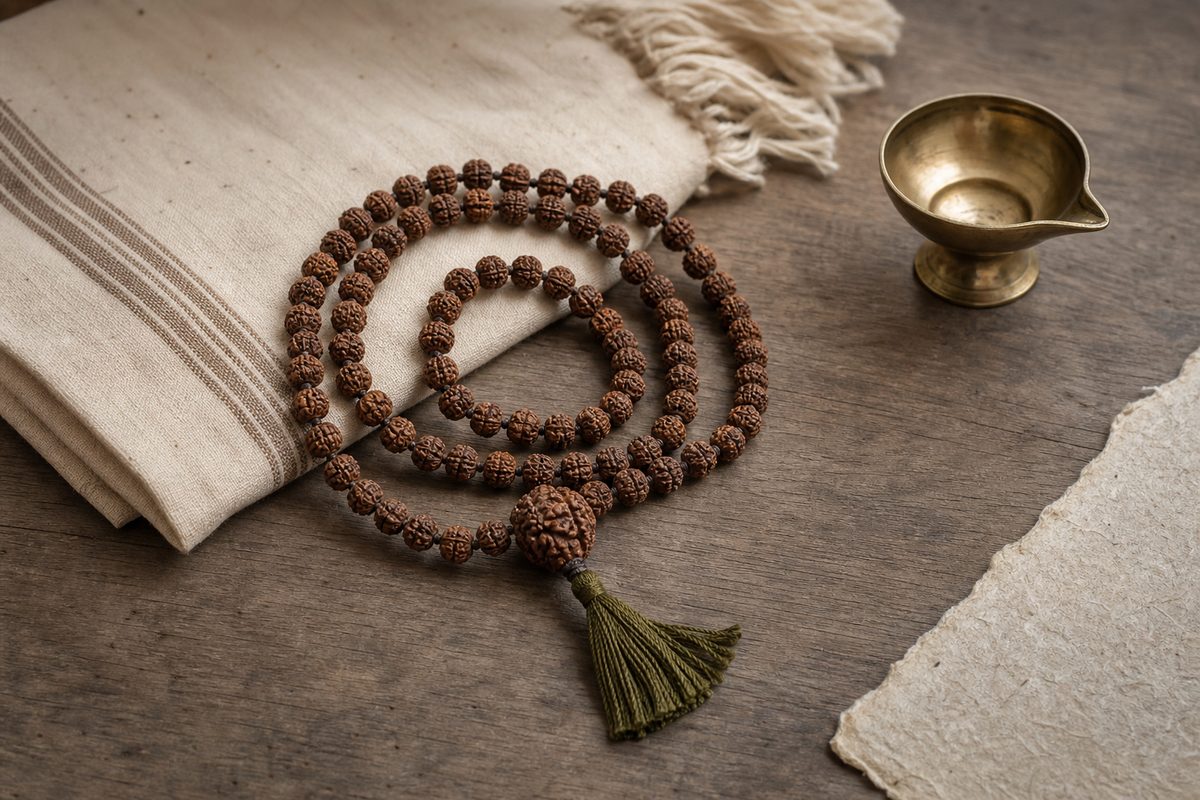
The number is also linked in Hindu cultural explanation with 108 dance forms or karanas associated with Shiva’s cosmic dance, and with groupings of sacred pilgrimage sites. In modern yoga communities, practitioners may complete 108 sun salutations at a seasonal threshold or special gathering. The repetition transforms a number into duration, breath, heat, and shared effort.
Traditional Indian medicine describes vital points known as marma. Modern wellness writing sometimes compresses varied anatomical traditions into a simple claim about “108 chakras.” A more faithful framing keeps the spiritual image without turning it into a fixed biomedical fact: in contemporary yogic symbolism, 108 evokes a complete network of life, body, breath, sacred geography, and cosmic order.
Mathematics, Nine, and Modern Cosmic Symbolism
Mathematically, 108 has an elegant factorization: 108 = 2² × 3³, and it is also 9 × 12. In Chinese number culture, nine has long carried associations with fullness, height, duration, and the extreme of yang; twelve organizes months, zodiac branches, and recurring cycles. Read together, 9 × 12 naturally suggests fullness moving through an ordered cycle.
Modern spiritual writing often connects 108 with the apparent relationship between the Sun, Moon, and Earth. The actual astronomical ratios are approximate and vary depending on which diameter or distance is being compared. Their symbolic force comes from the striking visual fact that the Sun and Moon appear nearly the same size in our sky, making total eclipses possible. Used as modern cosmic symbolism, the image expresses proportion, wonder, and the human desire to find harmony between number and universe.
The Complete Structure of a 108-Bead Mala
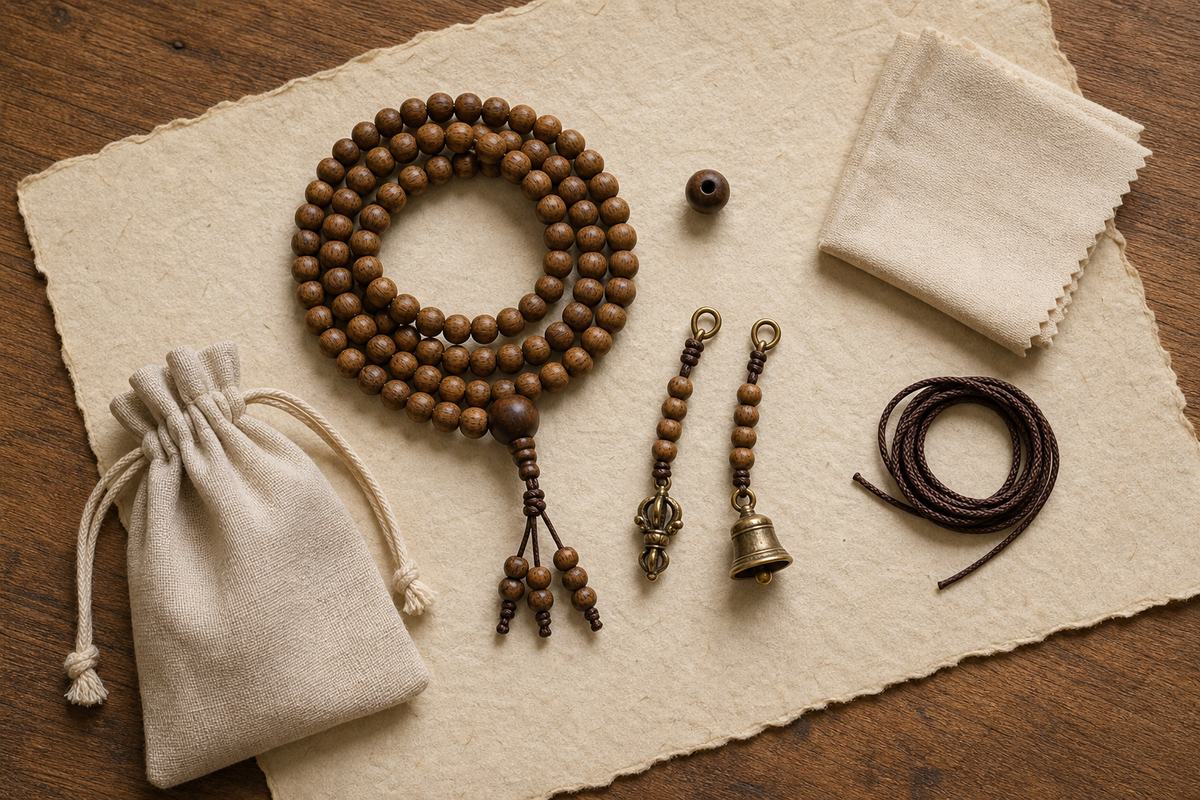
A plain practice mala can be beautifully simple: 108 base beads, one mother bead, cord, and perhaps a tassel. A more elaborate Chinese or Tibetan-style strand may use a carefully ordered system of focal beads, separators, hanging counters, a back ornament, and finishing beads. Knowing which parts count toward 108 prevents a common misunderstanding: decorative and functional fittings are often additional to the 108 working beads.
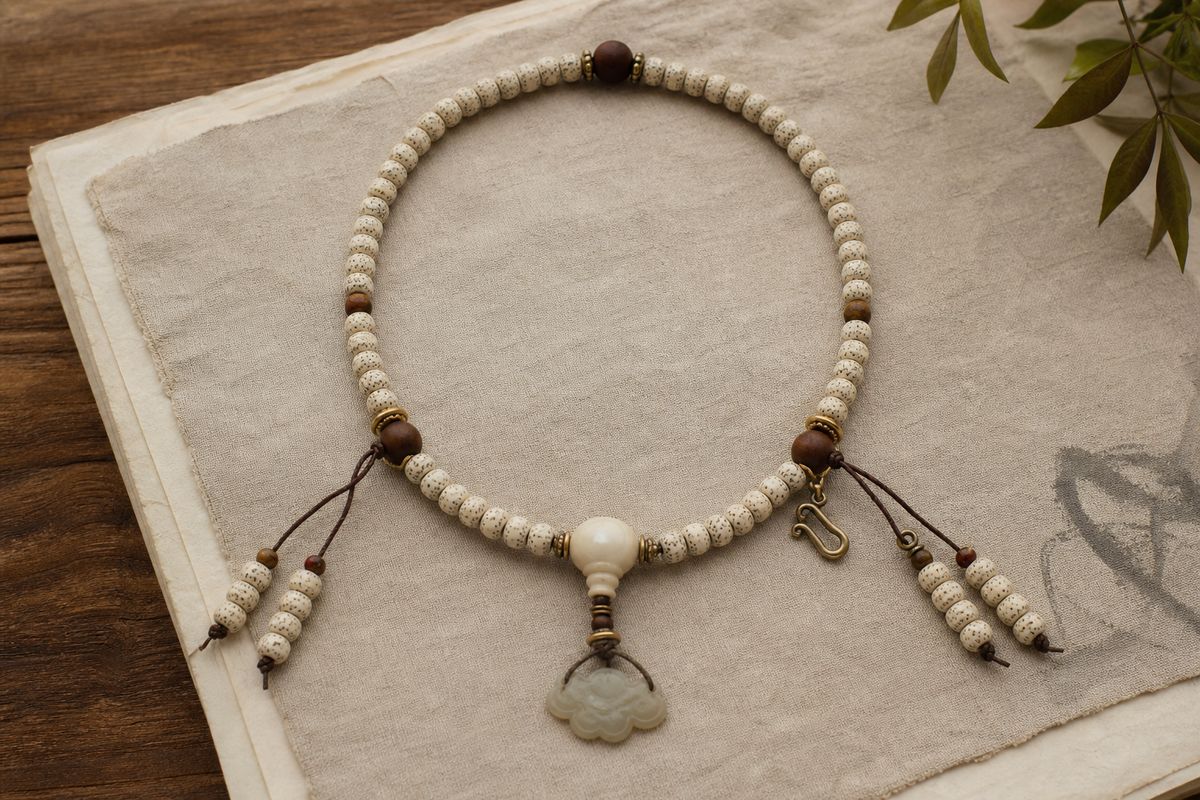
| Part | Position and form | Function | Counted in the 108? |
|---|---|---|---|
| Base beads | The uniform body of the strand, normally similar in size and material | One bead moves for each recitation; together they form the working count | Yes—108 in a full strand |
| Buddha-head / three-way / mother bead | The largest focal bead at the beginning and end; its three holes can connect the main loop to a stupa-shaped fitting, cord, or tassel | Marks the boundary of a round and gathers the strand’s structure | Usually no |
| Top bead | Opposite the Buddha-head at the highest point of the loop | Creates a visual axis and marks the halfway point; with waist beads it supports four sections of 27 | Usually an added marker or a designed replacement; verify the maker’s count |
| Waist beads | A matched pair midway between the top bead and Buddha-head on both sides | Mark the first and third quarter points, creating four 27-bead sections | Usually added markers or replacements; verify the construction |
| Separator beads | Any additional feature beads placed between top, waist, or three-way positions | Divide sections, improve orientation, or create a decorative rhythm | Depends on construction |
| Spacer discs | Thin discs between beads or beside valuable fittings; leather, rubber, seed, coconut shell, wood, metal, or stone may be used | Reduce direct rubbing, protect drilled edges, and add fine visual detail | No |
| Counter strands | Two short hanging strands, often with ten small movable beads each and a bell- or vajra-shaped end | Record completed rounds and higher place values | No |
| Movable clip | An open or hinged metal clip positioned between working beads | Marks a changing place on the main strand, commonly for ten-thousand progression | No |
| Back pendant / back cloud | A decorative element below the stupa portion of the Buddha-head; in Chinese bead culture it is called beiyun (背云), also known in some craft vocabulary as a “back fish” form | Creates a visual transition from the main loop to lower pendants or disciple beads | No |
| Disciple beads | Small finishing beads below the back pendant, often 6–12 beads divided into two balanced groups | Finish the strand, assist secondary counting in some designs, and balance the hanging elements | No |
The Buddha-Head or Three-Way Bead
The Buddha-head is the visual and functional center of a fitted strand. Chinese makers often call it a santong, or three-way bead, because two holes receive the sides of the loop and a third directs the cord downward. It may be made as one integrated Buddha-head-and-stupa form or as separate three-way and stupa pieces. It is normally larger than every other bead and can carry a tassel, ribbon, back pendant, disciple beads, or another hanging ornament.

In practice language, this same boundary may be called the mother bead, guru bead, or meru bead. The terms come from different cultural settings and are not perfectly interchangeable, but they all identify the point where the round begins and returns. It is generally not counted as one of the 108 working beads.
Top, Waist, Separator, and Spacer Beads
The top bead sits opposite the Buddha-head and establishes the strand’s main axis. Two waist beads sit between these points, one on each side. When positioned after every twenty-seven base beads, the three markers divide the 108 into four equal quarters. This makes the strand easier to orient and allows the practitioner to feel progress without interrupting the recitation.

“Separator bead” is a broader craft term for feature beads added beyond the main top, waist, and three-way arrangement. A separator can mark a smaller section, repeat a color, or bring visual order to a complex strand. A spacer disc is thinner. Its primary job is to keep hard beads and expensive fittings from grinding against one another. A soft leather, rubber, or other compatible spacer is especially useful beside carved turquoise, soft organic material, plated metal, or a valuable focal bead.
Counters, Clip, Back Cloud, and Disciple Beads
A complex mala can count far beyond one round. Two counter strands usually hang from the main loop. Each often carries ten small beads, commonly one-fifth to two-fifths the diameter of a base bead, with a bell, vajra, or similar terminal fitting. One counter records a lower place value and the other the next higher value. The exact assignment follows the practitioner’s method.
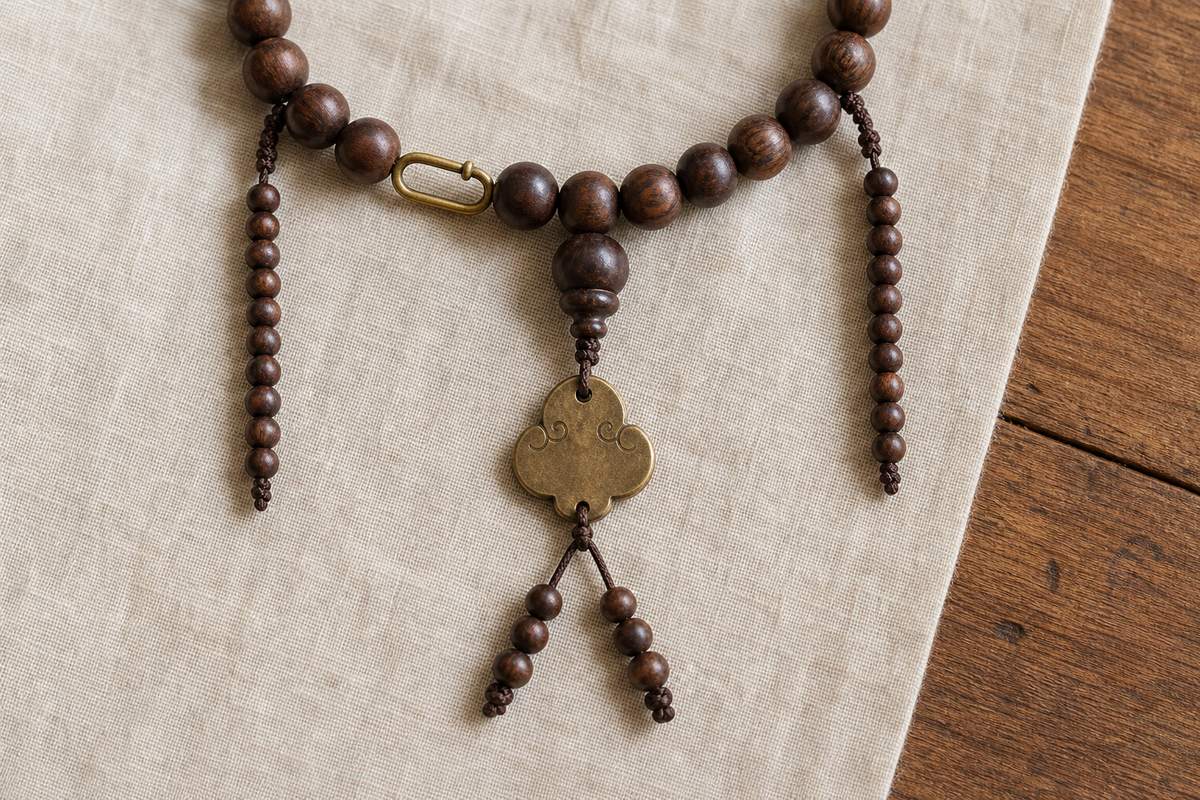
The movable clip attaches between two base beads and advances along the main strand. It makes the growing total visible without adding a separate notebook. Below the Buddha-head, the back cloud creates a graceful bridge to the lower elements. Disciple beads complete the ends, usually in two balanced groups and at a smaller scale than the base beads. In modern Chinese fitted strands, these lower parts are both functional and ornamental: the eye follows the movement from the large Buddha-head through the back cloud to the smaller finishing beads.
How to Choose Accessories and Keep the Strand Balanced
A well-composed 108-bead strand has a clear size hierarchy. The Buddha-head is largest, the top bead is the next visual anchor, and the waist beads are slightly smaller while remaining equal to or larger than the base beads. For a small-bead strand, a top bead and waist beads about 2–5 mm larger than the base beads create definition without making the strand awkward. Exact proportions depend on the weight, hole size, cord, and intended use.

- Keep the Buddha-head dominant. It should read as the boundary and center rather than compete with several equally large fittings.
- Let the top bead lead the quarter markers. The top bead is normally larger than the matched waist beads and smaller than the Buddha-head.
- Limit spacer diameter. A spacer wider than the main bead can catch the fingers and make handling tiring. When spacer and bead colors are close, a slightly larger spacer can remain visually quiet, but comfort still sets the limit.
- Protect valuable fittings. Place a soft, compatible spacer beside fragile carvings, porous stones, plated surfaces, or high-value focal pieces to reduce abrasion.
- Use color contrast deliberately. When every fitting matches the base beads too closely, the structure disappears. A contrasting top bead or waist pair can reveal the four-part rhythm and make the main material look richer.
- Balance both sides. Matched waist beads, equal hanging lengths, and consistent metal tones keep a richly fitted strand calm rather than crowded.
In a practice mala, smooth movement matters more than spectacle. The fingers should travel without sharp edges, oversized discs, loose clips, or heavy pendants interrupting the recitation. In a collector’s strand, rare material and carving may take a larger role, but the best compositions still respect scale, material compatibility, and the purpose of the object.
How to Count with 108 Beads, Counters, a Vajra, and a Clip

One Round and the Four Sections of 27
Begin with the bead beside the mother bead. Complete one recitation, then move one working bead. Continue until the mother bead returns. That is one round of 108. The top and waist beads divide the physical journey into four sections of twenty-seven, so a practitioner can sense the first quarter, halfway point, third quarter, and completion without leaving the rhythm of the practice.

In traditions that avoid crossing the mother bead, turn the mala at the end of the round and continue in the opposite direction. The reversal makes the boundary meaningful and keeps the motion connected with respect for the Buddha, teacher, teaching, or lineage represented by that point.
Recording Hundreds and Thousands with Two Ten-Bead Counters
For extended daily practice, two short ten-bead counters create a place-value system. After each completed 108-bead round, move one bead on the first counter. Ten completed rounds fill that counter. Return it to its starting position and move one bead on the second counter. In practical shorthand, the first strand records hundreds and the second records thousands, even though each full round contains 108 rather than exactly 100 recitations. Many practitioners dedicate the extra eight recitations toward mistakes, distraction, or completeness.
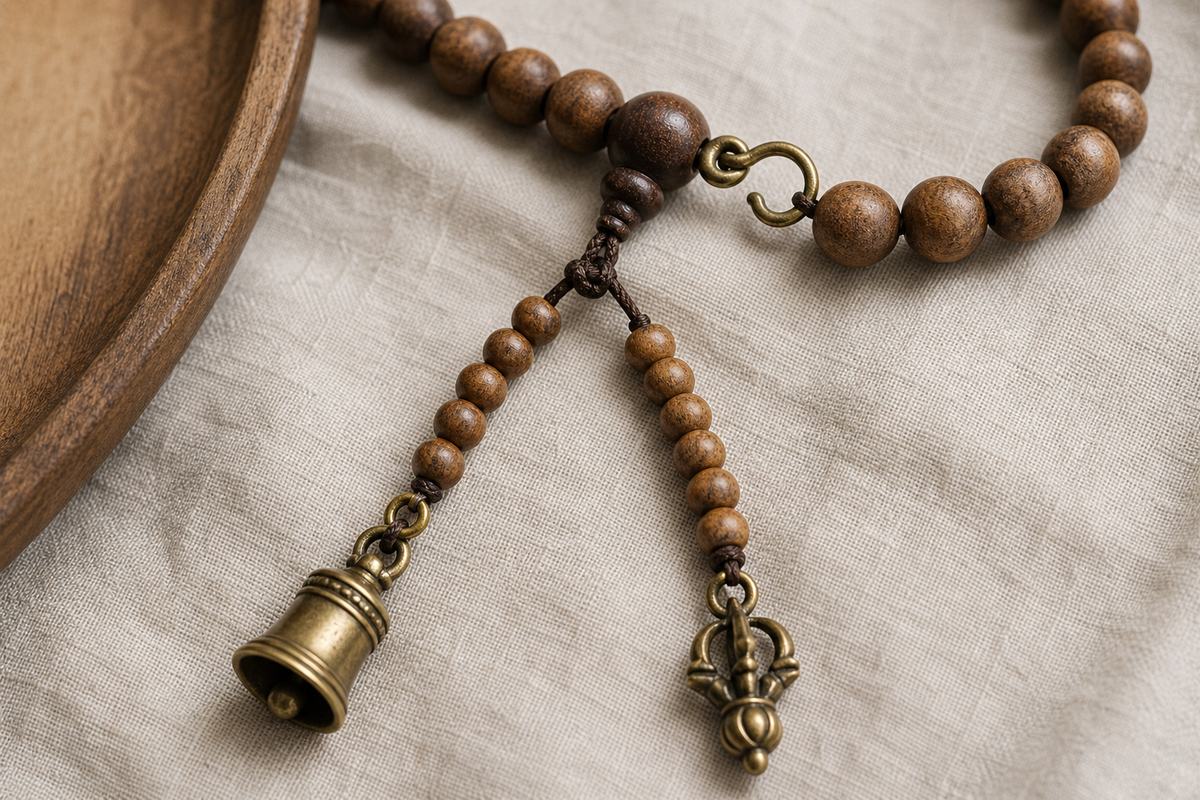
Some counter fittings use a small vajra at the end. A movable ring or disc on the vajra can serve as another marker: one movement records a completed round or one filled counter, depending on the method taught. What matters is consistency. Before beginning a long commitment, decide which fitting represents which place value and keep the same system throughout.
Ten-Thousands, Hundred-Thousands, and One Million
When both ten-bead counters have completed their full cycle, place the movable clip beside the first working bead after the top marker to record ten thousand. Repeat the counter cycle and advance the clip one bead at a time. Ten clip positions represent one hundred thousand; one hundred clip positions represent one million. On a 108-bead strand, reaching the last practical clip position provides room for a one-million-count commitment while preserving spare positions for the maker’s layout and the practitioner’s convention.
| Marker | Movement | Place-value idea |
|---|---|---|
| Main 108 beads | Move one bead per recitation | One full round |
| First ten-bead counter | Move one counter bead per completed round | Hundreds / completed rounds |
| Second ten-bead counter | Move one bead when the first counter fills | Thousands |
| Movable clip | Advance one main-bead position when both counters complete their cycle | Ten-thousands; continued positions build toward hundred-thousands and one million |
What Mala Beads Mean in Practice and Daily Life
A counting tool. This is the most direct function. The strand records recitations so attention can remain with the Buddha-name, scripture, mantra, breath, or prayer. The touch of each bead reduces the need to ask, “What number am I on?” and gives a repeated action a steady form.

A practice implement. In Buddhist traditions, a mala can be regarded as a Dharma implement and a support for recollecting the Three Jewels. In one devotional interpretation, the mother bead symbolizes the Buddha, the cord represents the continuity of the Dharma, and the individual beads recall the Sangha (僧伽). Years of recitation, blessings, and association can make a strand deeply sacred to its owner.
A bearer of blessing. In Chinese Buddhist and folk-influenced jewelry culture, different woods, seeds, stones, colors, carvings, and fittings carry auspicious associations—peace, protection, wisdom, clarity, compassion, longevity, or the wish that difficulties be transformed. These meanings express belief, prayer, and personal intention rather than a commercial guarantee.
A reminder and commitment. A mala worn at the wrist, held in the hand, or kept in a pouch can interrupt forgetfulness. Its presence recalls a vow, a teacher, a quality being cultivated, or the choice to respond more patiently. The object becomes a quiet companion in ordinary life.
A support for concentration and emotional steadiness. Repeated touch, breath, sound, and movement create a simple field of attention. In a tense moment, slowly moving beads can help a person settle, much like a familiar contemplative rhythm. The psychological value lies in returning the mind to a chosen focus.
A way to cultivate patience. In modern Chinese hand-bead culture, caring for and slowly handling wood or seed beads is called panwan (盘玩). The surface changes through time, clean handling, rest, and repeated contact. The process rewards patience over haste and can create a pocket of quiet inside a fast day.
A crafted accessory. As a bracelet, necklace, or hanging object, a well-balanced strand communicates material knowledge and cultural taste. Size hierarchy, color contrast, carving, metalwork, tassel work, and patina all contribute to the composition. A fashion use remains most respectful when it does not pretend that decoration automatically equals religious attainment.
A collectible craft object. Rarity, verified material identity, density and oil content in certain woods, color and texture in turquoise or jade, documented age, provenance, carving quality, maker reputation, condition, and the integrity of the complete fitting set can all affect value. These factors explain why some strands are collected, while also keeping value grounded in material, craft, documentation, and market demand rather than promised appreciation.
From Fear of Doing It Wrong to Inner Steadiness
A beginner once approached Buddhist practice as if every gesture were an examination. At night, after a recitation session, they replayed the movement in their mind: Was the mala in the correct hand? Had the thumb moved the bead in the right direction? Had one distracted motion crossed the mother bead? Concern for respect slowly turned into fear of making an invisible mistake.

Sometimes the worry became so strong that the beginner sent a late video to a teacher, demonstrating the grip and asking whether it was acceptable. Then came another round of questions to senior practitioners. Each answer brought a few minutes of relief, followed by a new uncertainty. The mala, meant to gather the mind, had become a magnifying glass for anxiety.
With further study, the form began to reveal its purpose. Holding the beads carefully taught attention. Turning at the mother bead taught respect and return. Keeping the strand clean taught gratitude for an object that supports practice. Temple etiquette protected a shared sacred space. The rules were not traps laid for a sincere beginner; they were vessels shaped by wisdom, compassion, memory, and community.
That understanding changed the emotional center of practice. The beginner still handled the mala respectfully, but no longer used every accidental movement as evidence of failure. A missed bead could be corrected. A question could be asked without panic. The deeper measure became the quality of attention, faith, and conduct carried beyond the recitation seat.
Over time, each round felt less like a performance and more like returning home. Recitation brought warmth and strength into the body; the familiar beads steadied the hands during difficult days. The old question—“Did I do every movement perfectly?”—gave way to a quieter one: “Did this practice help me return to clarity, compassion, and sincere faith?” This is the movement from formal anxiety to inner confidence: rules remain, but their deepest expression is a mind becoming steadier and kinder.
Han and Tibetan Buddhist Mala Etiquette
Han and Tibetan Buddhist communities share the mala’s basic role while preserving different habits of handling, wearing, and explanation. Regional custom, temple practice, teacher instruction, and the purpose of a particular recitation all matter. The most useful approach is to name the setting first, then follow the form taught in that setting.

Left Hand, Both Hands, and Moving the Beads
In Tibetan Buddhist traditions, practitioners commonly hold and move the mala with the left hand. In some ritual situations, both hands may work the beads at chest level. The thumb advances each bead while the other fingers support the strand; details can change with the practice.

In Han Buddhist communities, there is no single universal rule that every lay practitioner must always use the left hand. Some use the left hand, some use both hands respectfully, and some follow a temple or teacher’s specific instruction. When visiting a new community, observe the host practice and ask simply if the method matters for the ceremony.
Crossing the Mother Bead and the Position of the Buddha-Head
Across many Han and Tibetan instructions, the mother bead is treated as the boundary of the round. The careful method is to reach it, turn the strand, and begin the next round in the reverse direction. This honors the mother bead’s symbolism and prevents the practice from becoming a mechanical race around a closed loop.

In some Han Buddhist wearing customs, a long mala is arranged so the Buddha-head and tassel fall behind the body as an expression of order and respect. Tibetan daily practice is often more flexible in the visible front-or-back position, especially when people carry a mala while working or traveling. A strand connected with a specific empowerment or instruction follows that teacher’s guidance.
Where a Mala Is Worn and Temple Etiquette
Traditional texts and inherited customs describe mala beads carried at the neck, around the arm, or near a topknot. These positions have devotional interpretations connected with purifying body, speech, and mind. In ordinary modern use, practitioners often carry the strand in a clean pouch, wrap a shorter strand at the wrist, or wear a long strand around the neck according to community custom.
In some Han Buddhist monasteries, visible long malas and tassel positions historically communicate monastic office. The abbot’s tassel may fall at the back, an administrative monastic’s at the right, and a guest-prefect’s at the left. Because this is a localized institutional convention rather than a rule for every temple, a lay visitor entering a Han Buddhist monastery can show respect by removing a decorative long mala from the neck or keeping it discreet unless the host community indicates otherwise.
Daily Storage, Breakage, Damage, and Loss
For a practitioner, a mala belongs in a clean, secure place. Carry it in a dedicated pouch, place it on a clean surface during rest, and keep it away from the floor, shoes, bathrooms, and locations where people step over it. A blessed or practice-specific strand is often kept separate from casual jewelry. These actions express regard for the role the mala plays in practice.
A broken cord is a material event. Fiber ages, elastic hardens, knots loosen, heavy fittings pull, sweat weakens thread, and sharp drill holes abrade the line. Gather the beads, count them, inspect every hole and fitting, and restring the mala with an appropriate cord. The break invites maintenance and reflection, not fearful prediction.
If one or more beads are damaged or lost, the strand can often be repaired by replacing the missing count. In some Tibetan Buddhist settings, an incomplete or practice-specific mala may be placed respectfully on a mandala offering plate until guidance is received. Damaged natural beads can be wrapped and returned to clean earth or placed in a clean flower bed where local rules permit; valuable, treated, metal, synthetic, or wildlife-derived materials require material-appropriate handling. A usable smaller strand can also be restrung and given to another person as a respectful connection. When a blessed mala has special significance, ask a teacher or temple before disposing of parts.
Prayer Beads in Buddhism, Taoism, Islam, Catholicism, and Hinduism
Beads appear in several religions because repeated prayer creates the same practical need: the body requires a quiet way to keep count while the mind remains with devotion. Similar function does not make all strands interchangeable. Each tradition gives its beads a distinct name, structure, prayer sequence, hand method, and theological meaning.

| Tradition | Name and common count | Primary use and distinctive features |
|---|---|---|
| Buddhism | Mala, Buddha beads, recitation beads, or counting beads; 108 is the classic full count, with 54, 27, 21, and 18 also encountered | Counts Buddha-names, mantras, sutra passages, prostrations, or breaths. Han, Tibetan, Theravada, and other schools use different materials and handling methods. A mother bead marks the boundary. |
| Taoism | Liuzhu (流珠, flowing beads) or shuzhu (数珠, counting beads); 81, 36, and 24 are among traditional and modern counts | Supports scripture recitation, invocations, and ritual counting. The number 81 can express nine times nine and return to unity. Quanzhen aesthetics often favor restrained woods such as sandalwood or nanmu, while practical peachwood strands appear in popular and Zhengyi-influenced contexts. |
| Islam | Tasbih, misbaha, or praise beads; commonly 33 or 99 beads | Supports dhikr, the remembrance and praise of God. Thirty-three beads can be completed three times in relation to the Ninety-Nine Names. Dividers often mark groups of eleven or thirty-three. |
| Catholicism | The Rosary; commonly 59 beads plus a crucifix and connecting elements | Guides an ordered sequence of the Apostles’ Creed, Our Father, Hail Mary, Glory Be, and meditation on the Mysteries of Christ and Mary. Its decades, centerpiece, and crucifix create a path different from the circular 108-bead mala. |
| Hinduism | Japa mala; commonly 108 beads plus a meru or guru bead | Counts mantra and divine names in devotional and meditative practice. Materials such as rudraksha, tulsi, sandalwood, lotus seed, or crystal can be selected according to deity, lineage, or practice. |
Common Buddhist Bead Counts and Their Established Meanings
Some counts have a clear and frequently repeated relationship with Buddhist doctrine or practice. Others are chosen because they divide 108 conveniently. The exact list varies across schools, yet the following counts have a recognizable traditional context.

| Count | Common Buddhist or practice context | Practical relationship |
|---|---|---|
| 1080 | An exceptionally large count associated in modern explanations with eminent masters, complete liberation, or very extensive practice | Rare in ordinary daily wear |
| 108 | The 108 afflictions and the completeness of a full practice cycle | One full round |
| 54 | Often linked with fifty-four stages of bodhisattva cultivation in East Asian explanation | Two rounds equal 108 |
| 42 | Linked in some East Asian lists with forty-two stages or ranks of bodhisattva cultivation | A tradition-specific count |
| 36 | A compact count; modern Chinese explanations also associate it with thirty-six protective deities or heavenly spirits | Three rounds equal 108 |
| 27 | A quarter mala; also linked in some Buddhist explanations with stages or types of noble practitioners | Four rounds equal 108 |
| 21 | Associated in some lists with ten grounds, ten perfections, and buddhahood | A compact practice count used in particular recitations |
| 18 | The Eighteen Realms: six faculties, six objects, and six consciousnesses; “eighteen-seed” bracelets are common in Chinese Buddhist culture | Six rounds equal 108 |
| 14 | Connected in East Asian Buddhist interpretation with the fourteen fearlessnesses of Guanyin (观音) | A compact symbolic strand |
| 12 | The Twelve Links of Dependent Origination | A short bracelet or teaching reminder |
| 8 | The Noble Eightfold Path | A compact teaching reminder |
| 6 | The six sense faculties, or in other contexts the Six Perfections | A compact symbolic count |
| 3 | The Three Jewels: Buddha, Dharma, and Sangha | A minimal symbolic count |
Popular Bead-Count Meanings in Modern Chinese Bracelet Culture
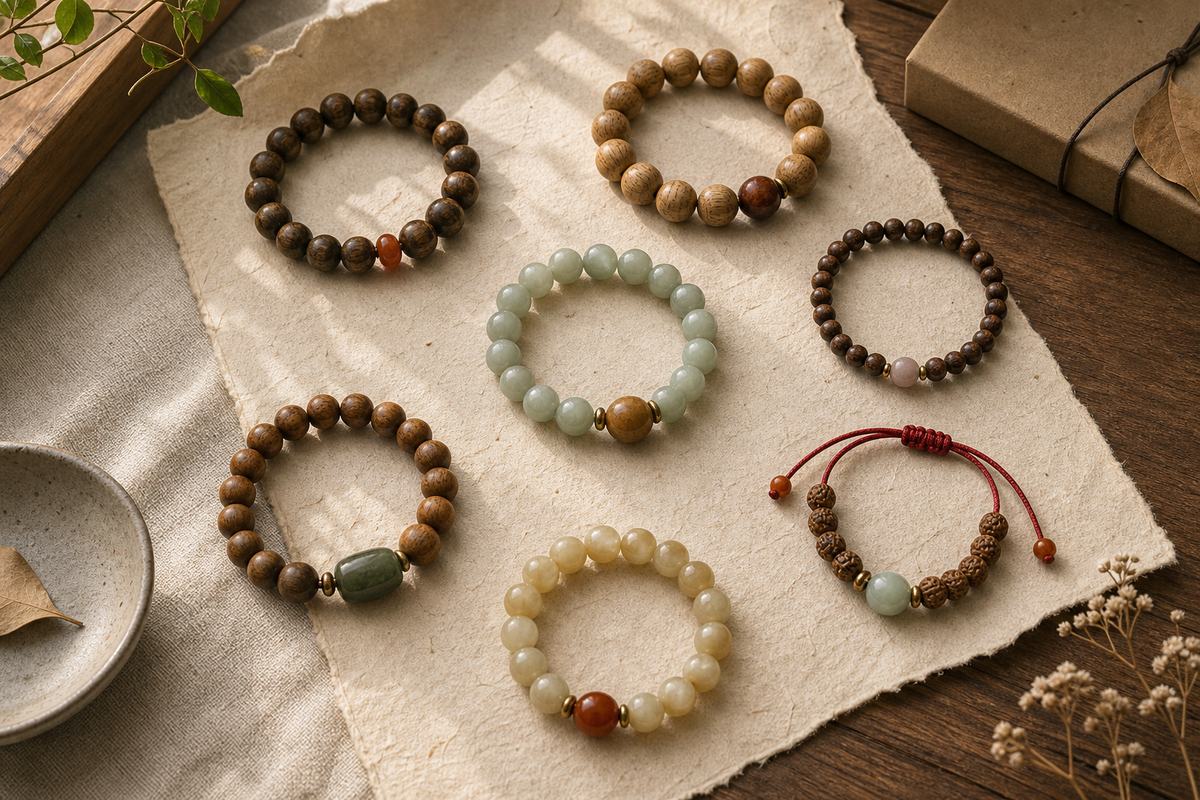
Modern Chinese bracelet culture assigns auspicious phrases to many counts. Some phrases borrow Buddhist or Taoist vocabulary; others arise from homophones, social-media captions, gift language, numerology, or the simple desire to match a wrist size with a hopeful message. They are living popular interpretations rather than one canonical Buddhist list. Preserving them in their own context allows readers to understand how beads function today as gifts, fashion, blessing language, and personal intention.
| Count | Popular modern interpretation | Cultural note |
|---|---|---|
| 1 | A turn of fortune; one smooth road ahead | A single focus or focal bead |
| 3 | Wholeness and things proceeding smoothly | Often connected with the Three Jewels |
| 6 | Healthy growth and smooth progress, often chosen for children | Six is broadly auspicious in modern Chinese number language |
| 8 | Finding the right methods to realize an aspiration | Can echo the Eightfold Path and the popular auspicious sound of eight |
| 10 | Ten benefits, completeness, and capability | “Ten out of ten” fullness |
| 11 | Strength, favorable momentum, and protection | Sometimes linked with “eleven powers” in Buddhist vocabulary |
| 12 | Good causes meeting good conditions; taking responsibility for life’s encounters | Borrowed from the Twelve Links of Dependent Origination |
| 13 | Abundant opportunity and being favored by circumstances | Contemporary blessing language |
| 14 | Meeting difficulty with courage and helpful people | Also has a Guanyin-related Buddhist interpretation |
| 15 | Positive growth and the easing of worries | Contemporary blessing language |
| 16 | Freedom, release from worry, and romantic possibility | Contemporary bracelet symbolism |
| 17 | Leaving noise behind and settling the mind | Sometimes described online as “seventeen pure lands” |
| 18 | Blessing, peace, prosperity, and the Eighteen Realms | A very common Chinese Buddhist-inspired bracelet count |
| 19 | Rising step by step, benefiting self and others, growing wisdom and merit | Contemporary blessing language |
| 20 | Phoenix (凤凰)-like renewal after difficulty | A modern rebirth metaphor |
| 21 | Peaceful progress and clearing heavy circumstances | Also appears in tradition-specific Buddhist lists |
| 22 | Completion, reunion, and smooth family relations | Modern gift language |
| 24 | Good things arriving through the full cycle of the day or seasons | Can echo the twenty-four solar terms |
| 25 | Fortune opening at the right time | Contemporary blessing language |
| 26 | Adding support to a career | Contemporary career blessing |
| 27 | Learning, intellectual depth, and support for knowledge work | Also a quarter of 108 |
| 28 | Being favored by good fortune | Modern auspicious phrase |
| 30 | Seeing one’s nature and seeking liberation | Sometimes framed through lists of thirty non-Buddhist paths |
| 31 | Abundant opportunity and good fortune | Modern auspicious phrase |
| 33 | Career and momentum rising steadily | Thirty-three also has wide Buddhist cosmological resonance |
| 34 | Cultivating body and mind and releasing entanglements | Borrowed from “thirty-four minds cutting bonds” in doctrinal vocabulary |
| 35 | Stability and freedom from worry | Modern blessing language |
| 36 | Good fortune, happiness, and protective company | Often linked with thirty-six divine protectors or heavenly spirits |
| 37 | Blessing and support on the path | Borrowed from the Thirty-Seven Factors of Awakening |
| 38 | Guests from eight directions and resources from four directions | Modern social and prosperity phrase |
| 39 | Helpful people and harmonious relationships | Modern interpersonal blessing |
| 40 | Awakening and wise discernment | Modern spiritual phrase |
| 41 | Cultivating both wisdom and merit | Sometimes connected with forty-one stages of practice |
| 42 | Growing connections and welcoming people from every direction | Sometimes connected with forty-two sages or stages |
| 43 | Cultivating body, mind, and conduct | Modern practice-oriented phrase |
| 48 | Difficulty turning toward auspicious resolution | Forty-eight also recalls Amitabha’s vows in Buddhist culture |
| 49 | Things proceeding according to the heart’s wish | Online lists sometimes connect it with “forty-nine wish-fulfilling halls” |
| 52 | A personal talisman for peace | Modern protective gift language |
| 54 | Wisdom becoming complete and bright | Connected with fifty-four stages of bodhisattva cultivation |
| 60 | Welcoming mentors and helpful people | Sometimes styled through “sixty Huayan” language; also echoes the sexagenary cycle (甲子) |
| 62 | Clear-mindedness and growing wisdom | Borrowed from the Buddhist list of sixty-two views |
| 64 | Sharper observation, judgment, and career growth | Sometimes described as “sixty-four eyes” in popular lists |
| 67 | Meeting helpful people | Modern blessing language |
| 68 | Welcoming prosperity | Popular number-word association |
| 70 | Understanding emptiness and easing affliction | Connected in popular lists with works on seventy aspects of emptiness |
| 72 | Auspicious progress under the complete movement of heaven and earth | Often linked with seventy-two seasonal periods or earthly spirits |
| 73 | Vajra-like wisdom | Sometimes connected with lists of seventy-three deities |
| 75 | Quieting the mind and welcoming favorable circumstances | Borrowed from the seventy-five dharmas in Abhidharma classification |
| 77 | Growing wisdom and making progress in study | Connected in popular lists with seventy-seven knowledges |
| 78 | Auspicious energy arriving from the east | Modern Chinese blessing phrase |
| 80 | Good fortune continuing without end | Modern longevity and continuity language |
| 81 | Wisdom reaching fullness | Nine times nine; important in Taoist number symbolism |
| 88 | Adversity turning and good fortune gathering | Can echo the Eighty-Eight Buddhas and the doubled auspicious eight |
| 89 | A life with fewer worries | Sometimes connected with lists of eighty-nine states of mind |
| 91 | Career, reputation, and authority coming together | Modern aspirational phrase |
| 96 | Career and reputation advancing together | Popular lists connect it with ninety-six non-Buddhist paths |
| 98 | Receiving support from companions on one’s path | Borrowed from the ninety-eight latent tendencies or “messengers” |
| 108 | Leaving suffering, finding peace, and transforming the 108 afflictions | The classic full mala count |
| 110 | Clear thinking and support for intellectual work | Sometimes linked with “one hundred and ten wholesome qualities” |
| 1080 | Transcendence and liberation associated with rare, eminent practice | An exceptional count, seldom used in ordinary daily wear |
How to Care for Mala Beads by Material
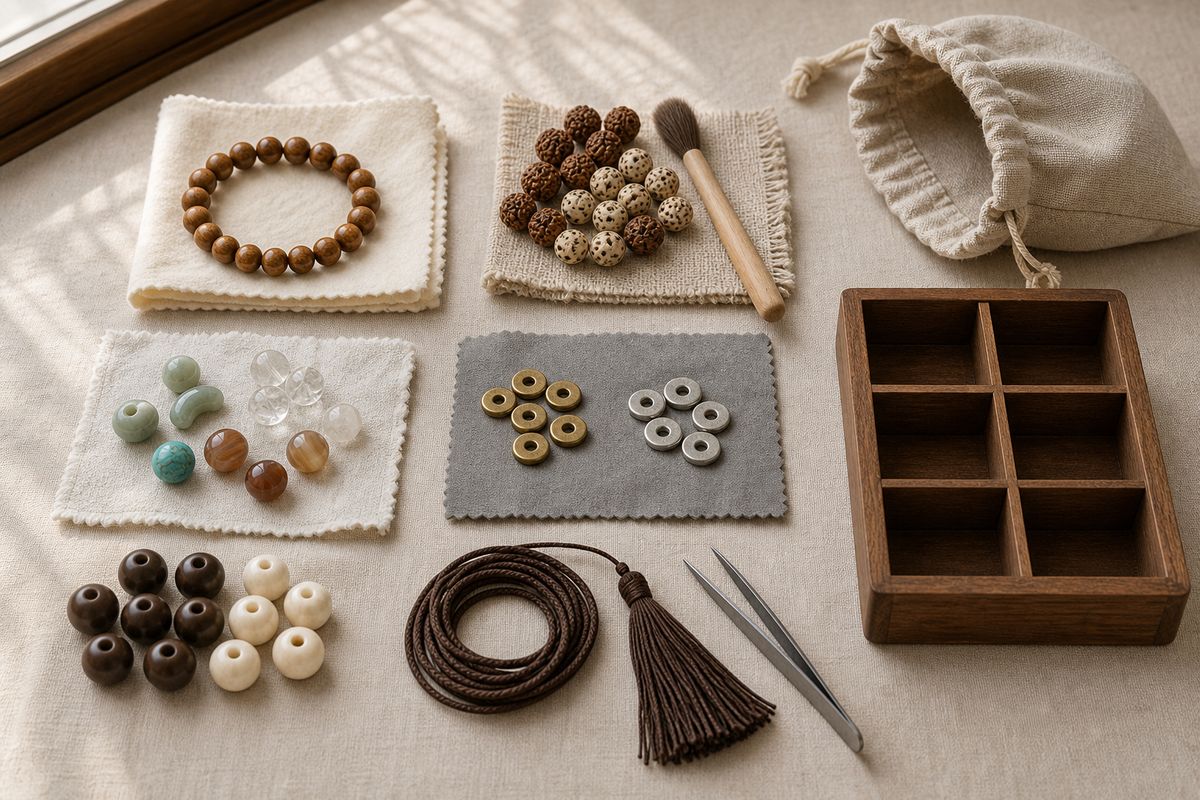
Good mala care begins with four habits: limit water, wipe away sweat, avoid prolonged sun and heat, and inspect the cord. Mixed-material strands require the gentlest method suitable for the most sensitive component. Remove a mala before bathing, swimming, strenuous exercise, or using perfume, sanitizer, household cleaners, and hair products.
Wood: Sandalwood, Rosewood, Agarwood, and Huanghuali
- Keep it dry. Wood absorbs water and can swell, warp, fade, or crack. If splashed, blot immediately with a soft cloth and let the strand dry in shade with normal airflow.
- Avoid sun and forced heat. A sunny windowsill, heater, hair dryer, or hot car can remove moisture too quickly and open cracks.
- Clean gently. Use a soft cotton cloth and a clean, soft brush around holes and carvings. Household cleaners strip finishes and scents.
- Respect aromatic woods. Agarwood and sandalwood are valued partly for fragrance. Heavy oiling, perfume, sealed plastic in damp conditions, and aggressive polishing can change that character.
- Handle with clean hands. For oily woods such as small-leaf red sandalwood, some collectors use clean cotton gloves for short sessions, then allow the strand to rest so the surface stabilizes. Natural patina develops through months and years, not forced daily friction.
- Use oil only with material-specific guidance. A generic kitchen oil can darken unevenly, turn rancid, attract dust, or alter scent. Follow the maker’s advice for the exact wood and finish, and test any approved product on a hidden point.
Bodhi (菩提) Seeds, Rudraksha, and Carved Kernels
- Brush crevices before polishing. Diamond-pattern bodhi, rudraksha, phoenix-eye bodhi, olive pits, and carved kernels trap dust. A clean, soft natural or synthetic detailing brush prevents dark compacted dirt.
- Use clean, dry hands. Heavy sweat can produce patchy darkening and carry salt into pores. A cloth or glove helps when hands are very damp.
- Manage humidity gradually. Very dry heated rooms encourage cracking; humid climates encourage mold. Store in a breathable pouch or stable box away from direct air-conditioning and rapid changes.
- Use conditioning oil sparingly. Some collectors apply a tiny amount of a stable, maker-approved oil to particular seed or kernel materials in dry climates. Too much oil traps dirt and can soften or stain the surface.
- Let color mature naturally. Alternating gentle brushing, clean handling, and rest creates a more even surface than aggressive rubbing.
Jade, Quartz, Agate, Turquoise, and Other Stones
- Start with a soft damp cloth. Wipe jade, quartz, and agate, then dry immediately. Mild soap and a soft brush suit only untreated stones whose cord, dye, metal, and spacers also tolerate water.
- Protect against impact. A mineral can resist scratching yet remain brittle at thin edges or drilled holes. Remove stone malas for exercise, manual work, and sudden temperature changes.
- Keep chemicals away. Perfume, hairspray, chlorine, alcohol, acids, and strong cleaners can cloud polish, attack dye or resin, and weaken cord.
- Treat porous stones more gently. Turquoise, coral, amber, lapis, malachite, dyed stones, coated beads, and filled material respond poorly to soaking, ultrasonic cleaning, steam, alcohol, and oil. Use a dry or barely damp soft cloth.
- Separate by hardness. Hard quartz beside softer turquoise or organic material causes wear. Soft spacer discs and separate storage reduce abrasion.
- Allow jade’s luster to develop through ordinary clean wear. Skin contact and careful wiping can support a soft surface glow, while lotions and sweat residue still need removal.
Metal, Bone, Horn, and Ivory-Like Materials
- Wipe metal after sweat. Dry steel, brass, copper, silver, and plated fittings with a soft cloth. Use a silver cloth only on silver surfaces and keep polishing compounds away from porous neighboring beads.
- Watch for plating wear. Metal spacers and clips can abrade softer beads. Replace rough-edged parts and use protective spacers.
- Keep bone and horn stable. Avoid soaking, sun, forced heat, and abrupt humidity changes. Follow the maker’s care advice for verified species and finish.
- Confirm wildlife materials before purchase. “Bone,” “ivory-like,” “mammoth,” and “vintage” are not complete provenance. Species, age, origin, documentation, and the law of the buyer’s and seller’s locations all matter. Modern elephant ivory trade is heavily restricted or prohibited in many jurisdictions.
- Choose lawful alternatives. Tagua nut, responsibly sourced domestic bone, documented fossil mammoth material where legal, resin, wood, and stone can provide a similar visual role without supporting illegal wildlife trade.
Cord, Tassels, Storage, and Routine Inspection
Inspect the cord every six months during regular use and more often on a heavy stone strand. Look beside the mother bead, counters, clip, knots, and metal fittings for flattening, fuzz, stretching, discoloration, or sharp contact. Nylon and braided synthetic cords often outlast cotton; cotton and silk may offer a traditional feel but need earlier replacement. Elastic bracelets commonly require restringing every six to twelve months, depending on wear.
Store each mala separately in a clean cloth pouch or divided box. Keep hard stones away from soft wood, turquoise, metal plating, tassels, keys, and phone hardware. Allow a strand that has absorbed sweat to air dry in shade before closing it in a container. Maintain moderate, stable humidity and avoid long-term tension: a heavy stone mala should rest in a loose circle rather than hang from one point.
For additional conservative care guidance, use Eastern Story’s Care Guide. When the exact material or treatment is uncertain, pause and ask the maker before applying oil, soap, polish, heat, or water.
Frequently Asked Questions
A Complete Count That Returns to the Heart of Practice
Mala beads are 108 because generations of practitioners received 108 as a complete sacred count and continued to understand it through doctrine, ritual, calendar, cosmology, number culture, and lived experience. The meanings do not need to cancel one another. Together they show how a number becomes a practice: repeated in the hand, remembered in sound, and carried through time.

A simple strand and a richly fitted strand can serve the same essential return. Base beads keep the count. The mother bead sets a boundary. Quarter markers orient the hand. Counters and a clip hold long commitments. Spacers protect the craft. A back cloud and disciple beads complete the visual descent. Yet the deepest value remains the quality cultivated bead by bead—attention, faith, patience, compassion, and steadiness.
Continue exploring the cultural life of meaningful objects in Eastern Story, and review the Care Guide before cleaning a mixed-material strand.
For readers choosing a symbolic gift or wearable blessing, Eastern Story’s Blessing Shop offers related pieces organized around protection, harmony, love, clarity, and good wishes.
Related Posts


8 Comments