
Four Gods roof tiles, or Sishen wadang (四神瓦当), are decorated clay roof-tile ends bearing the Azure Dragon, White Tiger, Vermilion Bird, and Black Tortoise-Snake. Closely associated with Han architecture, they bring the guardians of east, west, south, and north to the edge of a roof. Their enduring appeal is a beautiful wish: may the space within be peaceful, the seasons unfold in harmony, and those who live there feel protected.

A dragon curling around a small circle can hold the energy of spring. A poised tiger can carry courage; a rising bird, brightness; a tortoise and snake, steady endurance. Together, the four turn an everyday architectural surface into an image of a world held in balance. That is why their ancient forms still feel at home on a study wall, a keepsake, or a thoughtful housewarming gift.
What is a wadang, and where does it sit on a roof?
A wadang (瓦当) is the decorated terminal face at the eave end of a convex, curved cover tile, called a tongwa (筒瓦). Traditional roofing combines concave pan tiles with convex cover tiles over their joints. The wadang faces outward at the lower roof edge, helping shelter the exposed eave and finishing the roofline with a visible pattern.

Imagine looking up beneath the eaves: the rounded faces form a rhythm along the building. They belong to that roof edge, rather than exclusively to an upturned corner. A drip tile is a different component associated with the lower edge of a pan tile; a flat decorative wall or floor tile has another construction and purpose.
Both semicircular and circular tile ends occur in early architectural traditions. The celebrated Four Gods designs commonly use a round face, sometimes with part of the curved tile body still attached. Seen from behind, an intact piece reveals how the ornament belonged to a working roof. Seen from the front, it becomes a compact picture of protection.

Four guardians, four directions, and a year of blessings
The Four Symbols, Sixiang (四象), connect the four creatures with regions of the sky. Traditional astronomy groups the 28 lunar mansions into four sets of seven. On a roof tile, a much larger vision of the heavens becomes a familiar animal form: something people can see, recognize, and welcome above a doorway.
| Guardian | Direction | Season and phase | Meaning carried by the image |
|---|---|---|---|
| Azure Dragon, Qinglong (青龙) | East | Spring · Wood | New growth, vitality, auspicious beginnings |
| White Tiger, Baihu (白虎) | West | Autumn · Metal | Courage, strength, protective watchfulness |
| Vermilion Bird, Zhuque (朱雀) | South | Summer · Fire | Brightness, warmth, lively hope |
| Black Tortoise, Xuanwu (玄武) | North | Winter · Water | Endurance, longevity, settled protection |
These correspondences belong to the wider system of Wuxing, the Five Phases (五行). Wood, Fire, Metal, and Water accompany the four directions; Earth belongs to the center. Likewise, azure or blue-green, red, white, and black are four directional colors. Yellow completes the five-color arrangement at the center.
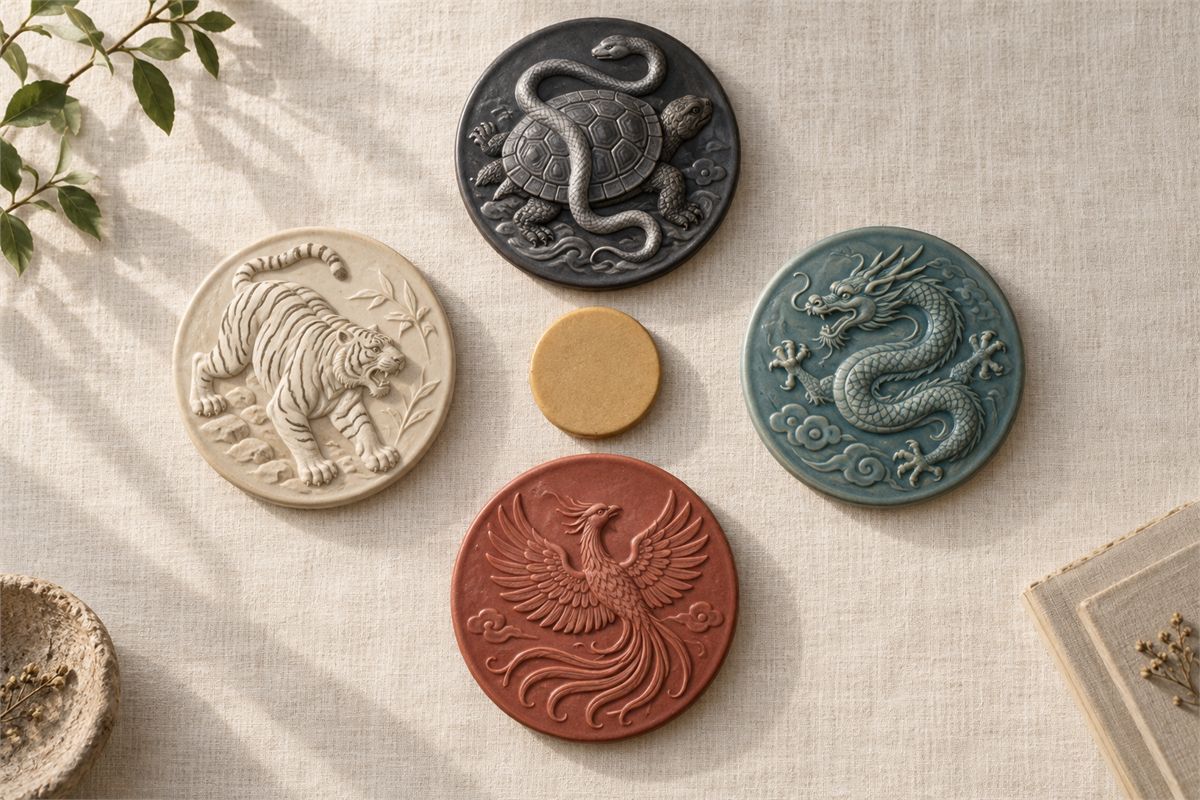
Sishen (四神) means the Four Gods or four divine guardians. Some descriptions of these tile patterns also use Siling (四灵), “Four Spirits.” Elsewhere, Siling names the auspicious grouping of qilin (麒麟), fenghuang (凤凰), dragon, and tortoise. The four creatures named on the object make its meaning clear. Here, they are the directional guardians surrounding a shared center.
Their combined blessing feels larger than any single wish: growth with steadiness, brightness with courage, movement with a place to return to. The eaves become a boundary of welcome and shelter, where the world outside meets the life cared for within.
Han roof tiles brought the heavens close to home
Four Gods tile ends are especially associated with the later Western Han and the Xin period of Wang Mang, whose reign ran from 9 to 23 CE. Around the capital Chang’an, near present-day Xi’an, palace and ritual architecture gave these guardian images an impressive public setting. Beliefs about the sky, seasons, and good order were expressed in the buildings through which people moved.
The ritual complex known as Wang Mang’s Nine Temples provides a vivid example. The Kurokawa Institute of Ancient Cultures describes directional guardian tiles at the corresponding gates of Building 3. In that particular setting, the four directions became part of the architectural composition. Across other sites, the arrangement belongs to each building’s own history; the shared symbolism is the wish for a protected, harmonious world.
This meeting of heaven and human life gives the tiles their emotional force. Clay, fired and set above the eaves, carried hopes for peace in the realm and safety within its walls. The guardians are energetic, yet the larger feeling is reassuring: a place watched over through the changing year.

Han roof decoration also carried blessings in words. Chang Le Wei Yang (长乐未央), lasting joy without end, belongs to that rich world of auspicious inscriptions. A written wish and an animal guardian offer different ways of giving a building a hopeful voice.
How to recognize the four designs
Qinglong: a circle full of spring
Look for an elongated body, a turning head, extended claws, and curves that echo the rim. The dragon may coil into a bow-like shape while its limbs suggest motion beyond the circle. Scales and small cloud-like details can enrich the surface without making the figure feel still.

As the eastern guardian of spring, Qinglong offers a natural image for a fresh start. A tile-inspired keepsake can accompany a new course of study, a first job, or a project beginning to grow. Its gift message is one of vitality and a hopeful path ahead.
Baihu: courage held within the rim
The tiger brings a strong feline body, paws, an expressive mouth, and an upward or curling tail. Some versions have wings, emphasizing a celestial creature rather than an ordinary animal. Its body can bend around the round face while retaining a powerful sense of readiness.

The White Tiger’s protective strength can carry a wish for courage, safe journeys, and the confidence to meet change. For someone building a business or working toward a more secure life, that same image can accompany a personal wish for prosperity through resolve and steady effort.
Zhuque: brightness in wings and feathers
The southern guardian appears as a magnificent bird, often with a lifted head, open wings, and a long, animated tail. Follow the feathers across the disc: their movement gives a small piece of clay an expansive feeling, like light opening a room.

Zhuque is the Vermilion Bird of the southern sky. Its identity is distinct from the fenghuang (凤凰), often translated as the Eastern phoenix. The tile’s warmth comes from its southern, summer, and Fire associations. It carries an inviting language of radiance, joyful expression, and hope. A gift may celebrate a friendship, a loving relationship, or the return of enthusiasm after a demanding season.
Xuanwu: quiet strength and long companionship
The northern guardian commonly combines a tortoise with an entwined snake. Trace the shell first, then follow the curling body around it. On some tile designs the snake is easily mistaken for a border; individual versions can also vary in the number and arrangement of serpent forms. The familiar meeting of stillness and movement gives Xuanwu its distinctive character.

Winter and Water bring a quieter register to the group. Xuanwu is chosen for wishes of longevity, health, composure, and lasting support. It can be a tender image for an elder, a dependable friend, or someone making room for a slower and more settled life.
Why the circular designs feel so alive
The circle is both a building form and an artistic invitation. A thick rim gathers the composition; claws, feathers, a tail, or a coiled body lead the eye around it. Empty areas give those lines room to move. The result can feel strong and spacious at once, even when the animal fills nearly the entire face.

Traditional examples were made in clay, with designs commonly formed by molding or impression before firing. Raised lines and relief catch light across the surface. A raised central boss appears on some well-known examples, but the center and border vary between designs. Those differences are part of the pleasure of looking closely.

The guardians’ color names describe their symbolic identities. A surviving tile may show the grey, brown, or buff of its ceramic body. A modern enamel or painted interpretation adds its own color language. Likewise, a carved stone plaque, a cast-metal ornament, and a resin reproduction each translate the old composition into a different material.
A rubbing, tapian (拓片), offers another encounter with the pattern. The impression on paper highlights the lines and contrasts of a relief surface. A framed rubbing or print brings attention to the creature’s movement, much as calligraphy invites the eye to follow a living line.

Looking at museum examples
Museum collections make the variations tangible. The Palace Museum’s Han White Tiger tile is 19.3 cm in diameter; its curved feline fills a broad circular frame. The Metropolitan Museum of Art records a Western Han roof-tile end, object 18.56.31, at 18.4 cm. These are measurements of individual objects, each with its own proportions.
The Kurokawa Institute’s Xin-period Vermilion Bird and White Tiger tile ends measure 16.0 cm and 18.0 cm, respectively. Its descriptions draw attention to the thick rims, central bosses, and movement of the figures. Comparing them helps explain why “Four Gods roof tiles” names a family of designs rather than a single uniform set.
The Xi’an Qin Brick and Han Tile Museum presents all four guardian designs in its collection material. Its Xuanwu example is especially memorable: the tortoise occupies the center while two serpents encircle it. Henan Museum’s online collection also includes Xuanwu, Vermilion Bird, tiger, and dragon tile ends. Its Xuanwu and Vermilion Bird examples each measure 18.5 cm. Each collection offers its own objects and stories to explore.
When viewing a tile, begin with the outline, then look at the rim, the relief, and any surviving curved body. The collection label supplies the period, material, and place of discovery when recorded. A close view can reveal both the energy of the animal and the hand-sized architectural surface that gave it shape.

The same guardians on bricks and bronze mirrors
The four creatures traveled across many kinds of objects. Their protective meaning could suit a roof, a decorated chamber, or the back of a mirror, while each object kept its own purpose.
| Object | Its place in life or architecture | How the guardian image appears |
|---|---|---|
| Wadang roof-tile end | At the eave end of a convex cover tile | A molded ceramic face shaped by the roofline |
| Pictorial brick or hollow brick | Building masonry; many decorated examples belong to tomb or ritual settings | Impressed, carved, or painted imagery on a brick surface |
| Tomb mural | A painted wall within a burial chamber | Guardians positioned within a larger visual world |
| Bronze mirror | A polished reflecting face with a decorated reverse | Cast patterns arranged around the mirror’s central knob |
| Modern plaque, pendant, or ornament | A personal keepsake or decorative object | A new interpretation of a historic composition |
Pictorial bricks, huaxiangzhuan (画像砖), give the imagery a different setting from a roof tile. The National Museum of China’s exhibition on the Hexi region’s painted bricks describes Four Gods images in Wei and Jin funerary art, where they accompanied hopes for protection and an onward journey. Hollow bricks, kongxinzhuan (空心砖), are a construction form; their exact use depends on the building or burial setting.

On bronze, Four Gods mirrors bring the guardians into another circular field. Some Han examples are guiju or boju mirrors (规矩镜、博局镜), often called TLV mirrors after their T-, L-, and V-shaped markings. That geometric layout belongs to a particular mirror family. Other Four Gods mirrors arrange their figures differently.

Later designs combined the guardians with the 12 zodiac animals. A Sui example at Baoji Bronze Ware Museum measures 18 cm in diameter and weighs 0.652 kg. Its four guardians occupy the inner area, while the zodiac animals sit in twelve outer compartments. The two groups bring direction and the cycle of time into one object.
These shared motifs reveal a lasting cultural wish for harmony and protection across everyday and ceremonial life. A modern pocket mirror may draw on an ancient bronze mirror; a round pendant may draw on a roof tile. Knowing the original form makes the story of a keepsake more personal.
Bringing four-direction protection into modern life
A guardian plaque or something to carry close
A contemporary “guardian plaque” is a modern name for a keepsake, not an ancient category of roof fitting. The round tile face can inspire a pendant, a bag charm, a small plaque, or a hand-held object. What carries through is the creature’s pose and the wish attached to it: courage on a difficult day, brightness in a new chapter, or peace carried from home.

Materials add a supporting note to that story. Fired ceramic recalls the roof tile’s earthen origin; metal offers a cast or worked interpretation; carved stone gives the image another surface; leather and resin allow other forms. A resin piece with an aged ceramic appearance remains a resin reproduction. The Eastern Story material guide offers a useful starting point for understanding the material named by a maker.
Magnets, small mirrors, bracelets, framed plaques, and desk ornaments can all carry guardian imagery. A rotating mechanism, inlay, enamel finish, or named museum collaboration belongs to the particular design that actually uses it. Choose the form whose image and story you enjoy returning to. A simple cord, an uncluttered shelf, or a plain fabric bag can give the motif room to speak.
A calm place for the motif at home
At an entrance, a framed four-guardian arrangement can welcome the household with a wish for peace from every direction. In a study, one dragon or tortoise-and-snake design may feel especially companionable. In a tea room, a ceramic plaque and soft side light can reveal the relief without filling the whole space with ornament.

For contemporary tile design, useful inspiration lies in the flowing outline, the circular frame, and restrained color. A designer might simplify the animal into a geometric drawing, use its curve as a border, or place a shallow relief in a small wall panel. Blue-green, warm white, muted red, and deep charcoal can echo the directional colors against wood and quiet neutral surfaces.

One focused panel often gives the eye more room than a repeating pattern across every wall. Relief belongs where its texture can be appreciated safely; a floor needs a product specifically suitable for foot traffic. Exterior panels likewise need materials and fixings suited to their setting. Let the scale follow the actual wall, furniture, and viewing distance.
For a small object, use a stable stand or secure mounting and keep fragile ceramic or stone away from knocks. Dust gently, and follow the finish’s care instructions before using water or cleaners; the Eastern Story care guide can help with everyday jewelry care. Car accessories should stay securely fixed, clear of sightlines, airbags, and controls. A peaceful symbol belongs in a setting that feels safe and considered.
Choosing a guardian as a heartfelt gift
The most meaningful choice often starts with the person’s present chapter. The individual wishes below are contemporary gift inspirations drawn from the guardians’ broader symbolism: they leave room for a personal story.
| Life moment | A fitting image | Words to accompany the gift |
|---|---|---|
| Beginning study, work, or a creative project | Qinglong and the energy of spring | May this new beginning take root and flourish. |
| Meeting a challenge or setting out on a journey | Baihu and protective courage | May you move forward with courage and return in peace. |
| Celebrating affection, friendship, or renewed joy | Zhuque and southern brightness | May warmth and bright days find you wherever you go. |
| Honoring an elder or a lasting friendship | Xuanwu and enduring support | May your days be peaceful, your health cherished, and your companionship long. |
| Moving into a home or opening a shared space | All four guardians together | May peace surround this home through every season. |
A single guardian can feel intimate; a complete group carries the generous idea of care in every direction. The blessing Ping An Ru Yi (平安如意)—peace and the fulfillment of heartfelt wishes—fits naturally with that spirit. Written on a card, it gives the old roofline image a voice in a new relationship.

The enduring beauty of Sishen wadang is that a small circle can hold such a wide wish. From the eaves of ancient buildings to a keepsake held close today, the four guardians invite growth, courage, warmth, and steadiness into life. Explore the Eastern Story blessing collection for objects chosen to carry your own hopes for peace and a beautiful life.
Frequently Asked Questions
Related Posts


