
The money tree is a tropical American tree, usually sold as Pachira aquatica, that became a modern symbol of prosperity, steady growth, and good wishes in Chinese-speaking homes and businesses. Its glossy palmate leaves, upright form, and often-braided trunks make it a popular houseplant and a practical gift for a new home, office, or business.
This guide brings money tree meaning and Pachira aquatica care together without confusing cultural symbolism with plant biology. You will learn what the name means, how the braided form is made, how often to water a money tree, what light it needs, how to diagnose yellow leaves and root rot, whether it is toxic to cats and dogs, and how to choose one as a gift.
Money Tree Care at a Glance
| Botanical name | Pachira aquatica, in the mallow family Malvaceae |
|---|---|
| Common names | Money tree, Malabar chestnut, Guiana chestnut, French peanut, and water chestnut |
| Light | Bright indirect light; gentle direct sun after gradual acclimation |
| Water | Check the root zone, pot weight, and drainage instead of following a calendar |
| Temperature | Warm indoor conditions, ideally about 65–75°F (18–24°C), away from cold drafts and heating vents |
| Soil and pot | Open, stable, well-drained potting mix in a container with drainage holes |
| Pet safety | Listed by the ASPCA as non-toxic to cats and dogs; prevent heavy chewing and access to potting products |
| Meaning | Prosperity, flourishing growth, rooted stability, and a good wish for home or business |
In this guide
- Plant identity and natural form
- The modern Chinese money tree meaning
- Light, water, temperature, and humidity
- Soil, pots, fertilizer, pruning, and repotting
- Braided money tree care
- Yellow leaves, pests, and root rot
- Placement, pets, buying, and gift choices
What Is a Money Tree?
The accepted botanical name is Pachira aquatica. Kew’s Plants of the World Online places it in the genus Pachira, family Malvaceae, and order Malvales. Older gardening books may list it in Bombacaceae, the former kapok-tree family. Modern classifications include that group within the broader mallow family, so the old name is historical rather than a second current family.
The species is native from Mexico through Central America into tropical South America, where it grows in wet tropical habitats including riverbanks, estuaries, and freshwater swamps. This background explains an important point: a wild tree that tolerates seasonally wet ground is not cared for like a constantly waterlogged houseplant. Roots in a container have less oxygen and far less room, so the potting mix must drain freely.
Common English names include money tree, Malabar chestnut, Guiana chestnut, French peanut, and water chestnut. In Chinese botanical use, Pachira aquatica is called gua li (瓜栗), while Malabar chestnut and the commercial name fa cai shu (发财树), literally “prosperity tree” or “fortune-making tree,” are also widely encountered. Because “money tree” and “money plant” are used for several unrelated species, the botanical label matters when you are buying or checking pet safety.
What does Pachira aquatica look like in nature?
In tropical landscapes, Pachira aquatica can become a substantial tree. Authoritative horticultural references describe wild trees reaching roughly 60 feet (about 18–20 meters), although landscape specimens are often smaller. The leaves are palmately compound, usually with five to nine glossy leaflets radiating from one point. Mature outdoor trees can produce large, fragrant, greenish-white flowers with hundreds of long stamens, followed by woody capsules containing several seeds. Indoor plants rarely flower or fruit.

A typical indoor money tree is a much more controlled plant. Pruning, limited root space, light levels, and the way several seedlings are combined keep it to a desk or floor-plant scale. Depending on cultivar, training, and conditions, a houseplant may remain under 5 feet (1.5 meters) or eventually approach 6–8 feet (1.8–2.4 meters). Its swollen-looking lower stem and flexible young trunks contribute to the familiar sculptural form, but they are not a reason to treat the plant as a desert succulent.
What Does the Money Tree Mean?
In modern Chinese-speaking culture and international plant retail, the money tree represents prosperity, flourishing growth, rooted stability, and good wishes for a home or business. The name fa cai shu (发财树) gives the plant an especially direct connection with the idea of becoming prosperous. An upright trunk suggests steady progress, green growth suggests renewal, and a healthy canopy makes the blessing visible in everyday space.

This symbolism is modern. Pachira aquatica is native to the Americas, not an ancient Chinese sacred plant. Its modern prosperity identity developed after the plant entered Asian horticulture and became popular in Taiwan during the 1980s. Braiding young stems also became associated with Taiwanese production and helped create the houseplant form now recognized around the world. Specific stories that assign the invention to one named driver or explain the name through a Cantonese sound-alike are often repeated in retail copy, but the reliable record supports the broader Taiwanese commercial history more clearly than those details.
Is it the same as the ancient “money tree”?
The older Chinese money-tree idea, yao qian shu (摇钱树), literally describes a “tree that shakes down money.” It appears in wealth imagery, stories, decorative objects, and blessing language. The living Pachira houseplant is a modern botanical carrier of that broader wish; it is not the original plant behind every ancient money-tree image. Keeping the two layers separate makes the history more meaningful: the ancient symbol supplied a familiar language of abundance, while the American tree supplied a living, giftable form for modern interiors.
Five leaflets are sometimes described in retail folklore as five directions, five kinds of fortune, or the Five Elements. The actual number of leaflets varies, and those associations are modern symbolic readings rather than a universal historical rule. The safest gift message is simpler and warmer: “May your new home, work, or business continue to grow.”
Natural, Single-Trunk, Multi-Stem, and Braided Forms
| Form | What it is | Practical trade-off |
|---|---|---|
| Single trunk | One plant trained upright | Easy to inspect and repot; may look more open or asymmetrical |
| Multi-stem cluster | Several stems or plants growing together without a tight braid | Full appearance; individual stems may still compete |
| Braided money tree | Several flexible young trunks woven together | Distinctive gift form; ties and hidden decay need regular checks |
| Cut-back or “stump” form | A thicker trunk pruned to encourage a compact canopy | Can be perfectly healthy; judge roots, firmness, and new growth instead of the shape alone |
| Mini or bonsai-style | Young or trained plant kept compact | Fits a desk; small pots dry faster and need closer moisture checks |
No form is automatically better. A slender seed-grown plant is not guaranteed to be stronger, and a pruned thick-trunk plant is not automatically difficult. The healthier choice has firm stems, clean leaves, active buds, a fresh earthy potting-mix smell, visible drainage, and no signs of scale, webbing, rot, or tight bands cutting into the bark.

Money Tree Light Requirements
Bright indirect light is the most dependable indoor position. It gives the plant enough energy to hold a dense canopy without exposing shade-grown leaves to sudden intense sun. “Bright indirect” is a description of intensity, not a fixed compass direction: window size, nearby buildings, latitude, curtains, and season all change the light a plant receives.

- Good light: the room is bright enough to cast a distinct soft shadow for much of the day.
- Gentle direct sun: early or late sun can be useful after gradual acclimation. Increase exposure over one to two weeks and watch the newest leaves.
- Too much light too quickly: bleached patches, crisp tan areas, or scorched margins appear on the most exposed leaves.
- Too little light: new growth becomes sparse or stretched, the plant leans strongly, lower leaves yellow, and the pot stays wet for a long time.
A money tree can survive in a low-light office for a while, but long-term deep shade weakens it and increases overwatering risk because the plant uses water slowly. Move it closer to useful daylight or provide a suitable grow light. Rotate the pot a quarter-turn every week or two if growth leans toward one side, but avoid changing its position every few days.
How Often to Water a Money Tree
There is no universal seven-day or monthly schedule. How often to water a money tree depends on pot diameter, root volume, potting mix, drainage, light, temperature, humidity, and season. A small plant in warm bright light may need water sooner than a large plant in a cool dim corner, while an oversized decorative planter can stay wet deep inside long after the surface looks dry.

Use this watering decision instead of a calendar
- Check below the surface. In a small pot, test roughly the upper 1–2 inches (2.5–5 centimeters). In a large floor pot, use a wooden skewer or probe to check deeper in several places near the root zone; a dry top layer can hide a wet core.
- Lift or tilt the pot. Learn how it feels after watering and when it becomes lighter. Pot weight is especially useful when bark or decorative moss hides the mix.
- Look at the plant and the season. Active new growth and brighter conditions use water faster. Low light, cool rooms, and recently pruned or stressed roots use it more slowly.
- Water thoroughly when the upper root zone has dried and the pot is noticeably lighter. Apply water evenly until excess drains from the holes. This wets the root ball and helps move accumulated salts downward.
- Drain completely. Empty the saucer or remove the nursery pot from its decorative cachepot. Never leave the root ball standing in collected water.

“Dry out, then soak” is useful only when interpreted carefully. The upper part of the mix should lose excess moisture before the next watering, but the entire root ball should not remain bone-dry for long. Repeated extreme drought can cause crisp leaves, leaf drop, and hydrophobic potting mix that sheds water around the edges. If water races down a gap without wetting the root ball, water slowly in several passes, then let the pot drain.
Temperature and Humidity
For steady indoor growth, aim for a warm, stable room around 65–75°F (18–24°C). A money tree can experience brief temperatures outside that band, but tolerance is different from healthy long-term growth. Protect it as temperatures approach about 45°F (7°C), and keep it above 59°F (15°C) when practical. Cold glass, exterior doors, air-conditioning vents, and sudden winter drafts can trigger leaf drop even when the room average seems acceptable.

Moderate household humidity is usually workable, while a warm humid environment supports the lushest leaves. If leaf tips brown during a dry heating season, confirm watering and root health first, then measure humidity with a hygrometer. A room humidifier, grouping plants with space for airflow, or choosing a naturally more humid room is more effective than frequent misting. Misting changes humidity only briefly and prolonged wet leaves can increase leaf-spot risk.
Money Tree Soil and Pot Choice
Choose a structural, airy potting mix that holds some moisture while allowing oxygen and excess water to move through it. A quality indoor-plant mix amended with perlite, pumice, fine bark, or coir can work. One adaptable example is two parts houseplant mix, one part fine bark or coir, and one part perlite or pumice. Materials vary by region, so judge the finished texture rather than treating one ratio as a rule.
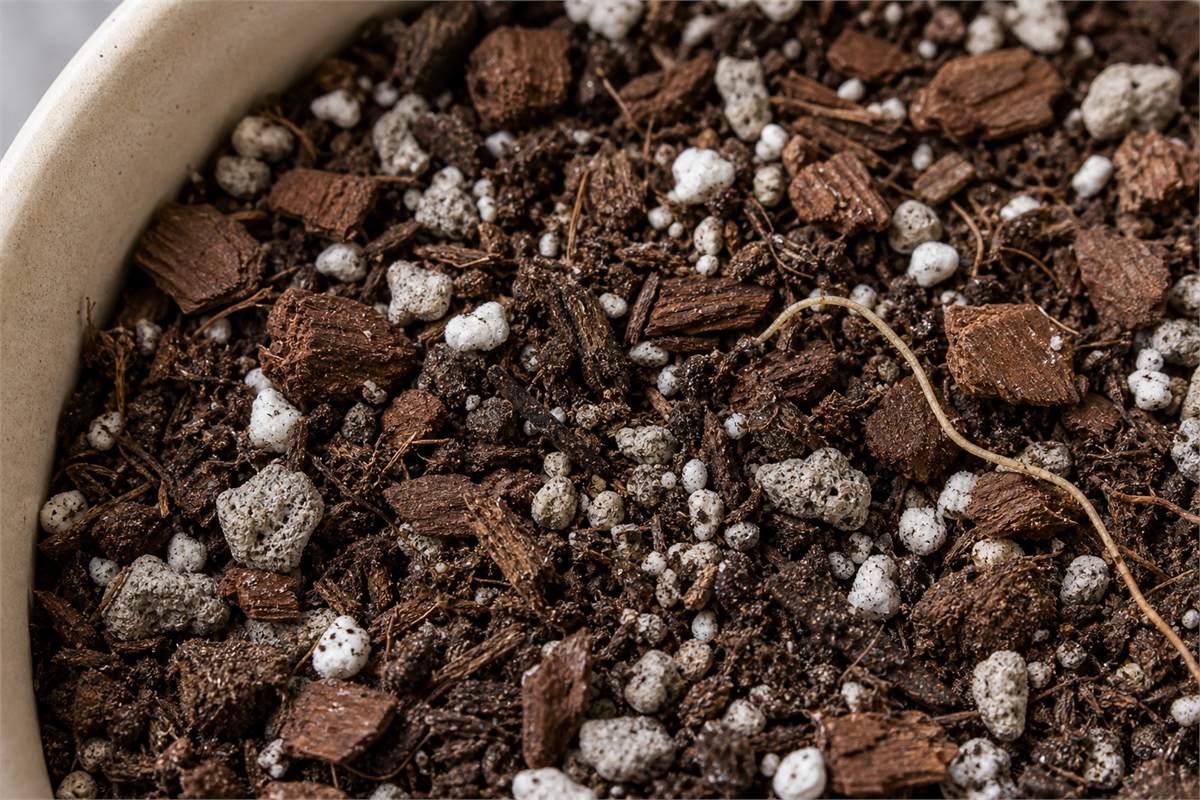
- Drainage holes are essential. A decorative outer pot may be used around a draining nursery pot, but collected water must be removed.
- Do not add a gravel “drainage layer.” Gravel at the bottom can leave a wetter layer of mix above it instead of improving drainage.
- Match the pot to the root ball. When moving up, choose only a slightly larger container—often one pot size or about 1–2 inches (2.5–5 centimeters) wider.
- Choose stability for floor plants. A broad, weighted pot reduces tipping risk, but the added volume should not surround a small root ball with a large mass of wet mix.

Fertilizing a Money Tree
Feed according to growth, light, and the fertilizer label. During active growth in adequate light, use a balanced houseplant fertilizer at the labeled rate and interval; if you prefer to feed more frequently, use the lower label rate. Reduce or pause feeding when the plant is in low light, cold, stressed, recently repotted, or showing root problems. A warm, brightly lit plant that continues producing healthy leaves in winter may still use modest nutrition, so the calendar alone should not decide.

Use a complete houseplant fertilizer according to its label instead of treating every pale leaf as a single-nutrient problem. Yellow leaves are more often solved by diagnosing water, roots, light, pests, and temperature. Excess fertilizer can burn roots and create white salt crusts. If salts accumulate, flush the potting mix with clean water and let it drain, provided the root system is healthy.
Pruning and Shaping
Pruning keeps a money tree within its space and encourages branching. The easiest time is spring or early summer when the plant is actively growing and can replace leaves. Use clean, sharp pruners. Remove dead, damaged, crossing, or crowded shoots first, then shorten healthy growth just above a node to direct the canopy.

Avoid removing a large share of foliage from a stressed plant. Correct root, pest, cold, or light problems before shaping. Continue watering according to the root-zone moisture after pruning; there is no universal need to withhold water for three days. Wipe dust from leaves with plain lukewarm water and a soft cloth, supporting each leaflet to avoid tearing it.
When and How to Repot
Repot when roots circle densely, grow through drainage holes, lift the plant from the pot, or cause the mix to dry unusually fast. Slowed growth can also be a sign, but check light and nutrition before assuming the pot is too small. Spring is convenient because increasing light supports recovery, though an urgent drainage or root-rot problem should not wait for a season.

- Choose a clean pot with drainage holes, only slightly larger than the root ball.
- Slide the plant out and inspect the roots. Healthy roots are firm and flexible; remove dead, brown, mushy, or hollow roots with sanitized tools.
- Loosen tightly circling outer roots without tearing the healthy center apart.
- Set the plant at its previous depth in fresh, lightly moistened mix. Do not bury the braided trunks.
- Water evenly to settle the mix, let excess drain, and return the plant to stable bright indirect light.
- Wait about two to four weeks before regular fertilizing, especially when the new mix already contains fertilizer.
Braided Money Tree Care
A braided money tree is usually several young plants trained together, not one trunk that naturally grew as a braid. The plants may continue thickening, compete for light and root space, press against one another, or lose an individual trunk. Some contact points may become fixed over time, while others rub or trap moisture. The meaning of unity and gathered prosperity is appealing, but the living structure needs inspection.
- Check every tie. Look near the top of the braid, at the base, and just below the soil surface. Remove or loosen wire, tape, rubber bands, or twine before it cuts into expanding bark.
- Keep the braid dry and visible. Do not pack moss tightly around the trunks or bury the woven section.
- Inspect individual stems. A firm green or woody stem with live buds is healthy. A dark, soft, hollow, or foul-smelling stem should be separated from healthy tissue when possible.
- Do not force mature trunks apart. If roots and stems are tightly integrated, aggressive separation can cause more damage. Young, loosely rooted plants can sometimes be divided during repotting.
- Stop braiding when stems stiffen. New training should be loose and gradual, with regular tie checks.

Common Pests and Diseases
Money trees may attract scale insects, mealybugs, spider mites, aphids, and fungus gnats. Quarantine a new plant for a few weeks, inspect leaf undersides and stem joints, and clean fallen leaves from the pot. Fine webbing, pale stippling, cottony clusters, sticky honeydew, or fixed brown bumps help identify the pest.

Begin with the least disruptive control: isolate the plant, rinse or wipe foliage, remove heavily infested material, clean the surrounding area, and correct dry or stagnant conditions. If a pesticide is needed, identify the pest first and use a product labeled for that pest and for indoor ornamental plants in your location. Follow the label for dilution, ventilation, protective equipment, re-entry, and pet safety. A local extension service, garden center professional, or plant clinic can help when the diagnosis is uncertain.
Leaf spot, powdery mildew, and root diseases become more likely when foliage remains wet, air is stagnant, or the root zone stays saturated. Remove affected leaves with clean tools, improve spacing and watering practice, and avoid splashing from diseased plants to healthy ones. Fungicides are disease-specific tools, not a routine household remedy.
Money Tree Yellow Leaves: A Diagnosis Guide
Money tree yellow leaves are a symptom, not a diagnosis. Before changing care, check the potting mix at depth, root smell and firmness, recent temperature changes, light exposure, pests, and which leaves are affected.

| Pattern | Likely cause | What to do |
|---|---|---|
| Yellow, soft leaves; mix stays wet; sour smell | Excess moisture, poor drainage, or root rot | Stop standing water, inspect roots, and improve pot and mix |
| Dry, crisp lower leaves; very light pot; mix pulls from sides | Prolonged drought or uneven rewetting | Rehydrate slowly and thoroughly, then use root-zone checks |
| Pale, stretched growth and gradual lower-leaf loss | Insufficient light | Move gradually to brighter indirect light or add a grow light |
| Bleached tan patches on the window side | Sudden strong sun | Move back from intense sun and acclimate new exposure |
| Rapid leaf drop after a cold night or move | Cold draft or abrupt environmental change | Stabilize temperature and avoid further changes |
| Stippled yellowing, webbing, sticky leaves, or bumps | Spider mites, aphids, mealybugs, or scale | Isolate, identify, clean, and use a labeled treatment if needed |
| One or two old lower leaves yellow while new growth is healthy | Normal leaf turnover | Remove the leaf when it releases easily and continue observing |
Money Tree Root Rot: How to Check and Respond
Suspect money tree root rot when the plant wilts despite wet mix, leaves yellow rapidly, the pot smells sour, or the trunk becomes soft near the soil. Lift the root ball gently. Healthy roots are firm and pliable; rotting roots are brown or black, fragile, mushy, and may shed their outer layer.
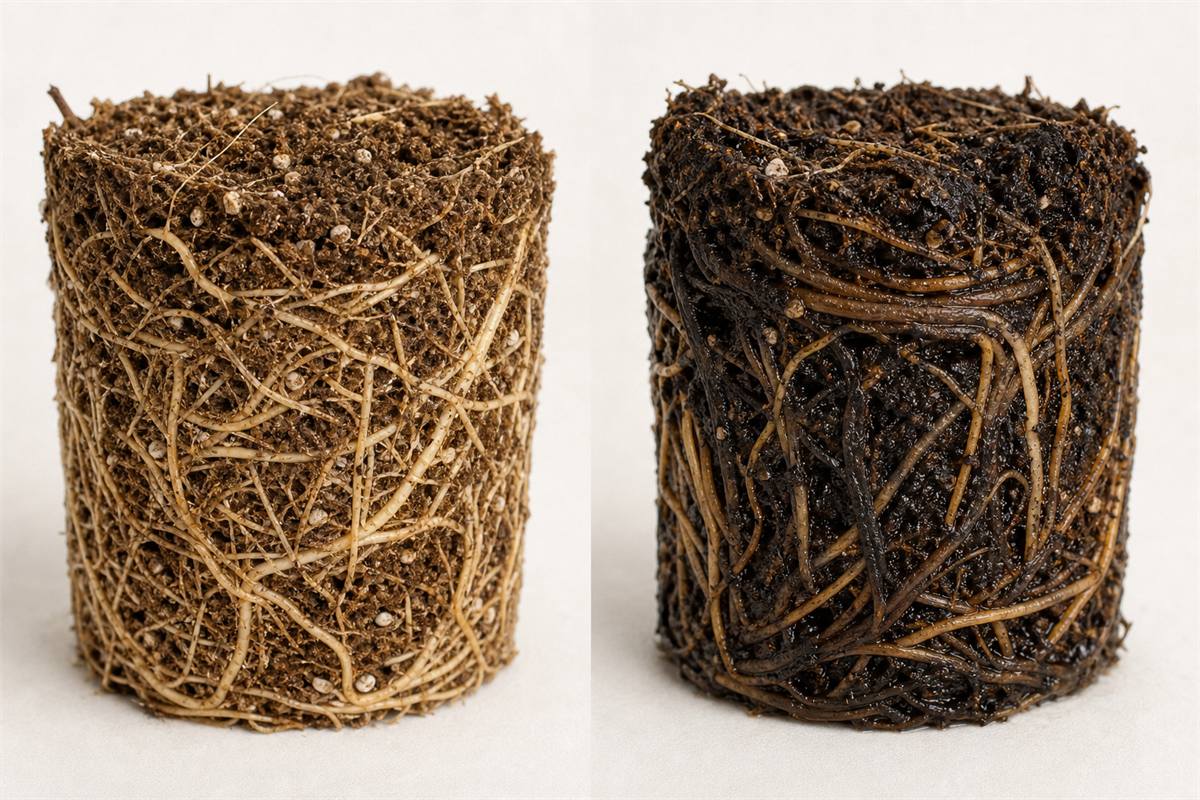
- Remove the plant from the wet mix and examine each trunk and root system.
- With a clean, sanitized tool, trim back to firm living tissue. Sanitize between cuts when decay is extensive.
- Discard the old mix. Clean the container or use a clean pot with open drainage holes.
- Repot in fresh, airy mix sized to the remaining roots; an oversized pot will stay wet too long.
- Water enough to settle the new mix and confirm drainage, then allow the root zone to lose excess moisture before watering again. The next interval depends on how many roots remain and how quickly the new mix dries.
- Keep the plant warm in bright indirect light. Do not fertilize until it shows stable recovery and new growth.

If decay has entered the trunk and no firm base remains, the original plant may not recover. Take healthy stem cuttings above the damaged area as a backup, using clean tools and clean propagation media. Avoid a universal chemical soak: the correct treatment depends on the organism, local product registration, plant condition, and label directions.
Best Money Tree Placement at Home or Work
The best money tree placement meets the plant’s needs first: useful light, stable temperature, airflow without a harsh draft, space around the leaves, access for watering, and a surface that will not tip. Keep it out of narrow walkways and away from heating vents, air conditioners, frequently opened exterior doors, and unprotected electronics.

In modern feng shui practice, people often choose an entry, living-room corner, desk area, reception space, or symbolic wealth corner because the growing tree suits ideas of opportunity and flourishing. Feng shui schools and household customs differ, so there is no universal 45-degree point, southeast rule, “dragon side,” or maximum height that applies to every room. If you enjoy symbolic placement, select the meaningful area that also keeps the plant healthy and the path clear. Eastern Story’s office feng shui layout guide offers a broader way to balance desk position, light, plants, and movement.
What can a money tree add to a room?
A healthy plant adds color, organic shape, seasonal change, and a sense of contact with nature. Those aesthetic and personal-comfort values are good reasons to grow one. For indoor air quality, rely on pollution-source control, clean-air ventilation, and appropriate filtration; ordinary numbers of potted plants are not a replacement for those measures.
Is a Money Tree Toxic to Cats or Dogs?
The ASPCA lists Pachira aquatica as non-toxic to cats and dogs. A pet that eats a large amount of any unfamiliar plant material may still develop nausea, vomiting, or loose stool. Potting mix, mold, fertilizer granules, systemic insecticides, and other treatment products can present separate risks, so keep the pot tidy and follow every product label.

Common names can cause dangerous mix-ups. The jade plant, Crassula ovata, is also called a money tree or money plant in some markets and is toxic to cats and dogs. Confirm the scientific name on the label, and contact a veterinarian or animal poison-control service if your pet develops symptoms after chewing a plant.
How to Choose a Healthy Money Tree
- Confirm the label: look for Pachira aquatica, especially in a pet household.
- Check leaves: choose a plant with firm green leaves and active buds, not widespread spotting, sticky residue, webbing, or cottony insects.
- Press the trunks gently: they should feel firm. Check between braided stems for dark, soft, or sunken areas.
- Inspect ties: bands should be loose enough not to cut the bark. Look below decorative moss and near the soil line.
- Smell the potting mix: fresh mix smells earthy; sour or swampy odors suggest long saturation.
- Check drainage: the inner pot needs open holes. Avoid sealed gift containers unless the plant can be removed for watering.
- Look at roots when practical: a few light-colored roots are reassuring; a dense black, slimy, or foul-smelling mass is not.
- Judge the whole plant, not a nursery stereotype: seed-grown, pruned, single-trunk, and braided forms can all be healthy.

Money Tree Gift Meaning and Size Guide
A money tree gift expresses a wish for growth, stability, and flourishing opportunity. It suits a housewarming, new office, business opening, promotion, graduation, or New Year greeting. Before ordering, ask about the recipient’s available light, floor or desk space, pets, maintenance interest, building rules, and ability to move a heavy pot.
| Gift type | Approximate scale | Best for | Trade-off |
|---|---|---|---|
| Mini or desktop | About 12–24 in (30–60 cm) | Desk, shelf, small apartment | Small pots dry faster and are easier to overwater in cachepots |
| Medium floor plant | About 2–4 ft (60–120 cm) | Home office, entry, living-room corner | Needs a stable floor position and useful window light |
| Large floor plant | About 4–6 ft (120–180 cm) | Reception, spacious home, commercial setting | Heavier to transport; deeper pots require careful moisture checks |
| Single trunk | Varies | Minimal, natural style | Less visually dense than a cluster |
| Braided or multi-stem | Varies | Classic money tree gift presentation | Requires tie and trunk checks |
The best size is the one the recipient can place and maintain, not a compulsory 1.6-meter tree or a particular number of pots. A simple card can explain the symbolism without adding rigid number taboos: “May this living tree mark a season of steady growth.” Keep decorative wrap loose during transport, remove any waterproof sleeve after delivery, and never seal the drainage holes. For another approach to gifts organized by intention, explore the Eastern Story blessing collection.

Living Money Tree vs. Money Tree Ornaments
A living money tree is Pachira aquatica and needs light, water, roots, and seasonal care. A gold money tree, crystal-chip tree, jade “life tree,” jewelry tree, or coin-leaf ornament is a decorative prosperity motif. The two can share gift language, but they are different objects with different materials, care, prices, and meanings. Choose the living plant for growth and greenery; choose an ornament when the recipient has poor light, plant restrictions, or no interest in maintenance.
A Simple Weekly Money Tree Check
- Check light and whether the plant has begun leaning or stretching.
- Test moisture at an appropriate depth and compare the pot’s weight.
- Empty any water from the saucer or decorative cachepot.
- Inspect leaf undersides, stem joints, ties, and the base of every braided trunk.
- Remove fallen leaves and wipe dust with plain water when needed.
- Change only one care factor at a time, then observe the response.
A healthy money tree rewards observation more than strict rules. Give it enough light to grow, water the root zone rather than the calendar, keep drainage open, and respond to patterns instead of isolated leaves. With that foundation, its modern prosperity symbolism becomes something tangible: a living reminder that growth is built through steady care.

Frequently Asked Questions
Related Posts


