
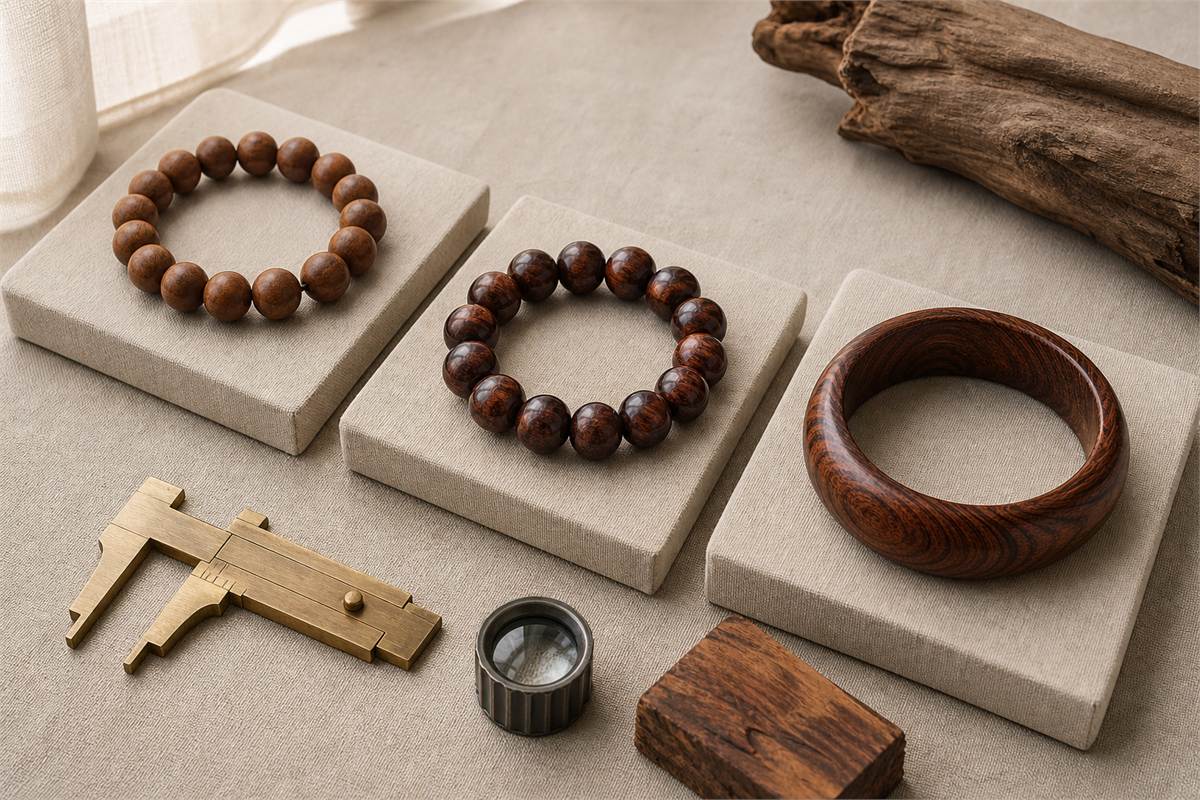
A Huanghuali bracelet is a wood bracelet valued for its flowing grain, warm touch, fragrance, craft, and connection to one of the most admired hardwood traditions in Eastern furniture and collecting. The name needs precision. Hainan Huanghuali (海南黄花梨) refers to Dalbergia odorifera; Vietnamese Huanghuali is commonly associated in the trade with Dalbergia tonkinensis. Both can be valuable woods, but they are different species and a seller should identify them accurately.
For a Hainan Huanghuali bracelet, the strongest purchase is not the piece with the loudest “ghost face” story. It is the piece whose species name, legal source, dimensions, condition, workmanship, report, invoice, and return terms all agree. Grain, scent, color, weight, sinking behavior, and fluorescence are useful observations, yet each changes with the sample, moisture, finish, age, and viewing conditions. They work best as a group of clues supported by documentary evidence.
What Is a Huanghuali Bracelet, and Why Is It Valuable?
Huanghuali (黄花梨) is a historical and trade name rather than a universal label for every yellow-brown rosewood. In the strict Hainan context, it means the fragrant heartwood of Dalbergia odorifera, an accepted species in the legume family Fabaceae. Kew’s Plants of the World Online records its native range from southeastern China to Hainan. In Chinese timber terminology, the species is also called Jiangxiang Huangtan (降香黄檀), while its fragrant heartwood is associated with the name Jiangxiang (降香).
The wood became renowned through refined furniture and objects, especially from the Ming and Qing periods. Museum collections give the history a firmer foundation than modern sales legends: the Metropolitan Museum of Art identifies surviving 16th- to 18th-century wardrobes and tables as Huanghuali or Dalbergia odorifera. These pieces show why the wood suited restrained design—its grain, color, joinery, and quiet luster could carry the visual interest without heavy surface decoration.

A bracelet concentrates those qualities into a small wearable form. Bead bracelets can be made from multiple pieces of sound stock; a closed Huanghuali bangle requires a larger continuous blank with enough sound wood around the center opening. That makes diameter, crack-free yield, grain direction, and cutting skill especially important. “Emperor wood,” “gold among woods,” and “wearable antique” are collector or market expressions, not legal grades or promises of future value. Their useful meaning is that exceptional material has long been treated with unusual respect.
Hainan Huanghuali vs Vietnamese Huanghuali and Similar Woods
The safest comparison begins with botanical names. “Rosewood,” “huali,” and “Huanghuali” are broad or shifting trade words in different markets. A receipt that says only “rosewood bracelet” leaves the most important question unanswered.

| Market name | Botanical identity to request | How to treat the name |
|---|---|---|
| Hainan Huanghuali (海南黄花梨) | Dalbergia odorifera T.C.Chen | The central species in this guide. Ask whether the report identifies the species and what it says about the tested sample. |
| Vietnamese Huanghuali (越南黄花梨) | Often Dalbergia tonkinensis Prain | A valuable species in its own right. It becomes a mislabel when sold as Hainan origin or as D. odorifera without support. |
| Other “huali,” “rosewood,” or “yellow rosewood” | Varies by seller and region | Request the scientific name. Similar appearance can occur in other Dalbergia, Pterocarpus, and unrelated woods. |
| Zitan, sandalwood, ebony, “Zitanliu,” grass huali, or dyed woods | Varies | These are separate materials or informal market names. Compare identification evidence, not a translated color name. |
Dalbergia tonkinensis is accepted by Kew and has a native range that includes Vietnam and Hainan. This is one reason geography alone can be difficult to infer from appearance. A laboratory may identify anatomy or a species-level match within the limits of its method, while claims such as “wild Hainan,” exact hillside, precise age, old material, oil pear, or royal provenance require different evidence. A seller should not turn one test result into conclusions the report never made.

If you enjoy comparing meaningful hardwood jewelry, the Zitan bracelet guide explains a different material tradition and helps keep rosewood, red sandalwood, and Huanghuali terminology separate.
Oil Pear vs Chaff Pear, and Old Material vs New Material
Oil pear Youli (油梨), chaff pear Kangli (糠梨), old material Laoliao (老料), and new material Xinliao (新料) are collector and market vocabularies. They are not formal botanical grades. They can still be useful when a seller defines what is being described and lets the buyer inspect the individual piece.

| Trade term | What sellers usually mean | What still needs checking |
|---|---|---|
| Oil pear / Youli (油梨) | Darker brown, reddish-brown, or purplish tone; a visually oily surface; often finer texture and a heavier feel within comparable dimensions | Species evidence, finish, moisture, cracks, repairs, size, and whether color or gloss has been enhanced |
| Chaff pear / Kangli (糠梨) | Lighter yellow or golden tone; more open, flowing grain; sometimes a drier-looking surface | Actual stability, pore structure, finish, craftsmanship, and condition rather than a blanket assumption of lower quality |
| Old material / Laoliao (老料) | Older stock, mature heartwood, reclaimed wood, long-stored material, or wood from an older tree—meanings vary | The seller’s exact definition, provenance, storage history, repairs, and moisture condition |
| New material / Xinliao (新料) | Recently harvested, plantation-grown, younger, or recently processed wood—again, meanings vary | Drying quality, grain orientation, moisture adjustment, structural integrity, and finish |

Dark color and high gloss do not automatically make oil pear superior, and light-colored material is not automatically unstable. A well-dried, honestly described, well-cut light piece can be more satisfying than a dark piece hidden under oil, stain, thick wax, or repair. Judge the exact bracelet: continuous sound material, balanced grain, smooth edges, clean holes, even beads, no active cracks, and a finish the seller can name.
Huanghuali Grain Patterns: Ghost Face, Paired Eyes, Water Wave, Tiger Skin, and Burl
Huanghuali grain patterns are aesthetic trade names. They describe what viewers see in a particular cut; they are not species certificates or fixed grades. The same blank can reveal different figures when cut across another plane, and a craftsperson can center a striking feature through careful layout.

| Pattern name | Chinese term | Visual character | Buying note |
|---|---|---|---|
| Ghost face | Guimian (鬼脸) | Swirling grain around a knot or growth disturbance that resembles a face | Look for natural continuity and sound wood around the feature; the name alone proves neither species nor grade. |
| Paired eyes | Duiyan (对眼) | Two eye-like figures arranged in visual balance | Symmetry can come from material and cutting. Inspect for printing, veneer, patching, or forced composition. |
| Water wave | Shuibo (水波) | Undulating bands that seem to move as light changes | Chatoyance and finish affect the effect; compare under neutral light. |
| Tiger skin | Hupi (虎皮) | Alternating dark and light bands with a striped rhythm | A strong everyday pattern when the bracelet remains structurally sound and well finished. |
| Landscape | Shanshui (山水) | Layered arcs and flowing lines that recall mountains and water | An interpretive name; composition and continuity matter more than a label. |
| Sesame | Zhima (芝麻) | Small dark points or fine pore-like marks | Not an “identity card” for old material; examine anatomy and the full evidence set. |
| Spider | Zhizhu (蜘蛛) | Fine rays spreading around a central point | Rare-looking figures invite premiums, so documentation and condition deserve extra attention. |
| Burl or knotted figure | Liuba (瘤疤) | Dense, twisting eyes and clustered figure from irregular growth | Can command high prices, but voids, bark inclusions, fills, weakness, and repairs may accompany dramatic figure. |

Butterfly, X-pattern, amber glow, and similar expressions also appear in the market. Treat them as visual descriptions. A rare figure can raise a premium when species, scale, continuity, surface, and craftsmanship are strong; it can also conceal checks, fills, or weak grain. For a bangle, structural integrity is more important than forcing one dramatic eye into the center.

Huanghuali Bracelet Price: What the Exact Numbers Mean
Huanghuali bracelet prices vary because the product description varies. The reference levels below apply to complete-size Hainan Huanghuali pieces presented as genuine Dalbergia odorifera, with legal source, good workmanship, coherent material evidence, and a condition suitable for wearing or collecting. They are not prices for every offcut, tiny bead, damaged antique, mixed-material bracelet, or unidentified secondhand item.
| Reference level | Product context | What should explain the price |
|---|---|---|
| $3,000+ | Entry-level oil-pear plain bead bracelet in a complete wearable specification | Species evidence, bead diameter and count, hole size, total weight, matching, surface, condition, source, and return terms |
| $5,000+ | Purple oil-pear bead bracelet with stronger color, material character, and execution | Natural color, finish disclosure, grain continuity, clean bead work, sound holes, report-to-object match, and seller documentation |
| $10,000+ | Rare ghost-face, paired-eye, burl, or exceptionally coherent high-integrity work | Pattern continuity, rarity in the actual piece, structural soundness, minimal repair, scale, craftsmanship, provenance, and market setting |
| Below $1,000 warning zone | A seller claims a complete-size old-material, high-oil, or rare-pattern Hainan Huanghuali collectible | The price conflicts with the claimed product level. Put species testing, legal source, invoice language, object-report match, and enforceable return terms first. |
For bead bracelets, record bead diameter, bead count, hole diameter, cord type, circumference, and total weight. A 20 mm bracelet weighing 50–55 g can be a real product specification for one particular set of beads, count, hole size, moisture condition, and finish; it is not an authenticity threshold. The same applies to a 20–25 g bangle. Without identical dimensions and construction, weight comparisons are weak.
How to Identify Huanghuali and Buy Responsibly
Begin with records, then use sensory details to see whether the object is consistent with them. This order protects the bracelet and avoids destructive “tests.” Do not sand, scrape, burn, drill, or cut an expensive finished piece simply to release scent or expose fresh wood.
1. Make the seller name the material precisely
The listing, invoice, and contract should state Hainan Huanghuali (海南黄花梨) and Dalbergia odorifera if that is the claim. “Huanghuali,” “rosewood,” “huali,” “scented wood,” or “old material” alone is incomplete. If the product is Vietnamese Huanghuali, it should be sold honestly under that identity rather than treated as a worthless imitation.

2. Match the report to the exact object
Check the testing institution, report number, date, sample description, photographs or seal, botanical name, method, result, and limitations. Confirm that the bracelet in your hand is the bracelet in the report. A loose wood chip or a generic certificate from the seller’s inventory is not enough. In China, CMA identifies inspection and testing work carried out within an institution’s authorized scope, while CNAS is the national accreditation system for laboratories and inspection bodies. The logo matters only together with the institution’s valid scope and the method used.
A report may address wood anatomy, chemical features, DNA, or another defined method. Read its actual conclusion. Species identification does not automatically establish Hainan geographic origin, wild versus planted source, old versus new material, oil pear versus chaff pear, tree age, historical ownership, or market price.
3. Read scent, grain, color, weight, and finish as supporting clues
- Scent: fresh D. odorifera heartwood is associated with a refined fragrant character, but age, surface coating, storage, oxidation, cleaning, and the amount of exposed wood can reduce or alter it.
- Grain: natural variation and continuity are useful, while repeated printed-looking figure or abrupt breaks invite closer inspection. Dramatic ghost face is a pattern, not a species test.
- Color and fluorescence: lighting, camera processing, patina, wax, lacquer, oil, stain, and moisture all change the surface. Inspect under neutral light and ask what finish was used.
- Weight and sinking: density varies by species, tree part, moisture, dimensions, holes, cord, fills, and coating. Record the specification; do not convert it into a pass/fail test.
- Surface: look for color transfer, sticky oil, cloudy thick wax, filled pores, glue lines, local gloss changes, repaired cracks, and finish accumulating at edges or holes.

4. Check legal source and transaction protection
Dalbergia odorifera is recorded by CITES under the Appendix II genus listing for Dalbergia. Under the current Annotation #15, finished products containing up to 10 kg of listed-species wood per shipment are excluded from that listing; other parts, derivatives, shipment sizes, origins, and national rules may be treated differently. A finished bracelet sale inside one country, cross-border shipment, raw blank, and commercial timber lot are therefore not the same legal situation.
Ask for lawful-source records appropriate to the transaction, the seller’s verifiable identity, a detailed invoice or contract, the testing report, and written return or reinspection terms. Keep the listing and unedited product images. Responsible buying supports traceable trade and avoids creating demand for illegal wild harvesting.
Huanghuali Bangle vs Bead Bracelet: Construction, Weight, and Comfort
A Huanghuali bangle and a Huanghuali bead bracelet solve fit in different ways. A closed bangle is a rigid ring that must pass over the compressed knuckles. An elastic bead bracelet stretches over the hand and settles around the wrist. A corded bracelet may be fixed, sliding, or adjustable.

| Construction | Size information to request | Comfort and risk |
|---|---|---|
| Closed one-piece bangle | Inner diameter, inner circumference, bar width, bar thickness, total weight | Lowest gift-size tolerance; inspect inner edge, ovality, grain direction, cracks, fills, joins, glue, and warping. |
| Elastic bead bracelet | Bead diameter, bead count, hole size, relaxed inner circumference, stretch range, total weight | More forgiving; check cord quality, knot, hole edges, bead matching, and whether beads pinch the skin. |
| Braided or adjustable cord | Minimum and maximum wearable circumference, bead dimensions, closure structure | Best gift tolerance when the adjustment range is real and the closure is comfortable. |
For bangles, 8–15 mm and 15 mm+ are useful references for bar width or visual presence, not inner diameter. A slender bar looks lighter; a wide bar gives more visual mass and may require more sound material. Comfort depends on the inside edge, finish, profile, weight distribution, and room for normal hand movement. A 20–25 g weight may describe one bangle sample, but another diameter, width, thickness, moisture level, or finish will change it.
How to Choose a Closed Huanghuali Bangle Size
Measure the part that must pass through the bangle: the hand compressed at its widest knuckle line, not only the narrowest point of the wrist.

- Bring the thumb toward the little finger as though putting on a rigid bangle.
- Wrap a non-stretch tape around the widest compressed knuckles. Keep it snug without digging into the hand.
- Record that hand circumference and compare it with the maker’s actual inner circumference.
- If the maker lists only inner diameter for a circular bangle, circumference ÷ 3.14 gives an approximate diameter. This conversion is useful only when the measured circumference refers to the same circular opening.
- Confirm whether the bangle is perfectly round or slightly oval, and ask for the smallest internal dimension.
- Discuss ease with the maker. Hand shape, knuckle prominence, swelling, and preferred movement can matter more than a generic size chart.

A closed wooden bangle that is too tight can be difficult to remove; one that is too loose meets desks, door frames, and hard jewelry more often. For surprise gifts, an elastic bracelet or genuinely adjustable cord structure is usually the safer choice. The bracelet size guide offers additional wrist-fit principles for flexible bracelets, while the rigid-bangle hand measurement remains essential here.
Patina: How Huanghuali Changes with Wear and Handling
Patina Baojiang (包浆) is the surface character that develops through handling, microscopic wear, oxidation, and tiny amounts of skin oil. The original polish, wax, lacquer, oil, or other finish can strongly influence the result. A “glass-bottom” surface is collector language for a particularly clear, deep-looking polish and patina; it is not a laboratory grade.

Start by asking the maker how the piece was finished. For an unfinished or lightly waxed bracelet, a clean cotton cloth or cotton gloves can remove loose dust and provide gentle early polishing. Ten to twenty minutes a day for one or two weeks is a comfortable optional rhythm, not a scientific rule. Another optional pattern is a few days of light handling followed by a few days of rest. Stop when the surface feels warm, sticky, or damp rather than chasing gloss through force.

Clean, dry hands are kinder than sweaty palms. Wear builds a more convincing surface than aggressive rubbing. Expect tone and gloss to develop gradually and unevenly according to contact points. A finished bangle may simply need ordinary careful wear and a soft wipe, while lacquered work should follow the craftsperson’s specific instructions.
Huanghuali Care: Cleaning, Storage, and Crack Prevention
Wood responds to moisture and temperature. The practical goal is a stable living environment, not a perfectly fixed number. A general indoor reference of 40%–60% relative humidity is comfortable for many wooden objects, but gradual change matters more than anxious daily adjustment.

- Avoid water and long sweat exposure. Remove the bracelet for bathing, swimming, vigorous exercise, handwashing, cooking, and sauna use.
- If it gets wet, blot immediately. Use a soft absorbent cloth, then let the piece dry slowly in shade with normal air circulation. Keep it away from hair dryers, heaters, and direct sun.
- Avoid abrupt environmental change. Do not leave it on a sunny windowsill, car dashboard, radiator, or in the path of heating or air-conditioning.
- Keep chemicals away. Alcohol, detergents, perfume, sanitizer, cleaning agents, and cosmetics can alter the finish and drive residue into pores.
- Skip routine oiling. Food oils, essential oils, olive oil, walnut oil, and unknown waxes can darken, become sticky, attract dirt, or conflict with the original finish. Follow a known maker’s finish instructions instead.
- Store only when dry. Use a soft pouch or lined box to prevent impact. Do not seal a damp piece or place wet cotton, water cups, foil wraps, desiccant, or humidifying material against the wood.
- Separate hard jewelry. Metal, jade, crystal, keys, and watches can dent or scratch the surface.

A hairline check, open crack, distortion, loose fill, or structural problem deserves calm assessment. Bagging a cracked bangle does not reliably make it heal. Stop wearing a damaged rigid bangle and consult a wood conservator, experienced Huanghuali craftsperson, or qualified repair professional. The Eastern Story care guide covers the same principle across meaningful jewelry: identify the material and finish before choosing a cleaning method.
Cultural Meaning, Wearing Hand, Gifts, and Collecting
In Eastern material culture, Huanghuali can speak of refinement, dignity, prosperity, longevity, wholeness, restraint, and patient appreciation. The closed circle of a bangle adds the gift language of completeness and continuity. Flowing grain evokes individuality; a surface that deepens through years of touch suits the idea of family memory and inheritance.
These are cultural symbols and personal messages. The fragrant heartwood used in the traditional medicine context of Jiangxiang (降香) is a distinct use governed by preparation and professional practice; wearing a wooden bracelet is not the same health behavior. Many owners simply find the scent, warm touch, and slow handling rhythm subjectively calming.
Left or right wrist is a matter of custom and practicality. “Left receives, right releases” is a familiar folk expression, while everyday wear often favors the non-dominant hand because it meets fewer hard surfaces. Choose the wrist that keeps the piece comfortable and protected.

As a gift, a Huanghuali bracelet can express respect for an elder, admiration for a partner’s quiet taste, appreciation for a mentor, or a wish for a family object to gather its own story. Get the size first. For a closed bangle, surprise is less valuable than fit; for an uncertain recipient, choose elastic or adjustable construction. Include the botanical name, report, invoice, source record, finish description, and a concise care card. Readers comparing styles for men may also find the men’s bracelet material and fit guide useful.

Collecting quality begins with enjoyment, evidence, and condition rather than resale promises. Museum Huanghuali furniture supports the wood’s historical importance, but a modern bracelet does not become an antique because it uses the same material. Collect the object in front of you: its species evidence, proportion, craft, natural figure, structural integrity, legal source, and the pleasure it brings in use.
A Practical Huanghuali Bracelet Buying Checklist
- Trade name and botanical name appear together.
- The invoice states the same material claim as the listing.
- The testing report names the institution, sample, method, scope, result, and limitations.
- Photographs, seal, dimensions, or another identifier tie the report to the exact bracelet.
- Legal source, seller identity, and cross-border documents fit the transaction.
- For beads: diameter, count, hole size, circumference, cord, and total weight are recorded.
- For a bangle: inner diameter, inner circumference, bar width, thickness, weight, and round or oval shape are recorded.
- Natural grain is continuous; the seller discloses stain, oil, wax, lacquer, filling, glue, repair, or replacement beads.
- One-piece bangles are checked for cracks, patches, joins, fills, warping, grain direction, and inner-edge comfort.
- The price is explained by evidence, dimensions, condition, pattern continuity, craftsmanship, source, and service—not by one poetic grain name.
- Reinspection and return terms are written clearly.
- The care instructions match the actual surface finish.

The broader Eastern Story material guide can help you compare wood with jade, crystal, metal, and other jewelry materials before deciding what suits your daily routine. When the material, evidence, fit, and care all make sense, Huanghuali offers something rare: a bracelet whose beauty comes from close looking and long companionship rather than loud decoration.
Frequently Asked Questions
Related Posts


0 Comments