
What are the Chinese zodiac signs? The Chinese zodiac signs are the twelve animal symbols used in traditional Chinese timekeeping and folk culture: Rat, Ox, Tiger, Rabbit, Dragon (龙), Snake, Horse, Goat, Monkey, Rooster, Dog, and Pig. In Chinese, the system is called shengxiao (生肖) or shuxiang (属相), and each animal is paired with one of the Twelve Earthly Branches (地支).
The best-known use is the birth-year animal: 2024 is Dragon, 2025 is Snake, 2026 is Horse, and 2027 is Goat. But the zodiac is more than a simple year label. It connects with the lunar calendar, the sexagenary cycle (甲子) of Heavenly Stems (天干) and Earthly Branches, the twelve traditional two-hour periods of the day, New Year customs, folk personality language, compatibility customs, symbolic gifts, and stories such as the Great Race.
Chinese Zodiac at a Glance
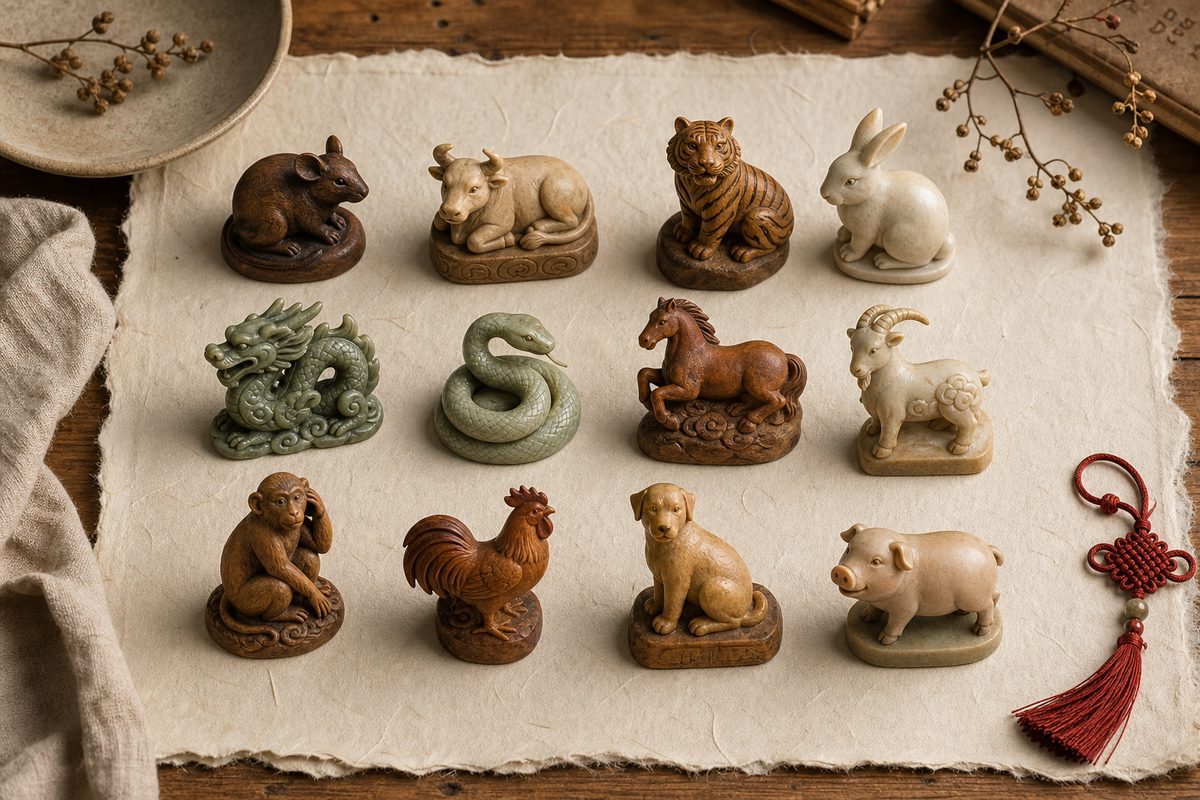
- Chinese names: shengxiao and shuxiang, often translated as Chinese zodiac signs or birth-year animals.
- Animal order: Rat, Ox, Tiger, Rabbit, Dragon, Snake, Horse, Goat, Monkey, Rooster, Dog, Pig.
- Branch order: Zi Rat, Chou Ox, Yin Tiger, Mao Rabbit, Chen Dragon, Si Snake, Wu Horse, Wei Goat, Shen Monkey, You Rooster, Xu Dog, Hai Pig.
- Cycle: 12 years for the animal cycle; 60 years when combined with the ten Heavenly Stems.
- Year boundary: In everyday folk use and modern lunar-calendar naming, the zodiac year begins at Lunar New Year, not January 1. Some Bazi (八字) astrology traditions use Lichun (立春), so ask which rule is being used for professional readings.
- 2026: The Year of the Horse begins on February 17, 2026, according to the Hong Kong Observatory's 2026 Gregorian-Lunar calendar.
The 12 Chinese Zodiac Animals in Order
The traditional order is fixed. It is usually remembered through the twelve Earthly Branches, which are old calendrical markers used for years, months, directions, and the twelve traditional time periods of the day.

| Order | Chinese pairing | English animal | Earthly Branch | Recent / upcoming years | Common folk meaning |
|---|---|---|---|---|---|
| 1 | 子鼠 | Rat | Zi | 2008, 2020, 2032 | Wisdom, resourcefulness, wealth, vitality |
| 2 | 丑牛 | Ox | Chou | 2009, 2021, 2033 | Diligence, devotion, patience, steady labor |
| 3 | 寅虎 | Tiger | Yin | 2010, 2022, 2034 | Strength, courage, authority, protection |
| 4 | 卯兔 | Rabbit | Mao | 2011, 2023, 2035 | Gentleness, peace, longevity, tact |
| 5 | 辰龙 | Dragon | Chen | 2012, 2024, 2036 | Auspicious power, success, rain, vitality |
| 6 | 巳蛇 | Snake | Si | 2013, 2025, 2037 | Wisdom, transformation, mystery, renewal |
| 7 | 午马 | Horse | Wu | 2014, 2026, 2038 | Energy, freedom, progress, achievement |
| 8 | 未羊 | Goat / Sheep / Ram | Wei | 2015, 2027, 2039 | Peace, kindness, harmony, good fortune |
| 9 | 申猴 | Monkey | Shen | 2016, 2028, 2040 | Flexibility, cleverness, wit, invention |
| 10 | 酉鸡 | Rooster | You | 2017, 2029, 2041 | Trustworthiness, punctuality, diligence, light |
| 11 | 戌狗 | Dog | Xu | 2018, 2030, 2042 | Loyalty, guardianship, justice, peace |
| 12 | 亥猪 | Pig | Hai | 2019, 2031, 2043 | Blessing, abundance, ease, sincerity |
Chinese Zodiac Years: How to Find Your Sign
For most everyday uses, your Chinese zodiac sign is based on the lunar year in which you were born. The key detail is the boundary. The zodiac year does not automatically begin on January 1. It begins at Lunar New Year, also called Chinese New Year or Spring Festival, which usually falls between January 21 and February 20 on the Gregorian calendar.

This matters most for people born in January or February. A person born on February 1, 2026 is still in the preceding Snake year under the common Lunar New Year rule, because the 2026 Horse year begins on February 17. A person born on or after February 17, 2026 belongs to the Horse year.
| Gregorian year | Lunar New Year date | Chinese zodiac year | Sexagenary year | Element |
|---|---|---|---|---|
| 2024 | February 10, 2024 | Dragon | Jia Chen | Wood Dragon |
| 2025 | January 29, 2025 | Snake | Yi Si | Wood Snake |
| 2026 | February 17, 2026 | Horse | Bing Wu (丙午) | Fire Horse |
| 2027 | February 6, 2027 | Goat | Ding Wei | Fire Goat |
| 2028 | January 26, 2028 | Monkey | Wu Shen | Earth Monkey |
| 2029 | February 13, 2029 | Rooster | Ji You | Earth Rooster |
| 2030 | February 2, 2030 | Dog | Geng Xu | Metal Dog |
| 2031 | January 23, 2031 | Pig | Xin Hai | Metal Pig |
Quick self-check method

- Find your Gregorian birth date. If you were born from March to December, the animal usually matches the animal assigned to that Gregorian year.
- Check January and February carefully. Convert your birthday to the lunar calendar or look up the Lunar New Year date for that year.
- Use the Lunar New Year boundary for everyday culture. This is the most common rule for family conversation, gifts, and zodiac-year charts.
- Use Lichun only when the system asks for it. Some Bazi or professional astrology calculations use the solar term Lichun, so a specialized reading may differ.
How the Zodiac Connects with the 60-Year Cycle
The zodiac animals form a twelve-year cycle. Traditional Chinese calendrical naming also combines the Twelve Earthly Branches with the Ten Heavenly Stems: Jia, Yi, Bing, Ding, Wu, Ji, Geng, Xin, Ren, and Gui (癸). Because 12 and 10 meet every 60 years, the full stem-branch cycle is called a sexagenary cycle, or jiazi cycle.

The five phases (五行) or elements are Wood, Fire, Earth, Metal, and Water. Each element appears in a yin and yang (阴阳) stem. That is why two people can both be Horse people but belong to different full year names. 2014 was a Wood Horse year; 2026 is a Fire Horse year; 2038 will be an Earth Horse year.
| Element | Heavenly Stems | Examples in recent zodiac years | How to read it |
|---|---|---|---|
| Wood | Jia / Yi | 2024 Wood Dragon, 2025 Wood Snake | Growth, flexibility, renewal in traditional five-phase language |
| Fire | Bing / Ding | 2026 Fire Horse, 2027 Fire Goat | Warmth, brightness, movement, visibility |
| Earth | Wu / Ji | 2028 Earth Monkey, 2029 Earth Rooster | Stability, support, grounding, center |
| Metal | Geng / Xin | 2030 Metal Dog, 2031 Metal Pig | Structure, refinement, clarity, firmness |
| Water | Ren / Gui | 2032 Water Rat, 2033 Water Ox | Flow, depth, adaptability, winter energy |
The 12 Zodiac Hours and Animal Activity
In traditional timekeeping, a day was divided into twelve double-hours, each about two modern hours long. The same Earthly Branches and animals were used to name these periods. Folk explanations often link the animals with the time when they are imagined to be active, visible, or symbolically appropriate.

| Traditional hour | Modern time | Animal | Common folk explanation |
|---|---|---|---|
| Zi hour | 23:00-01:00 | Rat | Rats are imagined as most active around midnight. |
| Chou hour | 01:00-03:00 | Ox | Oxen are associated with slow chewing, feeding, and preparation for labor. |
| Yin hour | 03:00-05:00 | Tiger | The tiger is linked with the deep night and predatory strength before dawn. |
| Mao hour | 05:00-07:00 | Rabbit | Rabbits are imagined leaving their burrows to feed at daybreak. |
| Chen hour | 07:00-09:00 | Dragon | Legends connect dragons with clouds, rain, and morning movement in the sky. |
| Si hour | 09:00-11:00 | Snake | Snakes are imagined coming out to warm themselves in the sun. |
| Wu hour | 11:00-13:00 | Horse | The horse suggests strong noon energy and active movement. |
| Wei hour | 13:00-15:00 | Goat | Goats and sheep are linked with grazing time and gentle pasture imagery. |
| Shen hour | 15:00-17:00 | Monkey | Monkeys are imagined as active, calling, and gathering fruit. |
| You hour | 17:00-19:00 | Rooster | Roosters return to the roost and mark the close of daylight work. |
| Xu hour | 19:00-21:00 | Dog | Dogs guard the house and become alert after dark. |
| Hai hour | 21:00-23:00 | Pig | Pigs are associated with eating, resting, and settling into the night. |
Origins: Totems, Bamboo Slips, and Early Texts
The origin of the Chinese zodiac cannot be reduced to one single document. A careful explanation needs several layers. One layer is ancient animal symbolism: early communities observed animals, used them in totemic imagination, and connected them with time, direction, season, and social values. Another layer is the Earthly Branch system, which was already an important way to organize recurring time.

Archaeological and textual evidence shows that animal-branch pairings were present before the fully standardized popular list became familiar. Qin-period bamboo slips from Shuihudi in Hubei are often discussed because they contain early animal associations with branches, though not every detail matches the modern sequence. By the Eastern Han period, Wang Chong's Lunheng records animal-branch associations that are much closer to the later twelve-animal system.
For modern readers, the safe summary is this: the Chinese zodiac grew from early calendrical practice, animal symbolism, and folk storytelling. It was not invented by one race story, but the race story became the most memorable way to explain the order.
Why Is There No Cat in the Chinese Zodiac?
There are two useful answers, and they should not be confused. The first is historical: the twelve-animal system was already old by the time domestic cats became common in China. Recent genetic and archaeological research suggests that ancient Chinese settlements had long relationships with leopard cats, while the earliest known domestic cat remains in China date to around 730 CE in the Tang dynasty, probably connected with Silk Road exchange.

The second answer is folkloric: in Great Race stories, the Cat and Rat were once companions. In one version, the Rat failed to wake the Cat for the race. In another, the Rat pushed the Cat from the Ox's back while crossing the river. The Cat missed the zodiac and became the Rat's enemy. This story explains the animal order as a legend, not as documented calendar history.
Regional traditions also vary. In Vietnam, the fourth zodiac animal is the Cat rather than the Rabbit. Royal Museums Greenwich notes one common explanation: the Chinese branch word Mao sounded similar to Vietnamese meo, meaning cat. This is a useful example of how the zodiac traveled across East and Southeast Asia while adapting to local language and culture.
The Great Race Legend: How the Order Is Explained
The Great Race is the best-known folk explanation for the zodiac order. In popular versions, the Jade Emperor wanted a way to mark years for the human world, so he called the animals to a race, a river crossing, or a heavenly gathering. The first twelve arrivals would become the twelve zodiac animals.

- Why the Rat came first: The Rat was small but clever. It rode on the hardworking Ox, then jumped ahead at the finish to take first place. Some versions say it slipped through the crowd or emerged from the Ox's ear.
- Why the Ox came second: The Ox was strong, steady, and generous enough to carry others, but the Rat's last-minute move placed it second.
- Why the Tiger and Rabbit followed: The Tiger arrived with fierce strength, while the Rabbit crossed through agile jumps, stones, logs, or floating help depending on the version.
- Why the Dragon was only fifth: The Dragon could have flown ahead, but in many tellings it stopped to bring rain or help people, showing benevolence rather than pure speed.
- Why the Snake and Horse are paired in the story: Some versions say the Snake hid near the Horse and startled it near the finish, explaining why Snake came before Horse.
- Why Goat, Monkey, and Rooster arrived together: They cooperated to cross the river, with the Rooster finding a raft and the Goat and Monkey helping move it.
- Why Dog and Pig came last: The Dog was distracted by play or bathing, while the Pig ate, rested, or slept before arriving twelfth.
Different families and regions tell the story differently. Some speak of a race, others of a banquet, river crossing, or martial contest. The value of the legend is not factual chronology; it is a story that turns calendar order into memorable character language.
What Each Chinese Zodiac Animal Means
Chinese zodiac meanings work best as symbolic associations. They appear in New Year greetings, children's objects, folk art, gift language, and everyday conversation. They should not be used to reduce a real person to one fixed personality.
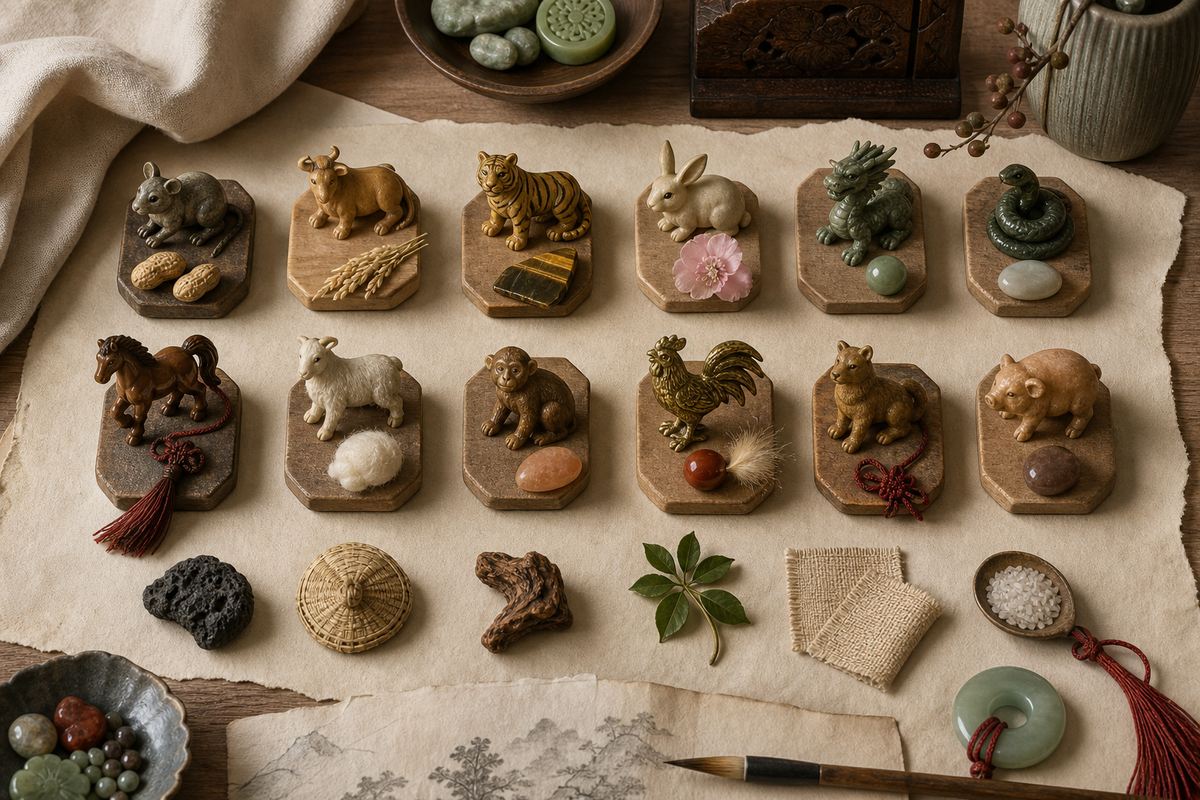
| Animal | Symbolic meaning in folk culture | Gift or design language |
|---|---|---|
| Rat | Wisdom, resourcefulness, wealth, alertness, life force. Folk sayings such as the Rat opening the heavens connect it with beginnings and vitality. | Good for clever, compact, lively designs; can suggest preparation and thoughtful saving. |
| Ox | Diligence, devotion, endurance, agricultural labor, and the spirit of steady service. | Works well for elders, teachers, disciplined workers, and gifts about patience or reliability. |
| Tiger | Strength, courage, majesty, and protection. Tiger-head shoes and folk objects often carry protective meaning. | Good for courage, guardianship, confidence, and bold renewal. |
| Rabbit | Gentleness, longevity, purity, tact, and peace. The Moon Rabbit adds a lunar and mythic layer. | Suitable for soft, refined, gentle, or family-centered gifts. |
| Dragon | Auspicious power, success, rain, vitality, imperial authority, and Chinese cultural identity. | Strong for New Year gifts, children born in Dragon years, ambition, and celebratory designs. |
| Snake | Wisdom, mystery, transformation, rebirth, and strategic perception. It is sometimes called a little dragon in folk speech. | Works for subtle, elegant, transformative, or introspective designs. |
| Horse | Energy, speed, freedom, progress, and success. The phrase ma dao cheng gong wishes success upon arrival. | Excellent for 2026 gifts, career encouragement, travel, graduation, or forward movement. |
| Goat | Peace, kindness, harmony, gentleness, and good fortune. Chinese characters such as beauty and auspiciousness are culturally linked with the sheep/goat form. | Good for calm, family harmony, warm blessings, and understated design. |
| Monkey | Flexibility, intelligence, imitation, humor, and quick thinking. The Monkey King adds courage and spirited independence. | Works for youthful, witty, creative, or playful gifts. |
| Rooster | Trustworthiness, punctuality, work ethic, bright announcement, and the arrival of daylight. | Good for discipline, new beginnings, professional steadiness, and daily rhythm. |
| Dog | Loyalty, protection, justice, companionship, and guarding the home. | Good for family, friendship, protection-themed keepsakes, and sincere gratitude. |
| Pig | Blessing, abundance, contentment, generosity, and an easygoing heart. The old idea that a home is not complete without pigs reflects household plenty. | Good for warmth, prosperity wishes, family comfort, and lighthearted abundance. |
How Chinese Zodiac Culture Is Used Today
The zodiac remains alive because it is practical, social, and visual. It helps people remember age, mark years, choose New Year decorations, design stamps, name artworks, tell family stories, and create gifts connected with someone's birth year.

- Year naming: Each lunar year carries an animal, making time easier to remember and discuss.
- Age calculation: In Chinese conversation, a person may estimate age by asking someone's zodiac animal and comparing cycles.
- Personality language: Popular culture links animals with traits such as Rat wisdom, Ox diligence, Tiger courage, and Dog loyalty.
- Compatibility customs: Folk marriage and relationship discussions sometimes refer to compatibility ideas such as liuhe and sanhe (三合). These are customs, not guarantees of marriage outcomes.
- Festivals and decoration: Lunar New Year designs often feature that year's animal in paper cuts, lanterns, stamps, toys, jewelry, and home objects.
- Regional spread: The zodiac appears across East and Southeast Asia, with local variations such as the Vietnamese Cat replacing the Rabbit and Buffalo replacing the Ox.
Benmingnian, Tai Sui (太岁), and Red Gifts
Benmingnian is a person's zodiac birth year returning after a twelve-year cycle. In Chinese folk tradition, people often treat the return year with extra care. Red clothing, red cord, red accessories, and blessing objects are commonly given because red is associated with celebration and protection in Chinese culture.

Some folk explanations also speak of fan Tai Sui, or clashing with the year's Tai Sui. In popular 2026 Horse-year discussions, the signs most often mentioned are Horse as the birth-year sign, Rat as the direct clash, Ox as harm, and Rabbit as break. This is best presented as traditional zodiac culture. It should not be written as a guarantee of misfortune or as a promise that any product can solve life problems.
How to Choose a Chinese Zodiac Gift
A good zodiac gift begins with accuracy and relationship. First check the recipient's zodiac sign, especially for January and February birthdays. Then choose an object whose material, color, symbol, and tone fit the person's age, style, and relationship to you.

| Recipient | Good gift direction | Cultural framing to use |
|---|---|---|
| Elders | Jade, amber, agate, cloisonne, refined ornaments, or a calm symbolic bracelet. | Longevity, peace, family blessing, and respect. Avoid exaggerated health claims. |
| Friends or peers | Modern zodiac charms, plush objects, creative stationery, small jewelry, or playful cultural goods. | Specific, warm, and personal. A small but thoughtful object can feel more meaningful than an expensive generic gift. |
| Clients or business partners | Understated zodiac desk objects, calendar gifts, tasteful Horse-year items for 2026, or refined symbolic packaging. | Momentum, appreciation, professional goodwill, and “wishing your work moves forward smoothly.” |
| Someone in their Benmingnian | Red cord, red accessories, symbolic jewelry, or a birth-year keepsake. | Care, encouragement, and folk blessing. Do not imply the item guarantees safety or success. |
| Children | Soft zodiac ornaments, safe age-appropriate keepsakes, story cards, or family memory gifts. | Identity, family storytelling, and a gentle introduction to Chinese culture. |
Choosing by zodiac element, color, trine, and guardian figures
Popular gift culture often layers the animal with other symbolic systems. Some people choose colors linked with a zodiac sign, such as white, gold, or soft pink for Rat; warm orange, red, or purple for Ox; and green, blue, or yellow for Tiger. Others use the sanhe trine idea: Horse is commonly grouped with Tiger and Dog, and Rat with Monkey and Dragon. Some folk lists also connect each zodiac with a guardian Buddha or bodhisattva, such as Thousand-Armed Guanyin (观音) for Rat, Akasagarbha for Ox and Tiger, Manjushri for Rabbit, Samantabhadra for Dragon and Snake, Mahasthamaprapta for Horse, Vairocana for Goat and Monkey, Acala for Rooster, and Amitabha for Dog and Pig.

These associations can be included respectfully as cultural or devotional traditions. They should not be sold as guaranteed spiritual protection. For Eastern Story's tone, the safest language is: “in Chinese folk tradition,” “is commonly associated with,” “may be chosen as a symbolic blessing,” or “can make the gift feel more personal.”
Popular zodiac gift categories

- Jewelry: Gold zodiac pendants, jade charms, crystal bracelets, red cord pieces, and small symbolic beads.
- Display objects: Cloisonne zodiac animals, bronze-inspired ornaments, ceramic animals, and desk pieces for study or entry areas.
- Cultural creative gifts: Zodiac calendars, stationery, blind boxes, plush animals, and limited New Year designs.
- Practical objects: Scarves, wallets, notebooks, bags, and home textiles with subtle zodiac motifs.
- Personal notes: A short card explaining the animal's meaning often makes the gift more memorable than the object alone.
2026 Year of the Horse: What to Know
2026 is the Year of the Horse, beginning on February 17, 2026. In the sexagenary cycle it is a Bing Wu year, commonly read as a Fire Horse year. The Horse is the seventh animal and is associated with movement, independence, energy, progress, and the idiom ma dao cheng gong, a wish that success arrives swiftly.

For a 2026 zodiac gift, a Horse motif can work well for career encouragement, graduation, travel, business momentum, or a birth-year keepsake. Red packaging, a subtle horse charm, a refined zodiac pendant, or a small desk object can carry the message without making claims about guaranteed career success or fortune.
Chinese Zodiac vs. Western Zodiac

| Feature | Chinese zodiac | Western zodiac |
|---|---|---|
| Best-known cycle | Twelve years | Twelve divisions of the annual solar path |
| Main popular label | Birth-year animal | Sun sign by birth date |
| Boundary | Lunar New Year in common use; Lichun in some specialized systems | Approximate monthly sign boundaries |
| Additional layers | Heavenly Stems, Earthly Branches, five phases, yin-yang, month, day, hour | Planets, houses, aspects, rising sign, moon sign |
| Common use today | Calendars, New Year culture, gifts, folk identity, compatibility customs | Horoscopes, personality language, astrology charts |
Frequently Asked Questions
The 12 Chinese zodiac signs in order are Rat, Ox, Tiger, Rabbit, Dragon, Snake, Horse, Goat, Monkey, Rooster, Dog, and Pig. In the Earthly Branch order, they are Zi Rat, Chou Ox, Yin Tiger, Mao Rabbit, Chen Dragon, Si Snake, Wu Horse, Wei Goat, Shen Monkey, You Rooster, Xu Dog, and Hai Pig.

The popular zodiac animal is based on the lunar birth year, not only the Gregorian year. If you were born in January or February, check the Lunar New Year date for your birth year before choosing your animal.
For everyday folk culture and modern lunar-calendar year naming, the animal changes at Lunar New Year, the first day of the first lunar month. Some Bazi astrology systems use Lichun, the Beginning of Spring solar term, so specialized readings may use a different boundary.
2026 is the Year of the Horse, beginning on February 17, 2026. In the stem-branch cycle, it is Bing Wu, commonly described as a Fire Horse year.
Historically, the twelve-animal system was already old before domestic cats became common in China. Folklore gives a different answer: in the Great Race story, the Cat missed the race because of the Rat, which explains why cats chase rats in the tale.
All three translations are used because the Chinese word yang can broadly refer to goat, sheep, or ram. They do not represent three different zodiac signs; they all refer to the eighth animal.
No. Zodiac personality and compatibility language belongs to folk culture and popular symbolism. It can be meaningful in storytelling, family custom, and gift language, but it should not be treated as a scientific personality test or a guarantee of relationship outcomes.
Benmingnian (本命年) is the year when your own zodiac animal returns, usually every twelve years. In Chinese folk tradition, people often wear red or choose symbolic objects during this year as a cultural blessing and reminder to move carefully.
A good zodiac gift names the recipient's animal accurately, fits the relationship, and uses symbolism gently. Jewelry, jade charms, red cord, desk ornaments, zodiac stationery, and tasteful New Year objects can all work when the message is personal and not exaggerated.
A Living Cycle of Time, Story, and Gifts
The Chinese zodiac is a timekeeping system, a symbolic vocabulary, and a family-friendly way to tell stories about years and identity. Its twelve animals connect the lunar calendar with Earthly Branches, the 60-year cycle, folk legends, New Year culture, and gift traditions. The most respectful way to use it is to check the date carefully, preserve the cultural meaning, and keep symbolic claims in proportion.

Eastern Story treats zodiac objects as cultural-symbolic gifts: chosen for meaning rather than expectation, worn or kept as quiet reminders of blessing, courage, harmony, and personal intention. For broader context on how we handle symbolic traditions, see our Editorial Policy and the Story collection.
For readers choosing a symbolic gift or wearable blessing, Eastern Story's Blessing Shop offers related pieces organized around protection, harmony, love, clarity, and good wishes.
Related Posts


