
What is Pixiu? Pixiu (貔貅), also written Pi Xiu or Pi Yao in some modern sources, is a Chinese mythical auspicious beast best known today for wealth symbolism, protection, and feng shui use. In Chinese jewelry culture, a Pixiu bracelet is often worn as a reminder to attract opportunity, guard what one has earned, and move through life with discipline and courage.
Pixiu is not a promise that money, safety, promotion, or good luck will appear automatically. It is a cultural symbol. In Chinese folklore and modern feng shui practice, Pixiu is associated with gathering treasure, guarding resources, warding off harmful influences, and supporting a steady enterprising spirit.
Pixiu Meaning at a Glance

- Identity: A Chinese mythical and auspicious beast, often described as a dragon-headed, horse-bodied, lion-like guardian creature.
- Best-known meaning: Wealth attraction and wealth guarding, expressed through the story that Pixiu takes treasure in and does not let it out.
- Other associations: Protection, warding off harmful influences, home guarding, career momentum, confidence, and disciplined prosperity.
- Common jewelry form: Pixiu bracelets, bangles, pendants, rings, and bead charms, often made with jade, gold, obsidian, crystal, or carved wood.
- Important boundary: These are symbolic and folk-cultural meanings, not guaranteed financial, medical, legal, or spiritual outcomes.
What Does Pixiu Look Like?
In modern Chinese descriptions, Pixiu is usually imagined as a powerful hybrid creature: an Eastern dragon (龙) head, horse body, qilin-like (麒麟) feet, a body that can resemble a lion, fierce eyes, a wide mouth, fangs, scales or armor, and wings at the shoulders. Some descriptions give it gray-white fur, while jewelry and feng shui objects may render it in gold, jade green, black obsidian, crystal yellow, or the natural color of the carving material.

The most famous physical feature is the folk image of a large mouth with no anus. This is the source of the phrase often translated as “only taking in, never letting out.” Because Pixiu is said to eat gold, silver, and jewels, this body image became a vivid metaphor for gathering wealth and holding onto it.
| Feature | Common description | Symbolic reading |
|---|---|---|
| Dragon head | A strong, elevated head with mythic authority | Noble energy, command, protection |
| Horse body | A fast, forward-moving body | Momentum, action, enterprise |
| Qilin-like feet | Hoofed or clawed feet, depending on the carving | Grounding, auspicious movement |
| Lion-like posture | Compact, alert, powerful, often crouching or ready to leap | Guardian strength and courage |
| Wings | Shoulder wings in many traditional and modern forms | Spiritual speed and otherworldly power |
| Wide mouth, no outlet | The creature swallows treasure and does not release it | Attracting and guarding wealth |
Where Does Pixiu Come From? Classical References and Later Legends
Pixiu belongs to a wide Chinese tradition of fierce guardian animals and auspicious beasts. The name appears in classical historical writing, while many details now popular in jewelry culture come from later folk retellings, feng shui practice, and modern craft interpretation.

Classical reference: Pixiu in the Records of the Grand Historian (史记)
A reliable classical reference is Sima Qian’s Shiji, or Records of the Grand Historian. In the “Annals of the Five Emperors,” Pixiu is listed among fierce creatures connected with Huangdi (黄帝), the Yellow Emperor, in the battle narrative at Banquan. In this context, Pixiu reads less like a modern wealth charm and more like a powerful martial or totemic animal associated with strength, command, and victory.

Shanhaijing (山海经) and the broader world of mythical beasts
Modern summaries sometimes connect Pixiu with the imaginative world of the Shanhaijing, the Classic of Mountains and Seas, because that text is central to Chinese mythic geography and strange beasts. The exact textual relationship is less straightforward than the Shiji passage, so it is best to treat Shanhaijing as part of the broader cultural background of hybrid creatures rather than as a simple one-line origin proof for every modern Pixiu detail.

Later folk legends: dragon son, Jiang Ziya (姜子牙), and imperial treasure
Many popular stories explain Pixiu through later folk imagination. One version says Pixiu is one of the dragon’s sons, sometimes the eighth or ninth son depending on the telling. Another says it offended heavenly order and was punished so that it could eat treasure but never release it. A separate popular retelling links Pixiu with Jiang Ziya during King Wu’s campaign against the Shang. These stories are culturally important, but they should be understood as later folk retellings rather than verified quotations from one early classical source.

Another recurring tradition says Pixiu’s image moved from battlefield ferocity to imperial symbolism, and later into the popular wealth culture of merchants and households. This arc is useful: Pixiu begins as a symbol of fierce force, becomes associated with elite guardian imagery, and eventually becomes a familiar folk symbol for gathering and protecting wealth.
What Does Pixiu Symbolize?
Pixiu’s meaning is built from several layers. Its wealth meaning is the most famous, but Chinese folk practice also connects it with protection, home guarding, career momentum, and psychological encouragement.

| Meaning | Traditional or folk explanation | Modern interpretation |
|---|---|---|
| Attracting wealth | Pixiu eats gold, silver, and jewels and draws treasure from many directions. | A symbol of opportunity, enterprise, and active wealth-building. |
| Guarding wealth | The “only in, not out” feature makes Pixiu a living treasure basin. | A reminder to protect resources, avoid waste, and keep what has been earned. |
| Warding off harmful influences | Its fierce form is believed to drive away negative or inauspicious forces. | A protective symbol for the home, body, workspace, or business. |
| Home and space protection | Pixiu and related beasts appear in guardian contexts, including tombs, doors, and architecture. | Used near entrances, counters, desks, and important storage areas. |
| Career and official luck | Names such as Tianlu (天禄) and Bixie (辟邪) carry ideas of fortune, rank, and removal of obstacles. | Chosen by people seeking confidence, promotion, business momentum, or steady progress. |
| Psychological support | Auspicious objects carry hopes for a better life. | A personal reminder to earn with intention and keep results with discipline. |
The most grounded way to read Pixiu is this: it symbolizes not only “making money,” but also learning to hold, protect, and honor what one has worked for. That makes it especially resonant in business, career, gifting, and personal discipline.
Pixiu, Tianlu, Bixie, and Qilin: What Is the Difference?
Pixiu, Tianlu, and Bixie often overlap in folk usage. Qilin (麒麟), however, is a distinct auspicious beast with a gentler moral symbolism. The names can be mixed in modern shops and popular writing, so it helps to compare them by horn, appearance, and meaning.

| Creature | Common horn description | Core meaning | Typical features |
|---|---|---|---|
| Pixiu | One or two horns in modern use | Wealth gathering, wealth guarding, protection | Dragon head, horse body, lion-like body, wings, no outlet in folk descriptions |
| Tianlu | Often described as one-horned | Receiving fortune, salary, blessing, and wealth | Closely related to Pixiu-type beasts in folk interpretation |
| Bixie | Often described as two-horned | Warding off evil, guarding the home, protecting wealth | Closely related to Pixiu-type guardian beasts |
| Qilin | A fleshy or softer horn in many descriptions | Benevolence, auspiciousness, virtue, blessing, children, peace | Deer-like body, ox tail, horse hooves, fish scales; gentler than Pixiu |
Some popular rules say a male Pixiu or Tianlu is one-horned and brings wealth from outside, while a female Pixiu or Bixie is two-horned and guards wealth at home. Other folk rules read the head direction or front foot: head turning left or left foot forward may be interpreted as male and wealth-attracting; head turning right may be read as female and wealth-guarding. These are useful folk distinctions, but they are not universal across all historical objects or modern carvings.
Pixiu Bracelet Meaning
A Pixiu bracelet carries the creature’s wealth and protection symbolism into daily wear. In modern Chinese jewelry culture, it is commonly associated with attracting prosperity, guarding accumulated resources, keeping away harmful influences, and encouraging a steady work-minded attitude.

The bracelet form matters because it keeps Pixiu close to the body. Some people wear it as a feng shui object; others wear it as meaningful jewelry, a family gift, or a quiet reminder of ambition and self-control. When Pixiu is paired with jade, jadeite, obsidian, gold, yellow crystal, or carved wood, the material adds another layer of meaning.
| Pixiu jewelry form | Common meaning | Traditional wearing note |
|---|---|---|
| Pixiu bracelet | Attracting and guarding wealth, protection, confidence | Often worn on the left wrist with the head facing outward toward the little finger |
| Pixiu bangle | Stable protection and continuous symbolic presence | Left wrist is common; comfort and respect also matter |
| Pixiu pendant | Close personal guardian and wealth symbol | Often worn with the head facing upward or outward, depending on design |
| Pixiu ring | Compact wealth-guarding sign | Direction rules vary by school and carving style |
| Pixiu display piece | Home, office, shop, or counter guardian | Usually placed with the head facing an entrance, window, or open space |
How to Wear a Pixiu Bracelet
In mainstream folk practice, a Pixiu bracelet is usually worn on the left hand. The explanation is the phrase “left receives, right releases.” The left side is associated with receiving wealth and opportunity, while the right side is sometimes associated with releasing or clearing. Some people temporarily wear Pixiu on the right hand for protection-focused reasons, especially with black obsidian, but the left wrist remains the most common wealth-oriented recommendation.

The head is usually turned outward, toward the little finger, so Pixiu symbolically goes out to seek wealth and bring it back. For pendants, many folk instructions prefer the head upward or outward. If a design makes direction unclear, choose the orientation that feels respectful and visually natural rather than forcing the charm into an awkward position.
- Left hand: Commonly used for attracting wealth and opportunity.
- Right hand: Sometimes used in protection or clearing interpretations; also acceptable if comfort, work, or handedness makes the left wrist impractical.
- Head outward: For bracelets, the head usually faces the little finger.
- Avoid touching the eyes and mouth: In folk practice, the eyes “find treasure” and the mouth “takes it in.”
- Touch the back, neck, or body instead: Some people gently stroke from head or back toward the tail to maintain connection.
- Store carefully when not worn: Wrap it in a soft cloth or place it in a clean jewelry box.
Folk taboos also mention not letting other people handle your Pixiu, not wearing it in dirty or chaotic settings, removing it before bathing or sleeping, and keeping it away from blood or harsh chemicals after activation. These are traditional respect rules, not scientific requirements. For jewelry care, the practical reasons are simpler: water, impact, sweat, perfume, and detergents can damage many materials.
Where to Place Pixiu at Home, in an Office, or in a Shop
For display pieces, the most common rule is to place Pixiu with the head facing outward: toward a door, window, entrance, or open space. The idea is that Pixiu looks outward for wealth and opportunity rather than staring back at the people inside the room.

| Place | Common placement | Reason in folk practice |
|---|---|---|
| Living room wealth corner | Near the diagonal corner from the entrance, with a solid wall behind it | Represents stable support and wealth guarding |
| Entrance or foyer | Side-facing or angled toward the door, not aggressively blocking movement | Symbolically welcomes outside opportunity |
| Office or study | On the left side of the desk from the seated person’s view | Linked with the “green dragon” side and work momentum |
| Shop or company | Near a cashier counter, safe, reception desk, or business-facing area | Connects Pixiu with commerce and resource protection |
| Display shelf | Clean, stable, bright, and not directly on the floor | Shows respect and keeps the object safe |
Traditional cautions include avoiding toilets, kitchens, mirrors, bedrooms, beds, low dirty corners, cluttered spaces, and places where the object is frequently moved. Some instructions also say Pixiu should be above waist height, near eye level, but not higher than the owner’s head. The underlying principle is consistent: keep the creature clean, stable, visible, and respectfully positioned.
Pixiu Activation, Consecration, and “Recognizing the Owner”
Pixiu activation, often called kaiguang (开光), “opening the eyes,” or “recognizing the owner,” is a folk practice. It is not a scientific process and should not be presented as a guaranteed way to change external results. Within traditional practice, however, these rituals express intention, respect, and a personal relationship with the symbolic object.

Common self-activation steps

- Choose a quiet day. Some people pick an auspicious date and make sure the space feels calm.
- Cleanse the piece. Folk instructions may use clean water, a porcelain bowl, or “yin-yang (阴阳) water” made from warm and cool water.
- Set an intention. The wearer may quietly state a name, place of residence, and sincere wish for disciplined prosperity.
- Open the eyes. Some traditions touch the left and right eyes with clean water, tea oil, or a new brush, often three times.
- Stroke the body. A common instruction is to gently stroke the body three times while avoiding the eyes and mouth.
- Wrap in red cloth. Some folk methods wrap Pixiu in red cloth and keep it undisturbed, sometimes for 49 hours.
- Let it see the owner first. A popular “recognizing the owner” step says Pixiu should first be uncovered in private and see only its owner.
Other traditional methods
Other methods include temple consecration, placing Pixiu near natural light to symbolically absorb sun and moon vitality, and “nourishing it with goodness” through kind actions performed in its name. These practices should be understood as folk and devotional customs. The most universally useful lesson is simple: treat the object with care, cleanliness, and intention.

Pixiu Shape Meanings: Money Tree (摇钱树), Coins, Gourds, and More
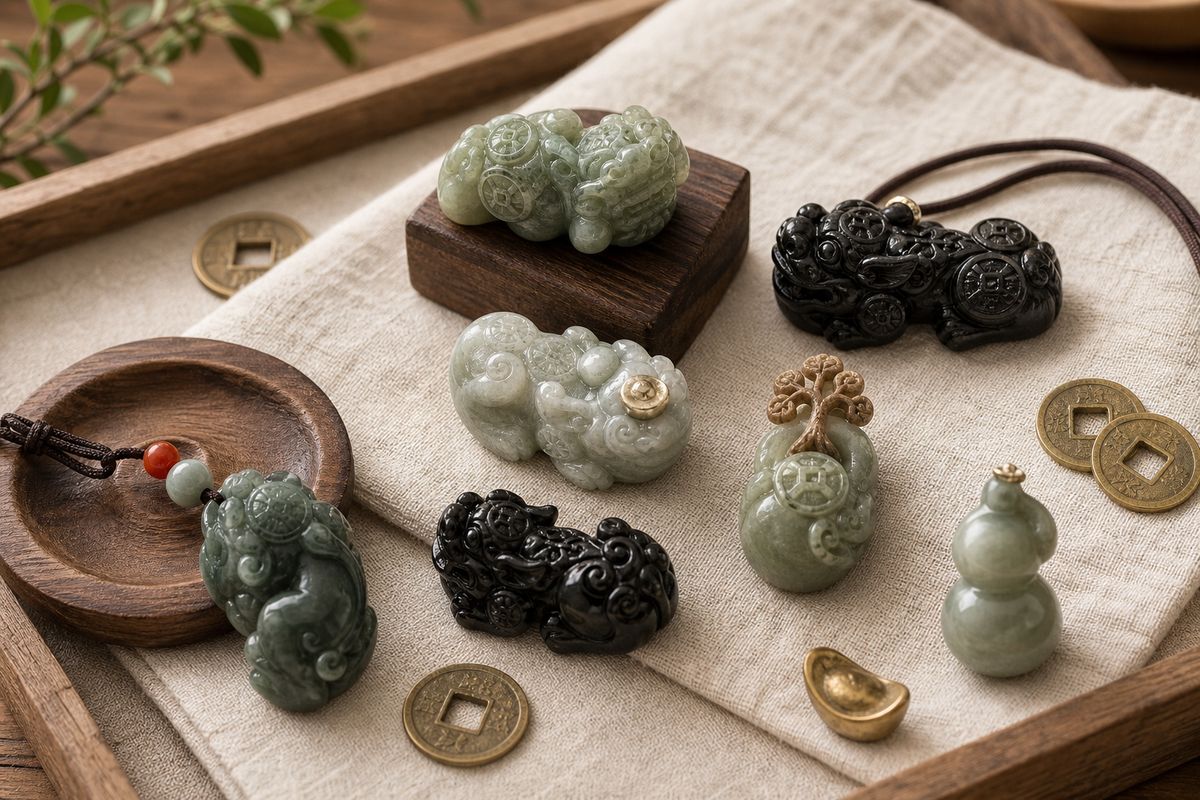
Modern Pixiu carvings often add extra symbols. These details are not random decoration; they turn Pixiu into a more specific blessing object. The meanings below are common in Chinese jewelry and ornament culture.
| Design detail | Common Chinese meaning | English interpretation |
|---|---|---|
| Money tree Pixiu | 财源滚滚, 富贵吉祥 | Growing resources, flourishing fortune, prosperity that keeps branching out |
| Coin on the head | 鸿运当头, 贵人相助 | Good fortune above the head, timely opportunity, helpful support |
| Fu character (福) and coins | 福开财运, 纳福纳财 | Blessing opens the path to prosperity; fortune and discipline belong together |
| Ruyi pearl (如意珠) or ingot (元宝) ball | 有求必应, 称心如意 | Wishes answered, things becoming favorable; one, two, or three balls may suggest lifelong fortune, doubled good things, or harmony of timing, place, and people |
| Gourd hulu (葫芦) on the back | 福寿庇护, 万事如意 | Longevity, protection, blessing, and broad good wishes |
| Coins on the body | 辈辈有财, 生生不息 | Family continuity, inherited abundance, prosperity across generations |
| Coins around the waist | 腰缠万贯 | Carrying abundant resources; old imagery of money strung around the waist for travel |
| Coins under the feet | 一路发财, 财路昌盛 | Prosperous steps, career growth, and a smooth road forward |
How to Choose a Pixiu Bracelet, Pendant, or Display Piece
Choosing Pixiu is partly cultural and partly practical. Look at material, carving quality, shape, comfort, certification, and personal affinity. In Chinese, people often call this final feeling yan yuan (眼缘), or “eye connection”: the piece simply feels right when you see it.

Material meanings and practical notes

| Material | Common symbolic association | Practical buying and care note |
|---|---|---|
| Gold Pixiu | Prosperity, brightness, wealth energy, business confidence | Gold is soft; protect detailed carving from bending and impact. |
| Jade or jadeite Pixiu | Warmth, refinement, protection, cultivated virtue | Ask for reputable identification when price is high; avoid chemical exposure and impact. |
| Yellow crystal Pixiu | Opportunity, abundance, business luck in popular crystal culture | Do not treat crystal meanings as financial advice; check clarity and durability. |
| Black obsidian Pixiu | Protection, grounding, warding off harmful influences | Often worn on the right hand in some modern practice; avoid dropping or hard knocks. |
| Wood Pixiu | Warmth, natural grounding, quiet presence | Keep away from water, harsh dryness, and strong heat; wood may crack. |
Carving and form details

- Overall proportion: A large alert head, solid body, and full rear are often preferred in wealth symbolism.
- Eyes: Clear, lively eyes are valued because the eyes symbolically search for treasure.
- Mouth and teeth: An open mouth is commonly chosen for attracting wealth; a closed mouth may be interpreted as guarding what is already held.
- Claws and paws: Strong claws suggest the ability to hold wealth securely.
- Smooth finish: Lines should be clean, edges should not scratch the skin, and bead holes should not damage important carved areas.
- Straight body or turned head: A straight-bodied Pixiu is associated with stable income and steady growth; a turned-head Pixiu is often interpreted as seeking side opportunities.
- “King” or Bawang Pixiu: A bold large-mouth form with a strong angle between head and body, associated in modern shops with both main and side wealth.
- Certificate and price caution: For jadeite, jade, gold, and high-priced stones, buy from reputable sellers and ask for suitable documentation.
Be cautious with universal price claims. Material quality, size, carving, treatment, origin, certificates, and seller trust all affect price. A very cheap “jade” Pixiu may be dyed, treated, or simply a different material. A very expensive one is not automatically better if the carving, certification, or seller transparency is weak.
How to Care for Pixiu Jewelry and Display Pieces
Pixiu “likes clean water” and “likes cleanliness” in folk sayings. Practically, this means the object should be kept clean, respected, and protected from materials that can damage it. For detailed jewelry upkeep, see our care guide.

| Situation | Recommended care | Why it matters |
|---|---|---|
| Regular cleaning | Use a soft cloth and clean water; dry thoroughly. | Protects finish and supports the folk idea of keeping Pixiu clean. |
| Chemicals | Avoid perfume, detergent, shampoo, soap, toothpaste, and harsh cleaners. | Chemicals can dull, discolor, corrode, or weaken many materials. |
| Bathing and sleeping | Remove the bracelet if it may hit hard surfaces, soak, snag, or press into the skin. | Prevents damage, stretching, and unnecessary wear. |
| Jade and jadeite | Avoid impact, heat, and chemicals; occasional clean water wiping is enough. | Stone can chip, crack, or lose luster. |
| Gold | Use a jewelry polishing cloth; seek professional cleaning for serious oxidation or damage. | Gold is soft and detailed Pixiu carving can deform. |
| Wood | Keep away from water and extreme dryness; use appropriate wood care sparingly. | Wood can swell, dry, split, or crack. |
| Long-term storage | Wrap in soft cloth and keep in a clean jewelry box away from direct sunlight. | Prevents scratches, fading, moisture damage, and cluttered handling. |
Source and Editorial Note
This article treats Pixiu as a cultural-symbolic topic. The classical Shiji reference is separated from later dragon-son, Jiang Ziya, heavenly punishment, activation, left-hand, placement, and jewelry rules, which belong mainly to folk practice, feng shui teaching, and modern Chinese jewelry culture. For broader context on Chinese mythical beasts and related terms, see the National Palace Museum’s discussion of divine beasts, the Chinese Text Project entry for the Shiji, and Eastern Story’s Editorial Policy.

- Chinese Text Project: Shiji, Annals of the Five Emperors
- National Palace Museum: Divine Beasts context
- Smithsonian Libraries: Shanhaijing historical edition
- Eastern Story: More symbolic culture guides
Frequently Asked Questions About Pixiu

A Powerful Symbol, Kept Grounded
Pixiu remains powerful because it joins myth, craft, wealth culture, and personal intention. Its fierce form speaks of protection; its treasure-eating story speaks of abundance; its “only in, not out” image speaks of stewardship. Worn as a bracelet or placed as a guardian object, Pixiu is best understood as a symbolic companion for mindful prosperity, not a shortcut around effort, ethics, or care.

For readers choosing a symbolic gift or wearable blessing, Eastern Story’s Blessing Shop offers related pieces organized around protection, harmony, love, clarity, and good wishes.
Related Posts


